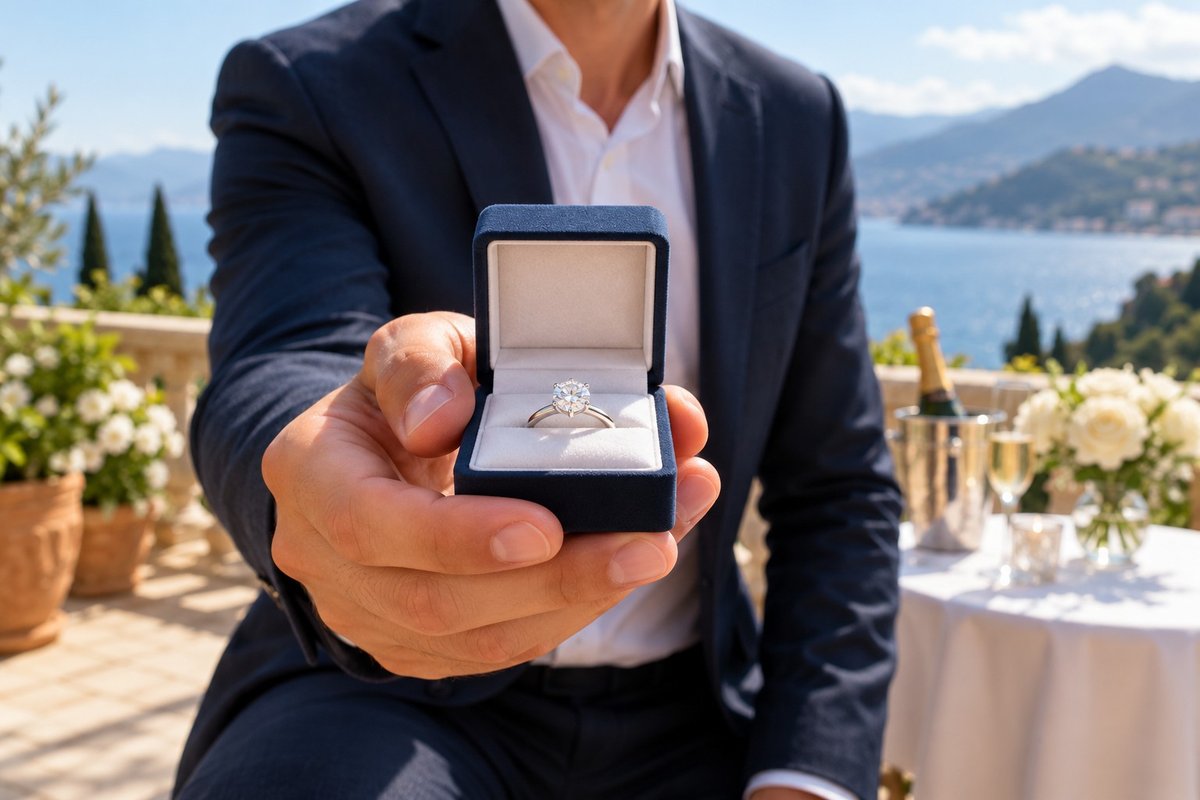
The best way to buy an engagement ring is to make the decisions in order: set a budget you are comfortable with, choose between a natural diamond, a laboratory-grown diamond or another stone, pick the shape, balance the 4Cs, then choose the setting, metal and size, and buy only with an independent grading report and clear written terms. Most regret comes from doing these steps out of order, such as falling for a setting before knowing what stone the budget allows.
This guide includes a few product links near the end. As an Amazon Associate, Diamond Taire earns from qualifying purchases, at no extra cost to you.
This guide is the starting point for everything on this site about engagement rings. It walks through eight decision steps, explains the trade-off at each one in plain language, and points you to the detailed guide for that step so you can go deeper only where you need to.
- Budget first, ring second. Decide the total you are happy to spend, including the setting, resizing, insurance and any wedding band, before you look at stones.
- Cut quality matters most for sparkle. A well-cut diamond with slightly lower colour or clarity usually looks better than a poorly cut stone with top grades.
- Lab-grown is real diamond, but the paperwork has changed. Since 1 October 2025, GIA no longer gives D-to-Z colour or clarity grades to laboratory-grown diamonds; it describes them as Premium or Standard instead.
- Insist on an independent report and written terms. Know the return policy, resizing policy and warranty before you pay.
- Size, insure and care. Measure properly, insure from the day you take it home, and have the setting checked regularly.
Try our free ring size chart and converter to switch between US, UK/Australian, EU and Japanese sizes.
The eight decisions at a glance
Use this table as your map. Each row is one decision, the trade-off people most often get wrong, and where to read more on this site.
| Step | What you are deciding | The usual trade-off | Read next |
|---|---|---|---|
| 1. Budget | Total spend and what matters most | Size versus quality versus metal and design | Price drivers, best-value combinations |
| 2. Stone type | Natural, lab-grown or an alternative | Origin and rarity versus size for the money | Lab-grown guide, moissanite, ethical sourcing |
| 3. Shape | Round, oval, emerald, pear and others | Brilliance versus spread and personal style | Diamond shapes, oval bow-tie |
| 4. The 4Cs | Cut, colour, clarity and carat weight | Paying for grades the eye cannot see | 4Cs, cut, colour, clarity guides |
| 5. Setting and style | Solitaire, halo, pavé, bezel, vintage | Look versus security and upkeep | Settings, style, trends, wedding bands |
| 6. Metal | Platinum, white, yellow or rose gold | Upfront cost versus long-term maintenance | Metals, platinum vs white gold, gold karats |
| 7. Paperwork and seller | Grading report, returns, warranty | Convenience versus verification | Certification, buying online |
| 8. Size, protect, care | Ring size, insurance, cleaning, storage | Rushing the size and skipping insurance | Ring sizing, insurance, cleaning, storage |
Step 1: Set a budget and decide what matters most
There is no correct amount to spend on an engagement ring. Salary-based rules of thumb have no basis in your actual finances, so ignore them. Set a figure you can pay without stress, then decide which of these matters most to you: the size of the centre stone, its quality, the design of the setting, or the metal. You can rarely maximise all four, and knowing your priority makes every later choice easier.
Include the hidden costs in that figure: resizing, engraving, insurance, any matching wedding band, and import duties or taxes if you buy from another country. Rules on sales tax, consumer protection and returns differ widely between countries, so check the ones that apply where you live and where the seller is based.
It also helps to understand why two diamonds that look similar can be priced very differently. Price climbs sharply at popular weights such as one carat and at the top colour and clarity grades, which is where clever buyers find savings by sitting just below those thresholds.
If you are wondering whether the ring is a store of value, treat it as something to wear and enjoy rather than an asset. Resale prices for jewellery are usually well below what was paid at retail, and this site covers that honestly as education, not investment advice.
Read next for this step:
- What really drives a diamond’s price: why weight thresholds, cut and grading create big price jumps.
- The best value diamond combinations by budget: grade combinations that look beautiful without paying for invisible extras.
- Do fine diamonds hold their value?: an honest look at resale so your expectations are realistic.
Step 2: Choose natural, lab-grown or another stone
This is the biggest decision after budget, because it changes how much stone your money buys. A laboratory-grown diamond is real diamond: it has essentially the same chemical, physical and optical properties as a mined diamond, but it was grown in a factory rather than formed in the earth. Under the US Federal Trade Commission’s Jewelry Guides, revised in 2018, sellers there should describe it with a clear qualifier such as “laboratory-grown”, “laboratory-created” or “[manufacturer name]-created” placed immediately before the word diamond. Other countries have their own consumer rules, but clear disclosure that a stone is not mined is the standard to expect anywhere.
Two current facts are worth knowing before you compare lab-grown stones:
- GIA’s lab-grown reports changed on 1 October 2025. GIA no longer uses the D-to-Z colour scale or the natural-diamond clarity scale for laboratory-grown diamonds. It now describes them as either “Premium” or “Standard” based on an overall assessment of colour, clarity and cut, and stones that fall below the Standard minimums receive no GIA assessment at all.
- IGI still uses familiar grades. IGI continues to grade laboratory-grown diamonds with D-to-Z colour and standard clarity grades, which is why many lab-grown listings still show grades such as “F VS1”.
Beyond diamond, some couples choose moissanite or a coloured gemstone. These can be lovely, but they vary a great deal in how well they survive daily wear, so check hardness and toughness before you fall for a colour. And if origin matters to you, learn what the Kimberley Process does and does not cover before you rely on any “ethical” label.
Read next for this step:
- Lab-grown or natural diamond?: a side-by-side comparison to help you decide which suits you.
- Lab-grown diamonds: how to buy the right one: the full buying guide once you have chosen lab-grown.
- Moissanite vs diamond: how moissanite differs in look, durability and value.
- Ethical diamonds: what traceability claims and the Kimberley Process really mean.
Step 3: Pick a shape
Shape is about personal taste first. The round brilliant is the classic choice and is cut to maximise sparkle, while fancy shapes such as oval, cushion, pear, emerald, radiant and marquise offer a different look and often appear larger for their weight because more of the stone faces upward. Elongated shapes can also make fingers look longer.
Each fancy shape has its own quirks. Ovals, pears and marquise cuts can show a dark “bow-tie” across the centre; step cuts such as the emerald cut show clarity characteristics more readily because they have large open facets. Grading reports do not give most fancy shapes a cut grade, so a clear video of the actual stone matters more.
If you are buying as a surprise, look at the jewellery your partner already wears. Someone who prefers clean, geometric pieces may like an emerald or asscher cut; someone who loves sparkle may prefer a round, oval or cushion.
Read next for this step:
- Diamond shapes explained: all ten common shapes, how they look on the hand and what to check in each.
- Oval diamonds and the bow-tie effect: how to spot a good oval and avoid a distracting dark band.
Step 4: Balance the 4Cs
The 4Cs are cut, colour, clarity and carat weight, a system GIA developed so that diamonds can be described consistently. They matter, but the goal is not to buy the highest grade in each; it is to buy the combination that looks best on the hand for your budget.
- Cut is the one to prioritise. It controls brightness, fire and sparkle. For round brilliants, GIA and IGI reports give a cut grade; for fancy shapes, you judge proportions and appearance.
- Colour describes how colourless a white diamond is. Many people cannot see a difference between neighbouring grades once the stone is set, and the metal colour affects what you see.
- Clarity describes internal and surface characteristics. What matters is whether you can see anything without magnification, not the grade itself; buyers often call this being “eye-clean”.
- Carat is weight, not size. Two stones of the same weight can look different in size depending on how they were cut.
Remember that for lab-grown diamonds graded by GIA from October 2025 onwards, you will see Premium or Standard rather than these individual colour and clarity grades, so the comparison works differently.
Read next for this step:
- The 4 Cs of diamonds: the full explanation of each C and how they interact.
- Diamond cut quality: proportions, angles and why cut drives sparkle.
- How to choose a diamond colour grade: where on the D-to-Z scale most people stop seeing a difference.
- How to choose diamond clarity: what inclusions really mean and how to judge eye-clean.
Step 5: Choose the setting and style
The setting holds the stone, protects it and shapes the whole look of the ring. A classic prong solitaire shows the most of the diamond and is the easiest to clean. A halo surrounds the centre stone with smaller stones and can make it look larger. Pavé bands add sparkle along the shank but contain many tiny stones that need occasional checking. A bezel wraps metal around the stone’s edge and is the most protective option for active hands.
Think about the wearer’s daily life. People who work with their hands, play sport or garden often prefer lower-profile settings or bezels that are less likely to snag or knock. Also think ahead to the wedding band: some engagement ring designs do not sit flush against a straight band, and it is easier to plan for that now than to have a custom band made later.
Trends come and go. A good test is whether the design would still feel like the wearer in twenty years; vintage-inspired and antique pieces can be a beautiful way to get a design that already has history.
Read next for this step:
- Diamond ring settings: solitaire, halo, pavé and bezel compared for looks and security.
- How to choose an engagement ring style: reading your partner’s taste and choosing a style they will love.
- Engagement ring trends: which styles tend to last and which may date.
- Vintage and antique diamond jewellery: periods, old cuts and how to judge an older piece.
- Wedding bands: matching, stacking and planning for a lifetime of wear.
Step 6: Choose the metal
The metal affects the look, the cost, the maintenance and how the diamond’s colour appears. Platinum is dense and naturally white, and when scratched the metal tends to move across the surface rather than wear away. White gold is gold alloyed with white metals and is usually plated with rhodium for a bright white finish, which needs replating from time to time. Yellow and rose gold are warm options that can make a slightly warmer diamond colour look intentional.
Karat describes how much pure gold is in the alloy. Higher karat gold is richer in colour but softer; lower karat gold is harder-wearing but contains less gold. Anyone with a known metal sensitivity should ask exactly what alloy is used.
Read next for this step:
- Gold, platinum or silver?: an overview of every common jewellery metal and its trade-offs.
- Platinum vs white gold: the engagement ring metal decision in detail, including upkeep.
- How to choose the right gold karat: what 9, 14, 18 and 22 karat mean for colour and durability.
Step 7: Check the paperwork and the seller
An independent grading report is the closest thing to a specification sheet for a diamond. It confirms what the stone is, records its characteristics and, for many reports, links to a laser inscription on the girdle that you can check with a loupe. Match the report number to the inscription and to the seller’s listing before you pay.
The laboratory landscape has changed in recent years. GIA remains the best-known laboratory for natural diamonds. The AGS Laboratories grading lab closed at the end of 2022, with its research and technology moving to GIA, so you may still see AGS reports on older stones, but new AGS laboratory reports are no longer issued. For laboratory-grown diamonds, remember the split described in Step 2: GIA now issues Premium or Standard assessments, while IGI still gives D-to-Z and clarity grades.
Whether you buy online or in a shop, get the key terms in writing: return window and condition, resizing policy, warranty coverage, what happens if a stone comes loose, and who pays shipping and insurance in transit.
Read next for this step:
- Understanding diamond certification: how to read a grading report line by line.
- How to buy a diamond online without getting burned: verification, videos, returns and red flags.
Step 8: Get the size right, then protect and care for it
Ring size varies with temperature, time of day and knuckle shape, so measure more than once and, if possible, have a jeweller size the finger. Wide bands usually need a slightly larger size than narrow ones. Some designs, such as full eternity bands and certain tension settings, are difficult or impossible to resize, so get the size right before choosing one.
Arrange insurance from the day the ring arrives rather than after the proposal. Many insurers ask for a recent valuation or appraisal, and requirements vary by country and insurer. After that, regular gentle cleaning and a professional check of the prongs or setting are what keep the stone safe for decades.
Read next for this step:
- Ring sizing: how to measure at home, including discreet methods for a surprise.
- Jewellery insurance and appraisals: what a valuation is for and what to check in a policy.
- How to clean and maintain your diamonds: safe home cleaning and when to see a professional.
- How to store jewellery: keeping rings from scratching each other and other pieces.
A worked example: one budget, three different rings
Imagine a couple with a fixed budget who both want a one-carat look. Here is how the same budget can lead to very different, equally sensible rings, without any prices involved.
- Size-first buyer. They choose a laboratory-grown diamond, which usually buys a larger stone than a natural diamond for the same money, pick an oval for extra face-up spread, and put the savings into a platinum setting. They check the oval for a strong bow-tie in a video before buying, and confirm which laboratory graded it and what the report actually says.
- Origin-first buyer. They want a natural diamond and accept a smaller stone. They prioritise an excellent cut, choose a colour and clarity just below the top grades where the eye cannot see a difference, and select a stone slightly under one carat to avoid the price jump at the full carat.
- Durability-first buyer. The wearer is a nurse who washes their hands constantly and works with gloves. They choose a bezel or low-profile setting, a sturdy band width, and a metal that is easy to maintain, then budget for a yearly professional check.
None of these is the “right” answer. Each is right because the buyer decided their priority in Step 1 and let it guide every later step.
Your pre-purchase checklist
Work through this list before you pay. If any answer is “no” or “not sure”, pause until it is clear.
- I know my total budget, including setting, resizing, insurance and any wedding band.
- I know whether the stone is natural, laboratory-grown or a different gem, and the listing says so clearly.
- I have seen the actual stone in person or in a clear, unedited video, not just a stock image.
- I have a grading report from an independent laboratory, and the report number matches any girdle inscription.
- For a lab-grown diamond, I know whether the report uses Premium or Standard (GIA) or D-to-Z grades (IGI), and I am comparing like with like.
- The setting suits the wearer’s lifestyle, and I have thought about how a wedding band will sit beside it.
- I have confirmed the ring size or the seller’s resizing policy in writing.
- I have the return policy, warranty and repair terms in writing.
- I will arrange insurance from the day I take the ring home.
Questions to ask the seller
- Which laboratory graded this stone, and can I see the full report before paying?
- Is there a laser inscription, and does it match the report?
- Has the stone been treated in any way, and is that stated on the report?
- Can I see a video of this exact stone in natural and indoor light?
- What is the return window, and are there any conditions or fees?
- Is resizing included, and are there any designs you cannot resize?
- What does the warranty cover, and what would void it?
- If I trade up or sell later, what is your policy? Get any answer in writing and treat it as a policy, not a promise of value.
Common mistakes to avoid
- Choosing the setting before the stone. A setting can be adapted to a stone far more easily than the other way round.
- Paying for grades you cannot see. Top colour and flawless clarity cost a great deal more and often look identical to the eye once set.
- Treating carat as size. A poorly cut heavy stone can look smaller than a well-cut lighter one.
- Comparing lab-grown reports that use different systems. A GIA “Standard” assessment and an IGI “G VS2” grade are not the same kind of description.
- Relying on a seller’s in-house “certificate”. It is not the same as an independent laboratory report.
- Guessing the ring size for a design that cannot be resized.
- Forgetting insurance until something goes wrong.
- Buying it as an investment. Buy a ring you love to wear; any resale value is a bonus, not a plan.
If you are still setting a budget, read our honest guide to how much an engagement ring should cost, with October 2026 price samples for lab-grown and natural stones.
If you want to mark your commitment before you are ready for an engagement ring, a promise ring is a simple, modest alternative.
Sources this guide draws on: GIA’s 4Cs education materials and its announcement of updated laboratory-grown diamond services from 1 October 2025; IGI’s published description of its laboratory-grown diamond reports; the US Federal Trade Commission’s Jewelry Guides (2018 revision) and its “In the Loupe” business guidance; and trade press reporting on the closure of AGS Laboratories at the end of 2022.
Useful tools for this guide
Practical picks for choosing, checking and caring for jewellery. As an Amazon Associate, Diamond Taire earns from qualifying purchases, at no extra cost to you. Prices and availability are set by Amazon and may vary by country.
- Gemstones of the World by Walter Schumann (5th edition)
A classic illustrated reference to more than 1,900 gemstones.
View on Amazon - Foldable 30x Jeweller’s Loupe
Pocket magnifier for checking stones, settings and hallmarks up close.
View on Amazon - KElofoN Travel Jewellery Case
Compact case with ring rolls and earring slots so pieces do not scratch each other.
View on Amazon
Frequently asked questions
What should I know before buying an engagement ring?
Know your total budget, whether you want a natural or laboratory-grown diamond or another stone, and your partner’s preferred shape and style. Then insist on an independent grading report and written return and resizing terms. Those few decisions prevent most buyer regret.
Which of the 4Cs is most important?
Cut is generally the most important, because it determines how bright and lively the diamond looks. Colour and clarity matter less once they are good enough that you cannot see a difference without magnification. Carat weight is about size, which depends partly on cut too.
Is a lab-grown diamond a real diamond?
Yes. A laboratory-grown diamond is diamond, with essentially the same chemical, physical and optical properties as a mined one. It must be clearly described as laboratory-grown or similar, and the main differences for buyers are origin, price and resale expectations.
Does GIA still grade lab-grown diamonds?
GIA still assesses laboratory-grown diamonds, but since 1 October 2025 it no longer gives them D-to-Z colour or clarity grades. It describes them as Premium or Standard, and stones below the Standard minimums are not assessed. IGI continues to give D-to-Z colour and clarity grades to lab-grown stones.
How do I find out my partner’s ring size secretly?
Common approaches include borrowing a ring they already wear on the same finger and having it measured, or asking a trusted friend or family member. Choosing a design that is easy to resize gives you a safety net if the guess is slightly off.
Should I insure an engagement ring?
For most people, yes, ideally from the day it arrives. Policies and requirements differ between countries and insurers, so check what proof of value is needed and whether loss as well as theft and damage is covered.
An engagement ring is easier to buy than it first appears once you take the decisions one at a time. Start with the budget and stone type, use the guides linked in each step to go deeper where it matters to you, and you will end up with a ring that suits the person wearing it and a purchase you feel calm about.