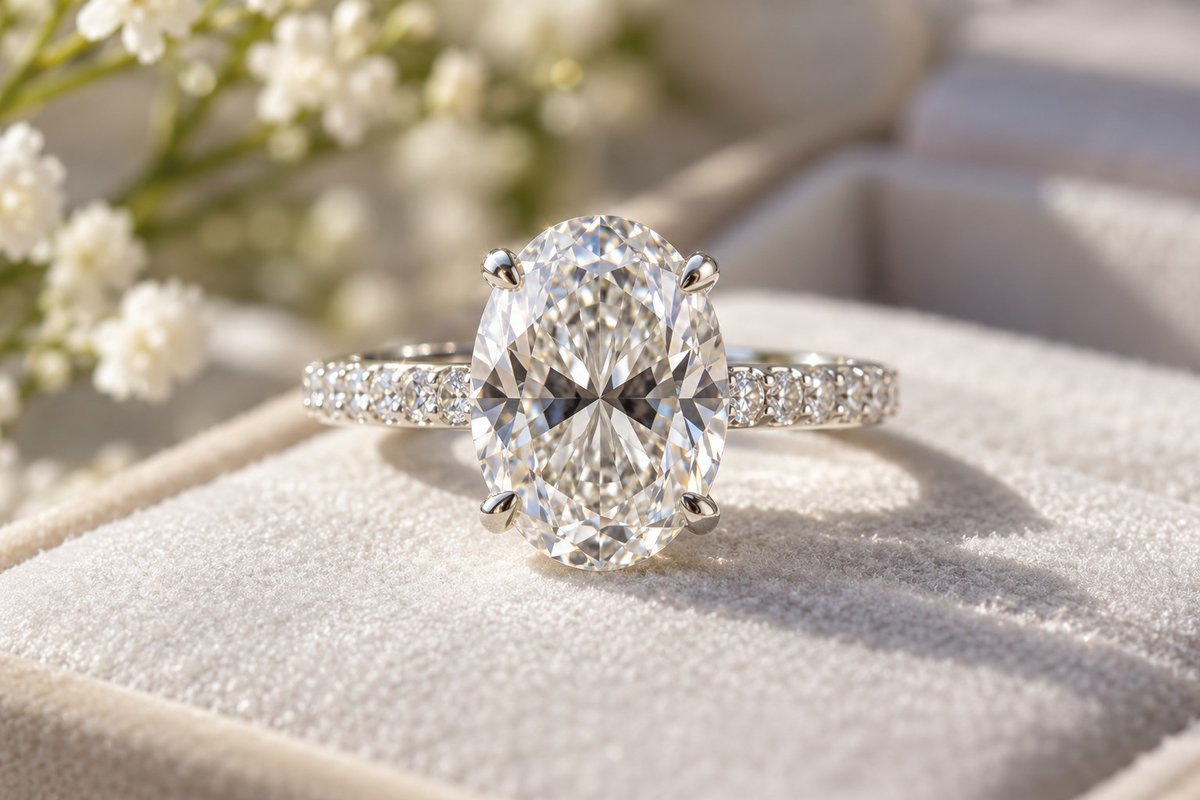
The bow-tie effect is a dark, bow-tie-shaped band that runs across the middle of an oval diamond, where light passes out of the stone instead of reflecting back to your eye. Almost every oval has some bow-tie; the goal is not to find one with none, but one where the bow-tie is soft, small and changes as the stone moves rather than staying as a solid black shape. Good proportions, a sensible length-to-width ratio and careful review of video are how you find it.
This guide includes a few product links near the end. As an Amazon Associate, Diamond Taire earns from qualifying purchases, at no extra cost to you.
This guide explains what causes the bow-tie, how to tell an acceptable one from a problem, which other features make a good oval, how colour and clarity behave in this shape, and a step-by-step method for shortlisting ovals online or in person.
At a glance
- Some bow-tie is normal. A light, shifting bow-tie adds contrast. A dark, fixed one that dominates the stone is the problem.
- The report will not tell you. Most grading reports do not give an overall cut grade for ovals or mention the bow-tie, so you must judge it from video or in person.
- Proportions help, but are not enough. Depth, table and ratio ranges can screen out poor stones, but two ovals with similar numbers can look very different.
- Ovals give a lot of look for the weight. They usually face up larger than a round of the same carat and often cost less per carat.
- Watch the tips. Colour tends to collect at the ends of an oval, and the tips need protection in the setting.
What causes the bow-tie effect
An oval is a brilliant-cut diamond stretched along one axis. Its facets have to be angled differently along the length than across the width. In the centre, across the narrower width, the pavilion facets meet at angles that can let light leak out of the back of the stone, or reflect the viewer’s own head and shadow back into view. The result is a darker area, usually shaped like a bow-tie or a pair of triangles meeting at the middle.
Several things make it stronger or weaker:
- Pavilion angles and depth. Facets that are too shallow leak light; facets that are too steep can create darkness too. The cutter’s choices matter more than any single number.
- Length-to-width ratio. GIA notes that longer ovals, above about 1.50, tend to show a stronger bow-tie, although bow-tie visibility varies a lot between stones of the same ratio and a well-cut stone can look good across a range of ratios.
- Lighting and viewing distance. A bow-tie looks stronger under a single overhead light or when you lean close over the stone, and softer in diffused daylight.
- Cutting for weight. Rough is expensive, so some ovals are cut to keep weight rather than to maximise light return. These often show the heaviest bow-ties.
Acceptable bow-tie or a problem? How to tell
| What you see | Mild (usually fine) | Moderate (judge carefully) | Severe (avoid) |
|---|---|---|---|
| Darkness | Light grey, broken up by sparkle | Noticeable grey band | Solid black or near-black band |
| Size | A small part of the centre | Reaches well across the width | Dominates the face of the stone |
| Movement | Shifts and flickers as the stone rocks | Changes a little with movement | Stays fixed from most angles |
| Rest of the stone | Bright and lively | Some dull zones | Large dark or watery areas besides the bow-tie |
| Effect on the hand | Adds contrast and depth | Visible at arm’s length in some light | The first thing people notice |
The single most useful test is movement. A bow-tie that flashes on and off as the stone rocks gives life to the diamond. A bow-tie that stays dark whichever way you tilt it will look the same on the hand every day.
Proportions and ratios: useful screening, not a guarantee
Because most laboratories do not grade the overall cut of fancy shapes, buyers lean on proportions to screen stones. Ranges quoted in trade buying guides vary, but they often suggest a total depth of roughly 58 to 63 percent and a table of roughly 53 to 63 percent. GIA’s own oval guidance stresses Excellent or Very Good symmetry and a medium girdle: a thick girdle adds weight without visible size, and an extremely thin one is more likely to chip. These are starting filters, not rules. A stone outside them may still look beautiful, and one inside them may still show a heavy bow-tie.
The length-to-width ratio is largely a matter of personal taste, and GIA reports list the measurements you need to work it out (length divided by width). GIA’s guidance describes about 1.40 to 1.50 as the most popular range for a traditional oval. As a rough guide:
| Length-to-width ratio | How it looks | Who it suits |
|---|---|---|
| About 1.20 to 1.30 | Fuller, softer, closer to round | Those who like a gentle oval or a halo setting |
| About 1.30 to 1.50 | The classic oval; balanced and elegant | Most buyers; the widest choice of stones |
| About 1.50 to 1.70 | Long and slender | Those who want an elongating look on the finger |
| Above about 1.70 | Very narrow, approaching marquise | A distinctive taste; check bow-tie and tips closely |
Also look at the outline. A good oval has smooth, even curves, without flat “shoulders” along the sides or pointed ends. Lay a transparent oval template over a photo, or simply look for symmetry: the two halves should mirror each other side to side and end to end.
For more on how proportions create brightness and fire, see diamond cut quality: proportions, angles and the craft behind a brilliant stone. For how ovals compare with the other nine main shapes, see diamond shapes explained.
Colour and clarity in oval diamonds
Colour gathers at the tips
Ovals tend to show colour slightly more at their ends than round brilliants of the same grade do, because the elongated tips concentrate colour, a point GIA’s oval guidance also makes. In white gold or platinum, many buyers choose G or H for an oval and find it looks white. In yellow or rose gold, a warmer grade can look natural. A longer oval may show colour at the tips a little more than a fuller one. The guide to choosing a diamond colour grade explains how shape and metal interact with colour.
Clarity is forgiving
Because the oval is a brilliant cut, its many facets break up light and help hide small inclusions. VS2 and many SI1 ovals are eye-clean, but always check where the inclusions sit. An inclusion near a tip can sometimes be hidden by a prong; a dark one in the centre, inside the bow-tie zone, can make that area look even darker. See how to choose diamond clarity for how to judge eye-cleanness.
How to judge an oval diamond online
Since the report will not show the bow-tie, video and images are essential. Here is what to look for:
- Rotating 360-degree video. Watch the stone rock from side to side. Pause on the face-up view and look at the centre. Is the dark area solid, or does it break up?
- More than one lighting condition. Bright studio lighting can flatter any stone. Ask for a photo or video in diffused daylight or ordinary room light if possible.
- Light performance images, if offered. Some sellers show reflector-scope images (such as ASET or Idealscope-style views). These show where the stone returns light and where it leaks, so a heavy bow-tie often appears as a clear dark or light-leaking zone.
- Accurate scale. Ask for the face-up measurements so you can compare size against a round or another oval.
The general seller checks, return windows and report verification steps in how to buy a diamond online without getting burned apply to ovals just as much as rounds. Always confirm the report number against the laboratory’s own online database.
Step-by-step: shortlisting a good oval
- Decide your ratio range by looking at photos of ovals on a hand: fuller, classic or slender.
- Set your colour and clarity floor for your metal, for example G to H and VS2 to SI1 in white metal.
- Filter by polish and symmetry of Very Good or Excellent, and by a depth and table within the usual ranges.
- Check the outline in the photo: even curves, no flat shoulders, matching halves.
- Watch every candidate’s video and rate the bow-tie as mild, moderate or severe using the table above. Remove any severe ones.
- Compare face-up size for the weight. A stone that looks small for its carat weight may be too deep, with weight hidden in the pavilion.
- Look at the tips for colour and for any inclusions or chips near the ends.
- Shortlist three and compare them side by side, ideally in the same video conditions.
- Verify the report and check that measurements match the listing.
Setting an oval diamond
Ovals have no sharp points, so they are less fragile than a marquise or pear. Even so, the ends are the most exposed parts. Four-prong settings show the most of the stone; six-prong or double-prong designs give more security at the tips; a bezel or partial bezel protects the edges fully and may help mask a slight tint at the ends. Halos make an oval look larger and can disguise a slightly wide shape. East-west settings, where the oval sits across the finger, give a distinctive modern look. Compare options in diamond ring settings explained.
Who an oval suits, and who it may not
| An oval suits you if | You might prefer another shape if |
|---|---|
| You want a stone that looks larger for its weight | You want the most predictable sparkle with the least checking (consider a round) |
| You like an elongating look on the finger | Any visible dark area in the centre would bother you |
| You can review good video or see stones in person | You must buy from a listing with photos only |
| You want brilliance with softer, rounded ends | You love the crisp “hall of mirrors” look of step cuts |
Common mistakes when choosing an oval
- Looking for zero bow-tie. You may reject lovely stones. Aim for a mild, shifting one.
- Relying on numbers alone. Depth and table ranges cannot predict the bow-tie. Video is essential.
- Judging from one flattering photo. A single bright image can hide a strong bow-tie. Watch the stone move.
- Ignoring the outline. Flat shoulders or lopsided ends are obvious once the stone is set.
- Forgetting the tips. Check colour and inclusions at the ends, and protect them in the setting.
- Buying a deep stone for the carat number. Extra hidden depth adds weight, not visible size, and can worsen darkness.
Sources this guide draws on: GIA (Gemological Institute of America) guidance on oval-cut diamonds, including length-to-width ratio, symmetry, girdle and the bow-tie effect; GIA’s practice of grading overall cut for round brilliants only; and proportion ranges commonly published in trade buying guides.
Useful tools for this guide
Practical picks for choosing, checking and caring for jewellery. As an Amazon Associate, Diamond Taire earns from qualifying purchases, at no extra cost to you. Prices and availability are set by Amazon and may vary by country.
- Foldable 30x Jeweller’s Loupe
Pocket magnifier for checking stones, settings and hallmarks up close.
View on Amazon - CONNOISSEURS Premium Jewellery Cleaner
Gentle dip cleaner with a brush and tray for diamonds, gold and platinum. Check the label for stones it should not be used on.
View on Amazon - Ring Sizer Measuring Tool Kit (27 pieces)
Sizing rings plus a mandrel, to check a size at home before you buy or resize.
View on Amazon
Frequently asked questions
Do all oval diamonds have a bow-tie?
Almost all do to some degree, because of how the facets must be arranged along an elongated shape. In well-cut stones it is light, small and shifts with movement. The aim is to avoid a dark, fixed bow-tie rather than to find one with none at all.
Does the grading report show the bow-tie effect?
No. Major reports list measurements, proportions, polish and symmetry, but they do not describe or grade the bow-tie, and most do not give an overall cut grade for ovals. You need video, images or an in-person look to judge it.
What is the best length-to-width ratio for an oval diamond?
There is no single best ratio; it is a matter of taste. Many buyers prefer roughly 1.30 to 1.50 for a classic look, and GIA describes 1.40 to 1.50 as the most popular traditional range, with fuller and longer shapes on either side. Choose the shape you like, then judge the bow-tie and brightness of each individual stone.
Can a bow-tie be fixed after the diamond is cut?
Not in a practical sense. The bow-tie comes from the facet angles, and changing them would mean re-cutting the stone and losing weight. It is far easier to choose a stone with a mild bow-tie from the start.
Do lab-grown ovals have bow-ties too?
Yes. The bow-tie comes from the cut, not the origin, so lab-grown and natural ovals are judged the same way. If you are weighing up the two origins, see lab-grown or natural diamond.
A good oval diamond is bright across its face, with an even outline and a bow-tie that flickers rather than glowers. Choose a ratio you love, use proportions to narrow the field, then let video make the final call. Take your time with that last step, because it is the one that decides how the ring will look every day.