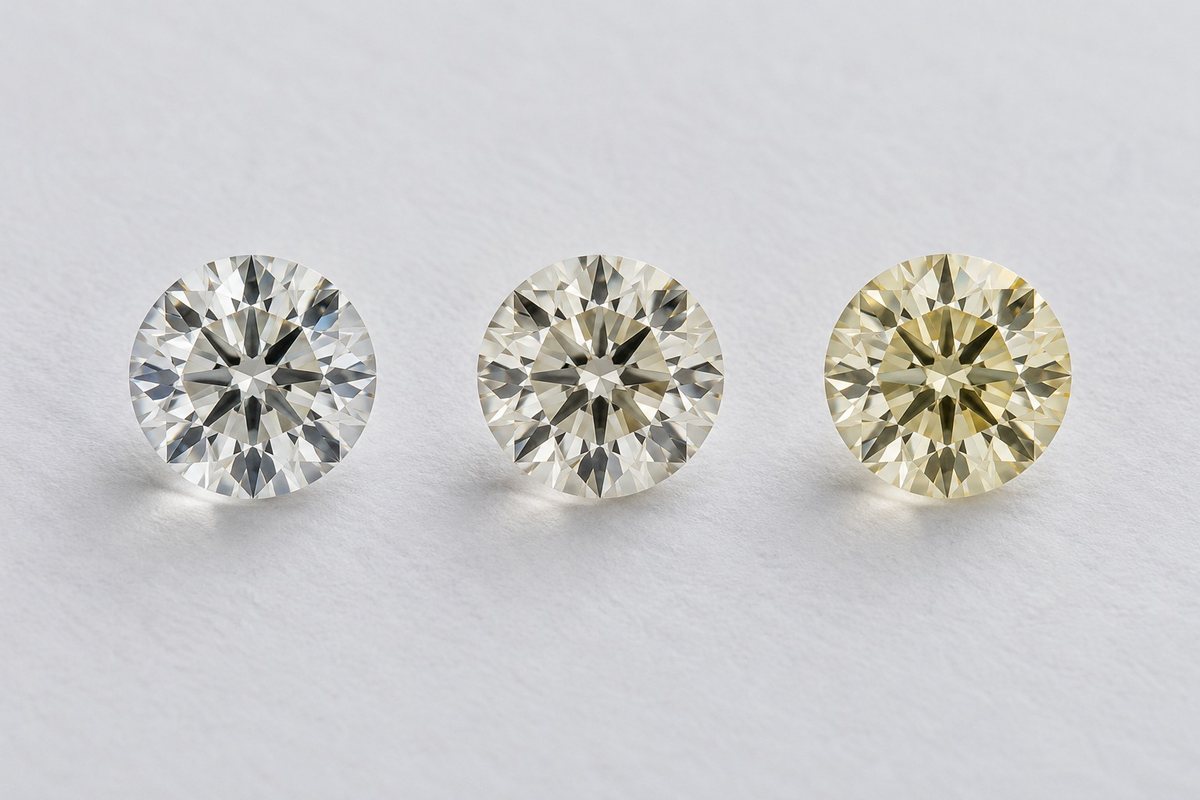
For most people, a diamond in the G to I range looks white once it is set, especially a well-cut round in white metal, and costs noticeably less than D to F. Choose a grade or two higher for large stones and step cuts such as emerald and Asscher, where colour shows more, and consider J or K if the setting is yellow or rose gold. The D-to-Z scale measures how little yellow or brown a white diamond shows, and the steps between grades are very small.
This guide includes a few product links near the end. As an Amazon Associate, Diamond Taire earns from qualifying purchases, at no extra cost to you.
This guide explains how the scale works, where each band sits, why the same grade can look different in different shapes and settings, and how to decide which part of the scale suits you. It sits alongside the overview of the 4 Cs of diamonds and goes deeper into the one “C” that buyers most often overpay for.
At a glance
- D is colourless, Z is light yellow or brown. Higher on the scale means less colour, not more of something desirable.
- Neighbouring grades are hard to tell apart face-up once set; graders use master stones and controlled light to separate them.
- G to I is the usual sweet spot for rounds in white metal; go higher for big stones and step cuts.
- Yellow and rose gold forgive warmth, so a lower grade often looks right at home.
- The laboratory matters. A grade is only as reliable as the report behind it, and lab-grown reports now differ between laboratories.
What the colour scale measures
The scale in use today was introduced by GIA in the 1950s and has since become the common language of the trade. It runs from D, completely colourless, down to Z, a noticeable light yellow or brown body colour. Most other laboratories use the same letters, although their grading standards are not always identical.
The scale starts at D rather than A for a historical reason. Before it existed, sellers used a muddle of letters, numbers and descriptive words, and some already labelled their best stones “A” or “AAA”. Starting fresh at D avoided any confusion with those older systems.
- It measures the absence of colour. For white diamonds, a higher grade means less colour.
- It is graded face-down. Graders look at the diamond upside down, through the side of the stone, against a white background. This removes the sparkle that hides colour when a diamond is viewed from the top.
The colour bands
The 23 letters are grouped into five broad bands. The band names describe roughly what an untrained eye can expect.
| Grades | Band | What it typically looks like | Who it often suits |
|---|---|---|---|
| D, E, F | Colourless | No visible colour, even side by side with other stones. D is the rarest. | Buyers who value rarity, large step cuts in platinum |
| G, H, I, J | Near colourless | Looks white face-up to most people once set. A trace of warmth may show in side-by-side comparison. | Most engagement rings; best balance of look and price |
| K, L, M | Faint | A soft warmth is often visible, especially in larger stones. | Yellow or rose gold, vintage looks, tighter budgets |
| N to R | Very light | Clearly tinted yellow or brown in larger stones. | People who like a warm tone and want size for the money |
| S to Z | Light | Obvious light yellow or brown colour. | Those who deliberately want a warm, champagne-like look |
When a diamond shows more colour than the Z master stone, it moves into a different system altogether: the fancy colour scale, used for yellow, pink, blue and other coloured diamonds.
How colour is graded
At a grading laboratory, each diamond is compared against a set of master stones of known colour. The grader places the stone between the masters and decides where it falls. This happens under standardised daylight-equivalent light, in a neutral environment, with the diamond face-down on a white tray.
More than one grader usually examines each stone. Even so, colour grading involves judgement at the boundaries: a stone right on the edge between G and H could reasonably receive either grade at different times or laboratories. That is one reason the report itself matters as much as the letter on it. The guide to reading a diamond grading report explains why the issuing laboratory’s consistency affects how much weight you can place on a grade.
What causes the colour
In most white diamonds, the faint yellow tint comes from small amounts of nitrogen trapped in the crystal as it formed. A brownish tint is usually linked to distortion in the crystal structure. Neither is a defect in any practical sense: they do not affect durability.
Why the same grade can look different
A colour grade is assigned in controlled conditions. Out in the world, a diamond is viewed face-up, in mixed lighting, inside a metal setting. Several factors change how much colour you actually notice.
Shape and cut
Round brilliants and other brilliant-style shapes break light into many small flashes, which helps mask body colour. Step cuts such as emerald and Asscher have long, open facets that act like windows, so colour is easier to see. Elongated shapes such as oval, pear and marquise tend to collect colour at their points or ends. The guides to diamond shapes and round versus oval diamonds cover how each shape handles light.
Cut quality matters too. A well-proportioned diamond returns more light and looks brighter, which makes a slight tint less noticeable. A poorly cut stone can look duller and, as a result, warmer.
Size
Colour becomes easier to see as diamonds get larger, because light travels a longer path through the stone. A small diamond graded J can look perfectly white, while a much larger J may show a gentle warmth.
Metal colour
The metal around a diamond reflects into it. Yellow and rose gold add warmth, which can make a near colourless or faint diamond look entirely at home, and can make a very high colour grade seem wasted. White gold and platinum are neutral and cool, so they show any tint more readily. If you are torn, try the stone against both before deciding.
Fluorescence and lighting
Some diamonds glow, usually blue, under ultraviolet light, which is present in daylight. Blue fluorescence can make a slightly yellow diamond look a little whiter in sunlight, while warm indoor lighting can bring out a tint. Fluorescence is listed on grading reports, so check it and, where possible, view the stone in daylight.
Choosing the right part of the scale
| Your diamond | White gold or platinum | Yellow or rose gold |
|---|---|---|
| Round brilliant under about 1 carat | H to J usually looks white | J to K usually looks harmonious |
| Round brilliant 1 to 2 carats | G to I | I to K |
| Oval, pear, marquise, cushion | G to H (colour gathers at the ends) | I to K |
| Emerald or Asscher step cut | F to H | H to J |
| Small accent and pavé stones | Consistent near colourless range | Consistent near colourless or faint range |
These are common starting points, not rules. What you actually see, in the setting you will wear, is what counts. Colour is also only one of several factors that shape price; the articles on what drives a diamond’s price and the best-value diamond combinations show how colour trades off against cut, clarity and carat weight.
Vintage and antique stones were often cut for candlelight and may show more warmth, which many people love as part of their character.
Natural, lab-grown and treated diamonds
IGI and most other laboratories grade lab-grown diamonds on the same D-to-Z scale. GIA changed its approach on 1 October 2025: it now issues a Laboratory-Grown Diamond Quality Assessment that uses two broad descriptors instead of letter grades. “Premium” requires D colour plus very high clarity and finish; “Standard” covers E to J colour with minimum clarity, polish and symmetry requirements. Stones below those minimums do not receive an assessment. GIA reports issued for lab-grown diamonds before that date show letter grades. The guide to buying lab-grown diamonds explains what this means when you compare reports.
What differs between natural and lab-grown is rarity, not what the letters mean. A high colour grade is genuinely uncommon in a natural diamond, while lab-grown producers can aim for high colours more consistently.
Some diamonds have their colour improved by treatment, such as high-pressure, high-temperature (HPHT) processing. Reputable laboratories test for this and state it on the report, and any treatment should be disclosed clearly at the point of sale.
How to compare colour grades in person: step by step
- Fix the shape, size and metal first, because they change how much colour you will see.
- Ask to see three stones of similar size and cut: your target grade, one grade higher and one or two lower.
- Look face-up, as you will wear it, not only face-down on a white card.
- View them in daylight and in ordinary indoor light, not just under bright shop spotlights.
- Hold each against the metal you plan to use, or a close equivalent.
- Check the report for the laboratory, the grade, fluorescence and any treatment.
- Choose the lowest grade that looks white to you, and put the saving into cut quality or size.
Many people discover that they cannot see the difference they were about to pay for, while others realise they are more sensitive to warmth than they expected. Either answer is useful.
Common mistakes
- Paying for D to F when the stone will be set in yellow gold. The metal adds warmth and hides the difference.
- Choosing a low grade for a large emerald cut in platinum. Step cuts and white metal show colour most.
- Comparing grades from different laboratories as if they were identical. Standards vary.
- Judging colour only under shop spotlights. Strong lighting flatters every stone.
- Trading away cut quality for a higher colour grade. A well-cut H usually looks better than a poorly cut E.
- Ignoring fluorescence and treatment lines on the report.
Questions to ask the jeweller
- Which laboratory issued the grading report, and can I see the full report?
- Can I view the diamond face-up in the setting metal I am choosing?
- Can I see it in daylight as well as under shop lighting?
- Does the diamond have fluorescence, and if so, how strong is it?
- Has the colour been treated in any way, and is that stated on the report?
- Can I compare it side by side with diamonds one or two grades higher and lower?
Related guide: Are Champagne Diamonds Worth It? How to Buy Without Regret.
Sources this guide draws on: GIA’s 4Cs colour grading guidance and its description of the D-to-Z grading process; GIA’s announcement of the Laboratory-Grown Diamond Quality Assessment introduced on 1 October 2025, as reported by National Jeweler; and IGI’s published grading information for natural and lab-grown diamonds.
Useful tools for this guide
Practical picks for choosing, checking and caring for jewellery. As an Amazon Associate, Diamond Taire earns from qualifying purchases, at no extra cost to you. Prices and availability are set by Amazon and may vary by country.
- Foldable 30x Jeweller’s Loupe
Pocket magnifier for checking stones, settings and hallmarks up close.
View on Amazon - CONNOISSEURS Premium Jewellery Cleaner
Gentle dip cleaner with a brush and tray for diamonds, gold and platinum. Check the label for stones it should not be used on.
View on Amazon - Ring Sizer Measuring Tool Kit (27 pieces)
Sizing rings plus a mandrel, to check a size at home before you buy or resize.
View on Amazon
FAQ
Can I see the difference between a D and a G diamond?
Face-up, once set, most people find it difficult or impossible to tell these grades apart without a direct comparison. The difference is real and measurable, but subtle. D to F grades are prized for their rarity as much as their appearance.
What is the best colour grade for the money?
For a well-cut round in white metal, G to I is where many buyers find the best balance of a white look and a lower price. In yellow or rose gold, J or K often looks just as good. The right answer depends on shape, size and your own eyes.
Is a J colour diamond a poor choice?
Not at all. J sits at the lower end of the near colourless band, and in a well-cut round set in yellow gold, or in a smaller stone, it can look entirely white face-up. It may show a little warmth in larger stones or step cuts set in white metal, so view it in person.
Does colour grade affect durability?
No. Colour grade describes appearance only. A K colour diamond is just as hard and durable as a D colour diamond.
Why do two diamonds with the same grade look different?
Each grade covers a small range, so one H may sit near G while another sits near I. Cut quality, shape, fluorescence and the setting also change how colour appears, which is why viewing diamonds in person, or in clear, honest video, matters.
Does colour matter for small accent diamonds?
Less so. Small side stones and pavé are usually graded in ranges rather than individually. The main thing is that they look consistent with each other and not noticeably warmer than the centre stone.
The D-to-Z scale measures how little colour a white diamond has, and the steps between grades are finer than most eyes can detect once a stone is set. Use the grade as a reliable guide, then let shape, size, metal and your own eyes decide. A diamond that looks white to you, in the setting you will wear, is the right colour.