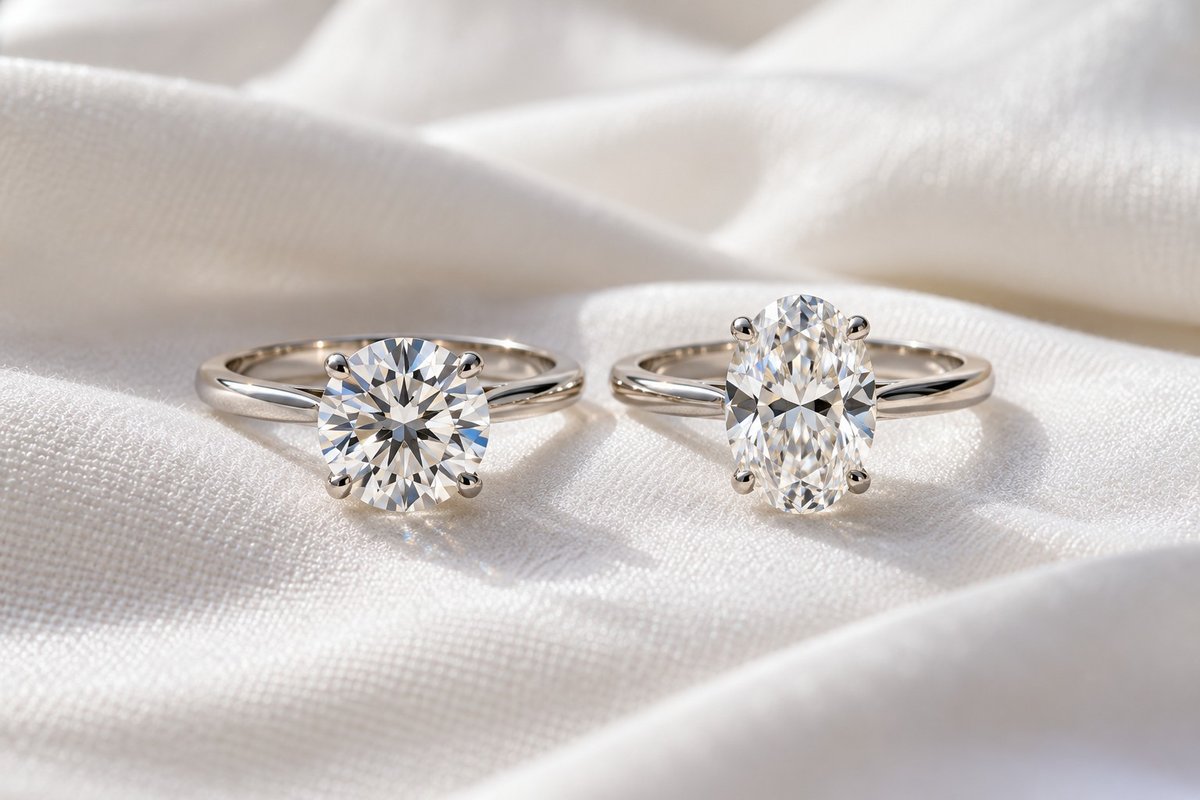
Carat for carat, an oval diamond usually looks bigger than a round one, because its elongated outline spreads the same weight over a larger face-up area and covers more of the finger. A well-cut round brilliant, however, usually sparkles more evenly and more reliably, because its faceting is designed to return light in a symmetrical pattern, while every oval shows at least some dark bow-tie. So the honest answer is that ovals tend to win on apparent size and rounds tend to win on consistent brilliance.
This guide includes a few product links near the end. As an Amazon Associate, Diamond Taire earns from qualifying purchases, at no extra cost to you.
This guide explains why that happens, how to compare two specific stones using the measurements on their grading reports, how cut grading differs between the two shapes, how price per carat compares, and which settings flatter each. It finishes with a buying checklist, common mistakes and answers to the questions buyers ask most.
- Looks bigger: ovals generally show more surface area than rounds of the same carat weight, and they make fingers look longer.
- Sparkles more: a well-cut round brilliant gives the most predictable, even sparkle; ovals vary much more from stone to stone.
- Cut grade: GIA gives an overall cut grade to round brilliants only; for ovals it reports polish and symmetry, so you must judge the oval’s look yourself.
- Price: rounds generally cost more per carat than ovals of similar grades.
- Best tool: compare face-up measurements, not carat weight, and always view an oval in real light or on video.
Why an oval looks bigger than a round of the same weight
Carat is weight, not size. How big a diamond looks depends on how much of that weight sits in its face-up outline, sometimes called spread, rather than hidden in the depth below the girdle.
According to GIA’s oval buying guidance, oval diamonds offer a larger surface area than round diamonds of the same carat weight, which gives the impression of a bigger stone. The longer outline also draws the eye along the finger, so an oval tends to read as larger even when the area difference is modest.
How to check spread yourself: a worked example
You do not need to rely on general claims. Every grading report lists measurements, and you can turn them into an approximate face-up area with simple arithmetic:
- Round: area is roughly 0.785 multiplied by the diameter squared.
- Oval: area is roughly 0.785 multiplied by length multiplied by width.
Imagine you are comparing two stones on paper: a round measuring 6.4 mm across and an oval measuring 7.6 mm by 5.4 mm. The round works out at about 32 square millimetres; the oval also works out at about 32 square millimetres. In that case the oval would not show more area at all, but it would still look longer on the hand. Now imagine an oval of 8.0 mm by 5.6 mm: that comes to about 35 square millimetres, noticeably more than the round. The lesson is that the size advantage depends on the individual oval’s proportions, which is why measurements matter more than shape alone.
Ovals cut very deep carry more weight underneath and lose much of their spread advantage. Ovals cut very shallow can look large but tend to leak light through the centre, an effect called windowing, and look glassy.
Finger coverage and length-to-width ratio
An oval’s shape is described by its length-to-width ratio. GIA’s guidance notes that many people prefer ratios between about 1.30 and 1.50. Around 1.30 to 1.40 gives a gently elongated look that suits most fingers; around 1.41 to 1.50 looks longer and slimmer and gives a stronger lengthening effect on the hand.
A round has no ratio to choose: it looks the same from every direction, which some people find classic and balanced, and others find less distinctive. On a slender finger, a round can look wide for its weight; on a broader finger, a slim oval can look narrow. Trying both on, or at least viewing photographs on a hand similar to yours, is the quickest way to decide.
Which sparkles more: light performance explained
Sparkle combines three things: brightness (white light returned), fire (flashes of colour) and scintillation (the pattern of light and dark that moves as the stone moves).
The round brilliant is the most studied diamond shape. Its circular outline and 57 or 58 facets allow cutters to aim for proportions that return light evenly across the whole face. A round with excellent cut quality looks bright from edge to edge, with a crisp, balanced pattern.
An oval uses a modified brilliant facet arrangement stretched into an ellipse. That stretch means light behaves differently at the narrow sides than at the ends, and most ovals show a darker band across the centre, the bow-tie. GIA notes that some degree of bow-tie is always present in ovals and becomes more obvious the closer your head is to the stone. A beautifully cut oval can be very lively; a poorly cut one can look patchy or dull. The guide to the oval bow-tie effect explains how to judge it in detail, so this guide will not repeat it here.
For a deeper look at how proportions and angles drive light return in any shape, see diamond cut quality explained.
Round vs oval at a glance
| Factor | Round brilliant | Oval |
|---|---|---|
| Face-up size per carat | Good | Usually larger; depends on proportions |
| Look on the finger | Classic, balanced | Elongating; makes fingers look longer |
| Sparkle consistency | Highly consistent when well cut | Varies widely between stones |
| Bow-tie | None | Always present to some degree |
| GIA overall cut grade | Yes (Excellent to Poor) | No; polish and symmetry only |
| How you judge cut | Report grade plus viewing | Measurements, ratio and careful viewing |
| Price per carat | Generally higher | Generally lower for similar grades |
| Setting choices | Widest range | Wide range; orientation adds options |
| Vulnerable points | None | None (no sharp tips) |
How cut grading differs between round and oval
This is the single most important practical difference, and it catches many buyers out.
Rounds: a grade does part of the work
GIA assigns an overall cut grade, from Excellent to Poor, to standard round brilliant diamonds in the D-to-Z colour range. That grade reflects proportions, polish and symmetry together, so a round graded Excellent has passed a recognised test of light performance before you ever see it.
Ovals: you do the judging
GIA’s buying guidance states that it only assigns an overall cut grade to round brilliants. For ovals, the report lists polish and symmetry, plus measurements, depth and table percentages, but no overall verdict on how the stone looks. A GIA article published in Gems & Gemology in 2024 discussed research towards fancy-shape cut grading and noted that methods for rounds cannot simply be transferred to fancy shapes.
Some other options exist. The same GIA article noted that IGI announced a cut grading service for several fancy shapes in 2022. GIA also offers the AGS Ideal Report as a digital supplement for certain facet arrangements of ovals and other shapes, as well as rounds; the American Gem Society closed its own laboratory, AGS Laboratories, in 2022. Neither replaces looking at the stone, but both can add useful information. The guide to diamond certification and how to read a grading report explains what each section of a report means.
A note on lab-grown diamonds
Since 1 October 2025, GIA no longer gives lab-grown diamonds the colour, clarity and cut grades used for natural stones. Instead, it describes eligible lab-grown diamonds as Premium or Standard. For round brilliants, the Premium and Standard criteria include a minimum cut grade; for fancy shapes such as ovals, they are based on polish and symmetry instead. IGI continues to grade lab-grown diamonds on the familiar scales. If you are comparing lab-grown rounds and ovals, check which laboratory issued the report and what it actually assesses. The lab-grown diamond buyer’s guide covers this in more depth.
Price per carat
Round brilliants generally command a higher price per carat than ovals of similar colour, clarity and weight. Two reasons are usually given: cutting a round from rough crystal typically keeps less of the original weight, and the round is the most popular shape, so demand is consistently high.
For buyers who want maximum visible size for their budget, that makes an oval attractive twice over: lower cost per carat and more apparent size per carat. The trade-off is the extra effort needed to find an oval with a pleasing appearance. For the wider picture of what moves price, see what really drives a diamond’s price, and for grade combinations that tend to look good without overspending, the guide to the best value diamond combinations.
Setting choices for each shape
Both shapes work in almost every setting style, but there are differences worth knowing.
- Claw (prong) settings: rounds are commonly held in four or six claws. Ovals are often held in four or six claws, often with claws placed at or near each end to hold and protect the stone’s outline.
- Bezel settings: a metal rim around the stone suits active lifestyles for both shapes and can make an oval look even more defined.
- Halo settings: a ring of small stones adds apparent size to either shape; with ovals the halo also exaggerates the elongated look.
- Orientation: ovals can be set north to south (along the finger) for a lengthening look, or east to west (across the finger) for a more unusual style. Rounds have no orientation choice.
- Bands and stacking: ovals sometimes need a curved or notched wedding band to sit flush; rounds pair easily with straight bands.
The guide to diamond ring settings goes through each style’s pros and cons.
Who each shape suits
A round may suit you if
- You want the most sparkle with the least guesswork.
- You value a timeless, symmetrical look.
- You are buying without seeing the stone and want a report grade to lean on.
An oval may suit you if
- You want the stone to look as large as possible for the budget.
- You like an elongated outline that flatters the finger.
- You are willing to compare several stones and review photos or video carefully.
Buying checklist
- Decide whether apparent size or consistent sparkle matters more to you.
- Compare face-up area from the report measurements, not just carat weight.
- For an oval, choose a length-to-width ratio you like, commonly between about 1.30 and 1.50.
- For a round, check the report’s overall cut grade.
- For an oval, check polish and symmetry, and review the stone on video or in person for bow-tie and windowing.
- Check which laboratory issued the report and what it assesses, especially for lab-grown stones.
- Choose a setting and orientation that suit the shape and your daily life.
- Confirm the returns policy before you buy, especially when buying an oval you have not seen in person.
Common mistakes to avoid
- Comparing carat weight instead of measurements. Two stones of the same weight can look very different in size.
- Assuming every oval looks bigger. A deep oval can face up no larger than a round of the same weight.
- Buying an oval on report alone. Without a cut grade, the report cannot tell you whether the bow-tie is distracting.
- Judging sparkle under shop spotlights only. Look at both shapes in ordinary daylight and indoor light as well.
- Forgetting the wedding band. Check early whether a straight band will sit comfortably beside the setting.
For sizes and October 2026 price samples at one carat, see our 1 carat diamond ring guide.
Related guide: Marquise Diamond Ring: How to Choose One Without Regret.
Sources this guide draws on: GIA’s oval diamond buying guidance, GIA’s Gems & Gemology research on oval, pear and marquise cut appearance (2024), GIA’s announcement of its updated laboratory-grown diamond services from 1 October 2025, and the American Gem Society’s information on the AGS Ideal Report by GIA and the closure of AGS Laboratories.
Useful tools for this guide
Practical picks for choosing, checking and caring for jewellery. As an Amazon Associate, Diamond Taire earns from qualifying purchases, at no extra cost to you. Prices and availability are set by Amazon and may vary by country.
- Foldable 30x Jeweller’s Loupe
Pocket magnifier for checking stones, settings and hallmarks up close.
View on Amazon - CONNOISSEURS Premium Jewellery Cleaner
Gentle dip cleaner with a brush and tray for diamonds, gold and platinum. Check the label for stones it should not be used on.
View on Amazon - Ring Sizer Measuring Tool Kit (27 pieces)
Sizing rings plus a mandrel, to check a size at home before you buy or resize.
View on Amazon
Frequently asked questions
Does an oval diamond look bigger than a round diamond?
Usually, yes. Ovals generally have a larger face-up surface area than rounds of the same carat weight, and their elongated shape makes them look longer on the finger. A deep oval can lose that advantage, so always compare measurements.
Which sparkles more, oval or round?
A well-cut round brilliant usually gives the most even, reliable sparkle. A well-cut oval can be very bright and lively too, but ovals vary more and always show some bow-tie.
Are oval diamonds cheaper than round diamonds?
Generally, rounds cost more per carat than ovals of similar grades, partly because more rough crystal is lost when cutting a round and partly because demand for rounds is high. Prices still vary widely with colour, clarity, cut and laboratory report.
Does GIA give oval diamonds a cut grade?
No. GIA gives an overall cut grade to round brilliant diamonds only. For ovals it grades polish and symmetry and lists measurements and proportions, so judging the overall look is up to you.
What length-to-width ratio is best for an oval?
There is no single best ratio; it is a matter of taste. GIA notes that many people prefer between about 1.30 and 1.50, with lower ratios looking softer and fuller and higher ratios looking longer and slimmer.
If you want the most sparkle with the least guesswork, a well-cut round is hard to beat. If you want the most visible size and a flattering, elongated look, an oval rewards a careful search. Either way, use measurements, reports and your own eyes together.