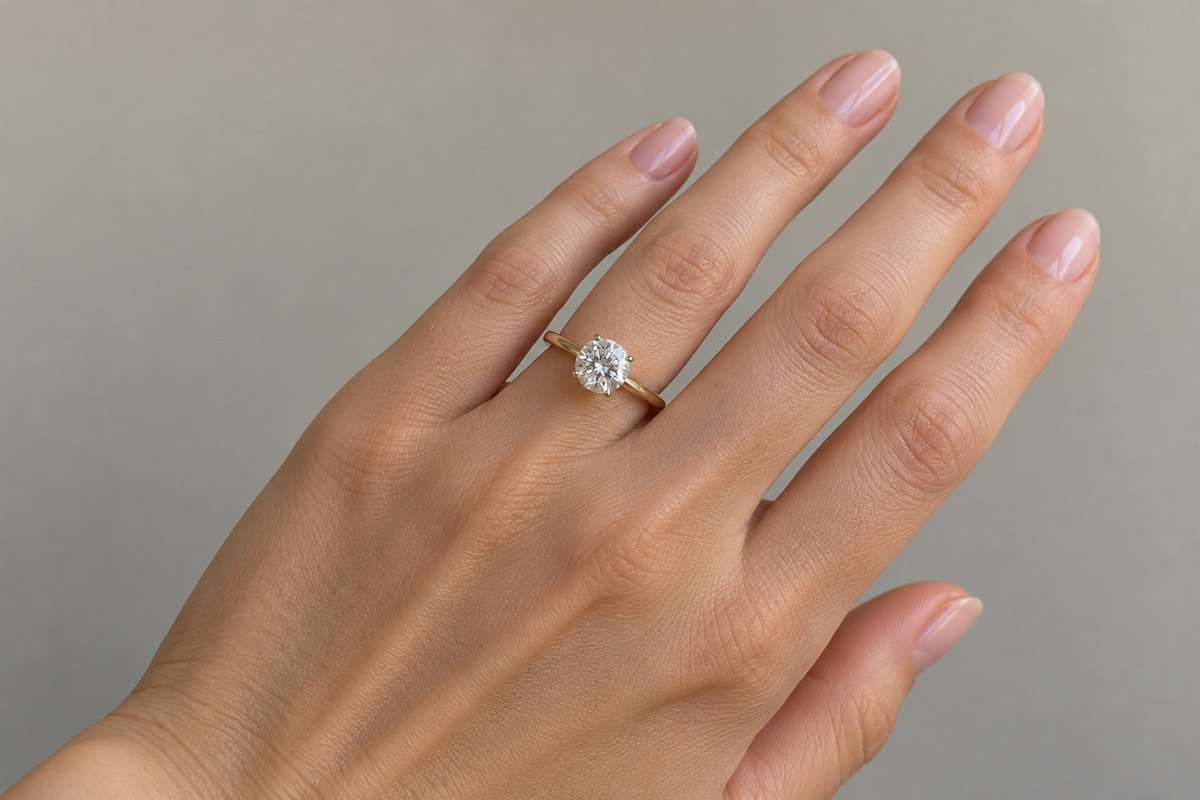
A 1 carat diamond weighs 0.2 grams, and a well-cut round one measures roughly 6.4 to 6.5 mm across. At the time of writing (October 2026), listed prices for a loose 1 carat lab-grown diamond started at under $400, while natural 1 carat stones ran from under $1,000 in low grades to $5,000 to $7,000 and more in top grades. The setting is extra, and prices change.
This guide includes a few product links near the end. As an Amazon Associate, Diamond Taire earns from qualifying purchases, at no extra cost to you.
This guide shows how big a 1 carat looks in each shape, what a 1 carat diamond ring costs in lab-grown and natural, why prices jump at exactly 1.00 carat, what to prioritise, how a 1 carat compares with a 1.5 carat, and what the stone is worth once you own it. It ends with a pre-purchase checklist, common mistakes and quick answers. Prices are in US dollars, sampled from retailer listings on 17 October 2026; they differ by country and retailer, so treat them as a starting point.
- Size: about 6.4 to 6.5 mm for a well-cut round. Elongated shapes such as oval, pear and marquise look bigger face-up.
- Price: lab-grown and natural differ by a large multiple, often five to ten times or more at the same grade.
- Magic size: stones at 1.00 carat carry a premium. Slightly lighter stones can look almost identical for less.
- Cut first: cut quality decides the sparkle and how big the stone looks, so do not trade it away.
- Setting extra: the ring is priced separately and adds to the total.
How big is a 1 carat diamond?
Carat is a measure of weight, not size. GIA defines a carat as one-fifth of a gram, divided into 100 points, so a 1.00 carat stone is 100 points. How large that weight looks depends on the shape and on how the stone is cut. GIA warns that a deep cut or a thick girdle can hide weight where it does not show, and that a poorly cut 1.20 carat diamond may look the same size as a well-cut 1.00 carat.
The table gives approximate face-up dimensions for a well-proportioned 1 carat stone in each shape. The round figure comes from the standard trade weight-estimation formula for round brilliants, assuming a typical depth of about 61 per cent; the fancy-shape figures use published shape factors at common length-to-width ratios. Real stones vary, so always check the measurements on the grading report.
| Shape | Approximate dimensions (mm) | Looks bigger or smaller than a round? |
|---|---|---|
| Round | 6.4 to 6.5 diameter | The reference |
| Oval (about 1.4:1) | About 7.9 x 5.7 | Bigger: a larger face-up area and a longer outline |
| Pear (about 1.6:1) | About 9.0 x 5.6 | Bigger, and lengthens the finger |
| Marquise (about 2:1) | About 10.5 x 5.2 | Noticeably bigger for its weight |
| Emerald (about 1.4:1) | About 6.9 x 5.0 | Similar or slightly smaller; step cuts are deeper |
| Princess, cushion, radiant | Vary widely with depth and ratio | Often similar or smaller; compare report measurements |
For help choosing between them, see diamond shapes explained and the detailed round vs oval comparison.
How much does a 1 carat diamond ring cost?
The figures below are listed prices for loose 1 carat stones (roughly 1.00 to 1.10 carats) sampled on 17 October 2026 from two large online diamond retailers and a diamond price-comparison marketplace that aggregates listings from many sellers. They exclude the setting and tax. They are a snapshot at the time of writing (October 2026); prices change, especially for lab-grown stones.
| Grade tier | Lab-grown (USD) | Natural (USD) | Notes |
|---|---|---|---|
| Value: H to K colour, SI1 to SI2 clarity, very good to excellent cut | Under $400 (sellers listed even D colour, VS2 stones at about $360 to $395) | About $890 to $2,100 | Check natural SI stones on video to make sure they are eye-clean |
| Middle: F to J colour, VS1 to VS2 clarity, excellent or ideal cut | About $360 to $400 | About $1,900 (J VS1, ideal cut) to $3,600 (F VS2, super ideal cut) | The grade range most buyers look at |
| Top: D to E colour, VVS to flawless, excellent or ideal cut | About $800 to $1,300 | About $4,900 to $7,000; one 1.09 carat D flawless was listed at $12,810 | Differences at this level are rarely visible to the eye |
Two things stand out. First, the gap between lab-grown and natural is enormous: in these samples a mid-grade natural 1 carat cost roughly five to ten times a lab-grown stone of similar or higher grade. Second, lab-grown prices vary widely between sellers, with premium retailers generally listing higher than marketplace sellers, so compare like with like. Fancy shapes are often cheaper than rounds: in the same samples, natural 1 carat ovals in H VS2 were listed at about $2,700, and princess cuts in H VS1 at about $1,600.
The setting adds to the total. At one large online retailer, plain 14k gold solitaire settings started at about $750, with diamond-set and halo styles costing more. See ring settings and their cost. For what moves the price within each tier, read what drives a diamond’s price.
Why prices jump at exactly 1 carat
Certain weights, 0.50, 0.75 and 1.00 carat among them, are known in the trade as “magic sizes”. GIA explains that diamonds at or just above these weights tend to cost more per carat than slightly lighter stones, simply because buyers want the round number. GIA also notes that, with the other Cs equal, you probably will not notice the size difference between a 0.98 carat and a 1.10 carat diamond.
Worked example (calculated sizes): a well-cut 0.90 carat round is about 6.2 mm across and a 1.00 carat about 6.5 mm, a difference of roughly 0.3 mm, or about 7 per cent less face-up area. On the hand that is very hard to see. If a seller’s 0.90 to 0.99 carat stones are priced meaningfully below comparable 1.00 carat stones, that saving can go into a better cut or a nicer setting. Compare actual listings side by side, because the size of the discount varies by seller and over time.
Remember that grading labs report weight to two decimal places; GIA rounds up only when the thousandths digit is a 9, so a stone listed at 1.00 carat really is at least 0.999 carat.
What to prioritise in a 1 carat: cut, then colour and clarity
- Cut: for round stones choose GIA Excellent or an equivalent top grade. Cut controls sparkle and how large the stone faces up. See the 4 Cs explained.
- Colour: GIA suggests H or better if you want a stone that looks colourless in white metal, while yellow or rose gold makes a slightly warmer grade less noticeable.
- Clarity: aim for “eye-clean”, an industry term (GIA does not use it) for a diamond whose inclusions you cannot see without magnification. At 1 carat, many VS2 and some SI1 stones qualify; check a magnified video.
- Origin: decide lab-grown or natural before you compare prices; see buying a lab-grown diamond.
For a ready-made shortlist of grade combinations, see the best value colour and clarity combinations.
Best shapes for a 1 carat that looks bigger
Ovals, pears and marquises spread their weight over a longer outline, so they look larger on the finger than a round of the same weight. Ovals and pears can show a dark “bow-tie” across the centre, so judge them by photos or video rather than grades alone. Emerald cuts, with their long open facets, show inclusions more readily, according to GIA, so they reward higher clarity.
Setting choices for a 1 carat
- Solitaire: the classic, and usually the least expensive.
- Halo: a ring of small diamonds around the centre makes it look larger, at extra cost and with more small stones to maintain.
- Pavé band: adds sparkle along the shank; small stones can loosen with heavy wear.
- Bezel: a metal rim protects the stone’s edge, good for active hands, though it shows slightly less of the stone.
1 carat vs 1.5 carat: worth the jump?
| Weight | Approximate round diameter | Face-up area compared with 1.00 carat | Sample listed prices (October 2026) |
|---|---|---|---|
| 0.90 carat | About 6.2 mm | About 7 per cent smaller | Not sampled; usually below 1.00 carat prices |
| 1.00 carat | About 6.5 mm | Reference | Lab-grown from about $360; natural F VS2 about $3,590 |
| 1.50 carat | About 7.4 mm | About 30 per cent larger | Lab-grown D VVS1 about $1,580; natural H VS2 very good cut about $4,470; natural F VS2 ideal cut about $8,440 |
A 1.5 carat is visibly larger, roughly 0.9 mm wider, but in natural diamonds the price per carat climbs as size increases because larger stones are rarer. In lab-grown, the step from 1 to 1.5 carats costs comparatively little. Diameters are calculated for well-cut rounds; prices change.
What is a 1 carat diamond worth after you buy it?
Retail price and resale value are very different things. Retail prices include the seller’s costs and margin, and buyers of second-hand diamonds generally pay well below retail. Natural diamonds have an established resale market, though at a discount; lab-grown diamonds currently have very limited resale value because new stones are cheap and prices have been falling. Buy a diamond because you love it, not as an investment. For an honest overview, see what diamonds are worth when resold.
If the diamond look matters more than the material, moissanite gives a similar size for less again, with its own trade-offs.
Checklist before you buy a 1 carat
- Insist on an independent grading report, and check that the laser inscription matches it.
- Choose an Excellent or ideal cut for a round stone.
- Confirm the stone is eye-clean in a magnified video or in person.
- Choose a colour that suits the metal.
- Compare 0.90 to 0.99 carat stones against 1.00 carat stones.
- Check the millimetre measurements, not just the weight.
- Price the setting separately and add tax, sizing and insurance.
- Read the return and upgrade policy.
Common mistakes
- Paying for D colour and flawless clarity that nobody can see once the ring is on.
- Accepting a weaker cut just to reach exactly 1.00 carat.
- Comparing lab-grown and natural prices as though they were the same product.
- Ignoring depth and spread, so the “1 carat” faces up like a smaller stone.
- Assuming every seller prices lab-grown alike; listed prices for similar stones varied widely between sellers.
- Buying with resale in mind.
If you are weighing a larger stone, our guide to 2 to 5 carat diamond rings shows how size and price change above 2 carats, and how much an engagement ring should cost helps you set the overall budget.
Sources this guide draws on: GIA education on carat weight, magic sizes and rounding, colour and clarity, and saving money on a diamond; the standard trade weight-estimation formulas for round and fancy-shape diamonds as published for jewellery professionals (including Jewellery Business, by GIA Graduate Gemologist Mark T. Cartwright); and listed retail prices for loose diamonds and ring settings sampled on 17 October 2026 from large online retailers and a diamond price-comparison marketplace.
Useful tools for this guide
Practical picks for choosing, checking and caring for jewellery. As an Amazon Associate, Diamond Taire earns from qualifying purchases, at no extra cost to you. Prices and availability are set by Amazon and may vary by country.
- Foldable 30x Jeweller’s Loupe
Pocket magnifier for checking stones, settings and hallmarks up close.
View on Amazon - Gemstones of the World by Walter Schumann (5th edition)
A classic illustrated reference to more than 1,900 gemstones.
View on Amazon - KElofoN Travel Jewellery Case
Compact case with ring rolls and earring slots so pieces do not scratch each other.
View on Amazon
FAQ
How much is a 1 carat diamond ring?
At the time of writing (October 2026), a loose 1 carat lab-grown diamond was listed from under $400, and natural 1 carat stones from under $1,000 in low grades to $5,000 to $7,000 or more in top grades. Add the setting, which started at about $750 for a plain 14k gold solitaire at one large retailer. Prices change.
How big is a 1 carat diamond?
A well-cut round 1 carat measures about 6.4 to 6.5 mm across. A 1 carat oval is roughly 7.9 x 5.7 mm and looks larger on the hand. Always check the report’s measurements.
Is a 1 carat diamond big enough for an engagement ring?
It is a classic size that looks substantial on most fingers, though it looks larger on slimmer fingers. US survey data from The Knot put the average centre stone in 2025 at about 1.9 carats, helped by cheaper lab-grown stones, but there is no “right” size.
How much is a 1 carat lab-grown diamond?
In October 2026 samples, 1 carat lab-grown stones in high colour and VS clarity were listed at about $360 to $400 by marketplace sellers, with premium retailers and top grades at about $800 to $1,300. Lab-grown prices have been falling, so check current listings.
Is a 0.9 carat diamond a better buy than 1 carat?
Often, yes. GIA notes that stones just under magic sizes such as 1.00 carat can offer savings, and the size difference is very hard to see. Compare real listings at the same grades.
How much is a 1 carat diamond worth if I sell it?
Usually much less than you paid. Natural diamonds resell at a discount to retail, and lab-grown diamonds currently have very limited resale value. A specialist buyer or appraiser can give a current figure for a specific stone.
A 1 carat stone is a classic for good reason. Put the money into cut, consider a stone just under the magic size, and decide lab-grown or natural before you compare prices.