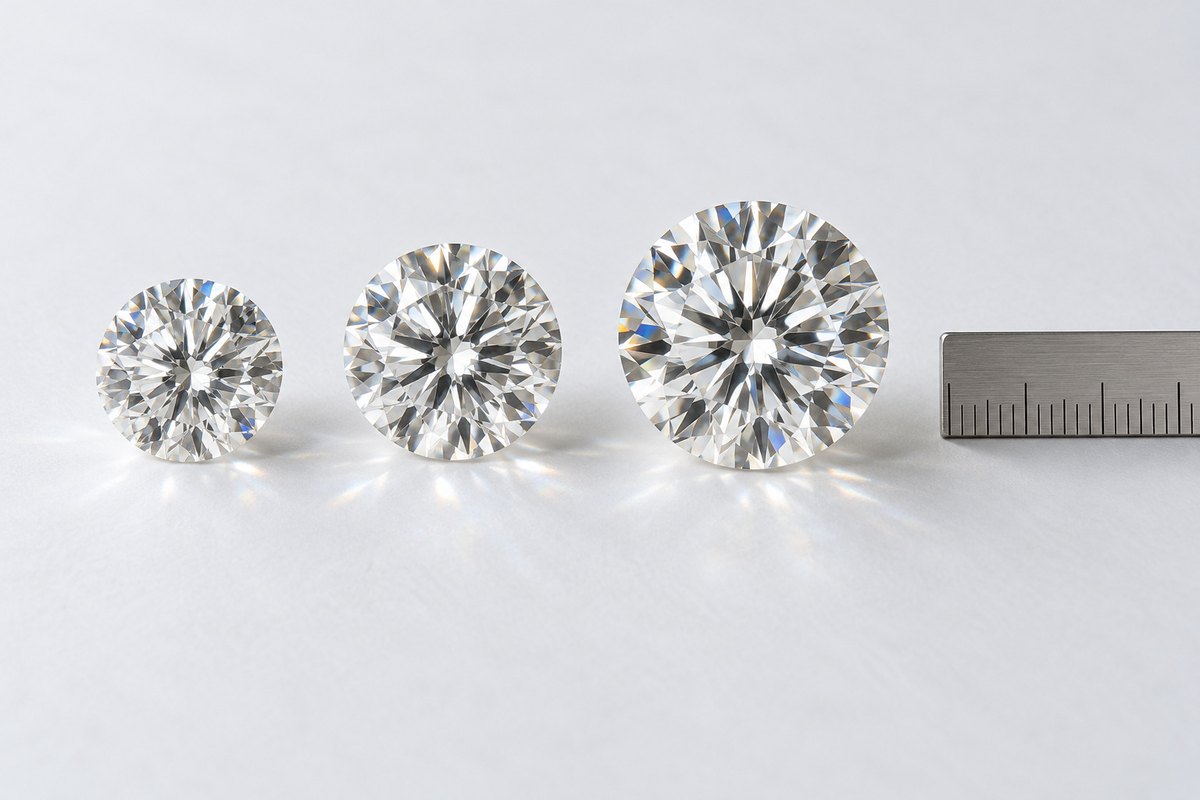
A well-cut 3 carat round diamond measures about 9.3 mm across. At the time of writing (October 2026), the median listed price of a loose 3 carat natural diamond on one large price-comparison marketplace was $26,875, against $2,655 for a lab-grown one, about ten times less. Natural prices per carat rise steeply as stones get bigger, while lab-grown prices per carat barely change with size. Prices change, and they vary by country and retailer.
This guide includes a few product links near the end. As an Amazon Associate, Diamond Taire earns from qualifying purchases, at no extra cost to you.
This guide puts 2, 3, 4 and 5 carat diamonds side by side: how big each looks in the main shapes, dated price samples for lab-grown and natural, why price per carat climbs, how your grade choices should shift as stones get bigger, and what living with a large stone involves, from settings to insurance. It ends with a checklist, common mistakes and quick answers.
- Size grows more slowly than weight: a 2 carat round is only about a quarter wider than a 1 carat, not twice as wide.
- Natural price per carat climbs with size, so one 3 carat stone can cost several times as much as three 1 carat stones.
- Lab-grown makes big sizes affordable, but resale value is very different.
- Bigger stones show colour and inclusions more, so grade choices shift as size goes up.
- Secure settings and insurance matter more at these sizes.
How big are 2, 3, 4 and 5 carat diamonds?
Carat is weight: GIA defines one carat as one-fifth of a gram. Because a diamond grows in three dimensions, its face-up width grows much more slowly than its weight. The table gives approximate dimensions for well-proportioned stones. Rounds are calculated with the standard trade weight-estimation formula for round brilliants at a typical 61 per cent depth; fancy shapes use published shape factors at common length-to-width ratios. Real stones vary, so always compare the measurements on the grading report.
| Carat | Round (mm) | Oval, about 1.4:1 (mm) | Emerald, about 1.4:1 (mm) | Pear, about 1.6:1 (mm) |
|---|---|---|---|---|
| 1 (reference) | 6.5 | 7.9 x 5.7 | 6.9 x 5.0 | 9.0 x 5.6 |
| 2 | 8.1 | 10.0 x 7.1 | 8.8 x 6.3 | 11.3 x 7.1 |
| 3 | 9.3 | 11.4 x 8.2 | 10.0 x 7.2 | 12.9 x 8.1 |
| 4 | 10.2 | 12.6 x 9.0 | 11.0 x 7.9 | 14.2 x 8.9 |
| 5 | 11.0 | 13.5 x 9.7 | 11.9 x 8.5 | 15.3 x 9.6 |
Cushion, princess and radiant cuts vary too much in depth and outline for a single figure, so compare their report measurements directly. On the hand, how large a stone looks also depends on finger width: the same 3 carat stone covers more of a slim finger than a broad one.
How much is a 2, 3, 4 or 5 carat diamond ring?
The table below uses listed prices for loose round diamonds sampled on 17 October 2026 from a diamond price-comparison marketplace that aggregates listings from many sellers, plus two large online retailers for lab-grown stones. Prices are in US dollars, before setting and tax. They are a snapshot at the time of writing (October 2026); prices change, often quickly for lab-grown stones.
| Carat | Lab-grown, value grades | Lab-grown, top grades | Natural, value grades | Natural, higher grades | Notes |
|---|---|---|---|---|---|
| 2 | About $685 to $710 (I to J, SI2 to VS1) | About $1,000 (G to H, VS) at marketplace sellers; $3,240 to $3,870 for D colour at a premium retailer | From $3,240 (K SI2, very good cut); mostly $7,200 to $9,800 (J to K, SI to VS) | G colour VS1 rounds started at $8,640, with a median of $17,340 | Median across all shapes: natural $12,406, lab-grown $1,574 |
| 3 | About $1,355 to $1,410 (J, VS1 to VS2) | About $2,055 (F VS2) at marketplace sellers; $6,300 to $6,800 for D to E colour fancy shapes at a premium retailer | From $7,575 (K SI2); mostly $16,000 to $27,000 (J to K, SI to VS) | About $23,000 to $27,000 for E to G colour, SI clarity | Median: natural $26,875, lab-grown $2,655 |
| 4 | About $2,000 (H SI1) to about $3,200 (E VS2) | Median listed lab-grown 4 carat: $3,668 | From $16,325 (K SI2); mostly $32,000 to $50,000 (J to K, SI to VS) | About $51,000 to $70,000 for E to H colour, SI to VS2 clarity | Natural grades above VS were scarce in the sample |
| 5 | About $2,460 (G SI1) to $4,555 (F VS1); a 5.07 carat E VVS2 cushion was $10,850 at a premium retailer | As left | From $25,270 (K SI2); mostly $38,000 to $64,000 (H to K, SI2) | About $75,000 to $98,000 for G to I, SI1; $166,000 to $174,000 for D to F, VS2 | Natural colourless VVS stones were not in the sample and cost more again |
2 carat
The most popular “big” size. A 2 carat lab-grown stone in good grades costs less than many 1 carat natural stones, while a 2 carat natural stone in near-colourless grades is a serious purchase. On the marketplace sampled, the cheapest natural 2 carat stone of any shape was listed at $2,495 and the median at $12,406.
3 carat
Large enough that grades start to show. In natural, the step from J or K colour to G or better adds thousands, and from SI to VS adds thousands more. In lab-grown, D to G colour and VS clarity remain affordable.
4 carat
Natural 4 carat stones in the sample began at about $16,000 for a K SI2 and rose past $65,000 for an F SI1. In lab-grown, the median listed price was under $4,000.
5 carat
Natural 5 carat stones are rare, and the sample ran from about $25,000 for a K SI2 to over $170,000 for a D VS2. Lab-grown 5 carat rounds in G or F colour were listed from about $2,500 to $4,600 at marketplace sellers.
Why price per carat climbs with size
GIA explains that larger diamonds are rarer, so their price per carat climbs faster than their weight: a 2 carat stone costs much more per carat than a 1 carat. Weights such as 1.50, 2.00 and 3.00 carats also behave as “magic sizes”, where stones at or just above the round number cost more per carat than slightly lighter ones.
Worked example, using marketplace medians from 16 to 17 October 2026:
- Median natural 1 carat: $2,390, or about $2,390 per carat.
- Median natural 2 carat: $12,406, or about $6,200 per carat.
- Median natural 3 carat: $26,875, or about $8,900 per carat.
Three median 1 carat stones would cost about $7,170 together; one median 3 carat stone cost about $26,875, nearly four times as much. Lab-grown behaves differently: the 2, 3 and 4 carat medians worked out at about $790, $890 and $920 per carat, almost flat. These medians mix shapes and grades, so use them to understand the pattern, not to price a particular stone. See why price per carat climbs for the wider picture.
What to prioritise as stones get bigger
GIA notes that large stones reveal colour and clarity more, and that emerald cuts, especially large ones, are more likely to show colour and clarity characteristics; their long, open facets make inclusions more readily visible. That changes how you should spend.
| Size | Cut | Colour | Clarity | Setting notes |
|---|---|---|---|---|
| 2 carat | Top grade for rounds; judge fancy shapes by video | Near-colourless (G to J) usually looks white in yellow or rose gold; H or better for white metal | VS2 or eye-clean SI1, checked on video | Four or six prongs; a bezel suits active hands |
| 3 carat | As above; avoid deep stones that face up small | Tint becomes easier to see; consider a grade higher than you would at 1 carat | VS2 or better in step cuts; eye-clean SI1 can work in brilliants | Six prongs or a bezel; consider a lower profile |
| 4 to 5 carats | Spread and outline matter more than ever | Higher colour matters most in white metal and step cuts | VS or better, especially for emerald and Asscher cuts | Sturdy prongs or bezel; regular checks; insurance before wear |
For more detail, see choosing a colour grade and clarity and inclusions.
Lab-grown vs natural at 2 to 5 carats
At these sizes the price gap is roughly tenfold or more. The Knot’s Real Weddings Study 2026 found lab-grown centre stones in 61 per cent of US engagement ring purchases and an average centre stone of about 1.9 carats. Both kinds are diamond and look the same; the differences are rarity, price and resale. A large lab-grown stone has very limited resale value, and a natural one resells at a discount to retail; neither should be treated as an investment.
Insist on an independent grading report that states the origin. Our lab-grown diamond buyer’s guide covers what to check, and CVD vs HPHT lab-grown diamonds explains the two growth methods. If you want the size without a diamond at all, read about moissanite if you want the size for less.
Best shapes for big stones
- Oval, pear and marquise spread their weight over a long outline and look large for their weight, but ovals and pears can show a dark bow-tie that becomes more obvious as stones get bigger; see the bow-tie effect in ovals.
- Round brilliants hide colour and small inclusions best and have the most predictable sparkle, at a higher price per carat.
- Emerald and Asscher cuts have a calm, mirror-like look but show inclusions and tint most clearly, so they need higher grades at large sizes.
Living with a big diamond: settings, wear and insurance
- Prongs: six prongs are a common choice for large centre stones, because the stone has more support if one prong is bent or worn. Thicker prongs last longer than very fine ones.
- Bezels: a full or partial metal rim protects the girdle from knocks and suits active wearers, at the cost of a little visible stone.
- Profile: a lower setting snags less on clothing and gloves; a high setting shows more of the stone but catches more.
- Checks: have a jeweller check prongs and settings regularly, and take the ring off for gym work, gardening and heavy lifting.
- Appraisal and insurance: arrange both before you wear the ring, and keep the grading report and photos together. See appraising and insuring a big stone.
What about 6 and 10 carat diamonds?
Above 5 carats, natural stones become rarer and pricing becomes more individual. In the October 2026 sample, a handful of natural rounds between 6 and 8.4 carats in mostly H to K colour and SI clarity were listed at roughly $74,000 to $168,000. Natural 10 carat stones are rare and priced individually. The same practical points apply with more force: report, secure setting, insurance, and a frank look at whether the size suits everyday life.
Checklist before you buy a 2 to 5 carat diamond
- Insist on an independent grading report from a recognised lab.
- Check that the laser inscription matches the report.
- Review a magnified 360-degree video, or view the stone in person, for eye-clean clarity.
- Pick a colour grade that suits the metal and the shape.
- Compare millimetre measurements, not just carat weight.
- Choose a secure setting: six prongs or a bezel for active wearers.
- Arrange an appraisal and insurance before wearing it.
- Read the return and upgrade policy.
- Decide lab-grown or natural knowing the resale facts.
Common mistakes
- Assuming size scales with weight: a 4 carat round is only about 1.6 times as wide as a 1 carat.
- Buying a poorly cut stone that faces up small for its weight.
- Choosing low clarity in a large emerald cut, where inclusions are easy to see.
- Using thin, four-prong settings on a 4 or 5 carat stone worn every day.
- Skipping insurance on a stone that would be expensive to replace.
- Buying a big lab-grown stone expecting resale value.
- Comparing per-stone prices without comparing grades, cut and report lab.
For a smaller stone, see our 1 carat diamond ring guide, and check that any stone is genuine with how to tell if a diamond is real.
Sources this guide draws on: GIA education on carat weight, price per carat, magic sizes, colour and clarity, and saving money on a diamond; the standard trade weight-estimation formulas for round and fancy-shape diamonds published for jewellery professionals; The Knot Real Weddings Study 2026 as reported by JCK (February 2026); and listed retail prices and medians for loose diamonds sampled on 16 and 17 October 2026 from a diamond price-comparison marketplace and two large online retailers.
Useful tools for this guide
Practical picks for choosing, checking and caring for jewellery. As an Amazon Associate, Diamond Taire earns from qualifying purchases, at no extra cost to you. Prices and availability are set by Amazon and may vary by country.
- Foldable 30x Jeweller’s Loupe
Pocket magnifier for checking stones, settings and hallmarks up close.
View on Amazon - CONNOISSEURS Premium Jewellery Cleaner
Gentle dip cleaner with a brush and tray for diamonds, gold and platinum. Check the label for stones it should not be used on.
View on Amazon - Ring Sizer Measuring Tool Kit (27 pieces)
Sizing rings plus a mandrel, to check a size at home before you buy or resize.
View on Amazon
FAQ
How much is a 3 carat diamond ring?
At the time of writing (October 2026), loose 3 carat lab-grown rounds were listed from about $1,355, with a marketplace median of $2,655. Natural 3 carat stones started at about $7,575 for a K SI2, with a median of $26,875. Add the setting, tax and insurance; prices change.
How much is a 2 carat diamond?
In October 2026 samples, 2 carat lab-grown rounds were listed from about $685, with a median of $1,574 across shapes. Natural 2 carat stones started at about $2,495 for any shape and had a median of $12,406. Grade and cut make a large difference to both.
How much is a 5 carat diamond ring?
Loose 5 carat lab-grown rounds were listed at about $2,460 to $4,600 at marketplace sellers in October 2026. Natural 5 carat rounds ran from about $25,000 for a K SI2 to over $170,000 for a D VS2, and more again for colourless VVS stones. The setting is extra.
How big is a 3 carat diamond on the hand?
A well-cut 3 carat round is about 9.3 mm wide, and a 3 carat oval roughly 11.4 x 8.2 mm. On an average finger it covers a large share of the width, and it looks bigger on slimmer fingers.
Are 3 carat lab-grown diamonds worth it?
If you want the size and look for a fraction of the natural price, many buyers think so: they are real diamonds and look identical. The trade-off is very limited resale value, so buy one to wear, not to sell.
Is a 4 or 5 carat diamond practical for everyday wear?
It can be, with the right setting. Choose sturdy prongs or a bezel and a lower profile, take the ring off for heavy work and sport, have the setting checked regularly, and insure it before you wear it.
Big stones reward careful choices. Compare grades rather than weights, protect the stone with a sound setting and insurance, and decide lab-grown or natural with your eyes open on resale.