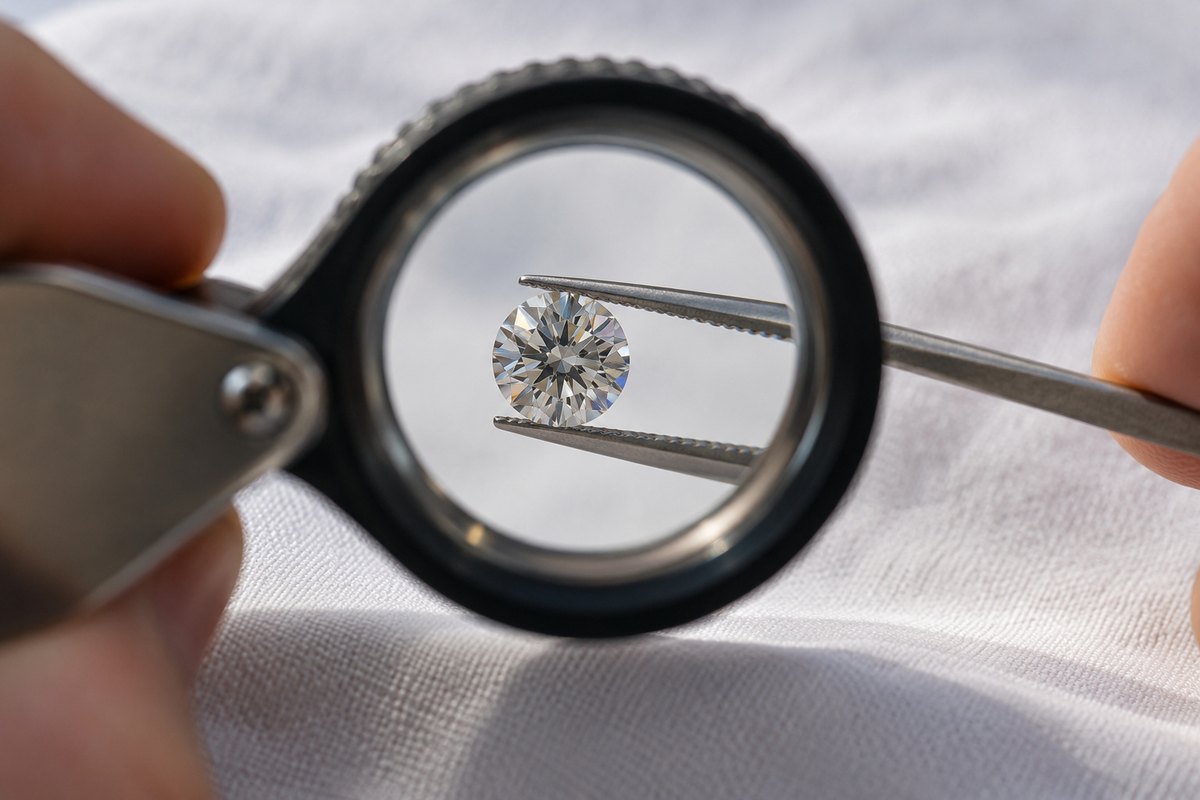
Home tests such as the fog test, the water test and the read-through test can rule out obvious fakes like glass, but none of them can prove a stone is a diamond, and moissanite passes several of them. A reliable answer comes from a jeweller’s multi-tester, checking a laser inscription against a matching grading report, or an examination by a qualified gemmologist or gem lab. Lab-grown diamonds are real diamonds and will pass every diamond test.
This guide includes a few product links near the end. As an Amazon Associate, Diamond Taire earns from qualifying purchases, at no extra cost to you.
This guide ranks each common check by how much it actually tells you, shows which simulants fool which tests, explains what diamond testers can and cannot do, and walks through how to verify a stone that came with a grading report. It finishes with a step-by-step plan for any stone you are unsure about, the mistakes that cause damage or false confidence, and answers to the questions people ask most.
- Home tests are screens, not proof. They can expose glass and poor imitations, but a pass means very little.
- Moissanite is the hard case. It conducts heat like diamond, so it passes heat-based testers and the fog test. A multi-tester, a loupe or a gemmologist tells them apart.
- Lab-grown is diamond. It has the same crystal structure as natural diamond. Telling lab-grown from natural needs laboratory equipment.
- A report only helps if it belongs to the stone. Match the laser inscription, weight and measurements, not just the paperwork.
- Never scratch, heat or bite a stone you value. These “tests” can chip or crack the stone and still prove nothing.
At a glance
- Home tests such as the fog, water and read-through tests can rule out obvious fakes, but none can prove a stone is a diamond.
- Moissanite is the hard case, because it passes the fog test and heat-only testers.
- A jeweller’s multi-tester, a laser inscription matched to a grading report, or a gemmologist gives a reliable answer.
- Lab-grown diamonds are real diamonds, and telling them from natural ones needs a gem lab.
- If a stone has a report, match the inscription, carat weight and measurements, not just the paperwork.
- Never scratch, heat or bite a stone you value, as it risks damage and proves nothing.
Real, natural, lab-grown or simulant? Get the words right first
Much of the confusion around this question comes from the word “real”. Before you test anything, it helps to know exactly what you are trying to find out.
- Diamond: crystallised carbon. Both natural and lab-grown diamonds are diamond.
- Natural diamond: a diamond formed in the earth and mined.
- Lab-grown diamond: a diamond made in a factory by the HPHT or CVD method. GIA explains that lab-grown diamonds have the same crystal structure as natural ones, so their properties are nearly identical and, by eye, they can be indistinguishable.
- Simulant (imitation): a different material that looks like diamond. GIA describes common simulants, including glass, moissanite and cubic zirconia, as completely unrelated to diamond at the atomic level.
The common simulants, in brief:
- Moissanite (silicon carbide): very hard, very fiery, and the simulant most likely to fool a quick test.
- Cubic zirconia (CZ): inexpensive and convincing when new, but softer, so its facet edges wear and round over with years of wear.
- White (colourless) sapphire: hard and durable, but with less brilliance and fire than diamond.
- Glass: the softest and least convincing; it chips and scratches easily.
The labelling rules reflect this. The US Federal Trade Commission’s Jewelry Guides (16 CFR Part 23) say a lab-made stone’s name must be preceded, with equal conspicuousness, by a qualifier such as “laboratory-grown”, “laboratory-created” or “[manufacturer name]-created”, or by “imitation” or “simulated” for a simulant, so that buyers are told the stone is not mined. Rules in other countries differ in detail, but the principle is similar: lab-grown is diamond and must be disclosed as lab-grown, and a simulant is not diamond.
So there are really two questions. “Is it diamond or a simulant?” can often be answered by a jeweller in minutes. “Is it natural or lab-grown?” usually needs a gem lab. For the full picture on origin, see lab-grown vs natural diamonds.
Home checks, ranked by how much they tell you
None of the checks below can confirm a diamond. Some can rule out obvious imitations. They are listed from most useful to least useful.
Loupe look: doubled facets, edges and the setting
A 10x jeweller’s loupe is the most informative tool most people can use at home. Look through the top of the stone at the back facets and their junctions.
- Doubled facet lines: moissanite is doubly refractive. GIA notes that this makes the back facets appear doubled, and the interior can look slightly blurry. Diamond is singly refractive, so its facet junctions look crisp and single. The doubling is easier to see from some angles than others, so tilt the stone slowly.
- Worn facet edges: diamond is the hardest gem material. Rounded, scuffed or chipped facet edges on an older piece suggest a softer stone such as CZ or glass.
- Inclusions: many natural diamonds show small crystals or feathers. A completely clean stone is not suspicious in itself, but tiny round gas bubbles point strongly to glass.
- The setting and metal stamps: stamps such as 750, 585 or PT950 tell you about the metal, not the stone. A fine stamped setting makes a diamond more likely, and a base-metal setting makes one less likely, but both are only clues.
Fog (breath) test
Breathe on the stone like a mirror. Diamond conducts heat extremely well, so a thin mist on a clean diamond clears almost at once. Glass and CZ tend to stay fogged for a few seconds longer. The catch is that moissanite also conducts heat very well, so it can clear just as quickly. A dirty or oily stone also gives a misleading result. Treat this as a screen for glass and CZ only.
Read-through and dot tests
Place a loose round stone upside down on printed text or on a small dot drawn on white paper. In a well-cut diamond, light is bent so strongly that you usually cannot read the print or see the dot clearly. Glass often lets you read straight through. The test only works with loose, well-cut round brilliants; fancy shapes, mounted stones and poorly cut diamonds give unreliable results, and moissanite also bends light strongly, so it can pass.
UV light (fluorescence)
Under a long-wave UV torch, some diamonds glow. According to GIA, 25 to 35 per cent of the diamonds submitted to it show some fluorescence, and in more than 95 per cent of those the colour is blue. That means most diamonds do not glow at all, and some simulants do. A blue glow across several stones in a vintage piece can be an interesting clue, but no glow, or glow, proves nothing on its own.
Water (sink) test
The popular advice is that a diamond sinks and a fake floats. In practice, virtually every gem material, including glass, CZ and moissanite, is denser than water and sinks too. This test tells you almost nothing and is not worth doing.
Tests to avoid: scratch, heat and cold, and the bite test
Do not try to scratch glass or a mirror with the stone, heat it and drop it into cold water, or bite it. Diamond is very hard but it is not tough: a sharp knock in the wrong direction can chip it, and sudden temperature changes can damage stones with inclusions or crack other gems. These tests are also meaningless, because moissanite, sapphire and CZ are all much harder than glass and will scratch it too.
Home and professional checks compared
| Check | What it shows | Fooled by moissanite? | Fooled by CZ or glass? | Risk to stone | Reliability |
|---|---|---|---|---|---|
| Fog test | How fast the stone sheds heat | Yes | Sometimes, especially if the stone is dirty | None | Low |
| Read-through or dot test | How strongly the stone bends light | Yes | Sometimes (well-cut CZ can pass) | None | Low |
| Water test | Whether it is denser than water | Yes | Yes | None | Very low |
| Loupe (doubling, edges, bubbles) | Double refraction, wear, glass bubbles | Usually not, if you know what to look for | Often not (worn edges, bubbles) | None | Medium |
| UV light | Fluorescence | Inconclusive | Inconclusive | None | Low |
| Thermal (heat) tester | Thermal conductivity | Yes | No | None if used correctly | Medium for CZ and glass; none for moissanite |
| Multi-tester (heat plus electrical) | Thermal and electrical conductivity | Usually not | No | None if used correctly | Medium to high; unexpected results need a gemmologist |
| Inscription matched to report | Whether the stone matches a lab’s record | Possible if the inscription is forged | Possible if forged | None | High only when weight and measurements also match |
| Gemmologist or gem lab | Identity and, with lab equipment, origin | No | No | None | High |
And here is how the materials themselves differ. Hardness figures are on the Mohs scale, from GIA and gemmological references.
| Material | Mohs hardness | Single or double refraction | Passes a thermal tester? | Typical look |
|---|---|---|---|---|
| Natural diamond | 10 | Single | Yes | Bright white sparkle with balanced flashes of colour |
| Lab-grown diamond | 10 | Single | Yes | Same as natural diamond |
| Moissanite | About 9.25 | Double | Yes | Very strong rainbow fire, especially in larger stones |
| Cubic zirconia | About 8.5 | Single | No | Convincing when new; edges wear over time |
| White sapphire | 9 | Double (weak) | No | Less sparkle and fire than diamond |
| Glass | Much softer | Single | No | Dull with wear; may show bubbles |
Diamond testers: thermal vs multi-tester
Handheld diamond testers are the next step up from home checks, and many jewellers have one on the counter.
Thermal testers measure how quickly heat moves through the stone. Diamond conducts heat far better than glass, CZ or sapphire, so a thermal tester is good at catching those. GIA’s 1997 Gems & Gemology study of moissanite found that its thermal properties are close enough to diamond’s that thermal probes read it as diamond. A heat-only tester therefore cannot separate moissanite from diamond.
Multi-testers add an electrical conductivity reading. Moissanite conducts electricity and most diamonds do not, which is how these tools flag moissanite. They are much more useful, but no handheld tester is infallible: readings depend on a clean stone, a charged battery, correct contact and the right setting for the stone’s size. Tester makers themselves caution that their devices can be fooled under some conditions. If a tester gives a surprising result in either direction, take the stone to a gemmologist rather than trusting the beep.
Testers also cannot tell lab-grown from natural, because both are diamond. If you are weighing moissanite as a deliberate choice rather than a mystery, see how moissanite compares to diamond in everyday wear.
If your diamond came with a grading report
An independent grading report is valuable, but only if you confirm that it describes the stone in front of you. GIA’s buying guidance recommends checking whether the report number is laser-inscribed on the girdle (the thin outer edge of the stone), which is visible with a 10x loupe.
- Find the inscription. Look around the girdle with a loupe, or ask a jeweller to show you under a microscope.
- Look the number up. GIA’s Report Check is its secure online database of report details. If your report is from another lab, use that lab’s own website to verify it.
- Match the details, not just the number. Compare the carat weight, measurements in millimetres, shape, and colour and clarity grades with what you see.
- Have the identity confirmed. GIA advises having an independent appraiser confirm that a diamond matches its paperwork once you have it.
That last step matters. GIA’s Gems & Gemology lab notes describe a moissanite submitted to GIA in Johannesburg that carried a fraudulent GIA inscription copying the number of a real natural diamond report. Standard tests showed it was not diamond, it showed obvious double refraction under the microscope, and its specific gravity and measurements did not match the genuine diamond’s record. An inscription is evidence, not proof.
Be wary of “certificates” issued by the seller rather than an independent laboratory. To understand what a genuine report contains, read how to read a diamond grading report.
Can you tell lab-grown from natural?
Not at home, and not with a handheld tester. GIA explains that it separates lab-grown from natural diamonds by their different growth histories, using atomic-level defects and spectroscopy, and that while a gemmologist can sometimes identify a lab-grown stone with standard equipment, other cases require advanced scientific instruments. GIA also laser-inscribes the girdles of lab-grown diamonds it grades with the report number and a statement that the stone is laboratory-grown.
For a stone with no paperwork, a gem lab report is the only reliable route. If you are buying, decide whether you want lab-grown or natural before you shop; our guide to buying lab-grown diamonds covers the choice, and how CVD and HPHT diamonds are made explains the two growth methods.
Step by step: what to do with a stone you are unsure about
- Clean it gently with warm water, a drop of washing-up liquid and a soft brush, then dry it. Dirt ruins every test.
- Look at the setting for metal stamps and build quality. Note them as clues, not proof.
- Do a fog test and a loupe check. Look for doubled back facets, worn edges and bubbles.
- Check any paperwork. If there is a grading report, find the inscription and look the number up on the issuing lab’s website. Compare weight and measurements.
- Ask a jeweller to test it with a multi-tester. Ask what the service costs first, as practices vary.
- For a valuable, inherited or disputed stone, get a gemmologist’s assessment or a lab report before you insure, sell or reset it.
- Keep the results with your appraisal and insurance papers.
If the stone is part of an older piece, the style and cut can also help date it; see judging vintage and inherited pieces.
Common mistakes
- Treating one passed home test as proof. Moissanite passes the fog, read-through, water and thermal tests.
- Calling lab-grown “fake”. It is diamond. The question is origin, which needs a lab.
- Trusting a heat-only pen tester against moissanite. It cannot tell them apart.
- Doing the scratch or heat test on an heirloom. It risks real damage and proves nothing.
- Assuming any certificate is an independent lab report. Seller-issued documents are not the same thing.
- Not checking that the report belongs to the stone. Match the inscription, carat weight and measurements.
- Ignoring the setting. Many old pieces mix diamonds with simulant side stones, or replacement stones added later, so test the centre stone and the accents separately.
If you are buying rather than checking, most of these risks disappear with an independent report and a good return policy; see buying a diamond online safely.
Sources this guide draws on: GIA (Gemological Institute of America) education pages on simulants, moissanite and lab-grown diamonds and on diamond fluorescence; GIA’s Gems & Gemology article “Synthetic Moissanite: A New Diamond Substitute” (Winter 1997) and its Fall 2020 lab note on a moissanite with a fraudulent GIA inscription; GIA’s guidance on buying diamonds online and Report Check; GIA’s overview of identifying lab-grown diamonds; and the US Federal Trade Commission’s Guides for the Jewelry, Precious Metals, and Pewter Industries (16 CFR Part 23).
Useful tools for this guide
Practical picks for choosing, checking and caring for jewellery. As an Amazon Associate, Diamond Taire earns from qualifying purchases, at no extra cost to you. Prices and availability are set by Amazon and may vary by country.
- Foldable 30x Jeweller’s Loupe
Pocket magnifier for checking stones, settings and hallmarks up close.
View on Amazon - CONNOISSEURS Premium Jewellery Cleaner
Gentle dip cleaner with a brush and tray for diamonds, gold and platinum. Check the label for stones it should not be used on.
View on Amazon - Ring Sizer Measuring Tool Kit (27 pieces)
Sizing rings plus a mandrel, to check a size at home before you buy or resize.
View on Amazon
FAQ
Does the fog test prove a diamond is real?
No. A real diamond sheds a breath of fog almost instantly, but moissanite does too, because it also conducts heat very well. The fog test can flag glass or CZ that stays misty, but a quick clear is not proof of a diamond.
Can a diamond tester detect moissanite?
A thermal-only tester cannot, because moissanite’s heat conductivity is close enough to diamond’s to read as diamond. A multi-tester that also measures electrical conductivity usually flags moissanite. Any surprising reading should be checked by a gemmologist.
Is a lab-grown diamond a real diamond?
Yes. Lab-grown diamonds have the same crystal structure and nearly identical properties to natural diamonds, and they pass diamond tests. They must be sold with a clear qualifier such as “laboratory-grown”, and only a gem lab can reliably confirm origin.
How can I tell if diamond earrings are real?
Use the same approach: check the metal stamps on the posts and backs, look at each stone with a loupe for doubled facets or worn edges, and ask a jeweller to test both stones, since a pair is not always matched in material. Small stones are harder to test at home, so a professional check is the sensible step.
Will a real diamond scratch glass, and should I try it?
A diamond will scratch glass, but so will moissanite, sapphire and CZ, so the test tells you nothing useful. It also risks chipping the stone. Do not try it on anything you value.
Where can I get a diamond tested?
Most jewellers can do a quick multi-tester check, so ask in store what they charge. For identity and origin you can trust, an independent appraiser who is a qualified gemmologist, or a gem laboratory report, is the reliable route, and it is worth arranging before you insure or sell. See getting jewellery appraised and insured.
Use home checks to rule out obvious fakes, never to confirm a diamond. For anything you plan to insure, sell or treasure, a professional test is quick, and it settles the question properly.