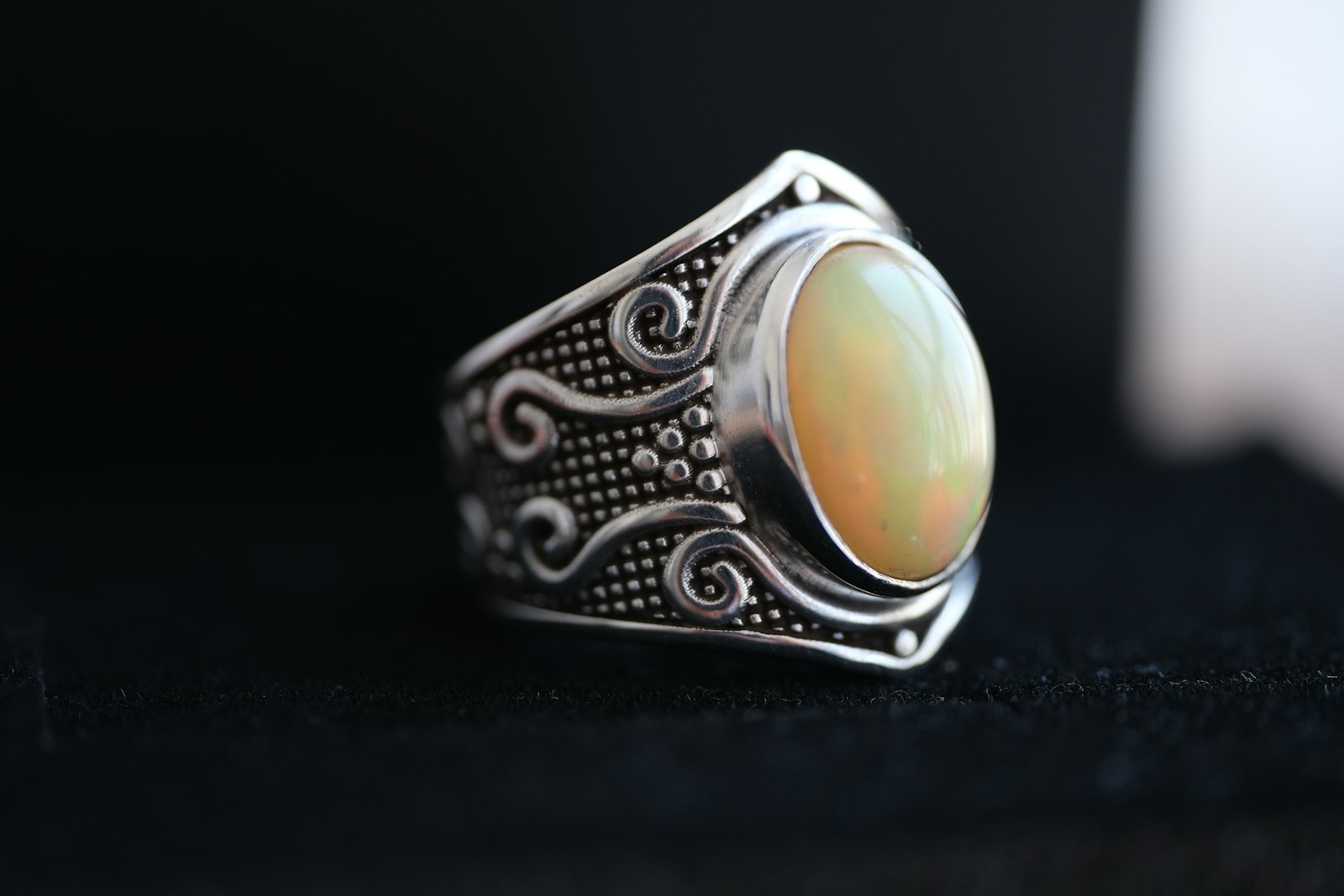
Vintage and antique diamond jewellery carries romantic history, unique design, and often exceptional value. These pieces were made one at a time, by hand, for a world with different tools and different taste, and they ask more of the buyer than new jewellery does: a period piece is a second-hand object with a working life behind it.
Antique, vintage and vintage-style: the words matter
Antique means jewellery over 100 years old, on a rolling basis, so the boundary moves each year. Vintage is generally used for pieces 20 to 100 years old. Estate means only that a piece has had a previous owner; an estate ring can be five years old.
The category that causes most confusion is vintage-style — “Art Deco style”, “Edwardian-inspired”, “in the manner of”. These are newly made pieces borrowing period design language. A good reproduction avoids most of the condition worries below, but it is a different product at a different price. Ask for the attribution in writing: period, approximate date, origin if known, and whether the piece is original throughout.
The periods, and how to tell them apart
Georgian (1714–1830)
The rarest category you are likely to meet, and entirely hand-wrought: drawn wire, hand-cut collets, visible file and solder marks. Diamonds are almost always rose cuts or early cushion-shaped old mine cuts in closed-back mounts, where metal seals the stone in from behind, often over tinted foil meant to lift the colour under candlelight. Silver was used at the settings because white metal flattered white diamonds, backed with gold so it did not tarnish skin and clothing. Closed backs are a dating clue and a care problem: water trapped behind a foiled stone ruins it.
Victorian (1837–1901)
Sixty-four years is not one style. Early Victorian work is romantic and naturalistic: serpents, hearts, hands, seed pearls, coloured gold. The middle decades bring mourning jewellery, jet, onyx and heavier gold. Late Victorian turns lighter, with stars, crescents, insects and swallows, and far more diamonds after the South African discoveries of the late 1860s. Old mine cuts dominate, often in silver-topped gold, and open backs become normal as stones stopped needing foil.
Art Nouveau (c. 1890–1910)
Overlapping the late Victorian and Edwardian years and standing apart from both. Whiplash curves, dragonflies, irises and female figures; gold and enamel, especially plique-à-jour, which sits in the metalwork like stained glass; and materials chosen for effect rather than cost, such as horn, opal and moonstone. Diamonds appear as accents, rarely as the subject.
Edwardian (1901–1920)
The technical leap here is platinum. Once torches ran hot enough to work it reliably, jewellers could make settings far finer and stronger than gold allowed: knife-edge wire, lace-like openwork, garland swags and bows, and the beaded edging called milgrain. The metal was meant to disappear so diamonds and pearls appeared to float. Old European cuts predominate. Delicate is the point and also the weakness — Edwardian openwork is the most fragile thing in the vintage market.
Art Deco (1920s–1930s)
Geometry, symmetry and hard contrast. Platinum again, with white gold spreading in the 1930s. This is the era of calibré-cut coloured stones fitted edge to edge like tiling, of onyx, coral, jade and rock crystal, and of cuts that suit straight lines — baguette, emerald, French cut and the Asscher. Old European and transitional cuts carry the centres. Deco is by far the most reproduced period, so it is where you should be most careful about the word “style”.
Retro (1940s–1950s)
Wartime restrictions pushed platinum into industrial use, so Retro jewellery is gold — rose and yellow, often both in one piece — and it is bold. Scrolls, ribbons, buckles, gas-pipe and snake links, cocktail rings built to read across a room. Diamonds are accents against volumes of gold, often alongside synthetic rubies and sapphires, which were used openly and are not a sign of a fake.
Mid-century (1950s–1960s)
Platinum and white gold return and the mood turns delicate again: starbursts, sprays, textured gold, clusters of melee around a centre stone. Marquise and pear brilliants come into their own, and illusion settings — a bright metal plate polished to make a small stone read larger — are common and a reliable dating cue.
The cuts, and why old diamonds look different
Antique diamonds were cut by eye and by hand, to be seen by candle and lamplight rather than under a spotlight. They throw broader, slower flashes and more coloured fire, where a modern brilliant returns finer, whiter, more uniform sparkle. Neither is better; they aim at different effects.
| Cut | Roughly when | What to look for |
|---|---|---|
| Rose cut | 16th century through the Georgian era | Flat back, no pavilion, a dome of triangular facets. Glows rather than sparkles; often set over foil. |
| Old mine cut | Georgian through Victorian | Squarish cushion outline, rounded corners, small table, high crown, deep pavilion, and an open culet that reads as a small hole at the centre. |
| Old European cut | Late Victorian through Art Deco | Round outline, still with small table, high crown, short lower halves and an open culet. Roundness reflects mechanical bruting. |
| Transitional cut | 1920s–1940s | The bridge: rounder, larger table, culet closing up. Neither antique nor modern. |
| Modern round brilliant | 20th century onward | Larger table, shallower crown, longer lower halves, culet closed to a point. Bright and even. |
An old cut in a period mount is evidence the piece is what it claims; a modern brilliant in a Victorian mount usually means a replacement. Antique stones were also never cut to modern proportion targets, so modern cut-grade language does not transfer meaningfully to them.
Hand fabrication versus casting
Most period jewellery was fabricated: built from sheet, wire and individually formed parts, then soldered. Most modern jewellery is cast from a mould. Under a loupe the difference is clear.
- Hand fabrication: visible solder seams, faint file marks, slight asymmetry between elements that ought to match, crisp engraving with sharp shoulders, milgrain applied with a knurling wheel so the beads vary a little.
- Casting: seamless joins where separate parts should meet, occasional porosity pits, a ground-off sprue mark, repeated motifs that are identical rather than merely similar, and engraving or milgrain that looks soft because it was moulded rather than cut.
Wear tells you as much as construction. Age marks the places a hand or a cuff rubs: the underside of a shank, the high points of engraving, prong tips. A “Georgian” ring with uniformly crisp detail deserves scepticism.
Reading condition
Assume a hundred-year-old ring has had a hundred years of life:
- Prongs. Thinned, flattened or splayed tips, or a bright blob of newer metal where one has been re-tipped. Re-tipping is maintenance, not a fault, but it should be disclosed.
- The shank. Thin at the bottom, or out of round. Run a fingernail inside for a step or colour change marking a replaced half-shank.
- Replaced stones. A centre sitting oddly high or low in its seat, or melee that flashes differently from its neighbours; modern single cuts among old ones are easy to spot once you look.
- Losses and repairs. Empty seats, missing seed pearls, chipped girdles, pale solder seams marking past work.
- Detail loss. Cracked milgrain, softened engraving, over-polishing that has rounded everything into blandness.
- Fittings and alterations. Worn hinges and pins, an original C-catch versus a later safety catch, a replaced clasp; brooches converted to pendants, screw-backs to posts, rings built from a broken larger piece. All common, all relevant to value.
What hallmarks can and cannot tell you
British and French pieces are the most informative. A full British hallmark carries a sponsor’s mark, a fineness mark, an assay office town mark and a date letter — a genuine year. French marks such as the eagle’s head for 18ct gold and the dog’s head for platinum identify metal and broad era. Elsewhere expect less: American jewellery was never subject to compulsory assay, so you may have only a karat stamp and a maker’s mark. Many genuine pieces carry no marks at all.
The limits matter more than the marks. A hallmark dates the metal it is struck on, which may be a later shank on an older head, and says nothing about the stones. Marks can be transferred and faked. Treat one as evidence to weigh against construction, cut and wear, never as proof on its own.
Questions to ask the seller
- What period do you attribute this to, and why?
- Is it original throughout, or has anything been replaced — centre stone, melee, shank, clasp, pin?
- Have the prongs been re-tipped, or the piece resized, refinished or converted?
- Are the diamonds period cuts, and is the centre stone removable for independent inspection?
- What is your return period, and may I have it independently appraised within it?
- Will the invoice say “antique” or “vintage” rather than “style”?
Why period pieces cannot always be resized or repaired
Worth knowing before you fall for something two sizes off. A plain modern band can be cut and re-joined almost invisibly; a hand-engraved or milgrained shank cannot, because sizing interrupts the pattern and matching hand engraving is not always possible. Full eternity bands and pierced galleries that carry the design all the way round cannot be sized without destroying what you bought. Heat is the other constraint: closed-back foiled settings, old enamel and natural pearls cannot go near a torch, so work must be done cold or by laser.
The answer is often not to alter the ring at all — sizing beads, a fitted insert or a hinged shank — and to use a jeweller who works on period pieces regularly. Many good workshops decline such jobs, which is a sign of competence rather than a reason to press them.
Appraisal and insurance work differently
A new ring is insured on replacement cost: the insurer can buy the same ring again. Nothing replaces a 1915 platinum openwork ring except another one, and there is no catalogue to order it from. Make sure the appraisal is written on the right basis — replacement with a comparable piece of the same period and quality — by someone who values in the antique market rather than pricing stones and metal as new, and check your policy will settle in kind or in cash rather than insisting on a modern substitute.
Where to buy, and what a good seller does
Established antique dealers, the major auction houses and specialist vintage jewellers are the sensible starting points, because all three stake a reputation on their descriptions. What separates a good source is paperwork and candour: a written attribution, disclosed repairs, a stated return period, and a willingness to let the piece be examined by someone who does not work for them. Be wary of listings where “Art Deco” does the job a date and a description should do. The piece with three honest paragraphs about its replaced clasp is usually the better buy.