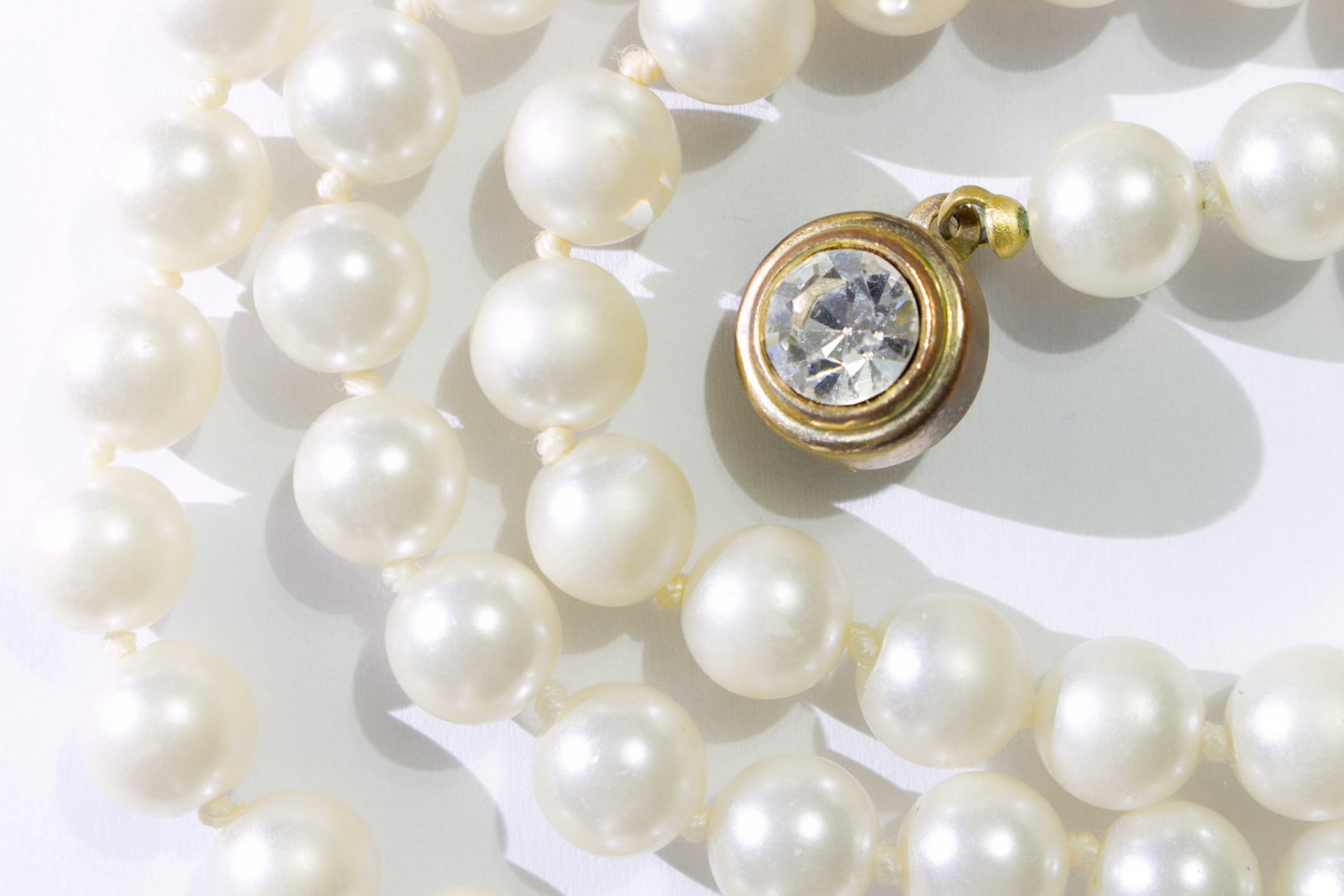
Pearls and diamonds share an elegant history together. It is a combination that keeps coming back — Victorian and Edwardian jewellers used it constantly, mid-century designers built whole collections on it, and it is on the workbench again now.
It is also, technically, an awkward pairing. One of these materials is the hardest natural substance there is; the other is a soft organic layer grown by a living animal. Understanding that mismatch is what separates a piece you will still be wearing in twenty years from one that quietly wears itself out. This guide covers the pearl side of the equation, because that is the side that sets the rules.
The four pearls you will actually meet
Almost all pearls in fine jewellery come from four groups, and the differences between them are not decorative — they determine size, colour, cost and how a piece can be designed.
Akoya
Saltwater pearls, farmed principally in Japan and China, and the classic white pearl of a strand or a stud. They are bead-nucleated, which means a round shell bead is inserted and coated with nacre, so they tend to be very round and very bright — Akoya lustre is sharp and mirror-like. The trade-off is a relatively thin nacre layer over that bead, so nacre quality is the thing to check. Sizes are modest compared with the South Sea pearls, and colours run white and cream with rose, silver or green overtones.
Freshwater
Grown in mussels, overwhelmingly in China, and the most varied group by a long way. Many are tissue-nucleated rather than bead-nucleated, so the pearl is nacre almost all the way through — durable, and forgiving if the surface is ever lightly polished. Historically they were less round and softer in lustre than Akoya; bead-nucleated freshwater production has narrowed that gap considerably. Colours are the widest available naturally: white, cream, peach, lavender, pink. This is the group where you will find interesting baroque shapes, and where budget goes furthest.
South Sea
The largest pearls in commercial production, farmed in Australia, Indonesia and the Philippines from a large oyster that takes longer to produce a pearl and yields fewer of them. Silver-lipped oysters give white and silver pearls, gold-lipped give the golden ones. The nacre is thick, and the lustre is characteristically satiny and deep rather than glassy. They are the most costly group, and their size means they need diamond work scaled to match or they will simply overwhelm it.
Tahitian
Grown in French Polynesia in the black-lipped oyster, and naturally dark — not dyed, which is worth saying because dyed dark pearls exist. Colours range through grey, aubergine, blue and the green-toned “peacock” that commands the most attention. Against white diamonds and white metal, the contrast is the whole point of the design.
Cultured, natural and imitation
Natural pearls form without human involvement and are genuinely rare; the great historic pearl jewellery was made from them, which is one reason antique pearl pieces are valued the way they are. Effectively everything sold today is cultured: a farmer implants a bead or a small piece of mantle tissue and the mollusc deposits nacre around it over months or years in the water. Cultured pearls are real pearls — the nacre is the same material, laid down the same way.
What is not a pearl is an imitation: a glass or plastic bead with a pearlised coating. These are legitimate costume materials but should never be sold ambiguously. The traditional check is to rub a pearl lightly against a tooth edge, where real nacre feels faintly gritty and a coated bead feels slick, though the reliable answer is a jeweller with a loupe looking at the drill hole.
Distinguishing natural from cultured is a laboratory job, done by X-ray imaging of the pearl’s internal growth structure. If a seller describes pearls as natural, ask for the report.
How pearls are judged, and why lustre wins
- Lustre. How sharply the pearl reflects light. On a good pearl you can see a defined reflection of a window or a light source, and the edge between light and shadow on the surface is crisp. On a poor one it is milky and diffuse. Lustre is the single factor you cannot fix, disguise or grow accustomed to, and a modest pearl with excellent lustre outclasses a large dull one every time.
- Nacre thickness. Mostly a bead-nucleated concern. Thin nacre looks dull, and can “blink” — a faint flicker as the bead’s banding shows through when the pearl is rotated. Thin nacre also wears through with time.
- Surface. Spots, pits, wrinkles and bumps. Almost every pearl has something; what matters is whether it is visible at arm’s length and whether it sits where a setting or a drill hole will hide it.
- Shape. Round is rarest and priciest, then near-round, then symmetrical drops and buttons, then baroque. Baroque is a design choice, not a defect — an interesting drop with real lustre makes a better pendant than a mediocre round.
- Colour. Body colour plus overtone (the translucent wash of rose, silver or green over it). Overtone is what makes a white pearl look alive rather than flat.
- Matching. Only relevant for multi-pearl pieces, and quietly expensive: assembling a strand of pearls that agree on size, colour, overtone and lustre takes a great deal of sorting.
Look at pearls in more than one light. Jewellery cases are lit to flatter, and lustre that survives an ordinary window is lustre you can trust.
The hardness problem
Diamond sits at 10 on the Mohs scale of scratch hardness. Pearl sits somewhere around 2.5 to 4.5, depending on the pearl and who is measuring. The Mohs scale is a ranking rather than a measurement, and the real gap between those numbers is enormous: a diamond will scratch a pearl instantly and without any force worth mentioning.
Hardness is only half of it. Nacre is aragonite platelets bound together by conchiolin, an organic protein. That means a pearl is not merely soft but also chemically vulnerable in a way no mineral gemstone is. It reacts to acids, dries out, and can craze if it loses moisture.
So the pairing has to be engineered, not just styled:
- Diamonds should sit below or beside the pearl’s widest point, not where they will rub against it. A halo that touches the pearl is a slow disaster.
- Pearls are rarely prong-set. Most are half-drilled and seated on a post with adhesive, or held in a cup or bezel that supports the base. Ask which, because it determines how the piece can be cleaned and repaired later.
- Rings and bracelets take the most knocks. Earrings, pendants and brooches are far kinder homes for a pearl, which is exactly why the classic pieces are the shapes they are.
- Watch what a pearl ring sits next to. A pavé band worn against a pearl ring on the same finger will abrade it, and so will a diamond tennis bracelet against a pearl bracelet.
- Pearl engagement rings are entirely possible, but treat them as occasion rings rather than something worn through washing up, gym sessions and gardening.
Care that is genuinely different
Almost everything that is good for a diamond is bad for a pearl. The rules are short and worth following exactly.
- Never an ultrasonic cleaner. The vibration attacks the nacre and will loosen the adhesive holding a half-drilled pearl on its post.
- Never steam, and no hot water. Heat dries out the conchiolin and can craze the surface.
- No chemicals. Ammonia, bleach, jewellery dips and alcohol-based cleaners all damage nacre. So do household acids — vinegar, lemon juice — and so, slowly, does perspiration.
- Last on, first off. Perfume, hairspray, sunscreen, hand sanitiser and cosmetics go on first and pearls go on last. Take them off before they come off.
- Wipe after wearing. A soft cloth, very slightly damp, then dry. That single habit does more for a pearl’s life than anything else.
- Restring knotted strands. Silk stretches, absorbs body oils and discolours. Knots between pearls stop them rubbing and stop the whole strand escaping if the thread breaks. The usual trade guidance is roughly every year or two with regular wear, and sooner if you can see thread between the pearls or the strand has gone limp.
- Store separately, and not sealed up. A soft pouch or a lined compartment away from diamonds and hard metal. Do not shut pearls in an airtight box or leave them for years in a safe deposit box — nacre needs the ambient humidity of a room, and pearls that never come out dry out. Lay strands flat rather than hanging them, so the silk does not stretch.
Pearls also benefit from being worn. Occasional contact with skin keeps them from drying, provided you are wiping them afterwards.
Classic pairings, and how to wear them now
The traditional combinations survive because they solve real problems. A strand with a diamond-set clasp gives you a piece with a front and a back; wearing the clasp to one side turns a formal necklace into something you can put on with a shirt. Pearl studs with removable diamond jackets do the same trick in reverse — plain by day, brighter at night. Drop earrings suspend the pearl below the diamond work, which is the technically correct arrangement as well as the flattering one, because the pearl swings clear.
Station necklaces, where pearls are spaced along a chain with diamond accents between, wear far more easily than a full strand and suit a neckline that a choker fights. A pearl centre with a diamond surround makes an unusual ring, provided the surround is set to stand slightly proud so it, and not the pearl, takes the knocks. Brooches are the most underused option: a Retro or mid-century pearl-and-diamond clip reads as deliberate on a coat lapel or a jacket pocket.
On metal, follow the pearl’s overtone rather than a rule. Golden South Sea pearls and warm creams want yellow or rose gold; silvery Akoya, white South Sea and most Tahitians look sharper against platinum or white gold. Scale matters as much as colour — small diamonds around a large South Sea pearl look like an afterthought, and a heavy diamond mount around a small Akoya looks like the pearl fell in by accident.
The modern move is to wear all of it more casually than the pieces were designed for: baroque drops with everyday clothes, a single strand with tailoring instead of eveningwear, mismatched pearl earrings, a pearl ring stacked with a plain band rather than a diamond one. Just keep the plain band on the side that does the rubbing.