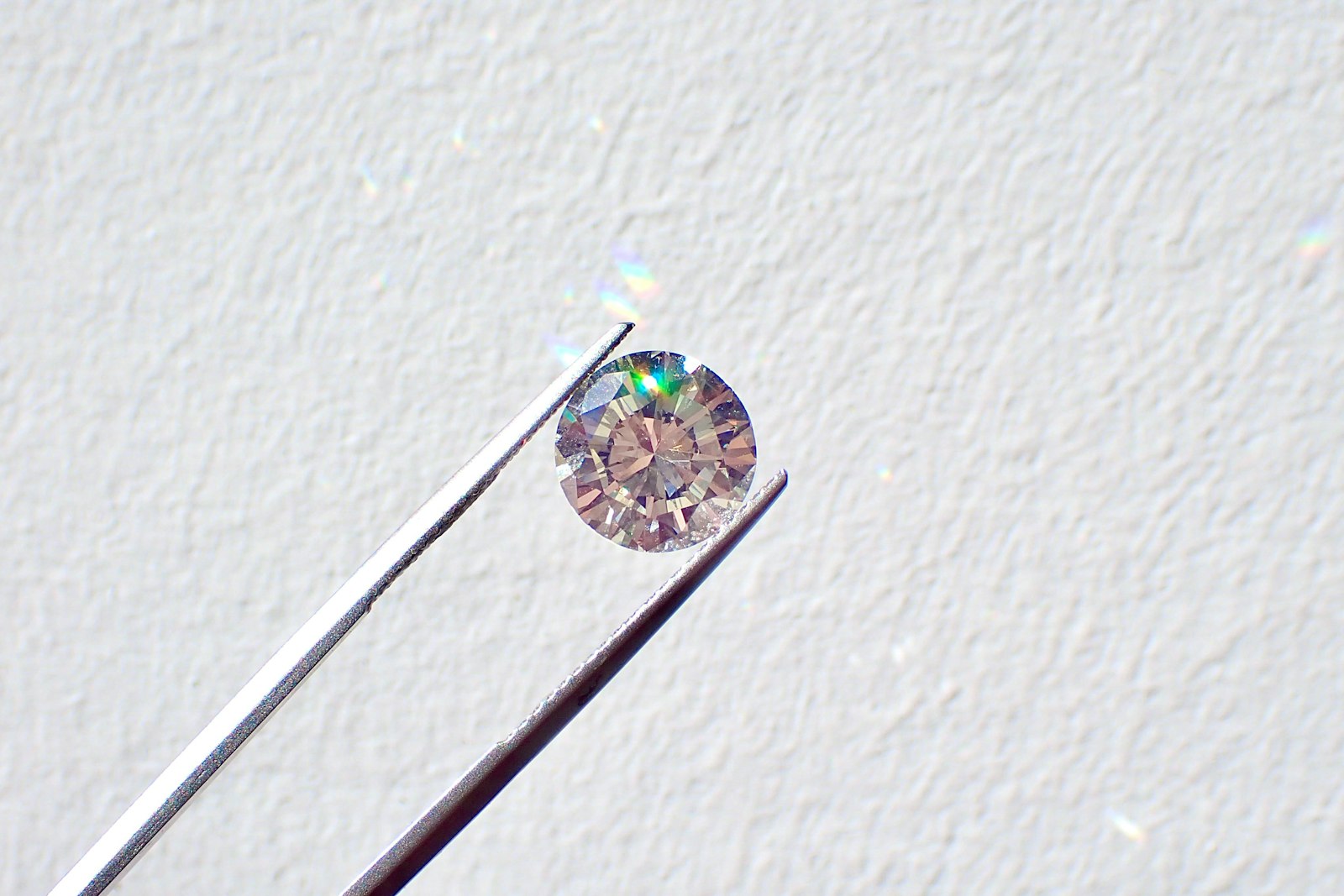
The diamond industry is evolving, and quickly. Laboratory-grown diamonds now represent a significant portion of the market, and a shopper walking into a jeweller today will be shown both options side by side, often in the same tray, often at prices that look startlingly different. Understanding what actually separates the two — and what does not — helps you choose the right diamond for your needs rather than the one you were steered towards. What follows does not tell you which to buy. It sets out what is known, what is contested, and what to ask before you hand over money.
What Are Lab-Grown Diamonds?
Lab-grown diamonds are chemically, physically and optically identical to natural diamonds. They are carbon atoms arranged in the same cubic crystal lattice, with the same refractive index, the same dispersion, the same hardness. Under a loupe, a lab-grown stone does not look “fake”. It is diamond. The difference is where it formed: in a controlled chamber over a matter of weeks, rather than deep in the Earth over geological time.
This is worth being precise about, because shop-window terminology is not always careful. A laboratory-grown diamond is not a simulant. Cubic zirconia and moissanite are simulants: different materials that resemble diamond to the eye but are chemically something else. Moissanite in particular gets conflated with lab-grown diamond constantly, and it should not be — it is silicon carbide, with different optical behaviour, and weighing it up is a separate comparison to the one on this page.
How Laboratory Diamonds Are Actually Made
There are two production methods in commercial use, and they leave different fingerprints.
HPHT: High Pressure, High Temperature
HPHT mimics the conditions under which diamonds form naturally. A tiny diamond seed goes into a press with a carbon source, usually graphite, and a molten metal flux — typically iron, nickel or cobalt — which lowers the temperature and pressure the reaction needs. The Gemological Institute of America puts the growth chamber at roughly 1,300–1,600 °C and pressures above 870,000 pounds per square inch. Carbon dissolves in the metal, migrates to the cooler seed and crystallises onto it over days or weeks.
HPHT crystals develop cubic faces alongside octahedral ones, unlike natural growth, producing distinctive cross-shaped internal patterns. Adding boron yields blue crystals.
CVD: Chemical Vapour Deposition
CVD works at much lower pressure. Seed plates go into a vacuum chamber filled with a carbon-bearing gas mixture, generally methane and hydrogen, heated to around 900–1,200 °C. A microwave beam creates a plasma, and carbon precipitates out of it onto the seed, layer by layer. Growth runs of three to four weeks are typical, and rough edges of black graphite have to be removed between cycles. The result is a flat, tabular crystal rather than the blocky shapes HPHT produces.
One detail worth knowing as a buyer: most colourless CVD material on the market was brown when it came out of the chamber and has been decolourised afterwards by HPHT annealing. That is a normal, disclosed part of the process, not a defect — but it is a treatment, and good reports say so.
How Graders Tell Them Apart, and Why That Is Reliable
The most common worry about lab-grown diamonds is whether anyone can really tell. They can, and the methods are not guesswork.
The first screen is diamond type. Colourless laboratory-grown diamonds are almost always type II — no detectable nitrogen — whereas the overwhelming majority of natural diamonds are type Ia. That alone sorts most stones into “clearly natural” and “needs a closer look” in seconds.
From there, laboratories use deep-ultraviolet fluorescence imaging, which typically reveals the layered growth structure of CVD material and the sector patterns of HPHT material; cathodoluminescence imaging when fluorescence is ambiguous; strain and birefringence patterns under crossed polarisers; and photoluminescence spectroscopy at liquid-nitrogen temperature, which maps thousands of spectra across a stone in minutes and picks up defect signatures such as the silicon-vacancy centre at 737 nm long associated with CVD growth.
Two honest caveats. Growers keep improving, so individual indicators drift — the silicon-vacancy signature is becoming less common as processes are refined, and some newer CVD material shows fluorescence patterns closer to natural type II stones — which is why laboratories never rely on a single observation. And the handheld testers you see on a shop counter mostly give a “pass” or “refer” result rather than a definitive identification; a “refer” means send it to a laboratory, not that something is wrong. Tiny melee stones remain the hardest case, simply because of their size. Even so, identification is a solved problem for a properly equipped laboratory — and the way you access that certainty is a report.
Grading and Disclosure: What the Paperwork Says
Both types are graded, but not identically, and this has changed recently enough that older advice is out of date.
Natural diamonds still receive the familiar individual grades on a full report. For laboratory-grown diamonds, GIA moved away from individual colour and clarity grades towards two descriptive quality categories, “premium” and “standard”, on the reasoning that most laboratory-grown material clusters into a narrow band anyway. GIA also laser-inscribes the girdle with the words “laboratory-grown” and the report number. IGI remains widely used for laboratory-grown goods and still issues itemised grades, which is why you will see both formats in the market.
A note on a lab cited in older articles: AGS Laboratories wound down and integrated with GIA, its light-performance cut-grading technology carried across. An AGS report on an older stone is still a real document; there is simply no new AGS grading being issued.
Three things to check on any report, for either type: that the report number matches the inscription on the girdle, that you can verify the report on the issuing laboratory’s own website rather than the seller’s, and that any post-growth or post-mining treatment is stated.
Durability: There Is No Difference
Lab-grown and natural diamonds are equally durable. Both sit at 10 on the Mohs hardness scale, with the same toughness and cleavage directions — so both can chip if struck hard on an edge, and neither is indestructible. Anyone implying that laboratory-grown stones cloud, scratch or “wear out” is selling something. Care requirements are identical, as is the sensible advice about protective settings for a stone worn daily.
The Price Gap, and Why It Behaves Differently
Laboratory-grown diamonds cost materially less than natural diamonds of comparable appearance, and that saving is the main reason people choose them. It buys a bigger stone, a better cut at the same size, or simply a smaller total spend.
What has changed is the size and stability of that gap. When laboratory-grown stones first reached the mainstream, the discount was modest. Production capacity then expanded, growing costs fell, and wholesale prices for laboratory-grown goods have declined steeply and repeatedly over recent years. The discount today is far wider than the figures quoted in articles written even a few years ago.
Natural prices behave differently because mine output cannot be scaled up in response to demand the way chamber capacity can. That does not make natural prices a one-way bet — they move with demand and the wider economy like anything else — but the two categories are not subject to the same forces. The practical consequence: compare quotes now, from more than one seller, and do not anchor on a percentage discount you read somewhere. Price the specific stone.
The Resale Reality
This is the consideration the price gap tends to obscure. Natural diamonds hold resale value better than laboratory-grown ones, and the gap is significant.
The reason is supply. A second-hand laboratory-grown diamond competes against new ones that can be produced to order, in quantity, at a falling cost. There is no scarcity underpinning the second-hand price, trade buyers know it, and their offers reflect it.
The point is often overstated in the other direction, though. Ordinary commercial natural diamonds do not resell for anything close to their retail price either. The honest framing is not “natural holds value and lab does not” — it is that most jewellery of either kind resells poorly, and laboratory-grown resells worse still. If the money needs to be recoverable, jewellery is the wrong vehicle whichever stone you pick.
The Ethical and Environmental Argument, Fairly Stated
The case for laboratory-grown stones on ethical grounds is real and simple: no pit, no tailings, no displaced watercourse, and no exposure to the conflict-financing and labour problems that have shadowed parts of the mined chain.
It is also more contested than the marketing suggests. Growing diamonds is energy-intensive, so the footprint depends heavily on where that energy comes from — a chamber running on renewables and one on coal-fired grid power are not remotely equivalent. This is not a fringe objection. When several laboratory-grown sellers advertised their goods as “eco-friendly”, “eco-conscious” and “sustainable”, the US Federal Trade Commission warned them it was highly unlikely they could substantiate all reasonable interpretations of those claims. Blanket green claims do not survive scrutiny; evidenced ones can.
The counter-case for mined diamonds is also real. Formal, well-regulated mining supports employment, public revenue and infrastructure in producing countries, and some operations run credible rehabilitation and traceability programmes. Informally regulated mining is a different situation with different risks.
Neither category, then, is automatically the ethical choice. What matters is the specific operation or the specific grower, and whether the seller can tell you anything concrete about either. “Sustainable” on a website means nothing on its own. A named mine, a named growing facility, a stated energy source, or a traceability programme you can verify means something.
Making Your Choice
Rather than a rule, here are the questions that actually decide it.
How much do size and cut quality matter relative to total spend? If the answer is “a great deal”, the laboratory-grown discount does more work for you than anything else here.
Does any part of this money need to come back? If yes, weight resale heavily — and consider whether jewellery is the right purchase at all. If no, resale is a distraction.
Does the formation story matter to you, or to the person who will wear it? This is not an irrational consideration. Some people care that the stone is old, and rarity and origin carry real meaning for them; others find that argument uninteresting. Both are legitimate, and it is worth asking the wearer rather than assuming.
Can the seller answer specific questions about origin, and can you verify the report independently? Whichever way you lean, this separates a serious jeweller from a shopfront — and it is non-negotiable for both types.
Both are genuine diamonds, and both will look beautiful in twenty years. The choice is not between a real stone and a fake one — it is between two sets of trade-offs, and you are the only person who knows which of them you are actually buying.