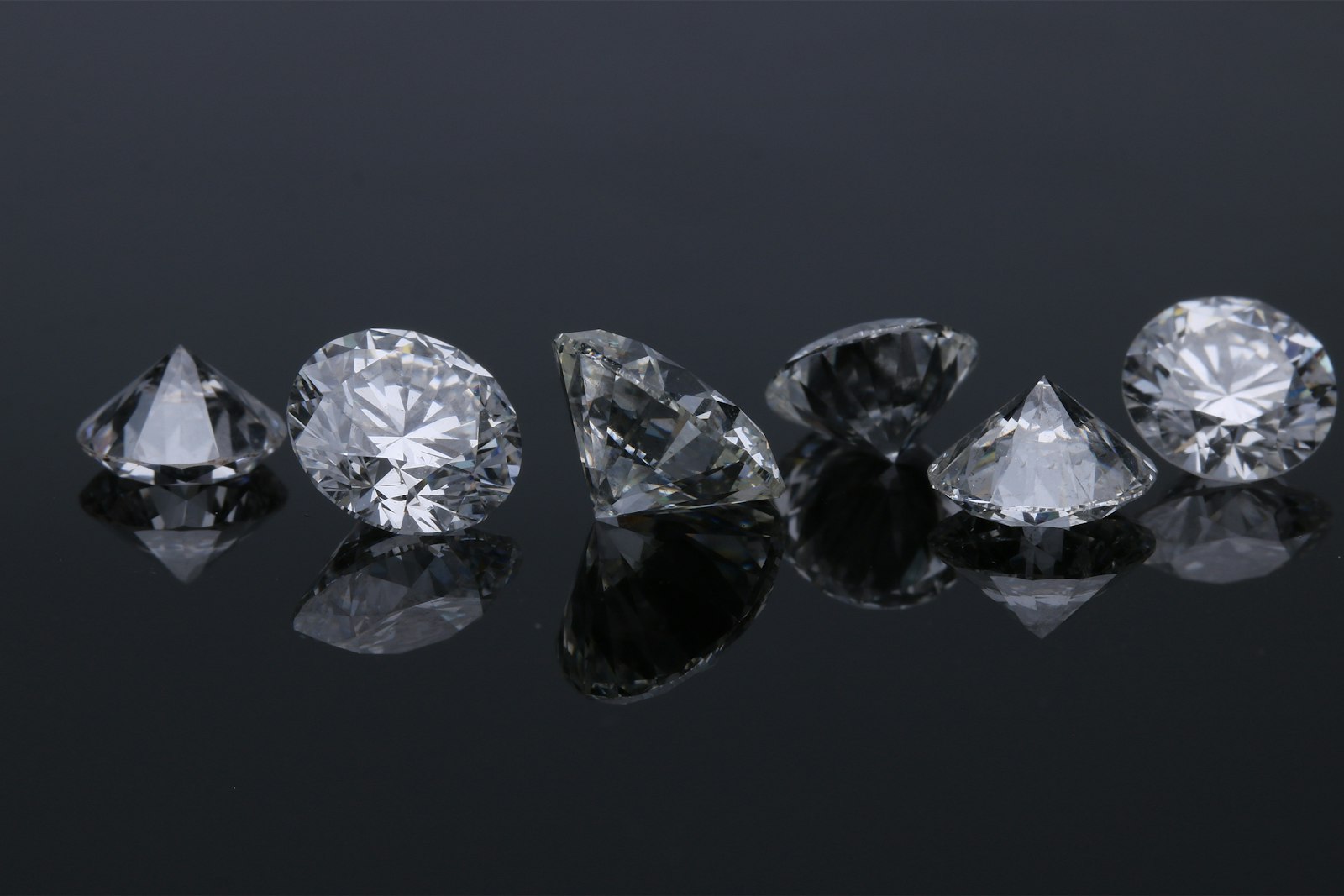
A diamond’s shape is often the very first decision a buyer makes, and it affects the stone’s personality, how big it looks on the hand and what it costs. “Shape” means the outline of the diamond seen from above. It is separate from “cut”, which describes how well the stone has been proportioned and faceted within that outline — we cover cut quality in its own guide.
Each shape has its own character and its own things to watch for. Here are the ten you are most likely to be choosing between, and the ideas that make the comparison make sense.
Brilliant cuts and step cuts: the distinction that explains everything
Nearly every difference in how shapes behave comes back to the faceting style.
Brilliant cuts use triangular and kite-shaped facets radiating from the centre of the stone. That arrangement chops incoming light into many small returns, which the eye reads as sparkle — rapid flashes of white light and coloured fire as the stone moves. Round, oval, princess, pear, marquise, heart, radiant and most cushions are brilliant-faceted.
Step cuts use long, flat facets running parallel to the girdle, arranged like the steps of a staircase. Instead of scattering light they return it in broad, mirror-like flashes — the hall-of-mirrors look of emerald and asscher cuts. It is a calmer, more architectural beauty: less sparkle, more depth and clarity of line.
This has a direct effect on what you should pay for. A brilliant’s busy sparkle disguises small inclusions and slight warmth of colour, so you can often drop a grade without seeing a difference. A step cut has nowhere to hide: its large open facets act like windows into the stone. On brilliants, put your money into cut; on step cuts, into clarity and colour.
The shapes, one by one
Round brilliant
The round brilliant is the most popular shape by a wide margin. Its 57 or 58 facets are the most thoroughly optimised arrangement in the trade, and it is the best-performing shape for pure brilliance and fire. It suits any hand, setting and style.
The trade-off is cost. Cutting a round loses more of the rough crystal than most other outlines, so rounds carry a noticeable premium per carat over fancy shapes of comparable quality. They also hold more weight in depth than flatter shapes, so a round looks slightly smaller face-up than an elongated stone of the same weight.
Oval
Ovals are hugely popular, and easily so: a brilliant-faceted oval delivers close to a round’s liveliness while spreading wider on the finger for the same carat weight, and its length flatters the hand.
The thing to check is the bow-tie — a dark, bow-shaped shadow across the centre of the stone, caused by the wearer’s own head and body blocking light from the direction the facets need it. Every elongated brilliant has some degree of bow-tie; in a well-cut stone it is faint, in a poorly cut one it is a black band that never goes away. No certificate reports it, so look at the stone itself or a high-resolution video. Outlines vary greatly between ovals — some slim, some almost round — so compare images, not just numbers.
Princess
The princess is a square brilliant with pointed corners: crisp, geometric and second only to the round for sparkle. Because a square outline wastes far less rough crystal, princess cuts give more carat weight for the money.
Their weakness is structural. Those four sharp corners are the most exposed points on the stone and the likeliest place for a chip, so V-shaped prongs covering each corner are close to essential. Like rounds, princess cuts carry weight in their depth and can look smaller face-up than their carat weight suggests.
Cushion
Cushions combine a square or slightly rectangular outline with rounded corners and softer, larger facets — a warm, romantic, vintage-leaning look. Those larger facets mean less dispersion to mask body colour, so cushions show warmth more than a round does; many buyers step up to a G or better here.
Cushions vary more than any other shape. Some are cut “chunky”, with large, distinct flashes; others as “crushed ice”, a shimmering scatter. Neither is better, but they look quite different and the terms appear on no certificate. The rounded corners make cushions durable for daily wear.
Emerald
The emerald cut is a rectangular step cut with cropped corners. Rather than sparkling, it flashes broad planes of light and dark — restrained and elegant. It is also a shallow, spreading shape, so it usually looks generously sized for its carat weight, and its length elongates the finger.
Two cautions. Clarity: with no sparkle to distract the eye, inclusions that would vanish in a brilliant are plainly visible, so aim for VS1 or better and view the stone itself. Colour: the large open table shows body tint more readily than a brilliant does, which matters most in white metal. The cropped corners make it reasonably robust.
Asscher
An asscher is a square emerald cut, with corners cropped so deeply the outline reads as an octagon, and typically a higher crown and smaller table. The result is a striking series of concentric squares drawing the eye down into the stone — a distinctly Art Deco effect.
Everything true of the emerald cut applies more intensely: clarity and colour are exposed, and this is not the shape on which to economise. Being squarer and deeper than an emerald, an asscher looks smaller face-up for the same weight.
Pear
The pear, or teardrop, is a brilliant with one rounded end and one point. It is elegant, spreads well for its weight and lengthens the finger; most people wear it with the point towards the fingernail.
It carries a bow-tie risk like the oval, and one genuinely vulnerable feature: the point, which needs a V-prong or bezel to protect it. Symmetry is unforgiving here. The point must sit exactly on the centreline, the shoulders must match, and the curve into the belly should be even. A slight wobble that would go unnoticed in a round is obvious in a pear.
Marquise
The marquise is an elongated brilliant with a point at each end. Of the common shapes it gives the largest face-up area for a given carat weight, and it is the most finger-lengthening.
It is also the least forgiving. The bow-tie tends to be most pronounced here, there are two points to protect rather than one, and any asymmetry between the halves is immediately visible. Because it spreads so widely, a marquise can be cut thin, making the girdle and points more fragile still. Buy this shape with your eyes, and take a jeweller’s advice on the setting.
Radiant
The radiant bridges the two faceting families: an emerald’s outline, cropped corners and all, with full brilliant faceting inside. You get the architectural silhouette with a brilliant’s sparkle and inclusion-hiding, which makes it forgiving on clarity and colour.
Radiants come square and rectangular and tend to be cut deep, so one usually looks a little smaller face-up than an emerald cut of the same weight. The cropped corners make it hardy for everyday wear.
Heart
A heart is, structurally, a pear with a cleft cut into the rounded end: romantic, and unmistakably a statement. Hearts need size to read properly — below roughly half a carat, and particularly once set with prongs, the outline becomes hard to recognise. Symmetry is everything: the lobes should mirror one another, the cleft should be distinct and centred, and the point needs protecting exactly as a pear’s does.
Length-to-width ratio
For any non-round shape, the length-to-width ratio is the length divided by the width, using the millimetre measurements printed on the grading report. A 9mm by 6mm oval has a ratio of 1.50.
Ratio is not a quality measure — there is no correct answer — but it changes a stone’s character more than almost anything else. A lower ratio looks fuller and more compact; a higher one looks slimmer and more elongating, but tends to show more bow-tie. The ranges most buyers gravitate towards:
| Shape | Commonly preferred ratio |
|---|---|
| Oval | 1.30 – 1.50 |
| Emerald | 1.30 – 1.50 |
| Radiant (rectangular) | 1.20 – 1.50 |
| Cushion (rectangular) | 1.10 – 1.30 |
| Pear | 1.45 – 1.75 |
| Marquise | 1.85 – 2.10 |
| Princess, asscher, square cushion | 1.00 – 1.05 |
| Heart | 0.95 – 1.05 |
Treat these as orientation, not rules. Work out the ratio yourself from the measurements, and look at stones at either end of the range before deciding.
Why carat weight and apparent size are not the same
Carat measures weight, not size, and shapes carry their weight differently. A deep stone hides much of its weight below the girdle, where nobody sees it; a shallow, spreading stone puts more of it into face-up area.
Broadly, elongated shapes — marquise, pear, oval and emerald — look larger for their weight, while rounds, princesses, asschers and radiants look smaller. This is why comparing diamonds by carat alone is misleading. Compare the millimetre measurements instead: they tell you what will actually be visible on the hand.
Shape, hand and setting
Elongated shapes draw the eye lengthways and suit shorter fingers; round, square and cushion shapes read as compact and sit well on longer, slender fingers. Broader hands carry wider stones better. Scale matters more than outline, though: a stone spanning the full width of the finger will dominate whatever its shape.
Lifestyle matters too. Pointed shapes and high-set stones catch on clothing and take knocks, so if you work with your hands, favour rounded outlines, protective settings and a low profile. And if the ring will sit beside a wedding band, pears, marquises and hearts often need a shaped band to sit flush, while rounds, emeralds and princesses pair with a straight one.
What a grading report will not tell you
A certificate gives measurements, proportions and, for rounds, a cut grade. It will not tell you whether an oval has an ugly bow-tie, whether a cushion is chunky or crushed ice, whether a pear’s shoulders match, or how obviously an emerald cut’s inclusions read to the eye. Those shape-specific issues decide whether you love a stone, and the only way to judge them is to look — in person, or through high-resolution video.
Choosing between them
- Maximum sparkle: round brilliant.
- The largest look for the weight: marquise, pear, oval or emerald.
- Strong sparkle at a gentler price than round: princess or radiant.
- Vintage and romantic: cushion.
- Understated, architectural elegance: emerald or asscher.
- Hard-wearing everyday shapes: round, cushion, radiant and emerald — outlines with no exposed points.
Whichever way you lean, decide the shape first and then compare stones only within it. Shapes are too different to judge side by side, and the outline you keep returning to is usually the right answer.