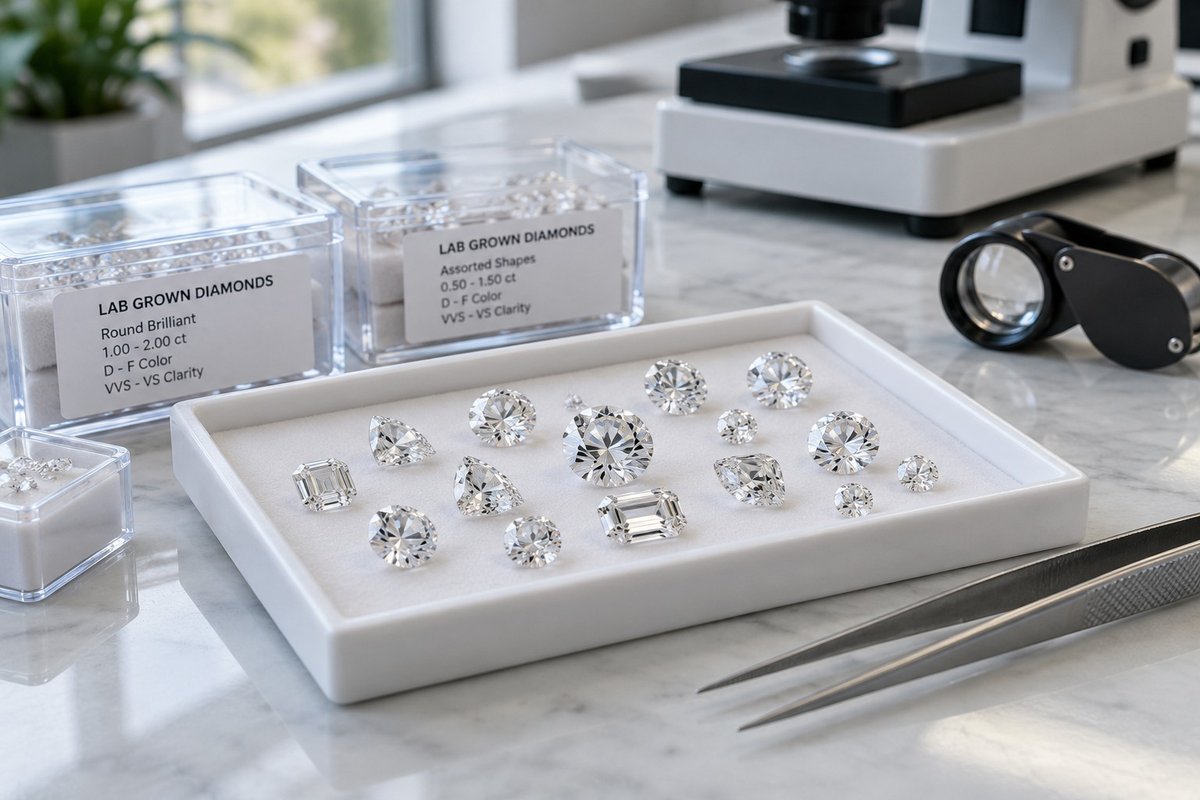
CVD and HPHT are the two methods used to grow laboratory-grown diamonds, and both produce real diamond. For most buyers the growth method matters far less than the individual stone: a well-cut, eye-clean diamond with good colour is a good buy whichever way it was grown, and a poor stone is a poor buy either way. What is worth checking is whether the stone has had post-growth treatment and how the grading report describes it.
This guide includes a few product links near the end. As an Amazon Associate, Diamond Taire earns from qualifying purchases, at no extra cost to you.
This guide explains how each method works, the real differences gemmologists see between them, why you mostly cannot see those differences with the eye, and what to check on a grading report. If you are still deciding whether to buy lab-grown at all, start with the lab-grown diamond buyer’s guide, which covers the wider buying process; this page focuses only on the CVD versus HPHT question.
- Both are diamond. CVD and HPHT stones have essentially the same chemical, physical and optical properties as mined diamonds.
- Neither method is automatically better. Each can produce excellent or poor stones; judge the stone, not the label.
- Many CVD stones are treated after growth. GIA reports that most CVD diamonds it has examined underwent post-growth treatment to improve colour.
- Check the report wording. IGI may state the growth method and whether there is any indication of post-growth treatment; since October 2025 GIA describes lab-grown stones as Premium or Standard.
At a glance
- CVD and HPHT are the two methods for growing lab-grown diamonds, and both produce real diamond.
- Neither method is automatically better, so judge the individual stone’s cut, colour and clarity, not the label.
- GIA reports that about 80 percent of the CVD stones it received had post-growth treatment to improve colour.
- Since 1 October 2025, GIA describes lab-grown stones as Premium or Standard, while IGI still gives exact D-to-Z grades.
- Do not pay extra for “type IIa”, because all colourless lab-grown diamonds in GIA’s research were type II.
- Read the report’s comments section and ask the seller in writing whether the stone was treated after growth.
How HPHT diamonds are grown
HPHT stands for high pressure, high temperature, and it imitates the conditions deep in the earth where natural diamonds form. According to GIA, a small diamond seed is placed in a growth capsule with a carbon source such as graphite and a metal flux, typically iron, nickel or cobalt. The capsule is heated to roughly 1,300 to 1,600 °C at pressures above 870,000 pounds per square inch. The carbon dissolves in the molten metal and crystallises on the cooler seed over several days to weeks.
HPHT crystals typically grow with both cube and octahedral faces, which produces internal growth sectors that gemmologists can see under special imaging. Because nitrogen gives diamond a yellow colour, growers exclude it to produce colourless stones, and GIA notes that colourless faceted HPHT stones of 10 carats and more are now made.
How CVD diamonds are grown
CVD stands for chemical vapour deposition. GIA describes flat diamond seed plates placed in a vacuum chamber filled with a carbon-containing gas, typically methane mixed with hydrogen. A microwave beam creates a plasma that breaks the gas down, and carbon deposits on the seed plates layer by layer at around 900 to 1,200 °C and low pressure. No metal flux is used. Growth happens in cycles, with crystals removed every few days so the top surface can be polished, and the whole process takes around three to four weeks.
CVD crystals are flat and tabular with a coating of black graphite that is cut away. GIA notes that brown-tinted CVD crystals are common and can be decolourised by HPHT annealing after growth, and that most colourless CVD material on the market was probably brown before that treatment.
CVD vs HPHT compared
This table sets out the differences GIA describes. Most of them are only visible with laboratory instruments, which is why they rarely affect what you see on the hand.
| Feature | HPHT | CVD |
|---|---|---|
| Conditions | Very high pressure; about 1,300 to 1,600 °C | Low pressure; about 900 to 1,200 °C |
| Carbon source | Solid carbon such as graphite, dissolved in molten metal flux | Methane and hydrogen gas broken down by plasma |
| Crystal shape | Cube and octahedral faces | Flat, tabular crystals |
| Typical inclusions | Dark metallic flux inclusions | No metallic inclusions; may contain dark graphite or other non-diamond carbon |
| Colour distribution | Often geometric colour zoning | Usually even colour |
| Strain under polarised light | None or weak | Banded strain patterns |
| Post-growth treatment | Used for some fancy colours, such as pink and red | Common, often HPHT annealing to remove brown tints |
| Magnet attraction | Only stones with large metallic inclusions | No |
| Phosphorescence | Colourless stones typically glow blue-green after strong UV | Usually not, though some can |
What GIA’s research says about the market
GIA’s 2024 Gems & Gemology update on laboratory-grown diamonds, which is based on the stones submitted to GIA rather than the whole world market, reported several useful trends:
- CVD stones now dominate laboratory-grown submissions to GIA, and most large stones of four carats and above submitted since 2021 were CVD.
- More than 90 percent of the HPHT stones GIA received in 2021 to 2023 were colourless.
- About 80 percent of the CVD stones GIA received had undergone post-growth treatment to improve colour.
- All the colourless laboratory-grown diamonds in GIA’s study were type II, a diamond type found in only about 1 percent of natural diamonds.
That last point matters for buyers. You may see lab-grown listings that promote “type IIa” as if it were a mark of rarity. For a colourless laboratory-grown diamond, being type II is normal, not special, so it should not add anything to the price.
Does the growth method change how the diamond looks?
For the vast majority of stones, no. Brightness, fire and sparkle are controlled by cut, and visible colour and clarity are what you judge, regardless of method. The method-specific features in the table, such as growth sectors, strain patterns and fluorescence patterns, show up under laboratory instruments, not across a dinner table.
There are a few cases where the method can show up in practice:
- Visible inclusions. A lower-clarity HPHT stone may contain dark metallic flux inclusions, while a lower-clarity CVD stone may show dark graphite inclusions. Either way, the fix is the same: choose a stone that is eye-clean.
- Residual tint or haze. If a CVD stone’s post-growth treatment did not fully remove a brown or grey tint, or a stone has a hazy look, it will show as a lower colour or a less lively appearance. Judge it from a clear video or in person, not from the grade alone.
- Phosphorescence. Colourless HPHT stones often glow blue-green after exposure to strong ultraviolet light. Under ordinary lighting this is not visible, so it is a curiosity rather than a problem.
Does post-growth treatment matter?
Post-growth treatment, usually HPHT annealing of CVD diamonds, is a normal part of how many colourless lab-grown diamonds are produced. A treated stone is not a fake or a lesser diamond, and many buyers are comfortable with it. What matters is disclosure: some people prefer an “as grown” stone, and you are entitled to know which you are buying.
The US Federal Trade Commission’s guidance on gemstone treatments says sellers should disclose a treatment when it is not permanent, when it requires special care, or when it significantly affects value. Consumer rules differ between countries, so the practical step anywhere is to ask the seller in writing whether the stone has been treated after growth and to check what the report says.
How grading reports describe growth method and treatment
This is where the two main laboratories now differ, so it is worth reading the report carefully. For a full guide to reading reports, see understanding diamond certification.
IGI
IGI continues to grade laboratory-grown diamonds with D-to-Z colour and standard clarity grades. In 2021 IGI announced that for untreated CVD and HPHT diamonds its reports state the growth process and that the stone is “as grown with no indication of post-growth treatment”, while other CVD diamonds are described as possibly including post-growth treatment. IGI’s current report description says the growth method and treatments are noted in the comments section in some cases or on request, so look there and ask if it is blank.
GIA
Since 1 October 2025, GIA no longer gives D-to-Z colour or clarity grades to laboratory-grown diamonds. Its assessment describes each stone as either “Premium” or “Standard”. GIA’s published criteria for Premium are D colour, VVS clarity or better, and Excellent polish and symmetry, plus an Excellent cut grade for round brilliants. Standard covers stones that meet minimums of E to J colour, VS clarity, and Very Good polish and symmetry (Good symmetry is accepted for fancy shapes), plus a Very Good cut grade for rounds. Stones below the Standard minimums receive no GIA assessment. GIA also laser inscribes each stone’s girdle with “Laboratory-Grown” and the assessment number.
Because the systems differ, do not compare a GIA “Standard” stone directly with an IGI-graded stone as if the labels were equivalent. A GIA Standard stone could sit anywhere from J to D colour and from VS clarity upwards, because missing any single Premium criterion places a stone in Standard, while an IGI report tells you the exact grades.
Who might care about the growth method
- You probably do not need to care if you are choosing on appearance, size and budget and are happy with a disclosed, stable post-growth treatment.
- You may want to filter by method or treatment if you specifically want an “as grown” stone, or if you are matching a stone to an existing piece and want consistent behaviour under UV light.
- You should be cautious if a seller charges a premium purely for one method, with claims that cannot be checked on the report.
A simple checklist for comparing two lab-grown diamonds
- Confirm both are clearly described as laboratory-grown, laboratory-created or similar.
- Note which laboratory graded each one: IGI grades or GIA Premium/Standard.
- Read the comments section for growth method and any mention of post-growth treatment.
- Compare cut quality first, then colour and clarity, using the 4Cs as your guide.
- Look at a clear, unedited video of each stone for tint, haze or visible inclusions.
- Check the laser inscription matches the report.
- Ask the seller in writing about treatment, returns and warranty.
- Only then consider whether the growth method makes any difference to you.
Common mistakes to avoid
- Believing one method is always superior. Both produce top-quality and poor-quality stones.
- Paying extra for “type IIa”. All colourless lab-grown diamonds in GIA’s research were type II.
- Assuming “treated” means “fake”. It describes a processing step, not a different material, but it should be disclosed.
- Skipping the comments section. That is where growth and treatment information usually appears.
- Treating a GIA Premium or Standard label as a colour grade. It is a band, not an exact grade.
- Using a magnet as a test. Only some HPHT stones with large metallic inclusions respond, so it proves very little.
- Expecting the method to protect resale value. This guide has found no reliable evidence that the growth method affects resale; for realistic expectations read do fine diamonds hold their value?
If you are still weighing lab-grown against mined, the lab-grown vs natural comparison covers that wider choice.
Sources this guide draws on: GIA’s explanation of HPHT and CVD diamond growth processes; GIA’s 2024 Gems & Gemology update on laboratory-grown diamonds and products evaluated at GIA; GIA’s announcement of its updated laboratory-grown diamond services from 1 October 2025; IGI’s 2021 announcement on treatment disclosure and its current laboratory-grown diamond report description; and the US Federal Trade Commission’s “In the Loupe” guidance on its Jewelry Guides.
Useful tools for this guide
Practical picks for choosing, checking and caring for jewellery. As an Amazon Associate, Diamond Taire earns from qualifying purchases, at no extra cost to you. Prices and availability are set by Amazon and may vary by country.
- Foldable 30x Jeweller’s Loupe
Pocket magnifier for checking stones, settings and hallmarks up close.
View on Amazon - CONNOISSEURS Premium Jewellery Cleaner
Gentle dip cleaner with a brush and tray for diamonds, gold and platinum. Check the label for stones it should not be used on.
View on Amazon - Ring Sizer Measuring Tool Kit (27 pieces)
Sizing rings plus a mandrel, to check a size at home before you buy or resize.
View on Amazon
Frequently asked questions
Is CVD or HPHT better?
Neither is better in general. Each method can produce excellent stones and poor ones, so compare the individual diamond’s cut, colour, clarity and report details. The growth method is a secondary consideration for most buyers.
Can you tell a CVD diamond from an HPHT diamond by eye?
No. The differences, such as growth sector patterns, strain and fluorescence patterns, are identified with laboratory instruments. Without magnification and specialist equipment, a CVD and an HPHT diamond of the same quality look the same.
Are CVD diamonds treated?
Many are. GIA reports that about 80 percent of the CVD stones it received had post-growth treatment, typically to improve colour. Some CVD stones are sold as grown with no indication of treatment, and a report may say so.
Do HPHT diamonds contain metal?
Some do. Because HPHT growth uses a molten metal flux, some stones contain dark metallic inclusions, and those with large inclusions can be attracted to a strong magnet. Higher-clarity stones may show none that you can see.
Does GIA show the growth method on lab-grown reports?
Since October 2025 GIA’s lab-grown assessment uses Premium and Standard categories rather than D-to-Z grades. Check the document itself for any comments on growth method or treatment, and ask the seller if it is unclear. IGI reports may state the method and whether there is any indication of post-growth treatment.
Are CVD and HPHT diamonds real diamonds?
Yes. Both are diamond, with essentially the same properties as mined diamond. Under the US Federal Trade Commission’s Jewelry Guides they should be described with a qualifier such as “laboratory-grown” or “laboratory-created”.
The growth method is an interesting part of a lab-grown diamond’s story, but it is rarely the deciding factor. Choose the stone that looks best for your budget, read the report’s comments for treatment details, and ask the seller anything the paperwork leaves unclear.