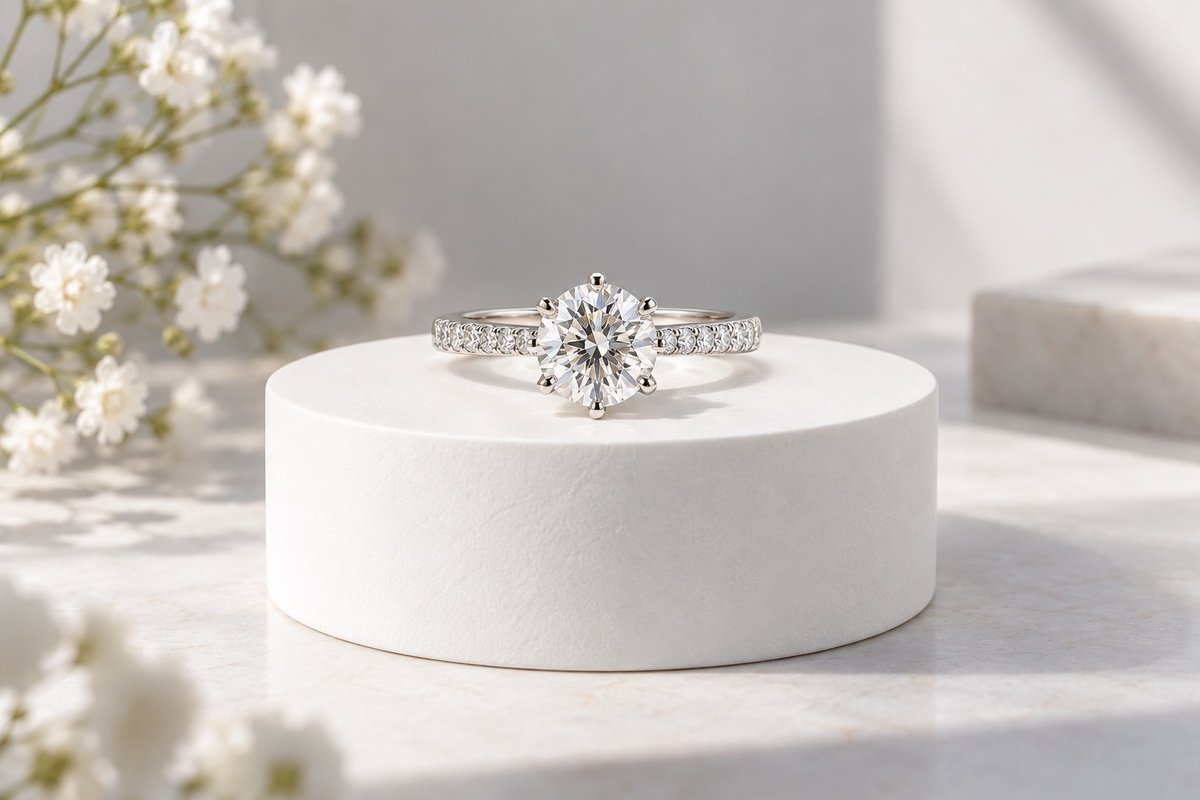
Lab-grown diamonds are real diamonds: pure crystallised carbon with the same hardness, brilliance and chemical make-up as mined stones, grown in weeks rather than formed over geological time. They usually cost far less than a natural diamond of similar size and quality, which is why so many buyers now start here. The catch is that the lower price comes with different rules on grading, resale, disclosure and value, and those rules are what this guide is about.
This guide includes a few product links near the end. As an Amazon Associate, Diamond Taire earns from qualifying purchases, at no extra cost to you.
This guide walks through the whole buying decision for a lab-grown diamond: how they are made and why the method rarely matters, how to read a lab-grown grading report, how to judge quality, what to expect on price and resale, how to think about ethics and environmental claims, and how to buy safely. Along the way it points to the more detailed guides on this site, so you can go deeper on any one question.
At a glance
- Same material, different origin. A lab-grown diamond is a diamond, not a simulant. Only specialist laboratory equipment can reliably tell it apart from a mined one.
- Judge the stone, not the method. CVD and HPHT can both produce beautiful diamonds. Cut quality, colour, clarity and an independent report matter far more.
- Expect little or no resale value. Lab-grown prices have fallen steadily as production has grown, and the second-hand market for them is thin. Buy one to wear and enjoy, not to hold value.
- Insist on a grading report and full disclosure. The report should state that the stone is laboratory-grown and note any post-growth treatment.
- Your savings are a choice. You can spend them on a bigger stone, a better cut, a finer setting, or simply keep them.
What a lab-grown diamond actually is
A lab-grown diamond (also called laboratory-grown or laboratory-created) is carbon crystallised in the same cubic structure as a natural diamond. It scores 10 on the Mohs hardness scale, bends light the same way and responds to cleaning, wear and heat the same way. That makes it different from simulants such as cubic zirconia, white sapphire or moissanite, which look similar but are different materials with different properties.
Most consumer-protection bodies treat the difference as one of origin, not identity. In the United States, for example, the Federal Trade Commission’s Jewelry Guides (revised in 2018) accept that a lab-grown stone is a diamond, but say the word should be qualified clearly with “laboratory-grown”, “laboratory-created” or “[manufacturer name]-created”. A term such as “cultured” is acceptable only when it sits right beside one of those qualifiers, and the word “diamond” on its own is understood to mean a mined stone. Many other countries and trade bodies have similar disclosure expectations, although the exact wording rules differ from place to place. Whatever your country, the safe principle is the same: expect the origin to be stated clearly in writing, on the invoice and on any grading report.
If you are still deciding between a lab-grown and a mined stone, the side-by-side comparison in lab-grown or natural diamond: how to choose covers that choice in detail. This guide assumes you are leaning towards lab-grown and want to buy a good one.
How lab-grown diamonds are made: CVD and HPHT
There are two main growth methods. Both start with a small diamond “seed” and add carbon to it in controlled conditions.
- HPHT (high pressure, high temperature) recreates something like the conditions deep in the Earth. A press applies enormous pressure and heat to a carbon source with a metal solvent, and diamond crystallises onto the seed.
- CVD (chemical vapour deposition) uses a low-pressure chamber filled with carbon-rich gas. The gas is broken down, usually with microwave energy, and carbon atoms settle onto a flat seed plate layer by layer.
| Point to compare | HPHT | CVD |
|---|---|---|
| How it grows | Heat and pressure with a metal solvent | Carbon from gas, deposited layer by layer |
| Typical crystal shape | Roughly cube-octahedral | Flat, tabular blocks |
| Inclusions you may see under magnification | Tiny metallic flux inclusions | Dark pinpoint or graphite-like inclusions; sometimes subtle strain |
| Post-growth treatment | Less common | More common, often to improve colour |
| Does it matter to the eye? | Rarely. A well-cut, well-graded stone from either method can look identical. Judge the individual diamond. | |
The method is printed on many lab-grown reports. It is useful information, but it is not a quality grade. A poor CVD stone and a superb CVD stone share a method and very little else.
Post-growth treatment: the question to ask
Some lab-grown diamonds, especially CVD stones, are treated after growth, often with an HPHT annealing step, to improve colour. Treatment is not automatically a problem, but it must be disclosed. IGI, for example, describes lab-grown stones it can confirm are untreated as “as grown” with no indication of post-growth treatment; stones it cannot confirm carry a note that they may have been treated after growth. Ask the seller directly: “Has this stone had any post-growth treatment, and is it shown on the report?” If the answer is vague, choose another stone.
Grading reports for lab-grown diamonds
A grading report is your independent evidence of what you are buying. For lab-grown diamonds, the most commonly seen reports come from IGI (International Gemological Institute) and GIA (Gemological Institute of America), with other laboratories active in different markets.
A few points are specific to lab-grown stones:
- The report must say “laboratory-grown” (or equivalent) prominently. The major laboratories typically also laser-inscribe the girdle with the report number and a lab-grown notation (GIA inscribes “Laboratory-Grown” and its assessment number), which a jeweller can show you under magnification.
- Report styles differ. IGI lab-grown reports use the familiar D-to-Z colour and clarity scales. GIA no longer does: since 1 October 2025 its Laboratory-Grown Diamond Quality Assessment places colourless lab-grown stones in one of two categories, “Premium” (D colour, VVS clarity or higher, Excellent polish and symmetry, and Excellent cut for rounds) or “Standard” (at least E to J colour, VS clarity and Very Good polish and symmetry, with Very Good cut for rounds). Stones below the Standard minimum receive no GIA assessment, and older GIA lab-grown reports with full grades remain valid. Read exactly what the document states rather than assuming two reports are comparable.
- Look for growth method and treatment notes in the comments section.
- Verify the number. Enter the report number on the laboratory’s own online report-check service and confirm the measurements, carat weight and inscription match the stone and the paperwork.
The full guide to diamond certification and how to read a grading report explains each section of a report and how the major laboratories differ.
Judging quality: the 4 Cs still apply
A lab-grown diamond is graded on the same four characteristics as a mined one: cut, colour, clarity and carat. The difference is that, because lab-grown stones cost less, buyers often push higher on colour and clarity than they need to. The smarter approach is the same one used for natural diamonds: put cut first, then buy colour and clarity that look clean and white to the eye in your chosen setting.
Start with the 4 Cs of diamonds explained if you want an overview, then go deeper on each factor:
- Diamond cut quality: how proportions and angles create brilliance and fire, and why cut is the factor most worth paying for.
- Choosing a diamond colour grade: what the D-to-Z scale measures and how metal and shape change the grade you actually need.
- Diamond clarity and inclusions: why most inclusions are invisible without magnification and how to judge eye-clean.
- Diamond shapes explained: all ten main shapes compared, including how each wears and which weak points to check.
Lab-grown specific quality checks
Beyond the 4 Cs, a few issues come up more often with lab-grown stones:
- Colour tints. Some CVD stones can show a faint brown or grey cast, and some HPHT stones a faint blue. Treatment can reduce these. Look at the stone in daylight-type light, not just under bright showroom lamps.
- Graining and strain. Some stones show internal graining that slightly softens their crispness. It may not be obvious on a report, so watch a high-quality video.
- Cutting for weight. Cheaper rough may reduce the pressure to keep every fraction of a carat, but cutting for weight still happens. A deep stone with a small face-up size is poor value at any price.
Lab-grown diamond prices: what to expect
Lab-grown diamonds are typically a fraction of the price of a comparable natural diamond. Prices have fallen markedly over recent years as production capacity has grown, and the gap between lab-grown and mined prices has widened. Prices also vary a great deal between sellers for similar stones, and by country because of taxes, import duties and local competition.
For that reason this guide does not quote figures; they would date quickly. Instead, compare like with like: same shape, similar carat, same report type and grades, and a similar cut standard. The guide to what really drives a diamond’s price explains carat thresholds, cut, colour and laboratory differences, which apply to lab-grown stones too.
One practical consequence of falling prices: if a seller pushes urgency (“prices are about to rise”), treat it as a sales line. Buy when you have found the right stone, not because of a forecast.
Resale and long-term value
This is the point most buyers underestimate. Any retail diamond resells for well below its purchase price, because the retail price includes cutting, setting, overheads and margin. With lab-grown diamonds the gap is usually much wider. Supply is not limited in the way mined supply is, new stones keep getting cheaper, and many jewellers and diamond buyers decline to buy lab-grown stones back at all, or offer very little.
That does not make a lab-grown diamond a bad buy. It means you should treat it like most other fine jewellery: as something you buy to wear and enjoy for decades, not as a store of money. Some retailers offer trade-in or upgrade programmes; read the terms carefully, because they often require spending more with the same store. For the full picture, see do fine diamonds hold their value? An honest look at resale.
Ethics and environmental claims
Many people choose lab-grown diamonds because they want a stone with a clear origin. That is a reasonable reason, with some nuance:
- Origin is easier to trace. A lab-grown stone does not come from a mine, so conflict and mining-related concerns do not apply in the same way. Labour conditions in growing, cutting and polishing still matter, and some producers publish more information than others.
- Environmental impact depends on energy. Growing diamonds uses a lot of electricity. The footprint depends heavily on whether that power comes from renewable or fossil sources. Regulators have cautioned sellers about this: in 2019 US Federal Trade Commission staff warned jewellery companies that unqualified claims such as “eco-friendly” or “sustainable” are very hard to substantiate.
- Ask for specifics. If a seller makes an environmental claim, ask what it is based on: which producer, which energy source, and whether an independent body has verified it.
For a wider look at origin, certification schemes and recycled or traceable natural stones, read ethical diamonds: what you need to know before you buy.
Lab-grown diamond or an alternative stone?
Lab-grown diamonds are not the only lower-cost option. Moissanite and white sapphire are often shown alongside them. The key difference is that a lab-grown diamond is a diamond; the others are not.
| Stone | What it is | Hardness (Mohs) | Look | Main trade-off |
|---|---|---|---|---|
| Natural diamond | Mined diamond | 10 | Diamond brilliance | Highest cost for a given size |
| Lab-grown diamond | Diamond grown in a laboratory | 10 | Identical to natural | Very low resale value |
| Moissanite | Silicon carbide, almost always lab-made | About 9.25 | More rainbow fire than diamond | Different sparkle; some people see it as “not diamond-like” |
| White sapphire | Colourless corundum | 9 | Less brilliance, can look glassy | Noticeably less sparkle than diamond, especially once dirty |
| Cubic zirconia | Synthetic simulant | About 8 to 8.5 | Bright when new | Scratches and dulls with everyday wear |
For a detailed side-by-side, see moissanite vs diamond: an honest comparison. If you are looking at coloured lab-created gemstones in silver, the guide to sterling silver gemstone jewellery explains natural, lab-created and simulated stones.
Who a lab-grown diamond suits, and who it does not
| A lab-grown diamond suits you if | You may prefer a natural diamond or alternative if |
|---|---|
| You want a real diamond and a larger or finer stone for your budget | It matters to you that the stone formed in the Earth over millions of years |
| You plan to keep and wear the piece for the long term | You want some chance of recovering part of the cost if you sell |
| You value a traceable, mine-free origin | You are buying for an heirloom where rarity is part of the meaning |
| You are comfortable explaining the choice if asked | The recipient has said they want a mined diamond |
| You want hardness and durability for everyday wear | Your budget is very tight and moissanite’s look appeals to you |
How to buy a lab-grown diamond: step by step
- Set your total budget first, including the setting, resizing, taxes, delivery and insurance.
- Choose shape and setting style before you shortlist stones, because they change how much colour and clarity you need.
- Filter by cut first. For round stones, choose the top cut grade. For fancy shapes, judge proportions and video, since many reports do not grade their cut.
- Pick colour and clarity that look clean to the eye in your setting, rather than the highest grades available.
- Confirm the report: lab-grown disclosure, growth method, treatment notes, matching measurements and girdle inscription. Check the number on the laboratory’s own website.
- Watch a high-quality video or see the stone in person, in more than one type of light.
- Compare at least three similar stones from different sellers so you know what a fair price looks like that week.
- Read the returns, warranty and resizing terms before you pay. Know exactly how long you have to return the piece and in what condition.
- Get an independent valuation and insure it once it arrives.
The guide to how to buy a diamond online without getting burned covers seller checks, video, returns and common tricks in more depth.
Questions to ask the seller
- Which laboratory graded this stone, and can you send the report number before I pay?
- Was it grown by CVD or HPHT, and has it had any post-growth treatment?
- Is the girdle laser-inscribed with the report number and a lab-grown notation?
- Can I see unedited video of this exact stone, not a stock image?
- What is your return window, and is the stone returnable once set?
- Do you offer buy-back or trade-in on lab-grown stones, and on what terms?
- If you make an environmental claim, what evidence is it based on?
Common mistakes with lab-grown diamonds
- Overspending on colour and clarity. A D-colour, flawless lab stone usually looks no different to the eye from a well-chosen near-colourless, eye-clean one. Spend on cut instead.
- Ignoring cut because “it is cheaper anyway”. A poorly cut lab-grown diamond is still a dull diamond.
- Treating it as an investment. Expect resale value to be low. Buy for enjoyment.
- Accepting vague disclosure. If the report or invoice does not clearly say lab-grown, do not buy.
- Comparing reports from different laboratories as if they were the same. Grading standards and report styles differ; a current GIA “Standard” assessment and an IGI colour and clarity grade are not directly comparable.
- Relying on a handheld diamond tester. Standard thermal testers identify a lab-grown diamond as diamond. They cannot tell origin.
- Skimping on the setting. A large stone in a flimsy setting is a risk. See diamond ring settings explained for how each style protects the stone.
Owning a lab-grown diamond
Day to day, a lab-grown diamond needs exactly the same care as a natural one. It attracts grease, so it loses sparkle quickly when dirty, and it can chip if struck hard on an edge. The setting, not the stone, is usually the weak point.
- How to clean and maintain your diamonds: safe home cleaning and when to avoid ultrasonic or steam cleaners.
- How to store jewellery: keeping diamonds from scratching other pieces, at home and when travelling.
- Jewellery insurance and appraisals: what a proper valuation includes and how to document what you own. Make sure the valuation clearly describes the stone as lab-grown so a replacement is like for like.
Choosing the ring around your lab-grown diamond
Because a lab-grown stone frees up budget, many buyers spend part of the difference on the ring itself. These guides help:
- How to choose an engagement ring style: reading someone’s taste and comparing the main styles.
- Platinum vs white gold: how the two metals wear, age and cost over time.
- Gold karats explained: what 9k, 14k, 18k and 22k mean for colour and durability.
- Engagement ring trends: which styles last and which date quickly.
- Wedding bands: matching and stacking a band with your engagement ring.
- Ring sizing: measuring accurately at home before you order.
If lab-grown prices have you looking at larger sizes, compare 2 to 5 carat diamonds by size, price and setting needs.
Related guide: How Are Diamonds Made? Earth vs Lab, the Simple Truth.
Sources this guide draws on: GIA (Gemological Institute of America) announcements on its laboratory-grown diamond quality assessment; IGI (International Gemological Institute) report wording on post-growth treatment; the US Federal Trade Commission’s Guides for the Jewelry, Precious Metals, and Pewter Industries (2018) and its 2019 warning letters to diamond sellers; and general gemmological references on CVD and HPHT growth.
Useful tools for this guide
Practical picks for choosing, checking and caring for jewellery. As an Amazon Associate, Diamond Taire earns from qualifying purchases, at no extra cost to you. Prices and availability are set by Amazon and may vary by country.
- Foldable 30x Jeweller’s Loupe
Pocket magnifier for checking stones, settings and hallmarks up close.
View on Amazon - CONNOISSEURS Premium Jewellery Cleaner
Gentle dip cleaner with a brush and tray for diamonds, gold and platinum. Check the label for stones it should not be used on.
View on Amazon - Ring Sizer Measuring Tool Kit (27 pieces)
Sizing rings plus a mandrel, to check a size at home before you buy or resize.
View on Amazon
Frequently asked questions
Are lab-grown diamonds real diamonds?
Yes. They are made of carbon in the same crystal structure as mined diamonds and share their hardness, brilliance and chemical properties. The difference is origin, which must be disclosed. They are not simulants like cubic zirconia.
Can a jeweller tell if a diamond is lab-grown?
Not by eye, and not with a standard handheld thermal diamond tester. Dedicated screening devices can flag a stone for further testing, but confirming origin needs specialist instruments, usually spectroscopy and fluorescence imaging, of the kind used by gemmological laboratories. That is why the grading report and girdle inscription matter so much.
Do lab-grown diamonds get cloudy or change colour over time?
A good-quality lab-grown diamond does not cloud or fade with normal wear, any more than a natural diamond does. If a diamond looks cloudy, it is almost always dirt and skin oils on the surface. Cleaning restores its sparkle.
Is CVD or HPHT better?
Neither is better as a rule. Both methods can produce excellent stones and poor ones. Judge each diamond on its cut, colour, clarity, report and any treatment disclosure rather than on the growth method.
Do lab-grown diamonds have resale value?
Usually very little. Prices for new lab-grown stones have fallen over time and many buyers of second-hand jewellery will not purchase them. Buy one because you want to wear it, not to recover money later.
Are lab-grown diamonds more ethical?
They avoid mining-related concerns, which is a genuine advantage for many buyers. Their environmental footprint depends largely on the energy used to grow them, and labour conditions in production still vary. Ask for specific, verifiable information rather than relying on general marketing claims.
A lab-grown diamond can be an excellent choice when you buy it for the right reasons: a real diamond, a beautiful stone for your budget and a clear origin, chosen with cut first and a verified report in hand. Go in knowing the resale value will be low, compare a few stones carefully, and put the money you save wherever it matters most to you.