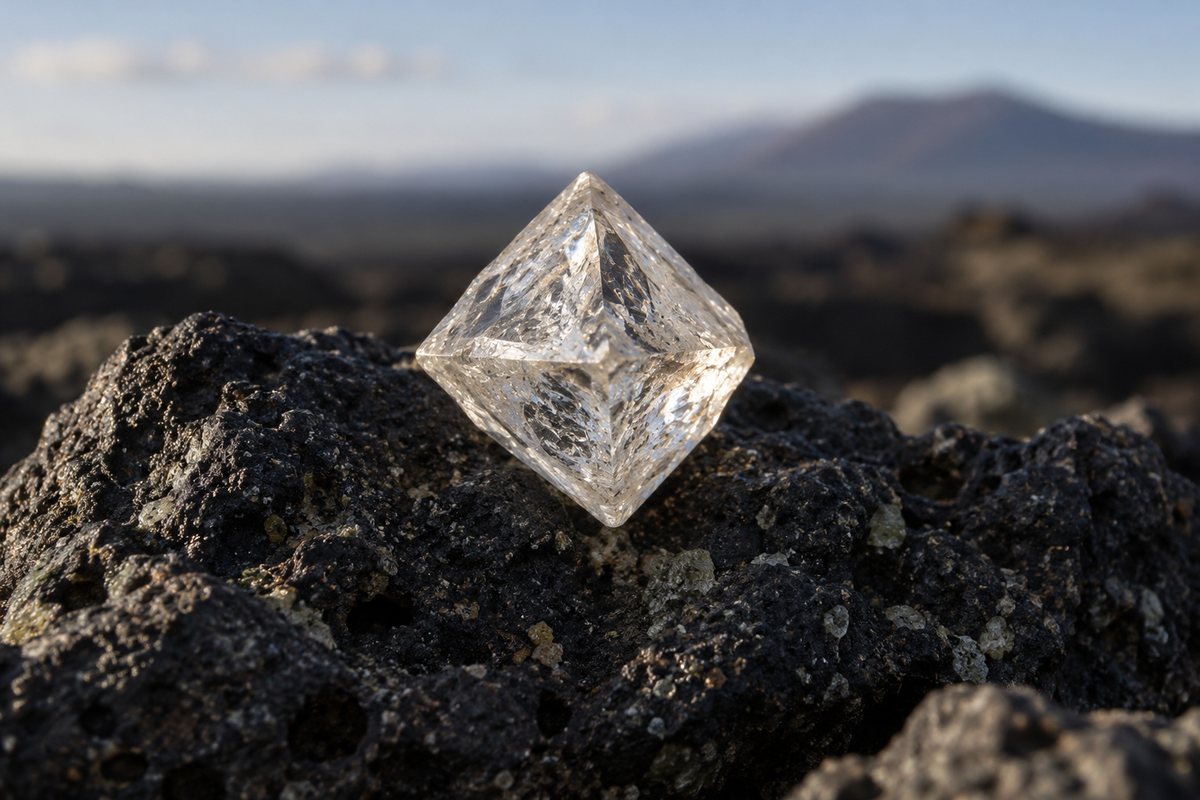
Natural diamonds are made when carbon crystallises under intense heat and pressure deep in the earth’s mantle, mostly 150 to 200 km down at around 900 to 1,300 °C, and are later carried to the surface by rare, fast volcanic eruptions. Lab-grown diamonds are made from the same element, carbon, in weeks rather than billions of years, using either high pressure and high temperature (HPHT) or chemical vapour deposition (CVD).
This guide includes a few product links near the end. As an Amazon Associate, Diamond Taire earns from qualifying purchases, at no extra cost to you.
This guide explains what diamonds are made of, how and where natural diamonds form, how they reach the surface, how laboratories grow them, and how gemmologists tell the two apart. It is neutral by design: both are real diamond, and the right choice depends on what matters to you.
At a glance
- A diamond is pure carbon arranged in a tightly bonded cubic crystal structure; graphite is the same element arranged differently.
- Most natural diamonds formed 150 to 200 km deep under ancient continents; a rare few formed far deeper, between about 200 and 800 km.
- The oldest dated diamonds are around 3.3 to 3.5 billion years old, yet some formed only around 90 million years ago.
- Kimberlite and lamproite eruptions carried diamonds up, possibly in a matter of hours to days.
- Lab-grown diamonds are grown on a diamond seed by HPHT or CVD, and laboratories identify them by their growth patterns, fluorescence and spectra.
What are diamonds made of?
A diamond is made of carbon, and nothing else apart from tiny traces of other elements. What makes it a diamond rather than pencil graphite is the arrangement of its atoms. In diamond, each carbon atom is strongly bonded to four neighbours in a rigid three-dimensional lattice, which is what gives diamond its exceptional hardness and brilliance. Graphite’s carbon atoms sit in sheets that slide over one another, which is why it is soft.
The trace elements matter for colour. According to GIA, nitrogen causes yellow tints and boron is often responsible for blue. Most colourless diamonds contain small amounts of nitrogen; very pure diamonds with almost no nitrogen are classed as type IIa.
A quick aside, because it often comes up in the same searches: white gold is not a natural metal. It is gold alloyed with white metals and often rhodium plated, as our guide to what white gold is made of explains.
How are diamonds made in nature?
Deep under old continents
GIA’s research summary on natural diamonds explains that most crystallise at the base of the oldest and thickest parts of continents, known as cratons, at depths of about 150 to 200 km and temperatures of about 900 to 1,300 °C. Only at those depths is the pressure high enough for carbon to form diamond rather than graphite.
Where the carbon comes from
Carbon is scarce in the mantle, present at only a few hundred parts per million. GIA describes diamonds growing from carbon-bearing fluids rich in carbon, oxygen and hydrogen, which deposit carbon as they react. Some of the rarest, deepest diamonds grew from carbon carried down by ancient ocean floor as it sank into the mantle.
Superdeep diamonds
A small group of diamonds, called sublithospheric or superdeep diamonds, formed far deeper, roughly 200 to 800 km down. GIA notes that some of the world’s most famous large stones belong to this group, including the Cullinan, which weighed 3,106 carats before cutting. Tiny minerals trapped inside such diamonds are among the deepest, best-preserved samples of the mantle that scientists have.
How old are diamonds?
Diamonds are not all the same age. The oldest dated examples, from mines in northern Canada, are about 3.3 to 3.5 billion years old. Others, from some South African mines, are around 90 million years old. Either way, most natural diamonds are far older than the rocks that carried them to the surface.
Not from coal
A popular belief is that diamonds are compressed coal. Coal forms from plant material near the surface, while natural diamonds formed far deeper, in the mantle. The carbon in diamonds is mantle carbon, not coal.
Where do diamonds come from? The journey to the surface
Diamonds would stay buried forever without a special kind of eruption. Kimberlite and, less often, lamproite magmas are the most deeply sourced magmas to reach the earth’s surface. GIA describes these melts rising 200 to 300 km, driven by water and carbon dioxide, and possibly reaching the surface within hours to days. The speed matters: diamonds that rise slowly can turn to graphite or be destroyed along the way.
The eruptions leave carrot-shaped bodies of rock called pipes. Many of the famous South African pipes erupted in the Cretaceous period, roughly 145 to 66 million years ago. Australia’s Argyle mine was notable as the first major commercial mine in a lamproite pipe rather than kimberlite.
Over time, erosion can wash diamonds out of pipes and into rivers and coastlines, forming what are known as alluvial or secondary deposits. Today, natural diamonds are mined in many regions, including parts of Africa, Russia, Canada and Australia. If origin and ethics matter to you, see our guide to ethical and traceable diamonds.
How lab-grown diamonds are made
Lab-grown diamonds have the same carbon crystal structure as natural ones. They are grown on a small diamond seed using one of two methods. Our CVD vs HPHT guide compares the two in depth for buyers; here is the science in brief, based on GIA’s description of the processes.
HPHT: recreating the mantle
HPHT growth imitates the conditions of the mantle. Carbon, usually graphite, is dissolved in a molten metal such as iron, nickel or cobalt inside a press at around 1,300 to 1,600 °C and pressures above 870,000 pounds per square inch. The carbon migrates to a cooler diamond seed and crystallises on it over several days to weeks. HPHT crystals typically show a mix of cube and octahedral faces.
CVD: building diamond from gas
CVD works quite differently. A gas mixture of hydrogen and a carbon-containing gas such as methane is fed into a vacuum chamber at about 900 to 1,200 °C and moderate pressure. Microwaves break the gas into a plasma, and carbon settles onto flat diamond seed plates layer by layer. Growth runs for about three to four weeks, and the resulting crystals are flat and tabular. Many CVD crystals come out brownish and are then treated with HPHT to improve their colour.
Natural vs lab-grown formation side by side
| Feature | Natural diamond | HPHT lab-grown | CVD lab-grown |
|---|---|---|---|
| Material | Carbon | Carbon | Carbon |
| Where it grows | Earth’s mantle, mostly 150 to 200 km deep | A high-pressure press | A vacuum chamber |
| Temperature | About 900 to 1,300 °C (most diamonds) | About 1,300 to 1,600 °C | About 900 to 1,200 °C |
| Pressure | Very high, from deep burial | Very high, above 870,000 psi | Moderate, in a vacuum chamber |
| Carbon source | Carbon-rich fluids in the mantle | Graphite in molten metal | Methane and hydrogen gas |
| Time | Formed up to billions of years ago | Days to weeks | About three to four weeks |
| Typical crystal shape | Usually octahedral | Cube and octahedral faces | Flat, tabular |
| Reaches you via | Volcanic eruption, then mining | Cutting and polishing | Cutting and polishing, often after treatment |
For a full comparison of price, value and grading, read our lab-grown vs natural diamond comparison.
How laboratories tell natural and lab-grown apart
Because the two are chemically the same, you cannot tell them apart by eye, by weight or with a basic diamond tester. The difference lies in the growth record each diamond carries. GIA describes several clues:
- Growth patterns. Under deep ultraviolet imaging, natural diamonds tend to show concentric growth patterns, HPHT diamonds show cross-shaped patterns and CVD diamonds show fine striations.
- Fluorescence. Lab-grown diamonds often fluoresce more strongly under short-wave than long-wave ultraviolet, the reverse of most natural diamonds, and some glow briefly after the light is switched off.
- Strain. Viewed between polarising filters, natural diamonds often show crosshatched strain, CVD diamonds banded strain, and HPHT diamonds little or none.
- Inclusions. HPHT diamonds may contain metallic flux inclusions, sometimes enough to be attracted to a magnet; CVD diamonds may contain dark graphite specks.
- Spectroscopy and screening. Laboratories use spectroscopic instruments and automated screening devices, including for very small melee diamonds.
Many lab-grown diamonds also carry a laser inscription on the girdle identifying them as laboratory-grown. For buyers, the practical takeaway is simple: rely on a reputable laboratory report, as explained in our guide to reading a diamond grading report. For home checks that separate diamonds from simulants, see how to tell if a diamond is real.
What this means when you buy
Knowing how diamonds are made does not tell you which to choose, but it does clarify what you are paying for. A natural diamond’s story is geological time and rarity. A lab-grown diamond’s story is technology, and it is usually available at a lower price for the same size and quality. Both are hard, durable diamond suitable for everyday wear.
- Decide whether natural origin matters to you personally.
- Ask for an independent report that states natural or laboratory-grown.
- Check for, and match, any girdle inscription.
- Ask whether the diamond has been treated, as many CVD diamonds are after growth.
- Compare value and resale expectations honestly; our lab-grown diamond buyer’s guide covers this.
Common mistakes and myths
- Thinking diamonds come from coal. They form from mantle carbon, far deeper than coal ever forms.
- Assuming lab-grown means fake. Lab-grown diamonds are real diamond; simulants such as cubic zirconia and moissanite are different materials.
- Believing a basic tester can spot lab-grown. Standard thermal testers respond to diamond of either origin.
- Assuming all natural diamonds are the same age. Ages range from hundreds of millions to billions of years.
- Ignoring treatment. Both natural and lab-grown diamonds can be treated; disclosure should be in writing.
- Treating either as an investment. Formation story affects price, but diamonds bought at retail are not a reliable store of value.
If you are weighing diamond against a lookalike, our moissanite vs diamond comparison explains the material differences.
Sources this guide draws on: GIA Gems and Gemology research on the formation and age of natural diamonds and their journey to the surface; GIA’s explanation of HPHT and CVD diamond growth processes; GIA guidance on identifying laboratory-grown diamonds; GIA material on the causes of colour in diamonds; published accounts of the Argyle lamproite mine.
Useful tools for this guide
Practical picks for choosing, checking and caring for jewellery. As an Amazon Associate, Diamond Taire earns from qualifying purchases, at no extra cost to you. Prices and availability are set by Amazon and may vary by country.
- Foldable 30x Jeweller’s Loupe
Pocket magnifier for checking stones, settings and hallmarks up close.
View on Amazon - CONNOISSEURS Premium Jewellery Cleaner
Gentle dip cleaner with a brush and tray for diamonds, gold and platinum. Check the label for stones it should not be used on.
View on Amazon - Ring Sizer Measuring Tool Kit (27 pieces)
Sizing rings plus a mandrel, to check a size at home before you buy or resize.
View on Amazon
Frequently asked questions
How are diamonds created naturally?
Carbon crystallises under very high pressure and temperature in the mantle, mostly 150 to 200 km below ancient continents. Deep-sourced kimberlite or lamproite eruptions later carry the diamonds to the surface, where they are mined.
How long does it take for a diamond to form?
For natural diamonds, scientists date when they formed rather than measure growth time directly, and their ages range from about 90 million to 3.5 billion years. Lab-grown diamonds take days to weeks with HPHT and about three to four weeks with CVD.
Are lab-grown diamonds made of the same thing as natural diamonds?
Yes. Both are carbon in the same crystal structure, with the same hardness and optical properties. They differ in their growth features and trace impurities, which is how laboratories identify them.
Where do most diamonds come from?
Natural diamonds are mined from kimberlite and lamproite pipes and from alluvial deposits in many parts of the world, including Africa, Russia, Canada and Australia. Lab-grown diamonds are produced in factories in several countries.
Can a jeweller tell if a diamond is lab-grown?
Not reliably by eye or with a basic tester. Specialist screening instruments and full laboratory analysis are needed, which is why an independent report is the dependable check.
Whether it rose from the mantle in a volcanic eruption or grew layer by layer in a chamber, a diamond is the same remarkable form of carbon. Understanding how it was made helps you ask the right questions and choose the one that suits your values and budget.