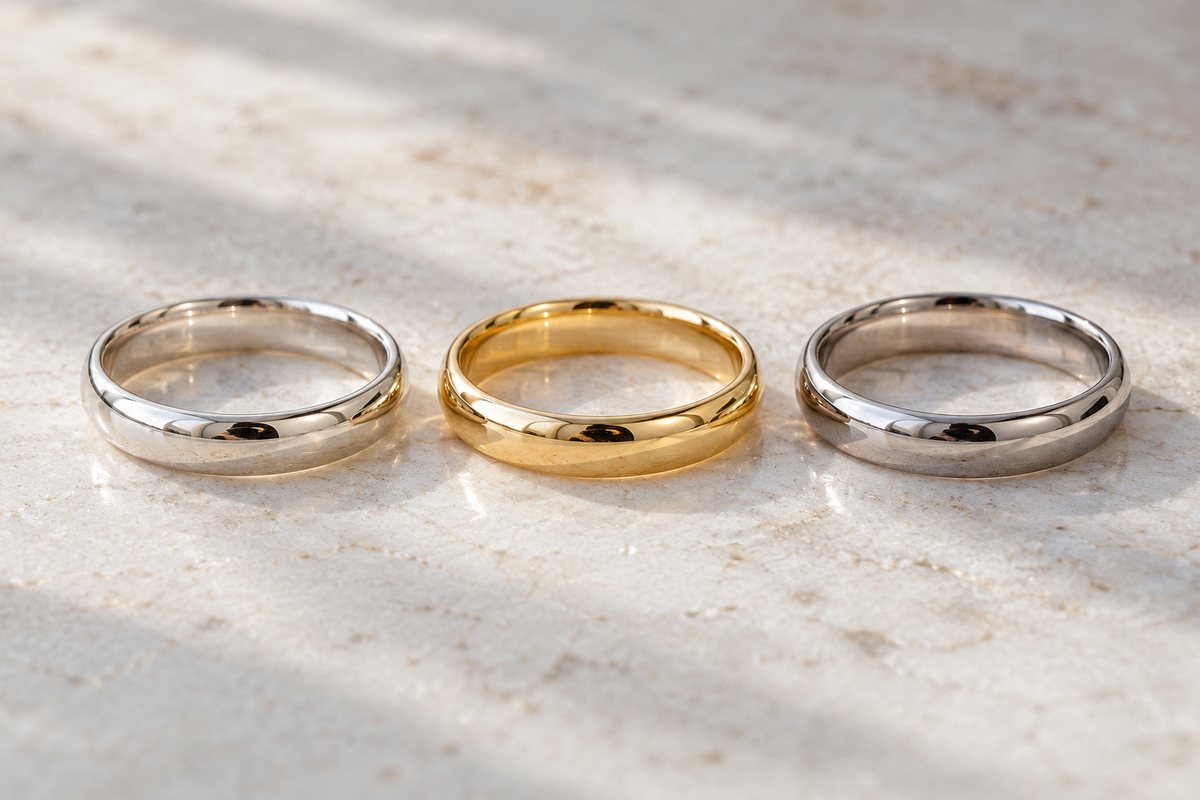
White gold is real gold: pure yellow gold mixed with white metals such as palladium or nickel (often with silver, copper or zinc) to make a harder, paler alloy. On its own, most white gold is a soft greyish or faintly warm white, so jewellers usually coat it with a thin layer of rhodium, a bright white platinum-group metal, which is what gives a new white gold ring its mirror-white shine. That plating wears with time and needs renewing.
This guide includes a few product links near the end. As an Amazon Associate, Diamond Taire earns from qualifying purchases, at no extra cost to you.
This plain-English guide explains how white gold is made, whether it counts as “real gold”, how 9k, 14k and 18k white gold differ, why it is rhodium plated and how often that needs redoing, nickel allergy rules, and whether white gold costs more than yellow gold. If you are deciding between white gold and platinum specifically, our platinum vs white gold comparison covers that choice in depth.
At a glance
- Is white gold real gold? Yes. 18k white gold is 75% pure gold, 14k is 58.3% and 9k is 37.5%, exactly the same gold content as yellow gold of the same karat.
- How it is made white: gold is alloyed with “whitening” metals, mainly palladium or nickel, then usually rhodium plated for a bright white finish.
- Upkeep: rhodium wears off with friction; rings worn daily often need re-plating every year or two, while earrings and pendants last much longer.
- Allergies: nickel is the most common metal allergen. Palladium white gold is the usual alternative for sensitive skin, and the EU limits nickel release from jewellery.
- Price: similar to yellow gold of the same karat, sometimes a little higher because of palladium and plating.
How white gold is made
Pure gold (24 karat) is a deep yellow and far too soft for jewellery that is worn every day. All gold jewellery is therefore an alloy: gold mixed with other metals to make it harder and to change its colour. Yellow gold uses mostly silver and copper, rose gold uses more copper, and white gold uses metals that “bleach” the yellow.
The two main whitening metals are:
- Nickel: a strong, inexpensive whitener that also makes the alloy hard. Nickel white gold is widely used in some markets, including much of North America. It is harder to work and can cause allergic reactions in some people.
- Palladium: a platinum-group metal that whitens gold without the nickel allergy issue. Palladium white gold is softer and easier to work, but palladium is expensive, which raises the cost of the alloy.
Small amounts of silver, copper and zinc are often added to fine-tune hardness, colour and casting behaviour. Every manufacturer uses its own recipes, which is why two “18k white gold” rings can look subtly different before plating.
Is white gold real gold?
Yes. The karat tells you exactly how much pure gold is in the metal, whatever its colour:
| Karat | Pure gold content | Common hallmark | White gold character |
|---|---|---|---|
| 9k | 37.5% | 375 | Hardest and least expensive; most alloy metal; common in the UK and Australia |
| 14k | 58.3% | 585 | Durable, popular for everyday rings; slightly more alloy colour |
| 18k | 75% | 750 | More gold, so naturally a little warmer; softer than 14k; feels more luxurious |
A white gold ring of a given karat contains the same proportion of gold as a yellow gold ring of that karat. The difference is only in the other 25-62.5%. So white gold is not “fake”, “plated” or “gold-coloured” metal; it is solid gold alloy. The rhodium on top is a very thin finish, not the metal itself. For more on what karat numbers mean, see our gold karats guide, and for how plated and filled jewellery differs from solid gold, see gold vermeil vs gold filled.
What does white gold look like?
Freshly rhodium-plated white gold looks bright, cool and very white, similar to platinum or polished silver. Without plating, white gold ranges from a soft steely white to a faintly warm, champagne-like tone, depending on the alloy and karat. Higher karats contain more yellow gold, so 18k white gold tends to look slightly warmer than 14k before plating.
The jewellery industry measures this with a yellowness index. Under one widely used industry classification, white gold falls into three grades: Grade 1 “premium white” (the whitest, which can be worn without rhodium), Grade 2 “standard white” (where rhodium is optional), and Grade 3 “off-white” (which needs rhodium to look white). Few retailers tell you which grade their alloy is, but you can ask. If a white gold piece is described as “rhodium-free”, it should be made from a premium white alloy.
Why white gold is rhodium plated
Rhodium plating does three things:
- Colour: it gives a consistent bright white that hides any warm tone in the alloy.
- Shine: it has a mirror-like lustre that makes diamonds look whiter beside it.
- A barrier: it sits between the skin and the alloy, which can reduce reactions for some people while the plating is intact.
The catch is that rhodium plating is very thin and wears away where the metal rubs, especially on the underside of a ring and wherever it touches another ring. When it thins, the alloy’s natural colour shows through, which people often describe as white gold “turning yellow”. It has not changed; the coating has simply worn.
How often does white gold need re-plating?
It depends on wear. Rings worn every day, particularly with a second ring rubbing against them, often need re-plating every 12 to 24 months. Pendants and earrings take much less friction and can go years. Re-plating involves cleaning, polishing and electroplating, and is a routine job for most jewellers. Prices vary by country, jeweller and the complexity of the piece, so ask for a quote; at the time of writing (October 2026), it is generally a small cost relative to the value of a fine ring, but prices change.
Each re-plating includes polishing, which removes a tiny amount of metal. Over many decades this adds up, so it is sensible not to re-plate more often than you need to.
Nickel allergy and white gold
Nickel is the most common cause of metal contact allergy. People who react often notice itching, redness or an eczema-like rash where the metal touches the skin. If you know you react to nickel, or you are buying for someone who does:
- Ask whether the white gold is palladium-based or nickel-based, and get the answer in writing.
- Do not rely on rhodium plating as protection, because it wears through.
- Consider platinum, palladium, or yellow or rose gold as alternatives.
Rules differ by country. In the European Union, the REACH regulation limits nickel release from items in direct and prolonged contact with skin, such as rings and bracelets, to 0.5 micrograms per square centimetre per week, and from piercing posts to 0.2 micrograms per square centimetre per week. These limits reduce risk but do not guarantee that very sensitive people will not react. Outside Europe, standards vary, so ask the seller. Our guide to choosing the right metal compares hypoallergenic options.
Is white gold more expensive than yellow gold?
At the same karat, white gold and yellow gold contain the same amount of gold, so the main cost is similar. White gold can cost a little more because:
- palladium, if used, is an expensive alloy metal;
- rhodium plating adds a step in manufacturing;
- harder nickel alloys take more work to cast and finish.
In practice, many jewellers price white and yellow versions of the same design the same or very close. The longer-term difference is upkeep: white gold needs occasional re-plating; yellow gold does not.
White gold vs yellow gold vs platinum
| Feature | White gold | Yellow gold | Platinum |
|---|---|---|---|
| Colour | Bright white when plated; soft grey-white beneath | Warm yellow, all the way through | Naturally white, slightly grey |
| Purity | Same karats as yellow (9k, 14k, 18k) | 9k, 14k, 18k, 22k | Usually 95% platinum (950) |
| Upkeep | Re-plating every year or two for daily-wear rings | Polishing only | Polishing only; develops a patina |
| Allergy | Ask about nickel; palladium alloys are safer | Rarely an issue | Very rarely an issue |
| Price | Similar to yellow at the same karat | Baseline | Usually higher |
| With diamonds | Makes white diamonds look whiter | Warms the look; flatters warmer diamonds | Makes white diamonds look whiter |
If your diamond is near-colourless and you plan to set it in white gold, colour grade matters more than in yellow gold, because white metal highlights any warmth. See our diamond colour guide.
14k vs 18k white gold: which to choose
For an everyday ring, 14k white gold is often the practical pick: it contains more alloy metal, so it is harder and holds up better to knocks and scratches. 18k white gold has more gold, feels a little heavier and more luxurious, and is softer, so it marks more easily. Because 18k contains more yellow gold, its unplated colour is slightly warmer. 9k is harder still and more affordable, and is common in the UK and Australia, though in the US metal below 10k cannot be sold as karat gold.
Checklist: buying white gold jewellery
- Check the karat stamp (375, 585 or 750, or 9k, 14k, 18k) and, where your country has one, the official hallmark.
- Ask what the alloy is: nickel-based or palladium-based.
- Ask whether it is rhodium plated and, if so, whether re-plating is included in any aftercare plan.
- Ask about the alloy’s colour grade if you want to wear it unplated.
- Think about friction. If you will stack rings, expect faster plating wear where they touch.
- Match metals deliberately. An engagement ring and wedding band in white gold usually look best when both are plated at the same time; see our guide to matching wedding bands.
- Get care advice in writing, including how to clean it and when to bring it in.
Common mistakes
- Thinking white gold is plated base metal. It is solid gold alloy; only the surface finish is rhodium.
- Thinking a “yellowing” ring is faulty. Usually the plating has worn; re-plating restores it.
- Assuming all white gold is hypoallergenic. Nickel white gold can trigger allergies.
- Over-plating. Each re-plate removes a tiny amount of metal through polishing.
- Using harsh chemicals. Chlorine, such as in pools and bleach, is hard on gold alloys; take rings off. Our diamond cleaning guide explains safe methods.
- Comparing prices without comparing karat. A 9k ring and an 18k ring are very different amounts of gold.
Sources this guide draws on: established gold karat and fineness standards (375, 585, 750), jewellery-industry technical writing on white gold alloys and the yellowness index grading published through the Ganoksin jewellers’ resource, the EU REACH regulation’s nickel restriction as summarised by the Danish Environmental Protection Agency, and standard jewellers’ guidance on rhodium plating.
Useful tools for this guide
Practical picks for choosing, checking and caring for jewellery. As an Amazon Associate, Diamond Taire earns from qualifying purchases, at no extra cost to you. Prices and availability are set by Amazon and may vary by country.
- Sunshine Polishing Cloths (5 Pack)
Pre-treated cloths that lift tarnish from sterling silver, gold and brass.
View on Amazon - Rosenthal Anti-Tarnish Strips (100 Tabs)
Drop one in each box or pouch to slow tarnish on stored silver.
View on Amazon - KElofoN Travel Jewellery Case
Compact case with ring rolls and earring slots so pieces do not scratch each other.
View on Amazon
Frequently asked questions
Is white gold real gold?
Yes. White gold is a solid gold alloy with the same gold content as yellow gold of the same karat: 75% for 18k, 58.3% for 14k and 37.5% for 9k. Only the thin rhodium finish is a coating.
How is white gold made white?
Gold is alloyed with whitening metals, mainly palladium or nickel, which pale its colour. Most pieces are then rhodium plated for a bright, consistent white.
Does white gold turn yellow?
The metal does not change, but the rhodium plating wears away with friction, letting the alloy’s slightly warmer colour show. A jeweller can re-plate it to restore the bright white.
Is white gold more expensive than yellow gold?
Usually only slightly, if at all. The gold content is the same at the same karat; palladium alloys and plating can add a little to the price, and re-plating adds small costs over time.
Can you wear white gold every day?
Yes. White gold is durable, especially at 14k. Expect to re-plate a daily-wear ring every year or two, and take it off for chlorine pools, cleaning and heavy work.
Is white gold good for sensitive skin?
It depends on the alloy. Palladium white gold is generally a better choice for sensitive skin than nickel white gold. Ask the jeweller what the alloy contains before you buy.
White gold gives you the look of a white metal with the familiar security of gold. Ask what the alloy is, choose the karat that suits your life, and plan for a little upkeep, and it will stay beautiful for decades.