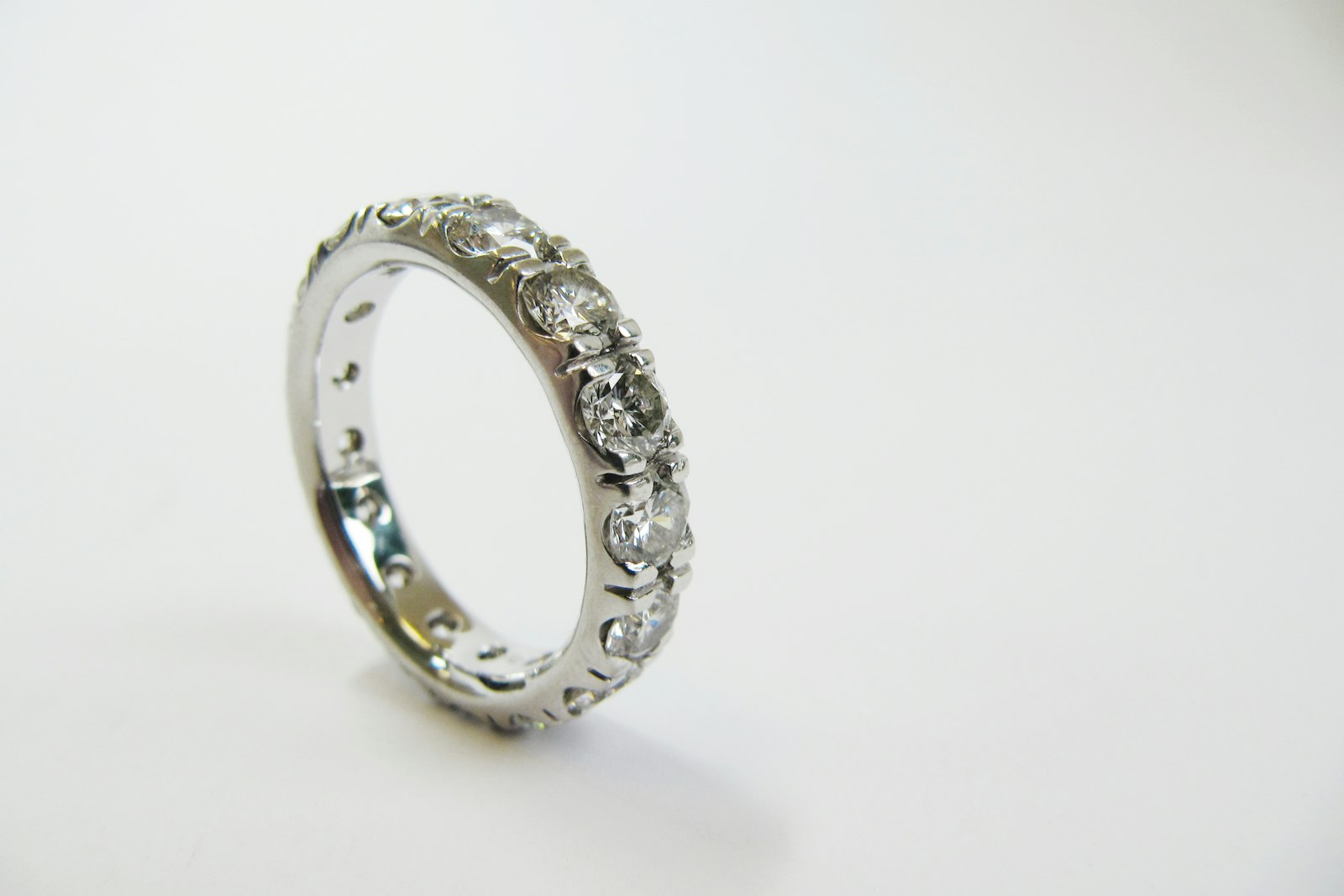
When people shop for an engagement ring, the diamond takes almost all of the attention. The metal holding it decides rather more than most buyers expect: how the ring ages, how much maintenance it asks for, how secure the stone is, and how the whole thing looks after ten years of daily wear. Platinum and white gold look similar in a display case and behave quite differently on a hand.
Here is what actually separates them.
What white gold is
White gold is an alloy. Pure gold is yellow and far too soft for a ring worn every day, so it is mixed with other metals — palladium, zinc, nickel or copper, depending on the formula — to harden it and shift its colour. The result is still faintly warm rather than truly white, so most white gold jewellery is then plated with rhodium, a bright white metal from the platinum family, to give it the finish buyers expect.
It is usually sold as 14k, which is 58.3% pure gold, or 18k, which is 75%. The higher the gold content, the more the warm base tone shows through once the plating starts to wear, and the sooner that becomes noticeable.
That plating is the key fact about white gold, and the one most often glossed over at the point of sale. It is a surface layer, it wears off, and it is replaced as routine maintenance.
What platinum is
Platinum is not plated. A ring marked platinum is typically 90 to 95 per cent pure platinum — hallmarked Pt900 or Pt950 — and the white colour goes all the way through. There is nothing to wear off and nothing to redo.
It is also considerably denser than gold, which is why a platinum ring feels noticeably heavier in the hand than a white gold one of the same design. Some people love that weight; a few find it distracting. It is worth handling both before deciding, because it is not something you can judge from a photograph.
How each one ages
Both are durable enough for daily wear. They simply show their age differently, and this is the difference that matters most over a lifetime.
Platinum scratches more readily than white gold, but it does not lose metal when it does. When platinum is scratched the metal is pushed aside rather than worn off, so the surface develops a soft, slightly matte finish — a patina. A great many people come to prefer that look, and it is one of the reasons platinum suits antique-style designs. If you want the original mirror polish back, a jeweller can restore it, and the metal you started with is still there. Over decades of hard wear a platinum shank will eventually thin like any other, but it does so far more slowly than an alloy that loses material with every scratch.
White gold is harder and resists scratching better, but its finish is temporary. As the rhodium plating wears, a faint warm tone comes through — usually noticeable after one to three years of daily wear, sooner on an active hand and on the inside of the band where it rubs. Replating restores it completely and takes a jeweller a week or two. Done periodically, white gold can look new indefinitely. Left undone, the ring looks tired, and the contrast between the plated and worn areas is more obvious than an even warm tone would be.
The trade-off, stated plainly: platinum asks nothing of you but shows its history; white gold hides its history but asks for periodic upkeep.
Setting security and design
Platinum’s strength and density mean prongs can be finer while still holding a stone securely. That matters for delicate, filigree and vintage-inspired settings, where thick prongs would spoil the design. It is also why platinum is the traditional choice for antique-style work and for very fine pavé.
White gold prongs need to be a little more substantial to do the same job. For a clean modern solitaire this makes almost no visible difference. For an ornate setting with a lot of fine metalwork, it can change the character of the piece.
Whichever metal you choose, prongs are wear items and should be checked by a jeweller periodically. That is true of both metals and is a bigger factor in whether you keep your stone than the metal choice itself.
Cost
This is where the two diverge most, and where a specific figure would be misleading: both platinum and gold trade on daily markets, the gap between them moves, and it has at various points narrowed sharply and widened again. Your jeweller can quote the same design in both metals on the day, which is the only comparison worth acting on.
What is stable is the shape of the comparison. Platinum carries a meaningful premium over 14k white gold, driven both by the metal price and by the extra weight of metal in the ring and the additional skill platinum work requires. 18k white gold sits between the two. Against that upfront difference, platinum needs no replating, while white gold will be replated periodically for as long as it is worn — a modest cost each time that accumulates over decades. Over a lifetime the gap narrows; at the point of purchase it is real.
Neither answer is wrong. 14k white gold makes a beautiful, hard-wearing ring, and choosing it to put more of the budget into the stone is a perfectly sound decision.
Appearance over time
Platinum has a naturally white, slightly cool, neutral tone, and it keeps it. Freshly rhodium-plated white gold is actually brighter and whiter than platinum — rhodium is a very white metal — so a new white gold ring can look crisper in the case than the platinum beside it. The difference is what happens next: the platinum will look the same in twenty years, and the white gold will not unless it is maintained.
If you want a metal that never changes, that is platinum. If you do not mind a warm tone developing, or you intend to have the ring serviced regularly anyway, white gold is not a compromise.
Metal sensitivity
Nickel is the most common cause of contact allergy in jewellery, and some white gold alloys contain it. Nickel-free white gold exists, and 18k white gold alloyed with palladium rather than nickel is a common alternative — worth asking about specifically rather than assuming, because the alloy is not usually stated on a price tag.
Platinum very rarely causes a reaction, which is why it is often suggested for people who have had trouble with other jewellery. If you have a known metal allergy, that is a question for your doctor as well as your jeweller, and it is worth raising before the ring is made rather than after.
One point that catches people out: a reaction to a white gold ring is sometimes a reaction to the alloy showing through worn plating rather than to the ring as it was when new. If a ring that was comfortable for years becomes irritating, worn rhodium is a likely explanation.
Rhodium plating: what the upkeep involves
Most white gold is plated with rhodium, a bright white metal from the platinum family. The plating wears fastest on the underside of the band and on surfaces that touch desks, steering wheels and other rings. How quickly it wears depends on the alloy, the thickness of the plating and how the ring is worn. When the warmer colour of the gold underneath begins to show, a jeweller can clean, polish and re-plate the ring, often within a few days.
Ask what re-plating costs when you buy, and treat it as part of the long-term cost of a white gold ring. With daily wear, many owners have their rings re-plated every year or two.
Karat and alloy choices in white gold
White gold is sold in different purities. 18 karat white gold is 75 per cent gold, and 14 karat is about 58.5 per cent gold. 14 karat is slightly harder and usually less expensive; 18 karat contains more gold and has a richer weight in the hand. The metals mixed with the gold matter as much as the karat. Some white gold alloys use nickel, which whitens the metal well but is a common cause of skin reactions. Others use palladium, which is generally better tolerated and tends to cost more. If you have sensitive skin, ask which alloy the jeweller uses before you commit.
Platinum purity marks
Platinum jewellery is usually around 95 per cent pure and is often stamped PT950 or PLAT. Some pieces are made in 90 per cent platinum, stamped PT900. Lower-purity platinum alloys also exist, so check the stamp and the written description before comparing prices between sellers.
Resizing, repairs and future changes
Both metals can be resized. White gold is generally quicker and cheaper for a jeweller to work, and resizing usually finishes with fresh rhodium plating. Platinum work needs higher temperatures and specialist skill, so it can cost more, but it does not need plating afterwards. If you plan to add a wedding band later, consider matching the metal: a harder metal worn against a softer one can wear the softer ring faster over the years.
Questions to ask before you buy
- What is the karat or purity, and what does the stamp say?
- For white gold, is the alloy nickel-based or palladium-based?
- Is the ring rhodium plated, and what does re-plating cost?
- Are the claws or prongs in the same metal as the band?
- What do resizing and future repairs cost?
Which to choose
Platinum suits you if you would rather not think about maintenance, you want a white tone that never shifts, you like the idea of a patina rather than dreading it, you are having an intricate or antique-style setting made, or you have had trouble with other metals.
White gold suits you if the upfront cost matters and you would rather put the difference into the stone, you are happy to treat replating as part of normal jewellery care, you prefer maximum scratch resistance in the metal’s surface, or you simply like how it looks — which is a perfectly good reason on its own.
Both will serve well for decades. The best metal is the one that suits how you live and what you want to stop thinking about — and the honest test is to try the same design in both and see which one you keep looking at.