Disclosure: this article contains affiliate links, marked “(affiliate link)”. If you buy through one, Diamond Taire may earn a small commission at no extra cost to you. We only link to shops, never to other information sites.
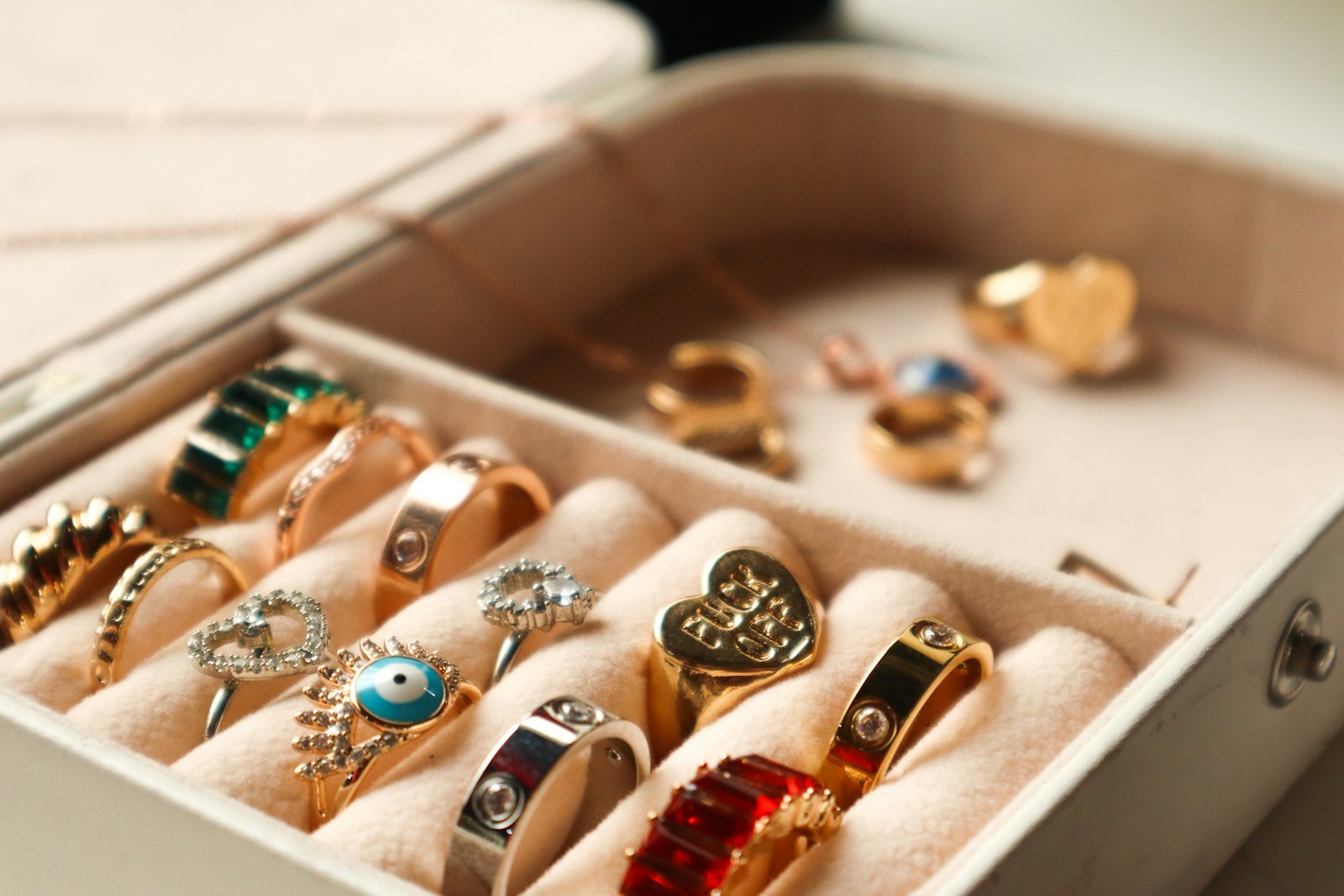
A jewellery collection is not really a shopping list. It is closer to a wardrobe: a small group of pieces worn in different combinations, on different sorts of days, over years. The ones that earn their place are rarely the ones that looked most impressive under the shop lights. They go with what you already own, survive being worn without much thought, and still look right a decade later.
So rather than a set of things you ought to have, this is a guide to building that kind of collection slowly: which pieces do the most work, how to make things bought years apart sit together, and how to spread the buying out instead of assembling it all at once.
Start with the pieces that do the most work
The useful test is not beauty, it is frequency. A piece worn twice a year and a piece worn four days a week are not comparable purchases, whatever they cost. A handful of formats survive that test for most people, and they are worth understanding as categories rather than items to tick off.
A pair of simple studs
Earrings are the highest-utility category in most collections. They are visible in every context, never get in the way of your hands, and a plain stud goes with everything from a work shirt to black tie. Diamond studs are the classic version, though a gold ball or small coloured stone does the same job.
Somewhere around three-quarters of a carat to a carat and a half per pair suits most ears for everyday wear; smaller reads as quiet and modern, larger as evening. Check the backs before the stones: screw or locking backs are worth the small extra cost, because a butterfly back on a heavier stud is the most common way people lose an earring.
A fine chain with a small pendant
A delicate chain with a modest diamond or gemstone pendant, somewhere in the quarter to three-quarter carat range, is the most quietly useful necklace you can own. It sits under a collar, wears alone with a T-shirt, and layers with almost anything. The pendant is not usually what fails; the chain is, so buy a heavier gauge than looks necessary and ask what the jump ring and clasp are made of.
A ring you can wear most days
A simple solitaire, a plain band or a low-set stone in a secure setting is the piece most likely to become the one you feel undressed without. Cut quality matters more than size here, because a well-cut smaller stone out-performs a larger dull one in ordinary indoor light, where it spends most of its life. Around VS clarity, and a colour grade that looks white against your metal, is a sensible floor; beyond that you are paying for things you cannot see.
A bracelet
A line bracelet, a fine chain or a plain bangle adds movement to an outfit in a way nothing else does. Bracelets take more knocks than anything else, so construction is everything: a proper box clasp with a safety catch, and flexible links rather than a rigid run of settings that will stress at one point.
A strand of pearls
Pearls do something diamonds cannot, which is soften the face, and they behave nothing like gemstones. They are soft, porous and easily damaged by perfume, hairspray and perspiration, so they are an occasion piece, and they need restringing periodically. Knotting between pearls is not decoration: it stops them abrading each other and stops the strand escaping if the silk breaks.
One piece that is only yours
Every collection benefits from something that is not sensible: a cocktail ring, an unusual coloured stone, a piece inherited or found. This is where personality lives, and one is usually enough.
Where to buy affordable silver pieces
If you are building a collection on a budget, sterling silver is an easy place to start. SilverRushStyle sells sterling silver rings, pendants and earrings, many set with natural gemstones.
Browse sterling silver at SilverRushStyle → (affiliate link)
Metal consistency, and why it matters more than it sounds
Pieces bought a decade apart still end up on the same hand and the same neckline. Choosing a dominant metal early makes everything you buy afterwards easier, because you are always adding to something rather than starting again.
Two practical points beyond the aesthetic one. White golds vary: alloys and rhodium plating differ between makers, so two white gold pieces bought in different places may not read as the same colour side by side, and plating wears off in time and needs redoing. Hardness differs too, and a softer piece worn tight against a harder one loses that argument over years of contact. Mixing metals is a genuine style choice rather than an error, but it works best when it is deliberate and the pieces are not rubbing together. Our separate guide to metals covers the trade-offs properly.
Day, evening and occasion
Most people buy as though their life were mostly occasions, when in fact it is mostly Tuesdays. Sort candidates into three registers.
- Day. Low profile, secure, nothing that snags on a jumper or a seatbelt, nothing you would be anxious about at the supermarket. This should be the bulk of the collection.
- Evening. More scale, more movement, more light. These earn their place by being versatile enough to appear several times a year.
- Occasion. Weddings and anything with a dress code. The most over-bought category, and the one where wearing the same thing repeatedly is entirely reasonable.
Building in stages, on a real budget
The sensible sequence is by frequency of wear, not by importance. Buy the thing you would wear most days first, even if it is the least dramatic item on the list. The second purchase should fill the largest gap in what you actually do — if your life has more work days than parties, that is another day piece. Three habits make a slow build work:
- Decide the piece before the budget. Knowing exactly what you are saving for stops the drift into buying something adjacent and slightly wrong because it was available today.
- Wait rather than downgrade. Compromising on cut or construction to reach a size target almost always produces a piece that gets worn less. Compromising on size rarely does.
- Do not buy sets. Matched sets look coordinated in the box and inflexible in life. Pieces that merely share a metal and a sensibility combine in far more ways.
Where it is worth spending, and where it is not
Worth spending on: cut quality in any stone, because it decides whether a piece looks alive; the parts that hold things together, meaning clasps, prongs, settings and chain gauge; and anything worn daily, where construction is repaid in years of service.
Less worth spending on: clarity beyond the point where a stone is clean to the naked eye; colour grades invisible once a stone sits in yellow gold; brand premiums on plain chains and bands; and elaborate design on a piece you have admitted you will wear twice a year.
Buying pieces that survive daily wear
Things fail in predictable places. Chains go at the jump ring or the clasp. Prongs thin and eventually catch and bend, usually the ones facing outwards. Small pavé stones drop out of worn beads. Ring shanks thin at the bottom. Earring backs loosen. Almost none of this is sudden, so almost all of it is preventable if someone looks at the piece occasionally. When choosing for durability rather than for the photograph:
- Setting. A bezel or half-bezel protects a stone’s edges far better than prongs. If you prefer prongs, six hold more securely than four, and a lower profile catches on less.
- Vulnerable stones. Any stone with a point or a sharp corner needs a setting that covers it — a question to ask directly when buying.
- Metal. Higher-purity gold is softer, so an 18 carat band shows wear sooner than a 9 or 14 carat one; platinum is dense and tends to displace rather than lose metal, which is why it holds settings well but marks readily.
- Gemstone hardness. Diamond and sapphire take daily wear happily. Emerald, opal, tanzanite and pearl do not belong in a ring you never take off.
An annual look at prongs and clasps by a jeweller catches most of this. Cleaning is covered in our care guide, and documentation and valuation in our piece on insuring and appraising jewellery.
Sizing and fit, especially for gifts
Fit is where well-chosen gifts most often go wrong. Rings are the hardest: fingers change size with heat, time of day and the passing years, and the ring must clear a knuckle that may be wider than the base of the finger. Wide bands fit more tightly than narrow ones at the same nominal size, so a broad band usually needs to go up. For a surprise, slightly large is more recoverable than small.
Necklace length interacts with neckline: a shorter chain sits at the collarbone and suits open necks, a longer one falls onto the sternum and works over knitwear. If layering is the intent, leave a gap of several centimetres between chains or they will tangle into one. Bracelets need to clear the widest part of the hand if rigid, and to move without sliding off if flexible. Earrings avoid sizing entirely, which is why they are the safest gift, followed by pendants on adjustable chains.
Trend pieces, and how to tell them apart
There is nothing wrong with buying something because it is of the moment. The mistake is buying it at the price of a piece meant to last.
Designs that date tend to share features: novelty motifs, extreme proportions, hardware borrowed from a season’s fashion, plating over base metal, and anything so distinctive you can name the year it came from. Designs that survive are simpler in geometry, restrained in scale, and interesting because of how well they are made rather than how unusual they look. A useful question: would you still want this if it were not currently everywhere? If not, buy it cheaply and enjoy it for what it is.
A word about value
The word “investment” gets attached to jewellery very loosely, and it is worth being plain. Most jewellery sells second-hand for well below what was paid for it, because retail prices include design, manufacture, distribution and shop margin, none of which comes back. A piece can be durable, repairable and worth keeping for a lifetime without being a financial asset; those are different claims, and only the first should shape what you buy. For how diamond value actually behaves, see our separate article on why fine diamonds hold value.
Wear the things
The most common fault in a collection is not what was bought but that it sits in a box. Keep the daily pieces where you can see them, rotate the occasional ones into ordinary days, and if something genuinely has not been worn in years, consider having it reset into a form you would wear.