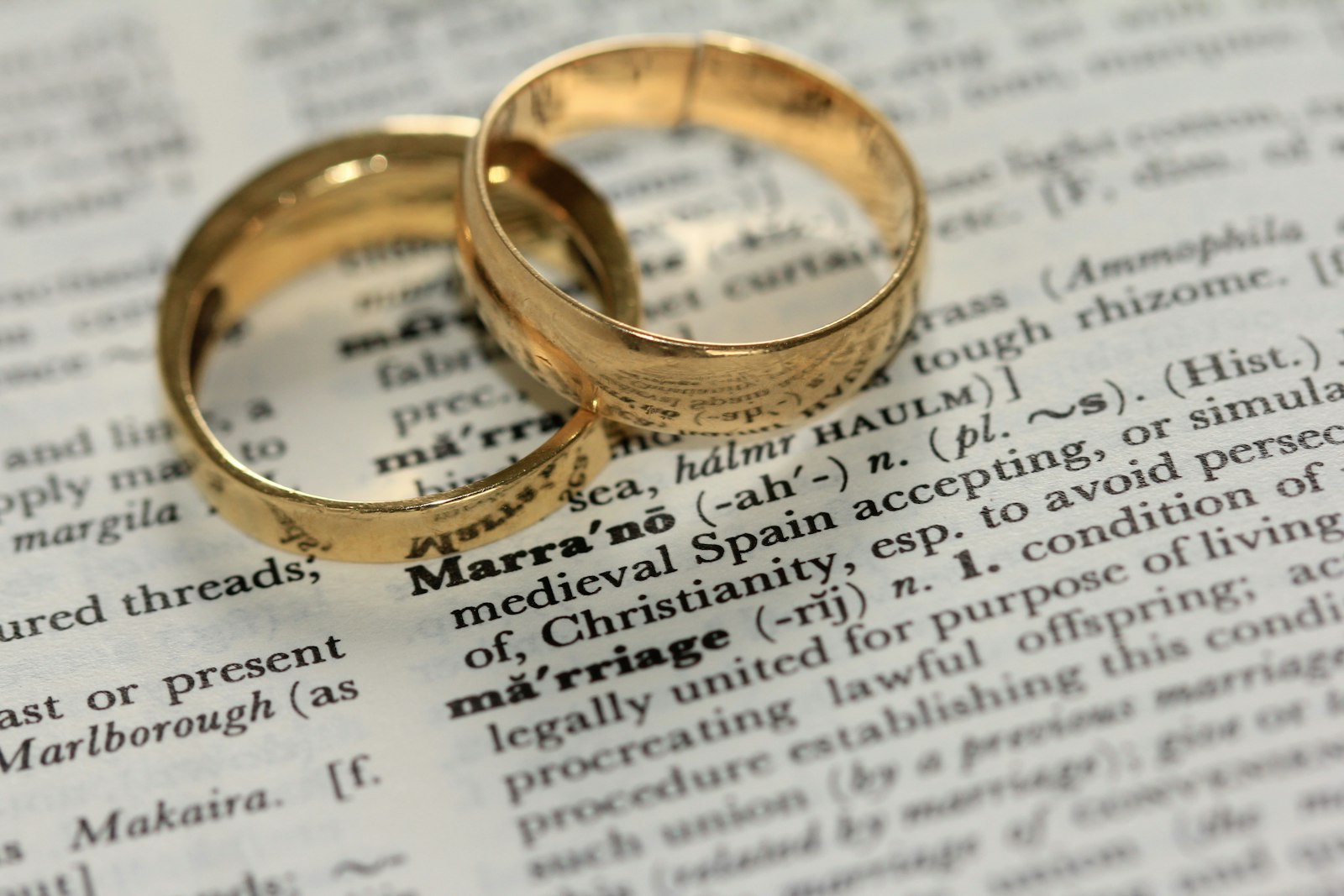
A wedding band is the piece of jewellery most likely to be worn every day for fifty years, and it is usually chosen in an afternoon after the engagement ring has absorbed all the attention and most of the budget. That is backwards. The band is the harder engineering problem, because it has to survive constant wear, sit against another ring without damaging it, and still fit a hand that will change over decades.
Here is what to think about.
First: will it sit flat against the engagement ring?
This is the question that decides most of the rest, and it is the one people discover too late.
A straight band placed next to a solitaire whose stone sits in a raised setting will not sit flush. There will be a wedge-shaped gap. Worse, if the setting overhangs the shank, the two rings will grind against each other every time the hand is used, and over years that wears a visible groove into the softer of the two.
Your options:
A contoured or shadow band. Cut with a curve or a notch that follows the profile of the engagement ring’s setting, so the two nest together. This is the standard solution and it works well. The catch is that a contoured band is shaped for one specific ring — it will look odd worn alone, and it will not fit a different engagement ring later.
A straight band with a spacer. A thin plain ring worn between the two, lifting the band clear of the setting. Discreet, cheap, reversible, and it protects both rings from contact wear. Under-used.
Choose a low-profile engagement ring in the first place. A bezel or basket setting that sits close to the finger accepts a straight band without any modification. If you have not bought the engagement ring yet, this is the easiest answer to a problem you can simply avoid having.
Buy them as a bridal set. Designed together, guaranteed to fit. The constraint is that you are committing to both designs at once, and replacing one later is difficult.
Wear them on different hands or different fingers. Increasingly common, entirely legitimate, and it removes the problem completely.
Have the engagement ring soldered to the band. Some couples fuse the two into a single unit. It eliminates spinning and wear between them permanently. It also means neither can be worn separately again, resizing becomes a bigger job, and cleaning the join is harder. It is not reversible in any practical sense. Think about it for a year before doing it.
Metal: match it, or don’t, but do it deliberately
Mixing metals is fine aesthetically — a rose gold band with a white gold engagement ring is a deliberate look and many people love it.
Mixing metals of very different hardness is a practical problem. When two rings rub together constantly, the softer one wears. A platinum ring against an 18k gold ring will, over years, wear the gold. If you are mixing, use a spacer, or accept that one ring will need its shank rebuilt eventually.
Quick metal notes for a ring that will be worn daily:
- Platinum. Dense, hypoallergenic, holds prongs superbly. It does not lose metal when scratched — it displaces it, developing a soft matte patina. Some people love that patina; those who do not can have it repolished. Heavier on the hand than gold, which people either like or notice constantly.
- 18k gold. Rich colour, 75% pure gold. Softer than 14k, so it marks more readily. White gold is almost always rhodium plated and that plating wears through in one to three years and needs redoing — a small recurring cost that catches people by surprise.
- 14k gold. Harder, more scratch-resistant, less expensive, slightly less saturated in colour. Often the better practical choice for a band that will take daily punishment.
- Palladium. White, light, hypoallergenic, no plating needed. Less common than it once was and fewer jewellers work with it.
- Titanium, tungsten carbide, ceramic, cobalt. Extremely hard, very scratch-resistant, inexpensive, and available in finishes gold cannot achieve. Two significant limitations: they cannot be resized — they are replaced instead — and in an emergency they must be cracked or cut off with specialised tools rather than the standard ring cutter. Emergency departments do this routinely and it is not the safety hazard it is sometimes made out to be, but it is worth knowing.
- Silver. Beautiful and inexpensive, but too soft for daily wear over decades. It deforms and tarnishes. Fine for a fashion band, not for a lifetime one.
Width and profile change how a ring feels
Width. Women’s bands commonly run 2–4mm, men’s 4–8mm. This is convention, not rule. What matters is the hand: a wide band on a short finger visually shortens it further; a narrow band can look lost on a broad hand.
Remember the sizing consequence: a band 6mm or wider fits more tightly than a narrow band of the same nominal size, because it covers more finger. Go up a quarter to a half size, and tell the jeweller the width so they can allow for it.
Profile — the cross-section shape — affects comfort more than anything else:
- Flat. Modern, architectural, sits squarely. Sharper edges can feel more present.
- Domed / court. Rounded outside, gently rounded inside. The traditional shape and the most forgiving.
- Comfort fit. Domed on the inside, so the band rides on a rounded surface rather than flat edges. Noticeably more comfortable for wide bands and for anyone whose fingers swell. It fits more snugly than a standard fit of the same size, so it usually needs a slightly larger size. For any band 5mm or wider, comfort fit is worth the small extra cost.
- Knife edge. A ridge along the outside. Elegant, but the ridge wears down over years and it is the least forgiving profile against an adjacent ring.
Finish: choose one you can live with as it ages
- Polished. Bright, classic, shows every scratch — but is also the easiest to restore. A polished band can be brought back to new in minutes.
- Matte / satin / brushed. Contemporary, hides small scratches well, but it slowly polishes itself on the high points through wear and eventually looks patchy. It can be re-finished, but that is a recurring cost.
- Hammered. Texture disguises wear better than any other finish, and it ages gracefully. Probably the most practical choice for someone hard on their hands.
- Milgrain (a beaded edge). Beautiful, and it does wear smooth over decades. It can be re-cut by a good jeweller.
Diamond bands: eternity, half-eternity and plain
Full eternity bands — stones all the way around — are stunning and have one enormous drawback: they cannot be resized. There is nowhere to cut. If your finger size changes, and over fifty years it very likely will, the only remedy is remaking the ring. Full eternity bands also sit stones against the palm, where they take the most impact and are most likely to loosen.
Half-eternity bands — stones across the top half only — solve both problems. They can usually be sized within a limited range, and the plain underside is comfortable and durable. For a ring that will be worn every day, this is almost always the better engineering choice, and the difference is invisible when worn.
Channel-set stones sit in a groove between two metal walls, protected on both sides. This is the most secure and most snag-resistant way to set stones in a band, and the best choice for daily wear.
Pavé is brighter and more delicate. Expect to lose a small stone occasionally over decades; treat it as maintenance rather than a fault.
Plain bands are the most durable object in this entire article, need almost nothing, and look right on every hand at every age. There is a reason they have never gone away.
Stacking
Stacked bands — several thin rings worn together, often added over time to mark anniversaries or children — have become one of the most popular approaches, and they solve several problems at once.
What works:
- Keep individual bands thin, 1/5–2.5mm. Three thin bands read as intentional; three medium bands read as crowded.
- Vary texture, not just metal — one plain, one hammered, one with stones — so the stack has rhythm.
- Mind the total width. Four 2mm bands is 8mm of finger covered, and the whole stack fits more tightly than the sum of its parts suggests. Size the stack, not each ring in isolation.
- Buy stackers that are flat-profiled on their contact faces so they sit against each other without rocking.
- Accept that they will wear against each other. Matching metal hardness across the stack reduces this considerably.
The advantage over one wide band: you can add to it over decades, and if your size changes, plain thin bands are the easiest thing in the world to resize.
Engraving
Common choices: initials and the wedding date, a short phrase, coordinates, a line of handwriting reproduced from the original.
Practical notes:
- Inside engraving is protected and lasts. Outside engraving wears away.
- Machine engraving is crisp, cheap and uniform. Hand engraving is deeper, more characterful, more expensive, and holds up better over a very long time.
- Engraving almost always voids the return policy. Do not engrave until you are certain — of the ring and the size.
- Engraving slightly reduces the interior space, and deep engraving can affect later resizing. Tell the jeweller if the ring might need sizing.
- Leave room. A 4mm band holds far more characters than a 2mm one.
Buying for a lifetime, not for a day
A few things that matter at year twenty and are invisible at week one:
- Buy a size that is right, and expect it to change. Fingers change with weight, age, pregnancy, arthritis, medication and season. Choose a band that can be sized — this is the single strongest argument against full eternity bands and against titanium and tungsten.
- Choose a design that can be repaired. Plain and simple designs can be rebuilt by any jeweller anywhere in the world in fifty years’ time. Highly specific proprietary designs may not be.
- Have both rings inspected annually. Prongs and settings fail; that is what fails, not stones. Many jewellers do this free.
- Clean it fortnightly. Warm water, a drop of mild dish soap, a soft toothbrush around the underside. That is the whole method.
- Take it off for gym work, gardening, heavy lifting and swimming in chlorine. Most ring damage happens in about six identifiable activities.
- Insure it. Household contents policies commonly cap individual items well below the value of wedding jewellery, and often require the piece to be specified by name and value. Get an independent valuation and check the policy wording. Photograph both rings, keep the certificates, and keep a copy somewhere other than the house.
- Consider a silicone band for the gym, travel, hiking and hands-on work. Inexpensive, and it means the real ring is at home rather than in a locker.
The short version
- Solve the flush-fit problem first — contoured band, spacer, low-profile engagement ring, or different fingers.
- Match metal hardness where two rings touch, or use a spacer.
- Comfort fit for anything 5mm or wider, and size up for width.
- Half-eternity over full eternity for a daily ring, every time.
- Channel setting for security; hammered or polished finish for graceful ageing.
- Do not engrave or resize until the return window has closed.
- Buy something that can be sized and repaired in forty years.
The band you can still wear, still fit and still repair in 2076 is a better ring than the one that photographed best in 2026.
This article is educational and general in nature. Metal properties, sizing conventions, insurance terms and available services vary between markets and providers. Consult a professional jeweller for fitting and an independent valuer for insurance purposes.