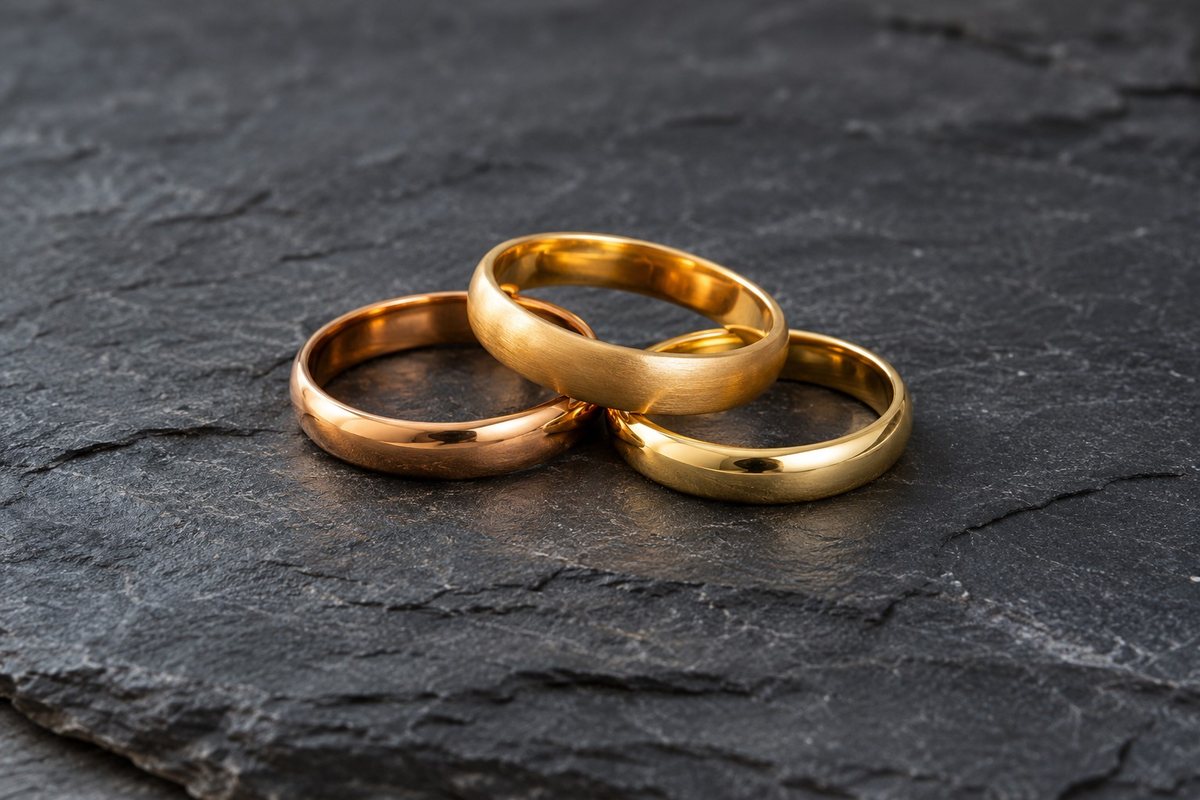
For most everyday jewellery, 14k gold is the safest all-round choice: it is 58.5 per cent gold, tough enough for daily rings and still a warm, true gold colour. Choose 18k (75 per cent gold) if you want a richer colour or have sensitive skin and accept a little more wear, and 9k or 10k if hardness and a lower price matter most. The karat number simply tells you how many of 24 parts are pure gold.
This guide includes a few product links near the end. As an Amazon Associate, Diamond Taire earns from qualifying purchases, at no extra cost to you.
This guide explains what karats mean, how each standard compares, why a higher number is not automatically better, how to read stamps and hallmarks anywhere in the world, and how to match a karat to the way a piece will actually be worn.
At a glance
- Karat = purity out of 24. 9k is 37.5% gold, 14k is 58.5%, 18k is 75%, 22k is 91.6% and 24k is essentially pure.
- Lower karat = harder, paler, cheaper. Higher karat = softer, richer in colour, gentler on most skin.
- 14k suits most daily rings; 18k suits people who want deeper colour or have nickel sensitivity; 22k and 24k suit necklaces, bangles and traditional pieces more than stone-set rings.
- Colour (yellow, white, rose) comes from the alloy, not the karat. Same karat, same gold content.
- Check the stamp and the weight. A heavy 14k piece can hold more gold than a light 18k one.
What a karat actually measures
Gold purity is measured in 24 parts. Pure gold is 24 karat, meaning all 24 parts are gold. An 18 karat alloy contains 18 parts gold and 6 parts other metals, so it is 75 per cent gold. The remaining metals, called alloys, are usually silver, copper, zinc, nickel or palladium, depending on the colour and properties the maker wants.
Karat (with a k) refers to gold purity. Carat (with a c) is the unit of weight for gemstones, where one carat equals 0.2 grams. The two words sound the same but have nothing to do with each other, and many countries, including the United Kingdom and Australia, spell gold purity as “carat” too (18ct), which adds to the confusion. On a diamond ring, the stone is described in carats of weight and the metal in karats of purity.
Pure gold is too soft for most jewellery. It bends, scratches and wears quickly, which is why alloys are added. Alloys make gold harder and more durable, and they also change its colour.
Gold karats compared
The table below shows the most common gold standards, their gold content and the fineness number you are likely to see stamped. The fineness number expresses purity in parts per thousand.
| Karat | Gold content | Fineness stamp | Colour (yellow gold) | Durability | Typical uses |
|---|---|---|---|---|---|
| 9k | 37.5% | 375 | Pale yellow | Hard, resists scratches well | Everyday rings, chains and budget fine jewellery (UK, Australia, Ireland) |
| 10k | 41.7% | 417 | Pale yellow | Hard, resists scratches well | Class rings and everyday pieces (United States, Canada) |
| 14k | 58.5% | 585 | Warm yellow | Good balance of hardness and colour | Engagement rings, wedding bands, daily wear |
| 18k | 75% | 750 | Rich yellow | Softer; scratches more readily | Fine and high-end jewellery, sensitive skin |
| 22k | 91.6% | 916 | Deep, saturated yellow | Soft; dents and scratches easily | Bangles, necklaces, traditional and heritage pieces |
| 24k | 99.9% | 999 | Deepest yellow | Very soft | Coins, bars, some traditional jewellery |
Fourteen karat works out at 58.3 per cent in theory, but it is usually made and stamped at 585 so that it never falls below the legal standard.
Each karat in detail
9k gold
Nine karat is the lowest gold standard recognised in the United Kingdom and is widely used there, in Ireland, Australia and several other markets. With less than half its content as gold, it is hard-wearing and keeps a crisp finish. Its colour is noticeably paler than higher karats, and because it contains more alloy metals it can dull or discolour slightly over time and is more likely to bother people with sensitive skin.
10k gold
Ten karat is the lowest purity that can be marketed as karat gold in the United States, under the Federal Trade Commission’s jewellery guides. It is common in North American jewellery, and its properties are very close to those of 9k.
14k gold
Fourteen karat is popular for engagement rings, wedding bands and everyday jewellery in many parts of the world. It offers a warm yellow colour while remaining tough enough for daily wear, so for many people it is the practical middle ground.
18k gold
Eighteen karat is the traditional fine jewellery standard in much of Europe and is widely used for high-end pieces. Its richer colour sits beautifully against the skin and, with fewer alloy metals, it is less likely to cause reactions. It is softer than 14k, so it shows scratches and wear sooner, particularly on rings, though it remains perfectly suitable for daily wear with sensible care.
22k gold
Twenty-two karat gold has a deep, saturated colour and is traditional in South Asian, Middle Eastern and some Southeast Asian jewellery, where it is often worn as both adornment and family wealth. It is soft, so it is better suited to necklaces, bangles and earrings than to rings set with valuable stones, where prongs need to stay strong.
24k gold
Pure gold is used for some traditional jewellery, coins and bars. It is too soft for most set jewellery and marks very easily.
Higher karat is not automatically better
It is natural to assume that more gold means a better piece. In reality, each karat suits a different purpose. Here is how the main trade-offs usually play out:
- Colour: higher karats are richer and deeper in colour; lower karats are paler.
- Durability: lower karats resist scratches and dents better; higher karats show wear sooner.
- Stone security: harder alloys hold prongs and settings more firmly over time.
- Skin sensitivity: higher karats contain fewer alloy metals and are less likely to cause reactions.
- Tarnish: higher karats are less prone to discolouration.
- Cost: because gold content rises with karat, higher karats generally cost more for the same weight and design.
Weight matters too. A heavy 14k ring can contain more gold than a very light 18k ring, so karat alone does not tell you how much gold a piece holds. When comparing pieces, look at both the karat and the weight in grams.
A worked example
Imagine two plain bands. One is 18k and weighs 4 grams; the other is 14k and weighs 6 grams. The 18k band holds 3 grams of pure gold (4 × 0.75). The 14k band holds about 3.5 grams (6 × 0.585). The “lower” karat ring actually contains more gold, will feel more substantial and will usually wear thin more slowly. This is why comparing price per gram of pure gold, rather than karat alone, gives a fairer picture of value for money.
Which karat suits which person?
| If this sounds like you | Consider | Why |
|---|---|---|
| You wear rings every day and work with your hands | 14k, or 9k/10k | Harder alloys resist knocks and hold prongs better |
| You love a deep, buttery yellow | 18k or 22k | More gold means richer colour |
| You react to cheap jewellery | 18k, or nickel-free white gold | Fewer alloy metals, or no nickel at all |
| You want the lowest price for a real gold piece | 9k or 10k | Least gold content per gram |
| You are buying a heritage or wedding-tradition piece | 22k | Matches cultural expectations and existing family pieces |
Yellow, white and rose gold
The karat number describes purity, not colour. The colour comes from the alloy mix:
- Yellow gold uses a balance of silver and copper to keep a natural golden tone.
- Rose gold uses a higher proportion of copper, giving a pink or reddish tone. Lower-karat rose gold tends to look pinker because it contains more copper.
- White gold uses white metals such as palladium or nickel. Most white gold is then plated with rhodium for a bright white finish, which wears over time and can be renewed.
A white gold ring and a yellow gold ring of the same karat contain the same proportion of gold. For a detailed comparison of white metals, see the guide to platinum and white gold, and for a wider look at metal choices, the guide to choosing the right jewellery metal.
Gold and sensitive skin
Most reactions to gold jewellery are caused by alloy metals rather than gold itself. Nickel is the most common trigger, and some white gold alloys contain it. The European Union restricts how much nickel jewellery that touches the skin may release, but rules differ between countries, so it is worth asking. People who react to lower-karat gold often find that 18k or nickel-free white gold, such as palladium-based alloys, is more comfortable. If you have known sensitivities, ask what the alloy contains before buying; a jeweller should be able to tell you.
Reading hallmarks and stamps
Gold jewellery is usually stamped with its purity, either as a karat (such as 18K or 18ct) or as a fineness number (such as 750). In some countries hallmarking is legally required and carried out by independent assay offices. In the United Kingdom, for example, gold articles over 1 gram must be hallmarked by an assay office before they can be described as gold, and the full mark can include the sponsor, the fineness, the assay office and optionally the year. In other countries, including the United States, a maker’s stamp is usually the only mark and there is no compulsory independent testing.
Be cautious of marks such as GP (gold plated), GF (gold filled), HGE (heavy gold electroplate) or vermeil. These indicate a layer of gold over another metal, not solid gold; the guide to gold vermeil versus gold filled explains how they differ. A small stamp can also be worn away on older pieces, so if a piece is unmarked, a jeweller or assayer can test its purity.
Choosing the right karat: a checklist
- How often will it be worn? Daily rings benefit from tougher 14k or 9k alloys; occasional pieces can be any karat.
- Is it a ring or a pendant? Rings take the most knocks; earrings and necklaces wear far more slowly.
- Will it hold valuable stones? Firmer alloys keep prongs secure for longer. If you are choosing an engagement ring, the engagement ring buying guide covers metal alongside the other decisions.
- What colour do you prefer? Compare karats side by side, as the difference in warmth can be striking.
- Do you have sensitive skin? Consider higher karats or nickel-free alloys.
- Will it be matched with other pieces? Engagement rings and wedding bands look best in the same karat and colour, and wear more evenly together. The guide to matching and stacking wedding bands covers this.
- What does the stamp say, and is there a hallmark? Confirm the karat and the weight in grams in writing on the receipt.
Common mistakes
- Assuming 24k or 22k is the “best” for a ring. High-karat gold is beautiful but soft; prongs wear and stones can loosen sooner.
- Comparing karat without comparing weight. A light high-karat piece can contain less gold than a heavier lower-karat one.
- Mixing karats in a set. A soft 18k band worn against a hard 9k engagement ring can wear unevenly over the years.
- Mistaking plated or filled jewellery for solid gold. Read the stamp for GP, GF, HGE or vermeil.
- Blaming gold for a skin reaction. It is usually the alloy. Ask about nickel before writing off gold altogether.
- Expecting white gold to stay bright white for ever. Rhodium plating wears and needs renewing; budget for it.
Caring for different karats
Softer, higher-karat pieces show scratches sooner, so store them separately and take rings off for gardening, gym work and heavy cleaning. Lower-karat gold can dull a little over time; a gentle wash in warm water with mild soap usually brings it back. The guide to cleaning and caring for diamond jewellery covers safe methods that also suit plain gold.
Related guide: How to Tell If Jewellery Is Real Gold: Safe, Simple Checks.
Related guide: Does Gold Tarnish? Simple, Smart Answers for Every Karat.
Sources this guide draws on: the UK Hallmarking Act 1973 and UK assay office guidance on gold standards; the US Federal Trade Commission Guides for the Jewelry, Precious Metals, and Pewter Industries; the World Gold Council’s guidance on gold jewellery alloys; and GIA educational material on gold and gemstone terminology.
Useful tools for this guide
Practical picks for choosing, checking and caring for jewellery. As an Amazon Associate, Diamond Taire earns from qualifying purchases, at no extra cost to you. Prices and availability are set by Amazon and may vary by country.
- Sunshine Polishing Cloths (5 Pack)
Pre-treated cloths that lift tarnish from sterling silver, gold and brass.
View on Amazon - Rosenthal Anti-Tarnish Strips (100 Tabs)
Drop one in each box or pouch to slow tarnish on stored silver.
View on Amazon - KElofoN Travel Jewellery Case
Compact case with ring rolls and earring slots so pieces do not scratch each other.
View on Amazon
FAQ
Is 9k gold real gold?
Yes. Nine karat gold is a genuine gold alloy containing 37.5 per cent gold. It is legally sold as gold in many countries, including the United Kingdom and Australia, although in the United States the minimum for calling a piece karat gold is 10k.
Which karat is best for an engagement ring?
Both 14k and 18k are popular. Fourteen karat is a little tougher, while 18k has a richer colour and is gentler on sensitive skin. Either works well with regular care and a prong check every year or so.
Is 14k or 18k better for everyday wear?
For pure toughness, 14k has the edge because it is harder and resists scratches better. For colour and skin comfort, 18k wins. Many people wear 18k every day without problems; they simply accept a little more visible wear on rings.
Why does my white gold ring look yellow?
White gold is usually rhodium plated. As the plating wears, the natural warmer tone of the alloy shows through. A jeweller can re-plate it to restore the bright white finish.
Does higher karat gold hold its value better?
Higher karat pieces contain more gold by weight, which affects their metal content. However, what jewellery is worth on resale depends on design, maker, condition and stones as well as metal, so karat is only one factor; the guide to jewellery resale and value explains this in more depth. This is education, not investment advice.
Can I tell the karat just by looking?
Colour can give a rough hint in yellow gold, but it is not reliable, especially for white and rose gold. The stamp, a hallmark or a jeweller’s test is the only dependable way to confirm purity.
Karats measure purity, not quality or worth. Decide how the piece will be worn, choose the colour you love, check the alloy if your skin is sensitive, and confirm the stamp and weight in writing. Do that and you will choose gold that suits your life for decades.