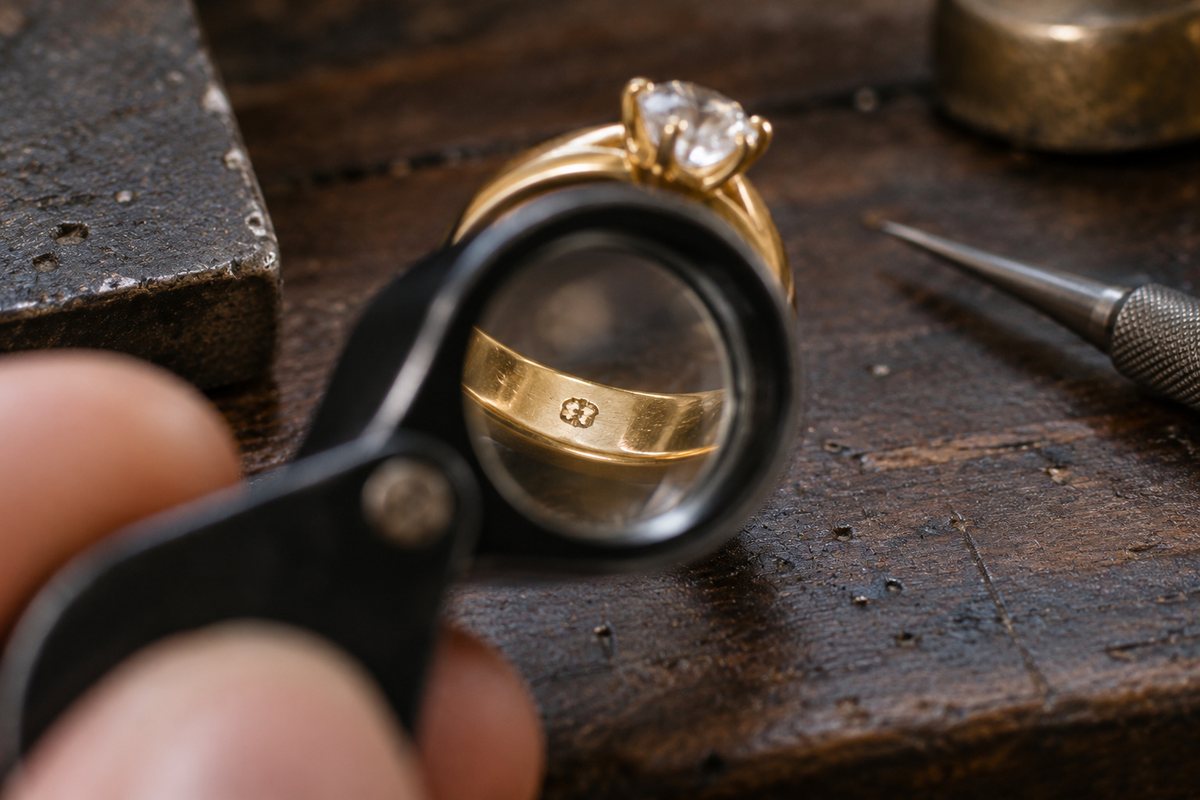
The most reliable way to tell if jewellery is real gold at home is to read its marks: a fineness number such as 375, 585 or 750, or a karat stamp such as 9ct, 14K or 18K, ideally with a maker’s mark beside it. Marks such as GP, GF, HGE or RGP mean the piece is plated or gold filled, not solid gold. A magnet or a close look can rule a fake out, but only a professional test, such as an assay office or an XRF check by a jeweller, can confirm it.
This guide includes a few product links near the end. As an Amazon Associate, Diamond Taire earns from qualifying purchases, at no extra cost to you.
If you are asking “is it real gold?” about a ring, chain or inherited piece, this guide on how to tell if jewellery is real gold ranks the checks from most to least reliable, explains what US, UK and other hallmarks mean, decodes plated and filled stamps, and explains why some popular DIY tests can damage the very piece you are trying to protect.
At a glance
- Start with the stamp. Look inside ring shanks, near clasps and on earring posts with a magnifier.
- Numbers mean parts per thousand. 375 is 9 carat, 585 is 14 carat, 750 is 18 carat and 916 is 22 carat gold.
- Letters can mean a coating. GP, GEP, HGE, RGP and GF describe plated, rolled or filled gold over another metal.
- Home tests only rule things out. A strong magnetic pull or worn patches showing a different metal point to base metal; passing them proves nothing.
- Leave acid and scratch tests to professionals. They can mark or damage jewellery, especially heirlooms.
- The UK is different. UK hallmarks are applied by an independent assay office; in many other countries, stamps are applied by the maker or importer.
Types of gold you might be holding
“Real gold” can mean several things, so it helps to know the main types first:
| Type | What it is | Typical marks | Solid gold? |
|---|---|---|---|
| Solid karat gold | A gold alloy all the way through, from 9 carat to 24 carat | 375, 417, 585, 750, 916, 999; 9ct, 10K, 14K, 18K, 22K | Yes |
| Gold filled | A thick layer of karat gold mechanically bonded to a base metal core | GF, 1/20 14K GF, 14K gold filled | No |
| Rolled gold plate (gold overlay) | A thinner bonded gold layer than gold filled | RGP, 1/40 10K RGP | No |
| Heavy gold electroplate | A thicker electroplated gold layer over another metal | HGE, 10K HGE | No |
| Gold plated or electroplated | A thin electroplated layer of gold | GP, GEP, EP, 18K GP | No |
| Gold vermeil | Gold layered over sterling silver | 925 with vermeil description | No (solid silver base) |
For the detail on filled, vermeil and plated pieces, including how long each lasts, see our gold vermeil vs gold filled comparison. For how karat affects colour, hardness and price, see our guide to gold karats.
Step 1: Find and read the marks
Use a 10x loupe or a phone camera on zoom and good light. Common places for marks are inside a ring shank, on a clasp or its tag, on the back of a pendant bail and on earring posts or butterflies.
Fineness numbers and karat stamps
| Parts per thousand | Karat | Gold content |
|---|---|---|
| 375 | 9 carat | 37.5% |
| 417 | 10 karat | 41.7% |
| 585 | 14 karat | 58.5% |
| 750 | 18 karat | 75% |
| 916 | 22 karat | 91.6% |
| 990 / 999 | 24 karat (fine gold) | 99% / 99.9% |
The UK and the US spell it differently: “carat” and “ct” in the UK and Australia, “karat” and “K” in the US. They mean the same thing for gold purity.
UK hallmarks
In the UK, it is a legal requirement for gold described as gold to be hallmarked by an independent assay office, with an exemption for gold items under 1 gram. According to the UK Assay Offices’ guidance, every hallmark has three compulsory parts: a sponsor’s (maker’s) mark of at least two letters in a shield, a metal and fineness mark showing parts per thousand in a shape that identifies the metal, and the mark of the assay office that tested it. There are four UK assay offices: London, Birmingham, Sheffield and Edinburgh. A date letter is optional today, but was compulsory until 1999, so older pieces often carry one. The approved UK gold standards are 375, 585, 750, 916, 990 and 999.
US stamps
In the US there is no independent hallmarking. Under federal stamping law and the FTC Jewelry Guides, a maker who stamps a quality mark such as “14K” must also stamp a registered trademark close to it, which identifies who is responsible for the claim. The law allows only a very small tolerance below the stated karat. A karat stamp with no maker’s mark next to it is a reason to be more cautious, though older or repaired pieces sometimes lack one.
Australia and other countries
Australia, Canada and many other countries do not have a compulsory independent hallmarking system like the UK’s. Marks such as 9ct or 750 are usually applied by the maker or importer, so they are a claim rather than an independent guarantee. Many countries do have consumer protection or trade description laws against false marking, and some, such as India, run their own hallmarking schemes. If a lot rides on the answer, get the piece tested.
Plated and filled marks
According to US marking guidance, “gold filled” or GF means a layer of at least 10 karat gold bonded to all surfaces that makes up at least one-twentieth of the total metal weight, so “1/20 14K GF” means one-twentieth of the weight is 14 karat gold. Rolled gold plate (RGP) uses a thinner bonded layer, and heavy gold electroplate (HGE) is a thicker electroplated layer. GP and GEP mean gold plated or gold electroplated. In each case, a karat number in the mark describes only the gold layer, not the whole piece, which is why “18K GP” is not solid 18 carat gold. In the UK, gold plated base metal cannot be hallmarked at all.
Step 2: Quick visual checks that can rule a piece out
- Wear patches. Look at edges, clasps and the underside of rings. A different colour showing through, often silver, grey or coppery, suggests plating has worn off.
- Green or black marks on skin. Discolouration often comes from copper or other base metals near the surface, though some lower-karat gold alloys and skin chemistry can also cause marks.
- Flaking or bubbling. Solid gold does not flake; a coating can.
- Price and context. A heavy “solid gold” chain at a fraction of gold’s value is a warning sign in itself.
Step 3: The magnet check (what it can and cannot tell you)
Gold is not magnetic. If a strong magnet, such as a neodymium magnet, pulls firmly on the body of a chain or ring, the core is likely steel, iron or nickel, and it is not solid gold. Clasps and springs often contain steel, so test the main part of the piece, not the fastening.
The important limit: plenty of metals used in fakes, including brass, copper and aluminium, are not magnetic either. So a piece that does not react has only passed one hurdle; it has not been proven to be gold.
Home and professional tests compared
| Test | Who should do it | What it tells you | Risk to the piece |
|---|---|---|---|
| Reading marks | You | The claimed purity and, ideally, who made it | None |
| Visual wear check | You | Can reveal plating wearing through | None |
| Magnet | You | Rules out steel or iron cores only | None |
| Ceramic streak test | Better avoided at home | A rough hint based on streak colour | Removes metal; scratches the piece |
| Acid test on a touchstone | A jeweller or buyer | An estimate of karat range | Needs a small scrape; acids are hazardous |
| XRF analysis | A jeweller, refiner or assay office | The metal make-up near the surface, without damage | None |
| Assay (fire assay or hallmarking) | An assay office | The most definitive answer, used for hallmarking | Small sample may be taken |
X-ray fluorescence (XRF) is the method many jewellers, buyers and assay offices use for a quick answer, and equipment makers describe it as non-destructive. Because it reads mainly the surface, a good tester will combine methods if they suspect thick plating. Assay offices also offer testing services for the public, which is worth considering for heirlooms.
DIY tests to avoid
- The bite test. Pure gold is soft, but most jewellery is an alloy, and biting proves nothing while risking your teeth and the piece.
- Vinegar or household chemicals. Popular online, but no reliable way to judge gold, and harsh liquids can harm gemstones, pearls and finishes.
- Scratching on unglazed ceramic. It removes metal from the piece and leaves marks; on antique or engraved jewellery that is permanent damage.
- Home acid kits. They require a scratch, involve corrosive acids and are easy to misread, especially on plated items.
- Lighter or flame tests. Heat can damage stones, solder joints and any coating.
A simple decision checklist
- Clean the piece gently and find every mark with a magnifier.
- Note whether marks are numbers, karat stamps, letters like GF or GP, or a full hallmark.
- Check for wear patches and a magnet reaction on the main body.
- If marks say solid gold and nothing looks wrong, you have a reasonable indication, not proof.
- If the piece has value, sentimental or financial, ask a jeweller for an XRF test or contact an assay office.
- Before selling, insuring or valuing, get the result in writing.
If the piece also holds stones, our guide on how to tell if a diamond is real ranks the checks for the stone itself. For older pieces, our guide to antique diamond jewellery explains how period and construction help with identification.
Common mistakes
- Reading “18K GP” as solid 18 carat. The karat describes only the plating.
- Treating a non-magnetic piece as proven gold. Brass and copper are not magnetic either.
- Testing the clasp with a magnet. Clasp springs often contain steel even on solid gold chains.
- Scratch-testing an heirloom. Professional XRF can answer the question without marking it.
- Assuming every stamp is truthful. Outside independent hallmarking systems, a stamp is the maker’s claim.
- Confusing white gold with silver or platinum. White gold carries a gold fineness mark; our platinum vs white gold guide explains the differences.
- Selling without a second opinion. If you plan to sell, get a test and more than one offer; our article on resale value explains why offers vary.
Sources this guide draws on: the UK Assay Offices’ hallmarking guidance notes, US Federal Trade Commission Jewelry Guides and US marking and stamping guidance for the jewellery trade, and precious metal analyser manufacturers’ explanations of XRF testing.
Useful tools for this guide
Practical picks for choosing, checking and caring for jewellery. As an Amazon Associate, Diamond Taire earns from qualifying purchases, at no extra cost to you. Prices and availability are set by Amazon and may vary by country.
- Sunshine Polishing Cloths (5 Pack)
Pre-treated cloths that lift tarnish from sterling silver, gold and brass.
View on Amazon - Rosenthal Anti-Tarnish Strips (100 Tabs)
Drop one in each box or pouch to slow tarnish on stored silver.
View on Amazon - KElofoN Travel Jewellery Case
Compact case with ring rolls and earring slots so pieces do not scratch each other.
View on Amazon
Frequently asked questions
What does GF mean on gold jewellery?
GF stands for gold filled: a layer of karat gold bonded to a base metal core. Under US marking guidance the gold layer must be at least one-twentieth of the total metal weight, often shown as “1/20 14K GF”. It is not solid gold, though it is thicker and longer-lasting than ordinary plating.
Is 14K stamped jewellery always real gold?
Not always. In the UK an independent hallmark backs the claim, but in many countries the stamp is applied by the maker and can be false. A maker’s mark beside the karat stamp is reassuring, and a professional test settles it.
Does real gold stick to a magnet?
No. Gold is not magnetic, so a strong pull on the main body of a piece suggests a steel or iron core. A lack of pull does not prove it is gold, because many non-gold metals are also non-magnetic.
Where can I get gold tested?
Many jewellers and precious metal buyers can do an XRF test, and assay offices offer testing in countries that have them. Ask whether the method is non-destructive before handing over a valued piece.
Can real gold tarnish or change colour?
Pure gold does not tarnish, but lower-karat gold contains other metals that can darken slightly over time, especially 9 or 10 carat. Discolouration does not on its own mean a piece is fake.
Marks first, simple checks second, a professional test when it matters: that order answers the question safely and keeps your jewellery in the condition you found it. For pieces you are keeping, our guide on storing jewellery helps them stay beautiful.