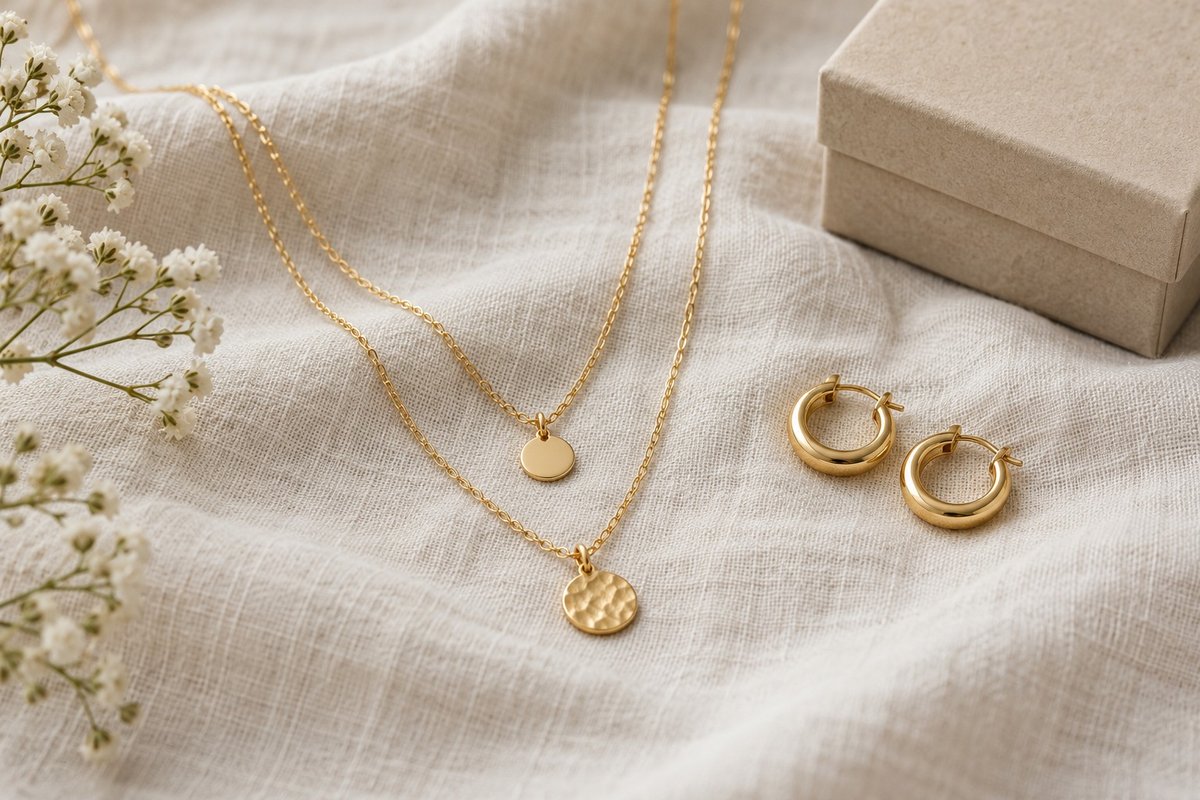
Gold filled usually lasts longest of the three, because its gold layer is a thick sheet bonded to the base metal; under United States guidance it must make up at least one twentieth of the item’s metal weight. Gold vermeil comes next: it is sterling silver with a gold layer that US guidance says must be at least 2.5 microns thick. Gold plated is the least durable, because the gold is usually a very thin electroplated film over a base metal such as brass, and it can wear through quickly with daily wear.
This guide includes a few product links near the end. As an Amazon Associate, Diamond Taire earns from qualifying purchases, at no extra cost to you.
This guide explains what each term legally means, how the rules differ between countries, how long each type tends to last in general terms, what to know if you have sensitive skin, how to read the stamps you will find on the piece, and when it makes more sense to buy solid gold instead.
- Gold filled: a thick, mechanically bonded layer of karat gold; in the US, at least 1/20 of the metal weight. Often lasts for years of regular wear.
- Gold vermeil: gold over sterling silver; in the US, at least 10K gold and at least 2.5 microns thick. Lasts well with care, but the layer is still thin.
- Gold plated: a thin film of gold, usually over brass or copper alloys. Best for occasional or fashion wear.
- Rules vary: the US, UK and other countries define these terms differently, and some have no legal definition at all.
- Stamps help: marks such as 1/20 14K GF, GP, GEP and 925 tell you a lot if you know how to read them.
At a glance
- Gold filled usually lasts longest, vermeil comes next, and gold plated is the least durable.
- Under US guidance, gold filled must be at least 1/20 of the metal weight and vermeil at least 2.5 microns of gold over sterling silver.
- Standard gold electroplate can be as thin as 0.175 microns, so it can wear through within weeks or months of daily wear.
- Rules differ by country: UK vermeil is defined differently, and Australia has no legal definition for these terms.
- A common mistake is treating “18K gold plated” as 18K gold, because the karat describes only the thin surface layer.
- Choose solid gold for rings or bracelets worn every day, or for pieces you want to keep for decades.
What each term means
All three are ways of putting a layer of real gold over a cheaper metal. What separates them is how thick the layer is, how it is attached, and what lies underneath. The definitions below come from the United States Federal Trade Commission’s Guides for the Jewelry, Precious Metals, and Pewter Industries, which are among the most detailed and widely quoted. Other countries use different rules, covered further down.
Gold filled
Gold-filled jewellery is made by mechanically bonding a layer of karat gold to a base metal core, usually brass, using heat and pressure, then rolling or drawing it into sheet or wire. Under the FTC Guides, the term “gold filled” should only be used when the gold layer is at least 10 karat and makes up at least one twentieth (1/20) of the weight of the metal in the whole item. The karat of the gold layer must be stated with it.
Because the gold is a real sheet rather than a film, gold filled is far thicker than standard plating and behaves much more like solid gold on the surface.
Rolled gold plate
The same method with less gold produces rolled gold plate. Since the FTC updated its Guides in 2018, terms such as “rolled gold plate”, “gold plate” and “gold overlay” for mechanically applied layers are advised for products where the gold makes up at least 1/40 of the metal weight, with the fraction and karat stated, for example 1/40 12K RGP.
Gold vermeil
Under the FTC Guides, vermeil means a base of sterling silver coated or plated on all significant surfaces with gold or gold alloy of at least 10 karat, with a minimum thickness equivalent to 2.5 microns of fine gold. The silver base is what distinguishes vermeil from ordinary plated jewellery: if the gold eventually wears through, you find precious silver underneath rather than brass.
Gold plated and gold electroplate
Gold plating normally means electroplating: the item is placed in a solution and an electric current deposits a thin layer of gold on its surface. Under the FTC Guides, “gold electroplate” should mean a layer of at least 10 karat gold with a minimum thickness equivalent to 0.175 microns of fine gold, and “heavy gold electroplate” a minimum of 2.5 microns. In the 2018 update, the FTC stopped advising that “gold flashed” and “gold washed” were acceptable terms for products with less than the 0.175 micron minimum.
To put those numbers in perspective, the standard electroplate minimum is far thinner than the vermeil minimum, and even 2.5 microns is a tiny fraction of a millimetre. That is why plated jewellery can show its base metal within months of daily wear.
Side-by-side comparison
| Feature | Gold filled | Gold vermeil | Gold plated | Solid gold |
|---|---|---|---|---|
| Base metal | Usually brass | Sterling silver | Usually brass or copper alloy; sometimes silver or steel | None; gold alloy throughout |
| How gold is applied | Mechanically bonded sheet | Usually electroplated | Electroplated | Not applicable |
| US minimum (FTC) | At least 10K; 1/20 of metal weight | At least 10K; 2.5 microns | At least 10K; 0.175 microns | Karat must be accurately disclosed |
| Typical wear life | Often years of regular wear | Often months to a few years, depending on wear and care | Can wear through within weeks or months of daily wear | Decades; can be refinished |
| Can it be re-plated or refinished? | Hard to restore once worn through | Can be re-plated | Can be re-plated | Can be polished and repaired |
| Sensitive skin | Usually fine until worn through | Usually fine; silver beneath | Risk rises as base metal is exposed | Depends on alloy |
| Relative cost | Moderate | Moderate | Low | Highest |
Wear life depends heavily on how often a piece is worn, where on the body it sits, and how it is cared for. Rings and bracelets rub against surfaces constantly and wear fastest; earrings and pendants last much longer.
Rules differ by country
A word that means one thing in the US can mean something else, or nothing at all, elsewhere. If you buy from overseas sellers, this matters.
- United States: the FTC Guides set out the definitions above. They are guidance on avoiding deceptive marketing rather than a hallmarking system.
- United Kingdom: hallmarking is compulsory for precious metals above certain weights under the Hallmarking Act 1973. According to the British Hallmarking Council’s guidance on describing gold-plated silver, such items are hallmarked as silver, and must be described as silver with the word “gold” followed directly by “plated”, for example “18ct gold plated silver ring”. “Vermeil” may be used only as an additional word alongside that description. The same guidance says the gold layer should be at least 375 parts per thousand fine and should not exceed 2 microns, which means UK vermeil is defined quite differently from US vermeil.
- Australia and many other countries: there is no compulsory government hallmarking system, and terms such as “vermeil” and “gold filled” have no specific legal definition. Marks are applied voluntarily, so the seller’s description and reputation matter more.
The practical takeaway is to ask what the gold layer actually is: its karat, its thickness or weight ratio, and the base metal. A good seller will be able to tell you.
How to read the stamps
Small marks inside a ring, on a clasp or on a tag reveal what you are buying. Here is what the most common ones mean:
- GF or G.F.: gold filled.
- 1/20 14K GF: gold filled, with 14K gold making up one twentieth of the total metal weight. You may also see 1/20 12K GF and similar.
- RGP or R.G.P.: rolled gold plate, a thinner mechanically bonded layer than gold filled, usually shown with a fraction such as 1/40.
- GP: gold plated. On its own, it tells you nothing about thickness.
- GEP or G.E.P.: gold electroplate.
- HGE: heavy gold electroplate, which under the FTC Guides means at least 2.5 microns.
- 925, Sterling or STER: sterling silver, which is 92.5 per cent silver. On a gold-coloured piece, a 925 mark alongside a gold karat usually means vermeil or gold-plated silver.
- Vermeil: sometimes stamped, more often stated on the tag or listing.
- 10K, 14K, 18K, or 417, 585, 750: on their own, these normally indicate solid gold of that karat. The guide to gold karats explains what each number means.
A stamp is a claim, not a guarantee. In countries without compulsory testing, anyone can stamp anything. Treat unusually cheap “solid gold” or “14K” pieces with caution.
Allergies and sensitive skin
Gold itself rarely causes skin reactions. Problems usually come from what is underneath.
- Gold plated pieces often use brass or copper alloys, and some cheaper base metals contain nickel, one of the most common causes of jewellery allergy. Once the plating wears thin, skin contact with the base metal increases. Copper alloys can also leave a green mark on skin.
- Gold filled pieces have a thick gold surface, so the base metal is rarely exposed in normal wear.
- Gold vermeil has a silver base, which most people tolerate well, although sterling silver contains a small proportion of other metals, usually copper.
- Solid gold is generally well tolerated, but some white gold alloys contain nickel.
If you react to jewellery, ask about the base metal and any nickel content before buying. Rules on nickel in jewellery differ by country, with the European Union among the strictest.
Caring for layered gold jewellery
Care makes the biggest difference to how long vermeil and plated pieces last. A simple routine:
- Put jewellery on last, after perfume, lotion, sunscreen and hairspray.
- Take it off before swimming, showering, exercising, cleaning or gardening. Chlorine, salt water, sweat and household chemicals all speed up wear.
- Wipe it gently with a soft, dry cloth after wearing.
- Clean only with mild soapy water if needed, then rinse and dry thoroughly. Avoid abrasive cloths, polishing compounds and ultrasonic cleaners on plated items.
- Store each piece separately in a soft pouch or lined compartment so harder items cannot scratch it. The guide to how to store jewellery has more ideas.
- For vermeil, store in a dry place or an anti-tarnish bag, because the silver underneath can tarnish where the gold is thin. The guide to sterling silver gemstone jewellery covers silver care in more detail.
When solid gold makes more sense
Layered gold is a sensible choice for trend pieces, earrings, pendants you wear now and then, or jewellery you want to try before investing more. Solid gold usually makes more sense when:
- The piece will be worn every day, especially a ring or bracelet.
- You want it to last for decades or pass it on.
- You want it resized, repaired or refinished in the future.
- You have sensitive skin and want to avoid any chance of base metal exposure.
- You value the metal content itself, which plated and filled items have very little of.
For help weighing metals more broadly, see how to choose between gold, platinum, silver and alternatives, and for buying with the long term in mind, how to build a jewellery collection that lasts.
Questions to ask before you buy
- What is the base metal?
- What karat is the gold layer?
- How thick is the layer, in microns, or what is the gold-to-metal weight ratio?
- Which country’s rules does the description follow?
- Does the piece contain nickel?
- Can it be re-plated, and is that offered?
Common mistakes to avoid
- Assuming “vermeil” means the same everywhere. US and UK definitions differ, and many countries have none.
- Treating “18K gold plated” as 18K gold. The karat describes only the thin surface layer.
- Buying plated rings for daily wear. Rings wear fastest; choose gold filled or solid gold for everyday rings.
- Using polishing cloths on plated pieces. They can remove the gold layer.
- Ignoring the base metal if you have sensitive skin. That is usually where reactions come from.
- Thinking of layered gold as an asset. These pieces hold very little gold and have little or no scrap value.
Sources this guide draws on: the US Federal Trade Commission’s Guides for the Jewelry, Precious Metals, and Pewter Industries (including its 2018 revisions), the British Hallmarking Council’s guidance on permitted descriptions for gold-plated silver articles in the UK, and the UK Hallmarking Act 1973.
Useful tools for this guide
Practical picks for choosing, checking and caring for jewellery. As an Amazon Associate, Diamond Taire earns from qualifying purchases, at no extra cost to you. Prices and availability are set by Amazon and may vary by country.
- Sunshine Polishing Cloths (5 Pack)
Pre-treated cloths that lift tarnish from sterling silver, gold and brass.
View on Amazon - Rosenthal Anti-Tarnish Strips (100 Tabs)
Drop one in each box or pouch to slow tarnish on stored silver.
View on Amazon - KElofoN Travel Jewellery Case
Compact case with ring rolls and earring slots so pieces do not scratch each other.
View on Amazon
Frequently asked questions
Which lasts longer, gold vermeil or gold filled?
Gold filled usually lasts longer. Its gold is a thick, bonded layer making up at least 1/20 of the metal weight under US guidance, while vermeil’s gold is typically a plated layer of at least 2.5 microns. With careful wear, both can last a long time, but gold filled resists daily friction better.
Is gold vermeil real gold?
The surface layer is real gold, and under US guidance it must be at least 10 karat. Underneath is sterling silver, so the piece as a whole is silver with a gold surface, not solid gold.
Can you shower with gold filled jewellery?
Gold filled is more water-resistant than plated jewellery, but regular exposure to soap, shampoo, chlorine and salt water can dull it and shorten its life. Taking it off before showering and swimming is the safest habit.
What does 1/20 14K GF mean?
It means the piece is gold filled, with a layer of 14 karat gold that makes up one twentieth of the total weight of the metal in the item. The rest is usually brass.
Will gold plated jewellery turn my skin green?
It can, once the plating wears thin and copper in the base metal reacts with moisture and sweat on your skin. The mark is not harmful and washes off, but it is a sign the plating has worn through.
Is gold vermeil good for sensitive skin?
Often, yes, because the base is sterling silver rather than a base metal that may contain nickel. People who react to silver or copper may still have problems once the gold wears thin.
Gold filled, vermeil and plated jewellery all have a place; the trick is matching the construction to how often you will wear the piece. Read the stamp, ask about the base metal and layer, and save solid gold for the pieces you want to keep for life.