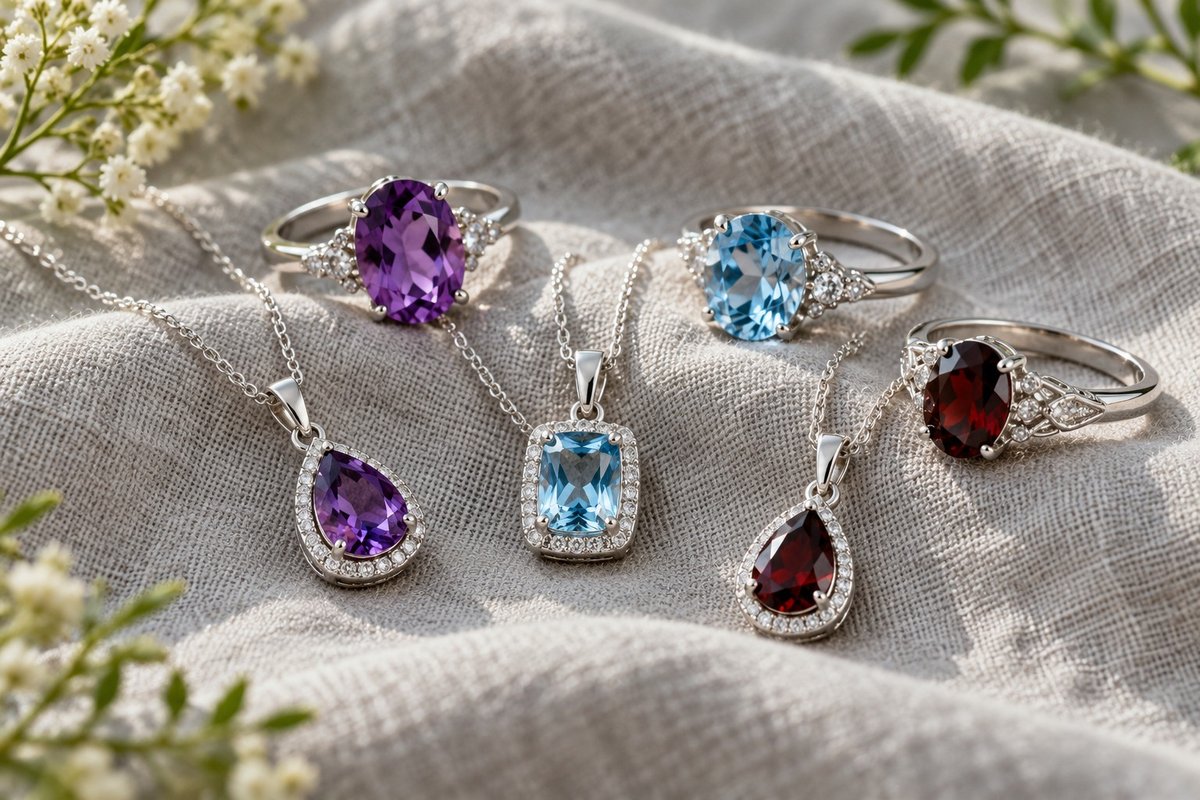
To choose sterling silver gemstone jewellery that lasts, look for a clear “925” or hallmark, pick gemstones of about 7 or higher on the Mohs hardness scale for rings, and make sure the listing says whether each stone is natural, lab-created or simulated. Choose secure settings, check returns and sizing before you buy, and store silver dry and separated so it stays bright.
This guide includes a few product links near the end. As an Amazon Associate, Diamond Taire earns from qualifying purchases, at no extra cost to you.
Sterling silver set with coloured stones is one of the most affordable ways to wear real precious metal and real gems every day, and it is where many collectors begin. This guide explains what “sterling” really means, which gemstones suit everyday wear, how to read a product listing, what quality checks to make, and how to care for silver so a small collection gives years of wear.
Disclosure: this guide contains affiliate links, marked as such. If you buy through them, Diamondtaire may earn a small commission at no extra cost to you.
At a glance
- Sterling is 92.5% silver, usually alloyed with copper, and is commonly stamped “925”.
- Hardness decides where a stone belongs. Stones around 7 and above suit rings; softer stones suit earrings and pendants.
- Labels matter. “Natural”, “lab-created” and “simulated” mean very different things for value.
- Treatments are common and usually fine, but a trustworthy seller discloses them.
- Tarnish is a surface layer, not damage, and good storage slows it down.
What sterling silver actually is
Pure silver is too soft for most jewellery: it bends and scratches easily. So it is alloyed with a small amount of another metal, usually copper, to make it stronger. Sterling silver is 92.5 percent silver and 7.5 percent other metals, which is why it is stamped “925” on the inside of a band or near a clasp.
In some countries, such as the United Kingdom, items sold as silver above a minimum weight (7.78 grams for silver under the UK Hallmarking Act) must carry an official hallmark from an independent assay office. In many other markets a maker’s “925” stamp is the norm and there is no independent testing. Either way, a clear metal description on the listing is the minimum you should expect.
Silver terms compared
| Term | What it means | Durability | Best for |
|---|---|---|---|
| Fine silver (999) | 99.9% silver | Very soft; bends and scratches | Coins, bullion, some hand-made pieces |
| Sterling silver (925) | 92.5% silver, usually with copper | Good for everyday jewellery; tarnishes over time | Rings, pendants, earrings, bracelets |
| Rhodium-plated sterling | Sterling with a thin rhodium coating | Brighter and slower to tarnish; plating wears on rings | Pieces where a whiter shine is wanted |
| Silver-plated | Thin layer of silver over a base metal | Plating can wear through | Low-cost fashion pieces only |
| Gold vermeil | Sterling silver with a thicker gold layer | Gold layer wears with heavy use | Gold look at silver prices |
If you are weighing silver against gold or platinum, our guide to choosing the right metal compares them in detail, and our explainer on gold vermeil vs gold filled covers gold-coloured silver options.
Where to buy sterling silver gemstone jewellery
SilverRushStyle sells 925 sterling silver rings, pendants and earrings, many set with natural gemstones. Check each listing’s metal and stone description using the tips in this guide.
Browse sterling silver at SilverRushStyle → (affiliate link)
Which gemstones suit silver and everyday wear
The cool, bright tone of silver flatters most coloured stones. For pieces you will wear often, hardness matters as much as colour. Hardness is measured on the Mohs scale from 1 (softest) to 10 (diamond). Household dust contains quartz, which is about 7, so stones softer than that slowly lose their polish when worn on the hands.
| Gemstone | Approx. Mohs hardness | Ring for daily wear? | Care notes |
|---|---|---|---|
| Sapphire and ruby | 9 | Excellent | Often lab-created at silver prices; should be labelled |
| Blue topaz | 8 | Very good | Colour is usually produced by treatment; normal, should be disclosed |
| Amethyst | 7 | Good | Can fade with long exposure to strong sunlight |
| Citrine | 7 | Good | Much citrine is heat-treated amethyst |
| Garnet | 6.5 to 7.5 | Good | Varies by type; deep reds are most common |
| Peridot | 6.5 to 7 | Fair; occasional wear | Avoid knocks and harsh chemicals |
| Moonstone | 6 to 6.5 | Better in earrings or pendants | Can chip or split if struck |
| Opal | 5.5 to 6.5 | Better in earrings or pendants | Sensitive to knocks, heat and sudden temperature changes |
| Turquoise | 5 to 6 | Better in earrings or pendants | Porous; keep away from oils, lotion and perfume |
| Pearl | 2.5 to 4.5 | Occasional wear only | Put on last, after perfume and hairspray |
Softer stones are not a poor choice; they simply belong in pieces that take fewer knocks. Our guide to choosing and caring for pearls covers pearl care in more depth, and our list of the best gemstones for engagement rings explains which stones handle constant wear.
Natural, lab-created or simulated: reading the label
Listings use specific words for good reason. Advertising guidance for the jewellery trade, such as the US Federal Trade Commission’s Jewelry Guides, expects sellers to make it clear when a stone is not natural. Rules differ by country, but the terms usually mean:
- Natural: formed in the earth. It may still be treated, for example heated to improve colour.
- Lab-created (also “lab-grown”, “synthetic” or “created”): the same chemical and physical make-up as the natural gem, but grown in a laboratory. Usually cleaner and cheaper than a natural stone of similar colour.
- Simulated or imitation: looks like the gem but is a different material, such as glass or cubic zirconia. Fine for fashion pieces if it is priced accordingly.
None of these is wrong. What matters is knowing what you are paying for. If the listing does not say, ask the seller before you buy.
Treatments such as heating, irradiation and filling are widespread across the trade. A treated stone is not a fake, but treatments can affect value and care. For a keepsake rather than a fashion piece, ask about treatment before you order.
Quality checks before you buy: a step-by-step list
- Confirm the metal. Look for “925 sterling silver” (or a hallmark) and note whether it is rhodium plated.
- Confirm the stone. Type, whether natural, lab-created or simulated, approximate size or carat weight, and any treatment.
- Look at the setting. Prongs should sit evenly and hold the stone firmly. Bezel settings, where metal wraps around the stone, protect softer gems well.
- Check weight and finish. Very light, thin pieces bend more easily. Close-up photos should show smooth edges and a clean polish.
- Check sizing. Measure properly before ordering a ring; our guide to measuring ring size at home shows how.
- Read the returns policy. This matters most when buying from overseas, where return postage and duties can add up.
- Check for skin sensitivity. Sterling usually contains copper, and some alloys contain other metals. If you react to certain metals, read the full description.
Who silver gemstone jewellery suits, and who it does not
It suits anyone who wants colour and real precious metal at an accessible price, gift buyers, people experimenting with style before committing to gold, and anyone building a varied everyday collection.
It suits less well someone who wants a ring to wear every day for decades without maintenance (silver scratches and bends more readily than gold or platinum), someone who dislikes polishing, or a buyer looking for a long-term heirloom with significant value.
Caring for silver gemstone jewellery
Silver tarnishes when it reacts with sulphur compounds in the air and in things like rubber, some foods and some fabrics. Tarnish is a surface layer and can be removed. These habits slow it down:
- Wear it. Gentle everyday wear helps keep silver bright.
- Take it off before swimming, cleaning, applying lotion or perfume, and exercise.
- Store it dry in a sealed bag or lined box, ideally with an anti-tarnish strip, and keep pieces apart so stones do not scratch each other. Our guide to storing jewellery has more ideas.
- Clean gently. A silver polishing cloth is the safest choice for gemstone pieces. Avoid silver dips and harsh cleaners on porous stones such as turquoise, opal and pearl. Mild soapy water and a soft brush suit hard stones like amethyst and topaz; dry thoroughly afterwards.
- Check the settings every few months and have loose prongs repaired before a stone is lost.
Silver birthstone jewellery as a gift
A birthstone set in silver feels personal without the price of fine gold. The modern birthstone list widely used by jewellers in the United States, published by Jewelers of America, runs as follows. Other countries use slightly different lists.
- January: garnet
- February: amethyst
- March: aquamarine
- April: diamond (white topaz or a lab-created stone are common lower-cost alternatives in silver, and should be labelled as such)
- May: emerald
- June: pearl, moonstone or alexandrite
- July: ruby
- August: peridot or spinel
- September: sapphire
- October: opal or tourmaline
- November: topaz or citrine
- December: turquoise, tanzanite or zircon (blue topaz also appears on some lists)
Natural emerald, ruby and sapphire of good quality are expensive, so silver pieces at gift prices often use lab-created versions. That is fine, as long as the listing says so. For softer birthstones such as opal, pearl and turquoise, a pendant or earrings will usually outlast a ring worn every day. For pendants, a chain of about 45 centimetres (18 inches) suits most people; our pendant buying guide explains chain lengths and bails.
Common mistakes
- Assuming “silver” means sterling. Silver-plated and “silver tone” pieces are not sterling.
- Putting soft stones in everyday rings. Opal, turquoise and pearl wear quickly on the hand.
- Not checking whether a stone is natural. A low price for “ruby” or “emerald” usually means lab-created or simulated.
- Using silver dip on porous stones. It can damage turquoise, opal and pearl.
- Storing pieces jumbled together. Harder stones scratch softer stones and silver.
- Ignoring the returns policy when buying from overseas.
Building a collection with silver
Silver gemstone jewellery is an easy way to experiment with colour before spending more on gold or rarer stones. Many collectors start with a birthstone, then add a versatile pendant and everyday earrings. Our guide on building a jewellery collection that lasts explains how to mix everyday pieces with special ones, and for higher-value pieces see insuring and appraising fine jewellery.
Related guide: January Birthstone: How to Choose a Beautiful Garnet Wisely.
Related guide: What Does 925 Mean on Jewellery? Smart Checks to Avoid Fakes.
Sources this guide draws on: US Federal Trade Commission, Guides for the Jewelry, Precious Metals, and Pewter Industries; UK Hallmarking Act 1973 and guidance from the UK assay offices; Gemological Institute of America (GIA) gem encyclopedia; Jewelers of America modern birthstone list.
Useful tools for this guide
Practical picks for choosing, checking and caring for jewellery. As an Amazon Associate, Diamond Taire earns from qualifying purchases, at no extra cost to you. Prices and availability are set by Amazon and may vary by country.
- Gemstones of the World by Walter Schumann (5th edition)
A classic illustrated reference to more than 1,900 gemstones.
View on Amazon - Foldable 30x Jeweller’s Loupe
Pocket magnifier for checking stones, settings and hallmarks up close.
View on Amazon - KElofoN Travel Jewellery Case
Compact case with ring rolls and earring slots so pieces do not scratch each other.
View on Amazon
Frequently asked questions
Is sterling silver real silver?
Yes. Sterling is 92.5 percent pure silver, with the rest usually copper for strength. It is the standard for quality silver jewellery and is normally stamped “925”.
Will sterling silver turn my finger green?
Occasionally, a faint mark appears where the copper in the alloy reacts with moisture, soap or lotion on the skin. It is harmless and washes off. Keeping the ring clean and dry, or choosing rhodium-plated sterling, reduces it.
Which gemstones are best for a silver ring worn every day?
Stones of about 7 or higher on the Mohs scale, such as sapphire, ruby, topaz, amethyst, citrine and many garnets. Softer stones such as opal, turquoise and pearl are better in earrings and pendants.
How can I tell if a gemstone is real?
You usually cannot by eye. Rely on the seller’s description of the stone as natural, lab-created or simulated, ask about treatments, and for valuable pieces have a qualified gemmologist or laboratory examine the stone.
How do I stop silver from tarnishing?
Store it dry in a sealed bag or lined box with an anti-tarnish strip, keep it away from perfume, lotion and cleaning products, and wear it regularly. A polishing cloth removes light tarnish safely.
Look for the 925 stamp, choose harder stones for rings, make sure the label tells you what each stone is, and store silver dry and separated. With those habits, a small silver collection can give years of everyday wear.