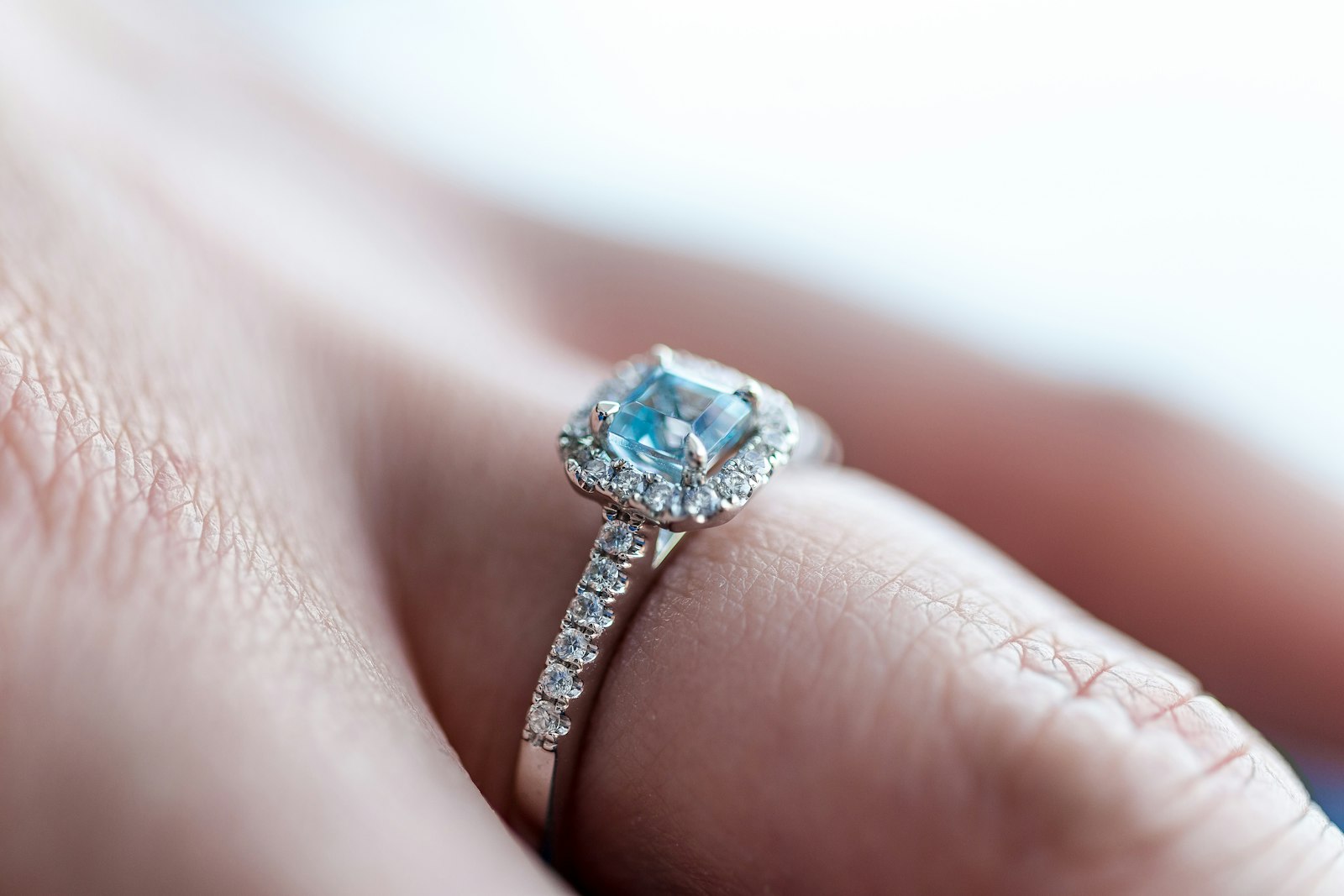
Ring size is the detail that ruins more ring purchases than any grading decision. A stone one clarity grade lower is invisible. A ring one size too small is unwearable, and depending on how it was made, it may not be fixable.
This guide covers how to measure accurately at home, how sizing systems differ around the world, when you cannot rely on measurement at all, and which rings can and cannot be resized afterwards.
Why ring size is harder than it sounds
Fingers are not stable objects. The same finger can vary by most of a full size across a single day and across a year:
- Temperature. Cold constricts, heat expands. A finger measured on a winter morning can be half a size smaller than the same finger in July.
- Time of day. Fingers are usually smallest in the early morning and largest in the evening, and are generally at their most representative in the late afternoon.
- Salt and hydration. A salty meal or dehydration both cause noticeable swelling.
- Exercise. Hands swell during and after activity, sometimes considerably.
- Pregnancy, medication and some medical conditions cause sustained changes in finger size, and these are common reasons a long-worn ring stops fitting.
- Knuckle size relative to the base of the finger. This is the one people forget and it matters most.
A ring must pass over the knuckle and then sit comfortably at the base. If your knuckle is much larger than the base of your finger, a ring sized to slide over the knuckle will spin and slide once it is on. That is not a fitting error — it is anatomy, and it has specific solutions covered further down.
Measuring at home: the three methods, ranked
Best: measure an existing ring’s internal diameter
If you already own a ring that fits the correct finger correctly, this is by far the most accurate home method, because you are measuring a rigid object rather than living tissue.
- Lay the ring flat on a table.
- With a ruler marked in millimetres, measure the inside diameter — the widest gap from one inner edge to the opposite inner edge, passing through the centre.
- Read to the nearest 0.1mm. Measure three times and take the average.
Then convert. The internal diameter maps to standard sizes as follows (approximate, and rounded):
| Inside diameter | US / Canada | UK / Australia / NZ | Europe (ISO circumference) |
|---|---|---|---|
| 14.9 mm | 4 | H½ | 47 |
| 15.7 mm | 5 | J½ | 49 |
| 16.5 mm | 6 | L½ | 52 |
| 17.3 mm | 7 | N½ | 54 |
| 18.1 mm | 8 | P½ | 57 |
| 18.9 mm | 9 | R½ | 59 |
| 19.8 mm | 10 | T½ | 62 |
| 20.6 mm | 11 | V½ | 65 |
| 21.4 mm | 12 | X½ | 67 |
Note that these are conventional equivalences and small variations exist between manufacturers. Always confirm the seller’s own conversion chart — this is one of the most common sources of a wrong order.
Important: measure a ring that is worn on the same finger of the same hand. The dominant hand is usually slightly larger. The ring finger and the middle finger of the same hand routinely differ by a full size.
Second best: printable sizer, used correctly
Most jewellers publish a printable ring sizer — either a paper strip you wrap around the finger, or a set of printed circles you place a ring on top of.
These work, but only if the print scale is exactly right. Before you use one, check the calibration mark. Every reputable printable sizer includes a line or a rectangle of a stated length; measure it with a ruler. If it does not match, your printer has scaled the page and every reading will be wrong. Set the print dialogue to 100% or “actual size”, never “fit to page”, and re-check.
The circle type is more reliable than the strip type, because it measures a rigid ring rather than compressible skin.
Least reliable: string or paper strip around the finger
The method everyone tries first and the one that fails most often. String stretches. Paper strips get pulled tight. Both consistently produce a reading that is too small, because people instinctively pull them snug rather than letting them sit as a rigid band would.
If you must use it:
- Use a strip of paper about 5mm wide, not string, not thread, not floss.
- Wrap it around the base of the finger and mark where it overlaps — snug enough not to fall off, loose enough to slide over the knuckle.
- Measure the marked length in millimetres. That length is the circumference.
- Divide by 3.14159 to get the diameter, then use the table above.
- Do it three times, at different times of day, and take the largest reading.
Do not size a surprise engagement ring from a string measurement. The failure rate is too high.
The rules that make measurement accurate
- Measure at the end of the day, when the hand is at its most typical.
- Measure at normal room temperature. Not straight in from the cold, not straight out of a hot shower.
- Measure three times on different days and take the average, or if the readings vary, the larger one.
- Match the band width. A wide band fits more tightly than a narrow one of the same nominal size, because it covers more of the finger. For a band 6mm or wider, go up a quarter to a half size from your measured size. Many jewellers will do this automatically if you tell them the band width — tell them.
- Account for the knuckle. Size so the ring passes the knuckle with moderate resistance, then check whether it spins at the base. If it spins badly, the ring needs a sizing aid rather than a smaller size.
- Err slightly large, not small. A ring that is marginally loose is wearable today and can be sized down. A ring that will not pass the knuckle cannot be worn at all.
Sizing a surprise engagement ring
If the ring is a surprise and you cannot ask, in rough order of reliability:
- Borrow a ring she already wears on that finger and take it to a jeweller, who will measure it on a calibrated mandrel in under a minute. This is the only genuinely reliable option.
- Trace the inside of a borrowed ring on paper with a fine pencil, or press it into a bar of soap to leave an impression, if you cannot keep it long enough to visit a jeweller.
- Ask someone who would know — a close friend, a sister, her mother. This is the most common route and it works.
- Use average sizes as a last resort. Across most Western populations the commonest women’s engagement ring sizes cluster around US 6 to 6.5 (UK L½ to M½) and men’s around US 9 to 10 (UK R½ to T½). These are population averages and will be wrong for a great many individuals. Treat them as a fallback that you fully expect to have to correct, and buy from a seller with a free resizing policy.
Whichever route you take: confirm the return and resizing terms before you buy. Many sellers offer one free resize within a set window. That policy is worth more than a small price difference.
What can and cannot be resized
This is the question to ask before you buy, not after.
Resizes easily:
- Plain metal bands in gold, platinum or silver.
- Solitaire settings with an unadorned shank.
- Rings with stones confined to the top third of the band.
Resizes with difficulty or within a limited range:
- Rings with pavé or channel-set stones part-way down the shoulders. Often sizeable by one or two sizes only, and only where a plain section remains at the bottom.
- Half-eternity rings, depending on how far the stones extend.
Cannot practically be resized:
- Full eternity rings. Stones run the entire circumference; there is nowhere to cut. The only remedy is remaking the ring.
- True tension settings. The tension is calibrated to the exact circumference and cannot be altered without recalibrating the entire structure.
- Rings with intricate engraving or milgrain running the full band, where cutting would destroy the pattern.
- Titanium, tungsten carbide and ceramic bands. These metals cannot be cut and rejoined by conventional jewellery methods. They are replaced, not sized.
- Rings with an inlay running the full circumference.
Also note that gold and platinum can be sized many times but not infinitely — each resize removes or adds metal and stresses the band. A ring that has been sized repeatedly may eventually need its shank replaced, which is normal and routine work.
Solutions for a large knuckle
If the ring passes the knuckle but spins at the base, the fix is not a smaller ring. The fix is one of these:
- Sizing beads. Two small beads of metal soldered inside the bottom of the band. They hold the ring away from the palm side of the finger and stop rotation. Cheap, discreet, easily removed.
- A sizing bar or “speed bump”. A hinged or fixed bar across the inside of the band. Slightly more supportive than beads.
- A horseshoe or spring insert. A U-shaped piece fitted inside the band, giving a little flex as it passes the knuckle. Good for pronounced knuckles.
- A hinged shank. The band opens on a hinge and latches closed. The most effective solution for arthritic or significantly enlarged knuckles, and the most expensive.
- Ring adjusters — clear plastic coils and silicone wraps sold cheaply online. Genuinely useful as a temporary measure while waiting for a proper sizing, and reasonable for a ring worn only occasionally. They discolour and perish with constant wear, so they are not a permanent answer for a daily ring.
Sizes change over a lifetime
Ring size is not a fixed personal attribute. It changes with weight, age, pregnancy, hormonal shifts, arthritis, some medications and simple seasonal variation. A wedding ring bought at thirty will very often need sizing by fifty, and that is unremarkable rather than a sign of anything wrong.
Two practical habits:
- Have the fit checked whenever you have the setting inspected — the same annual visit covers both.
- If a ring starts to feel tight, act early. A ring that has become genuinely stuck is a medical-grade problem and sometimes has to be cut off, which is both distressing and expensive to repair.
The short version
- Measure the inside diameter of a ring that already fits. It beats every other home method.
- Measure late in the day, at room temperature, three times.
- Check the calibration mark on any printed sizer.
- Go up a quarter to a half size for bands 6mm or wider.
- Err large. Loose is fixable; too small may not be.
- Ask what the resizing range is before you buy — and never assume an eternity ring or a titanium band can be sized at all.
- Do not resize or engrave until the return window has closed.
Get this one detail right and the ring is a pleasure for fifty years. Get it wrong and it lives in a drawer.
This article is educational and general in nature. Conversion charts vary slightly between manufacturers and markets — always confirm sizing with the seller before ordering, and consult a professional jeweller for fitting a significant piece.