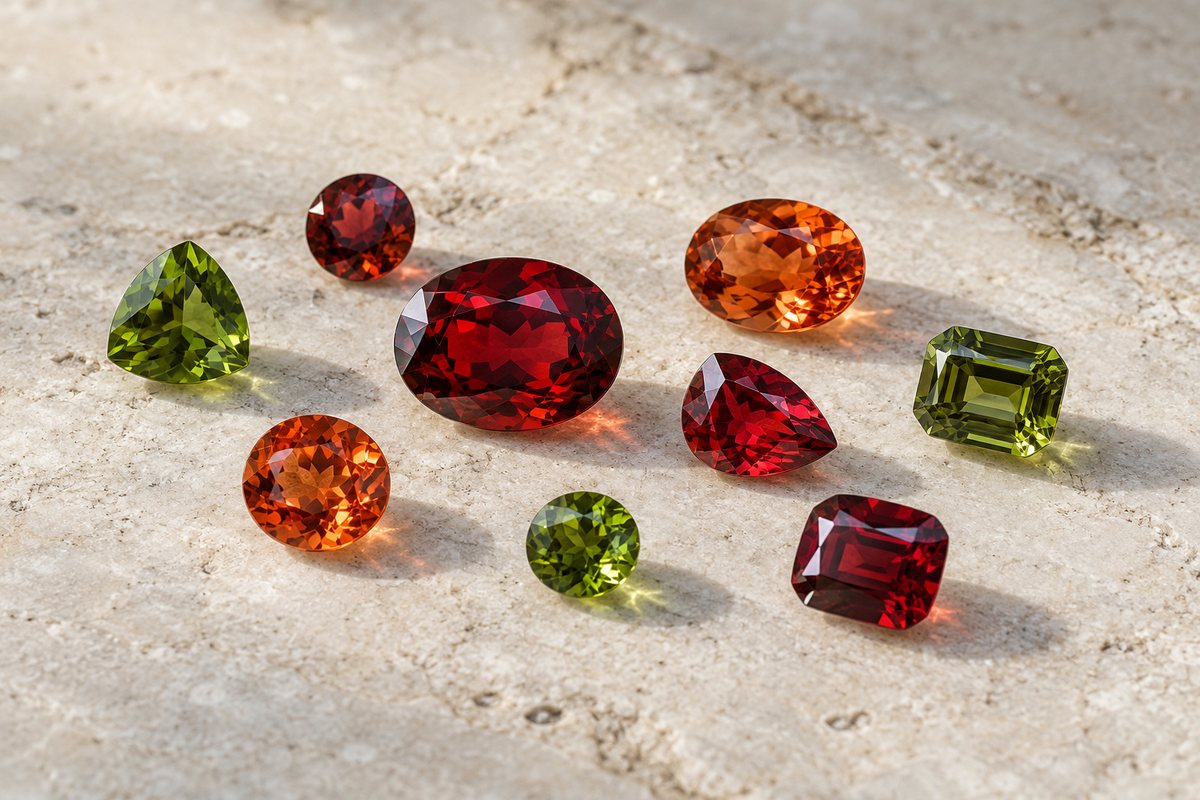
The January birthstone is garnet. Garnet is not a single gemstone but a group of related minerals, so although most people picture deep red stones, January birthstones also come in orange, pink, purple, yellow and vivid green.
The product links below are affiliate links. As an Amazon Associate, Diamond Taire earns from qualifying purchases, at no extra cost to you.
This guide explains the main garnet types and colours, how durable garnet is for everyday wear, how price varies from affordable to rare, how to tell garnet from ruby, and how to buy and care for a January birthstone without regret.
At a glance
- January’s birthstone: garnet, a family of minerals rather than one stone.
- Colour range: red and purplish red (pyrope, almandine, rhodolite), orange (spessartine), green (tsavorite and demantoid), plus rarer colour-change garnets.
- Durability: GIA lists garnet at 6.5 to 7.5 on the Mohs scale, softer than ruby, sapphire and diamond, so it suits earrings, pendants and occasional rings best.
- Value: red garnets are usually affordable; fine green tsavorite and demantoid are rarer and can cost much more, especially in larger sizes.
- Treatments: GIA notes most garnets are untreated, though some are fracture filled and need gentler care.
What is the January birthstone?
Garnet is the birthstone for the month of January. According to GIA, the name comes from the medieval Latin granatus, meaning pomegranate, because of the similar colour of the fruit’s seeds. Garnets have been used since the Bronze Age, both as gems and as abrasives. GIA’s history notes that red garnet necklaces adorned ancient Egyptian pharaohs, that ancient Roman signet rings used garnet intaglios to stamp wax seals, and that red garnets were favoured by medieval clergy and nobility. Bohemian pyrope garnets were especially fashionable in the Victorian era.
Because garnet is a family, two “January birthstones” can look completely different and vary greatly in price. Knowing the main types is the single most useful thing you can learn before you buy.
Garnet types and colours
GIA describes garnets as a group of closely related minerals and names pyrope, almandine, spessartine, andradite and grossular as the important gem species, with well-known varieties such as rhodolite, hessonite, tsavorite and demantoid.
| Type | Typical colours | What to know | Relative price |
|---|---|---|---|
| Almandine | Purplish red to orangy red, often dark | Widely available, including in large sizes; usually free of eye-visible inclusions | Usually affordable |
| Pyrope | Purplish red to orangy red | The classic Victorian Bohemian garnet; usually eye clean | Usually affordable |
| Rhodolite | Purplish red to purplish pink | Often lighter and brighter than almandine; usually eye clean | Affordable to moderate |
| Spessartine | Orange, from yellowish to reddish orange | Bright orange colours; often has some inclusions | Moderate |
| Hessonite (grossular) | Orange to brownish orange | Often has visible inclusions | Usually affordable |
| Tsavorite (grossular) | Vivid green | Rare in large sizes; value rises sharply with size | Higher to high |
| Demantoid (andradite) | Yellowish green to green | High dispersion (fire); softer than grossular; some show “horsetail” inclusions | Higher to high |
| Colour-change garnet | Changes colour under different lighting | GIA notes some shift from blue to purple | Higher, collector stone |
GIA notes that pure red garnets are rare above about half a carat, and that most red garnets have a brownish component or a very dark tone. When comparing red stones, look for a colour that stays lively rather than turning black in dim light.
A note on demantoid
Demantoid is prized for its fire. GIA explains that andradite has a higher refractive index and dispersion than grossular, though it is softer. GIA also notes that “horsetail” inclusions, fine curved fibres radiating from a point, appear in demantoid from Russia, Iran and Italy but not from Namibia or Madagascar, so they are a clue to origin rather than a flaw to avoid.
How durable is garnet?
GIA lists the garnet group at 6.5 to 7.5 on the Mohs hardness scale. That makes garnet more vulnerable to scratches and wear than ruby and sapphire (9) and diamond (10), and GIA notes that not every garnet is suited to daily wear.
In practical terms:
- Earrings, pendants and brooches are ideal, because they are rarely knocked.
- Rings can work, especially for occasional wear, but facet edges can dull over years of daily wear. Protective settings such as a bezel or a halo help.
- Engagement rings made with garnet are possible but need more care than harder stones; the guide to the best gemstones for engagement rings compares the options.
- Storage matters: GIA advises keeping garnet away from harder gems that can scratch it, and from softer gems such as opal and pearl, which garnet can scratch. The guide on how to store jewellery shows simple ways to do this.
The setting style matters as much as the stone. The guide to ring settings explained covers which styles protect a stone best.
Garnet vs ruby: how to tell them apart
Red garnet and ruby are often confused, and in history red stones were frequently misnamed. GIA’s education article on mistaken identity explains that ruby is doubly refractive and pleochroic, so it can show two slightly different shades of red depending on the viewing direction, while garnet is singly refractive and looks the same colour from every direction.
| Clue | Garnet | Ruby |
|---|---|---|
| Mineral | Garnet group | Corundum (same mineral as sapphire) |
| Mohs hardness | 6.5 to 7.5 | 9 |
| Optics | Singly refractive; same colour from all directions | Doubly refractive; can show two shades of red |
| Typical colour | Often darker, with brownish or purplish tones | Red to purplish or orangy red, often brighter in fine stones |
| Typical price | Usually much lower for red types | Usually much higher for fine stones |
None of these clues is a reliable home test. If a red stone is described as ruby and priced accordingly, or a significant piece is labelled garnet and you want certainty, ask for an independent gemmological lab report. GIA recommends lab reports for significant garnet purchases to confirm what the seller says.
Treatments and imitations
According to GIA, most garnets are untreated. Some are fracture filled, where a glass-like material fills surface-reaching breaks to improve apparent clarity; these stones need special care. Red glass and other materials can also imitate garnet in cheap costume pieces. Ask the seller to state in writing whether the stone is natural garnet and whether it has been treated.
GIA also notes that there is no standard quality grading scale for garnet. Labels such as “AAA” are each seller’s own system, so do not compare grades between shops as if they meant the same thing.
How to buy a January birthstone: checklist
- Choose the colour first: classic red, purplish rhodolite, orange spessartine or green tsavorite and demantoid.
- Choose the piece to suit durability: earrings and pendants for everyday, rings with protective settings.
- Ask which garnet type it is, not just “garnet”.
- Ask whether it is treated, especially if the price seems high for its clarity.
- View the colour in different light: red garnets can look almost black indoors.
- Check clarity face-up: red garnets are usually eye clean; spessartine and hessonite more often show inclusions.
- Do not rely on seller grades such as “AAA” as a universal standard.
- Get a lab report for valuable green garnets or any stone sold as rare.
- Choose the metal: red garnets glow in yellow gold, and silver keeps costs down; see sterling silver gemstone jewellery and gold karats explained.
Choosing a January birthstone gift
Most people buying a January birthstone are buying a gift, often without knowing the recipient’s taste in detail. A few simple choices make it far more likely to be worn and loved.
Match the piece to the person
- Everyday wearer, busy hands: stud earrings or a small pendant. They are protected from knocks and suit garnet’s hardness.
- Loves colour: consider an orange spessartine or a green garnet rather than the expected red. It is still a true January birthstone and often feels more personal.
- Prefers classic style: a deep red garnet in yellow gold has a timeless, Victorian-inspired look.
- Likes layering: a slim pendant works well with other chains; see how to layer jewellery for simple combinations.
- For a child or teenager: silver with a small red garnet keeps the cost sensible while they grow into finer pieces.
Who garnet suits, and who it may not
A good fit if you want a warm, rich colour at a sensible price, love vintage style, or want a meaningful birthstone that can be worn as earrings or a pendant every day.
Think twice if you want a daily engagement ring for very active hands and plan to wear it for decades without care; a harder stone such as sapphire may suit you better. If you want green, compare tsavorite with emerald and other green stones before deciding, because their durability and care needs differ.
A simple worked example
Imagine two red stones of similar size, both described as garnet. One is very dark and looks almost black under indoor lighting; the other is a brighter purplish red that stays lively in the same light. Even if their sizes and settings match, the brighter stone will usually be the more rewarding choice to wear, and it may be priced a little higher. Viewing both under the same indoor lighting, not just in a bright shop, is the quickest way to see the difference.
How to clean and care for garnet
GIA’s care advice is simple: warm, soapy water and a soft brush are always safe. Ultrasonic cleaners are usually safe, except for stones that are fracture filled or have fractures. Steam cleaning is not recommended. Remove garnet rings for gardening, gym work and heavy cleaning, and store each piece separately in a soft pouch or lined compartment.
Common mistakes
- Assuming all garnets are cheap. Red garnets usually are, but fine tsavorite and demantoid can be costly.
- Assuming all garnets are red. Choosing a green or orange garnet is just as authentically “January”.
- Wearing a garnet ring for heavy daily work. At 6.5 to 7.5 on the Mohs scale, it will show wear faster than sapphire or diamond.
- Buying a “ruby” at a too-good price without checking it is not garnet, glass or another red stone.
- Steam cleaning or ultrasonic cleaning a fracture-filled stone.
- Storing garnet loose with diamonds and sapphires, which can scratch it.
- Comparing “AAA” grades between sellers as if they were a shared standard.
Related guide: July Birthstone: How to Buy a Beautiful Ruby Without Regret.
Related guide: October Birthstone: How to Pick the Right One Without Regret.
Related guide: February Birthstone: How to Buy a Beautiful Amethyst Smartly.
Sources this guide draws on: GIA’s January birthstone page, GIA’s garnet buying guide, GIA’s education article on gemstones of mistaken identity, and GIA gem care guidance.
January birthstone FAQs
What is the birthstone for January?
Garnet. It is a family of minerals rather than one stone, so January birthstones can be red, purple, pink, orange, yellow or green.
Does January have more than one birthstone?
Standard birthstone lists give garnet as the single January stone. Because garnet comes in many colours and species, people sometimes talk about “January birthstones” in the plural.
What colour is the January birthstone?
Most people think of deep red, which is the most common colour. Garnets also come in purplish pink, orange, green and rarer colour-change varieties.
Is garnet strong enough for an everyday ring?
It can be worn in a ring, but at 6.5 to 7.5 on the Mohs scale it is softer than sapphire, ruby and diamond. A protective setting and removing the ring for rough tasks will help it last.
Is garnet expensive?
Most red garnets are among the more affordable coloured gemstones. Fine green tsavorite and demantoid are much rarer, and their prices rise steeply with size. Prices change and vary by country and seller.
How can I tell if my garnet is real?
Home tests are not reliable. A jeweller with gemmological training can check optical properties, and for valuable stones an independent lab report gives the clearest answer.
Garnet is a beautiful, versatile birthstone with a long history and a surprising rainbow of colours. Choose the type and colour you love, match the piece to how it will be worn, and care for it gently, and a January birthstone can be a happy, lasting gift. For more on building pieces that last, see the guide to building a jewellery collection.
Useful tools for this guide
Practical picks for choosing, checking and caring for jewellery. As an Amazon Associate, Diamond Taire earns from qualifying purchases, at no extra cost to you. Prices and availability are set by Amazon and may vary by country.
- Gemstones of the World by Walter Schumann (5th edition)
A classic illustrated reference to more than 1,900 gemstones.
View on Amazon - Foldable 30x Jeweller’s Loupe
Pocket magnifier for checking stones, settings and hallmarks up close.
View on Amazon - KElofoN Travel Jewellery Case
Compact case with ring rolls and earring slots so pieces do not scratch each other.
View on Amazon