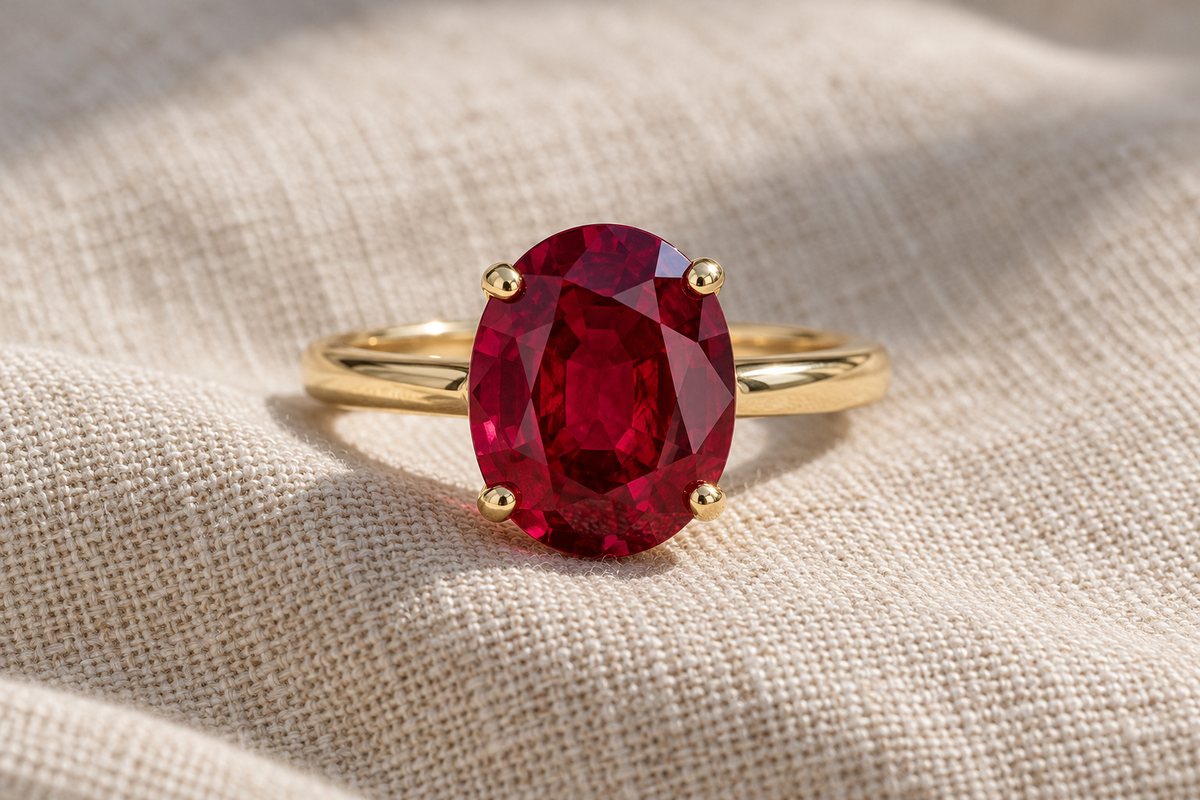
The July birthstone is ruby, the red variety of the mineral corundum. Its colour comes from trace amounts of chromium, and at 9 on the Mohs scale it is second only to diamond in hardness among the classic gems, which makes it one of the few coloured stones genuinely suited to a ring worn every day.
This guide includes a few product links near the end. As an Amazon Associate, Diamond Taire earns from qualifying purchases, at no extra cost to you.
This guide covers what July’s birthstone colour actually looks like, how to judge a ruby, which treatments are normal and which to avoid, lab-grown options, and how to tell a ruby from the red stones that are often mistaken for it. It ends with a buying checklist and the mistakes that cost people the most.
At a glance
- What is July’s birthstone? Ruby, a red corundum. Its name comes from the Latin ruber, meaning red.
- Colour matters most. GIA describes the finest rubies as a pure, vibrant red to slightly purplish red. Colour drives value far more than size or clarity.
- Heat treatment is normal. It is widely accepted because it is stable in normal wear. Lead-glass filling is a very different product and must be disclosed.
- Lab-grown ruby is real ruby. It has essentially the same chemical, physical and optical properties as natural ruby, at a fraction of the cost.
- Red is not proof. Garnet, spinel and glass can look similar. Only a gemmologist or a laboratory can confirm what you have.
What is the birthstone for July?
Ruby is the July birthstone on the standard modern lists used by jewellers in most countries. It belongs to the same mineral family as sapphire: corundum that is red enough is called ruby, while corundum of every other colour is called sapphire. That shared identity explains why ruby wears so well. Corundum is very hard, has no cleavage and is tough enough to cope with the knocks a ring takes.
Ruby has a long history as a prized stone. GIA notes that in ancient India it was called the “king of precious stones”, and ruby is the traditional gift for the 15th and 40th wedding anniversaries. Historical beliefs about its powers are part of its story, but they are folklore, not something to buy on.
July birthstone colour: what to look for
If you are asking what colour the birthstone for the month of July is, the short answer is red, but ruby red covers a wide range. Chromium creates the colour, and in general the more chromium, the stronger the red. Stones run from pinkish red to deep red and from slightly orange to slightly purple.
GIA describes the most prized colour as a deep red with a hint of purple, often called “pigeon’s blood” in the trade. That phrase is a trade description, not a scientific grade, and laboratories that use it apply their own criteria. Treat it as a description of a look rather than a guarantee.
How the other quality factors work
- Clarity: Rubies almost always have inclusions. GIA notes that inclusions which affect transparency or brilliance significantly lower value, but a few fine inclusions are expected and can even help confirm a natural origin.
- Cut: Rubies are commonly cut as mixed cuts, with brilliant-style facets on the crown and step-cut facets on the pavilion. Good cutting gives an even red across the face; poor cutting leaves dark or washed-out areas.
- Carat: GIA notes that fine rubies over one carat are very rare and that price rises significantly with size. A well-coloured smaller stone is usually a better buy than a large, dull one.
Does origin matter?
Ruby comes from many places. GIA lists Myanmar (the Mogok area has produced sought-after rubies for more than five centuries), Mozambique (whose Montepuez mines have been compared with Mogok), Vietnam, the Thailand and Cambodia border, and smaller sources including Afghanistan, Tajikistan, Pakistan, Sri Lanka, Kenya, Tanzania and Madagascar.
A common myth is that a country name tells you a stone is good. It does not. Every source produces a range of qualities, and origin can only be stated reliably by a laboratory that offers origin reports. Judge the stone in front of you first; treat an origin claim without a report as marketing.
Ruby treatments: normal, acceptable and avoid
Most rubies on the market have been treated in some way. That is not automatically a problem. What matters is which treatment, whether it is disclosed, and how it affects durability and care.
| Treatment | What it does | Durability | Cleaning | Verdict for most buyers |
|---|---|---|---|---|
| None (unheated) | Nothing; the colour is as found | Excellent | Ultrasonic and steam usually safe (GIA) | Fine, but expect a premium and ask for a lab report |
| Heat | Reduces purplish tones and improves colour | Stable in normal wear | Ultrasonic and steam usually safe (GIA) | Normal and widely accepted; should still be disclosed |
| Lattice diffusion | Adds colour from the surface using chemicals and high heat | Stable in normal wear (GIA cleaning guidance treats it like heated ruby) | Ultrasonic and steam usually safe (GIA) | Acceptable only when disclosed and priced accordingly |
| Lead-glass filling | Fills fractures and cavities in low-grade corundum with lead-rich glass | Vulnerable to heat, acids and some household chemicals | Damp cloth only (GIA) | Avoid for an heirloom or daily ring; it is a different, much lower-value product |
| Dye | Adds colour to fractured stones | Colour may not be permanent | Damp cloth only (GIA) | Avoid for fine jewellery |
Why lead-glass-filled ruby needs special caution
GIA’s research in Gems & Gemology (McClure and colleagues, 2006) studied lead-glass-filled rubies in detail. The starting material was typically low-grade, translucent to opaque corundum, and the glass filled fractures that would otherwise make the stone unattractive or fragile. The researchers found:
- The glass began to sweat out and melt at temperatures between about 600 and 700 degrees Celsius, well within the range of a jeweller’s torch. Stones should be removed from their setting before any repair.
- Jewellery pickling solution caused clear damage within a minute, and strong chemicals etched the glass. Even ammonia, bleach and concentrated lemon juice whitened fractures where they reached the surface.
- Telltale signs under magnification included blue or orange flashes in fractures and flattened gas bubbles trapped in the glass.
The same study states that lead-glass filling must be disclosed at all levels of sale. In many countries consumer law also requires treatments that affect value to be disclosed; GIA notes the US Federal Trade Commission rule, and other jurisdictions have their own. If a “ruby” seems remarkably large and cheap, ask directly whether it is glass-filled, and get the answer in writing.
Lab-grown ruby: a real ruby at a lower price
Laboratory-grown (synthetic) ruby has been produced commercially for more than a century. According to GIA, synthetic gems have essentially the same chemical, physical and optical properties as their natural counterparts. A lab-grown ruby is therefore just as hard and durable as a natural one; it is not glass and not an imitation.
The difference is rarity and value. Lab-grown ruby costs a small fraction of a comparable natural stone, and it should be expected to have little resale value. It is a sensible choice for a birthday gift, a child’s first fine jewellery or a bold red stone you simply want to enjoy. It must always be sold as lab-grown, created or synthetic. If you want a stone that holds value as a rare natural object, it is the wrong choice, and you should insist on a laboratory report confirming natural origin.
Ruby, garnet or spinel? A quick reality check
Many red stones in antique and modern jewellery are not ruby. Some famous historical “rubies” turned out to be red spinel, including the Black Prince’s Ruby set in the British Imperial State Crown. Garnet, the January birthstone, is another common red stone, along with red glass.
| Stone | Mohs hardness | Typical look | Relative cost | How it is told apart |
|---|---|---|---|---|
| Ruby (natural) | 9 | Pinkish to purplish red; often shows two slightly different reds from different angles | Highest | Gemmological tests (doubly refractive, dichroic); a lab confirms treatment and origin |
| Ruby (lab-grown) | 9 | Can be very clean and evenly coloured | Low | Laboratory testing of growth features |
| Red spinel | About 8 | Bright red, often very lively | Moderate to high | Singly refractive; no dichroism |
| Red garnet | About 6.5 to 7.5 | Deep red, often with brown or purple tones | Low to moderate | Singly refractive; different refractive index |
| Red glass | About 5 to 6 | Can look convincing; may show round bubbles and worn, rounded facet edges | Very low | Bubbles, swirl marks and wear under a loupe; simple tests |
None of these checks is something to rely on at home. Colour alone cannot separate these stones, so for anything of value, ask a qualified gemmologist or send the stone to a recognised laboratory.
Is ruby a good choice for daily wear?
Yes. With a hardness of 9 and excellent toughness, ruby handles everyday wear far better than most coloured gems. It is one of the strongest options covered in our guide to the best gemstones for engagement rings. The weak points are not the stone itself but treatments (glass-filled stones need much more care) and settings. Four or six secure prongs or a bezel suit a daily ring; the guide to ring settings explains the trade-offs.
Ruby works in every metal. Yellow and rose gold warm the red, while platinum and white gold make it look cooler and brighter. If you are unsure about alloys, see how to choose the right gold karat. Rubies also pair well with diamonds, either as side stones or as the centre of a three-stone ring.
How to buy a ruby: step by step
- Decide what the piece is for. A birthday pendant, a daily ring and an heirloom have different needs. This decides whether natural, heated natural or lab-grown makes sense.
- Set a budget for the stone and the setting separately. The metal and labour can be a large share of the total for small stones.
- Look at colour first. View the stone in daylight and indoor light. Avoid stones that look very dark, brownish or patchy face up.
- Ask what treatment it has had. Ask the seller to write it on the receipt: unheated, heated, diffused, glass-filled or dyed.
- Ask whether it is natural or lab-grown. Both are legitimate; mixing them up is not.
- Request a laboratory report for valuable stones. A report from a recognised laboratory can state whether the stone is natural or synthetic and whether it has been treated.
- Check the setting. Prongs should be even and secure, with no gaps between stone and metal.
- Get the returns policy in writing and keep all paperwork for insurance. See the guide to insuring and appraising jewellery.
Price: what drives the cost
Ruby prices vary more than almost any other gem. GIA notes that rubies can command the highest per-carat price of any coloured stone, and a 25.59-carat ruby ring set a coloured-gemstone auction record in 2015 at more than US$1.2 million per carat. At the other end, lab-grown and lower-grade natural rubies are within most gift budgets.
In order of impact, the main price drivers are colour, treatment (unheated commands a strong premium over heated, and glass-filled stones are worth far less), size, clarity and transparency, and documented origin. Any price you see for a specific stone is a snapshot: compare like with like, and remember that prices change and vary by country.
Caring for a ruby
According to GIA, most rubies can be cleaned with warm soapy water and a soft brush. Ultrasonic and steam cleaners are usually safe for untreated, heat-treated and lattice-diffused rubies. Glass-filled or dyed stones should only be wiped with a damp cloth, and should be kept away from household cleaners and acids. Store ruby separately from softer gems, because it can scratch them; our guide to storing jewellery covers simple ways to do this.
Common mistakes
- Buying on the word “ruby” alone. Glass-filled stones are sometimes sold with vague names. Ask what the treatment is and whether it is glass-filled.
- Paying for an origin story. A country name is not a quality grade, and origin claims need a laboratory report to mean much.
- Choosing size over colour. A larger, darker or brownish ruby often looks worse than a smaller, bright one.
- Assuming lab-grown means fake. Lab-grown ruby is real corundum. The mistake is paying a natural price for it, or the reverse.
- Cleaning a treated stone the wrong way. Steam, ultrasonic cleaners and chemicals can damage glass-filled rubies.
- Letting a jeweller work on a filled stone in its setting. Tell your jeweller about any filling before repairs or resizing.
- Treating ruby as an investment. Retail prices include margins, and selling coloured stones is harder than buying them. See whether fine stones hold their value for the wider picture.
Related guide: January Birthstone: How to Choose a Beautiful Garnet Wisely.
Related guide: March Birthstone: How to Choose the Right Aquamarine Safely.
Related guide: August Birthstone: Peridot, Spinel or Sardonyx? Choose Smart.
Related guide: Red Gemstones: How to Choose the Right One and Avoid Fakes.
Sources this guide draws on: GIA July birthstone and ruby gem pages; GIA ruby quality factors; McClure, Smith, Wang and Hall, “Identification and Durability of Lead Glass-Filled Rubies”, Gems & Gemology (Spring 2006); GIA care and cleaning guidance for ruby; US Federal Trade Commission jewellery disclosure guidance as summarised by GIA.
Useful tools for this guide
Practical picks for choosing, checking and caring for jewellery. As an Amazon Associate, Diamond Taire earns from qualifying purchases, at no extra cost to you. Prices and availability are set by Amazon and may vary by country.
- Gemstones of the World by Walter Schumann (5th edition)
A classic illustrated reference to more than 1,900 gemstones.
View on Amazon - Foldable 30x Jeweller’s Loupe
Pocket magnifier for checking stones, settings and hallmarks up close.
View on Amazon - KElofoN Travel Jewellery Case
Compact case with ring rolls and earring slots so pieces do not scratch each other.
View on Amazon
Frequently asked questions
What is July’s birthstone?
Ruby is the July birthstone. It is the red variety of corundum, the same mineral as sapphire, and gets its colour from chromium. It is hard and tough enough for everyday jewellery.
What is the July birthstone colour?
Red, ranging from pinkish red to deep, slightly purplish red. The most prized tone is a strong, pure red with a hint of purple, sometimes called “pigeon’s blood” in the trade.
Is a heat-treated ruby a real ruby?
Yes. Heat treatment is common and widely accepted because the result is stable in normal wear. It should still be disclosed, and unheated rubies of similar quality usually cost more.
How can I tell if my ruby is glass-filled?
Under magnification, glass-filled rubies often show blue or orange flashes in fractures and flattened gas bubbles. These signs need training to read, so a gemmologist or laboratory should confirm it. A large, clean-looking ruby at a very low price is a warning sign.
Is a lab-grown ruby worth buying?
It can be, if you want the look and durability of ruby at a low price and do not expect resale value. It is real corundum, not glass. It must be sold and labelled as lab-grown.
Can you wear a ruby ring every day?
Yes. At 9 on the Mohs scale with excellent toughness, ruby suits daily wear. Choose a secure setting, take it off for heavy work, and if the stone is glass-filled, treat it far more gently.
A good July birthstone purchase comes down to three questions: does the colour make you happy, what has been done to the stone, and is it natural or lab-grown? Get honest, written answers to those, and a ruby can be one of the most beautiful and hard-wearing pieces in a collection. For more on building pieces that last, see our guide to building a jewellery collection.