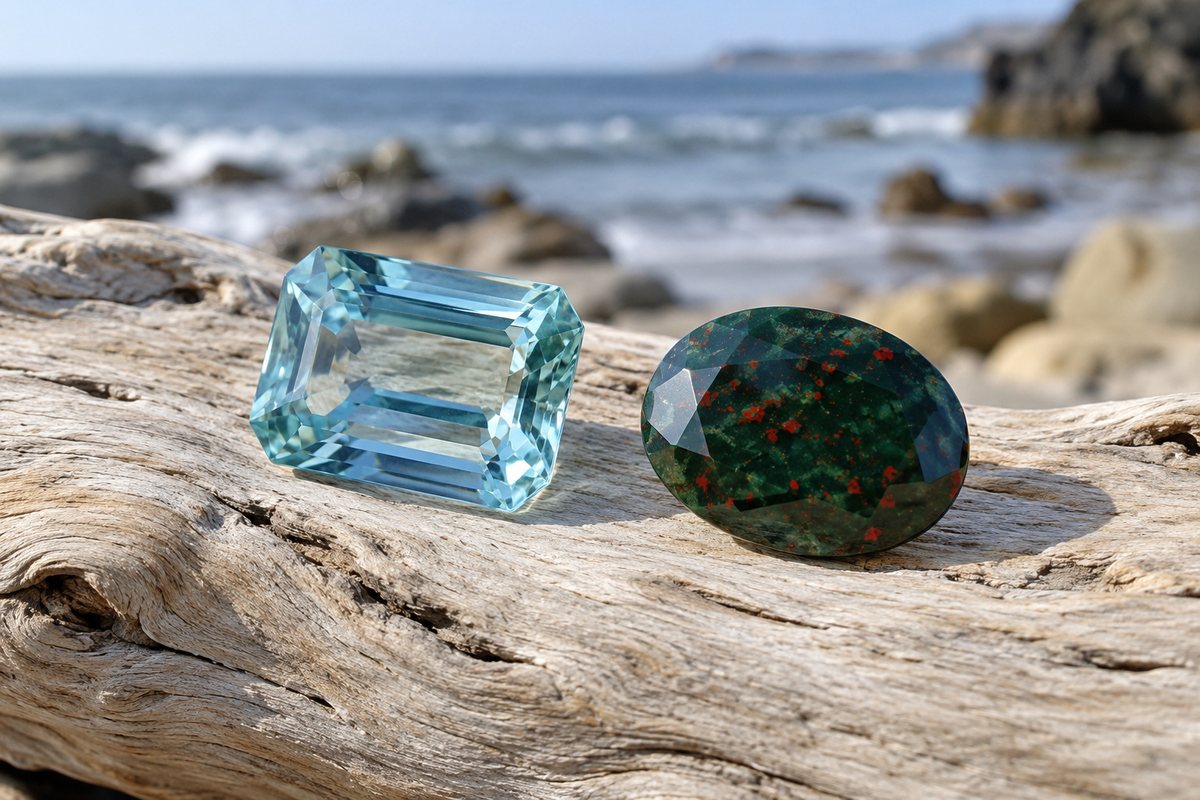
March has two birthstones: aquamarine and bloodstone. Aquamarine is the pale to deep greenish-blue variety of beryl that most people mean by the March birthstone, while bloodstone is a dark green chalcedony flecked with red. Aquamarine is the harder and more versatile of the two, at 7.5 to 8 on the Mohs scale according to GIA, which makes it a practical choice for everyday jewellery.
This guide includes a few product links near the end. As an Amazon Associate, Diamond Taire earns from qualifying purchases, at no extra cost to you.
This guide explains why March has two stones, how aquamarine colour is judged and why most of it is heat treated, how to tell aquamarine from the much cheaper blue topaz, when bloodstone is the better pick, and how to buy and care for a March birthstone without regret.
At a glance
- What is March’s birthstone? Aquamarine and bloodstone. Aquamarine is the modern primary stone; bloodstone is the traditional alternative.
- March birthstone colour: aquamarine runs from light greenish blue to moderately strong dark blue; bloodstone is dark green with red spots.
- Heat treatment is normal: GIA notes that most aquamarine on the market has been heated to give it a purer blue.
- Size changes colour: small aquamarines are usually pale; deeper colour typically appears in larger stones.
- Beware look-alikes: blue topaz is far more common and costs much less than fine aquamarine.
Why does March have two birthstones?
The birthstone list used by most jewellers today grew from a list adopted in 1912 by the National Association of Jewelers, now Jewelers of America. That list included both bloodstone and aquamarine for March, with bloodstone placed first. The Jewelry Industry Council of America’s 1952 revision is usually credited with switching the order, making aquamarine the primary March stone and bloodstone the alternative. Lists in other countries are broadly similar for March, but small differences between national lists do exist.
The two stones could hardly be more different. Aquamarine is transparent, light and sparkling; bloodstone is opaque, earthy and usually cut as a smooth cabochon or carved. That contrast is useful: if the person you are buying for loves classic blue, choose aquamarine; if they prefer bold, vintage or masculine-looking pieces, bloodstone may be the more personal choice.
Aquamarine vs bloodstone compared
| Factor | Aquamarine | Bloodstone |
|---|---|---|
| Mineral | Beryl (the same species as emerald) | Chalcedony, a cryptocrystalline quartz; also called heliotrope |
| Colour | Greenish blue to blue, light to moderately dark | Dark green with red spots of iron oxide (often hematite) |
| Transparency | Transparent; faceted stones usually eye clean | Semi-translucent to opaque |
| Mohs hardness (GIA) | 7.5 to 8 | 6.5 to 7 |
| Usual cut | Emerald cut, round and oval brilliants, designer cuts | Cabochons, carvings, signet stones; some faceted |
| Common treatment | Heat, to give a purer blue | Not commonly discussed; ask the seller |
| Best for | Rings, earrings, pendants, everyday wear | Signet rings, cufflinks, pendants, statement pieces |
| Relative price | Moderate to high, rising with colour depth | Usually affordable |
March birthstone colour: how aquamarine is judged
The name aquamarine comes from the Latin for seawater, and its colour range is narrow compared with many gems. GIA describes it as running from blue through slightly greenish blue to green-blue, and notes that most stones on the market are light greenish blue.
What the most valued colour looks like
According to GIA, the most valuable aquamarine is a dark blue to slightly greenish blue of moderately strong intensity. The purer and more intense the blue, the higher the value. GIA’s buying guide adds that fine stones show even colour without visible zoning.
Greener stones cost less than pure blue ones of the same quality. If you or the person you are buying for prefers a fresher sea-green look, GIA points out that this can stretch the budget further. Some buyers actively prefer the natural greenish colour.
Why bigger aquamarines look bluer
Aquamarine’s colour is light, so depth of colour depends heavily on size. GIA’s buying guide notes that stones under one carat are usually pale, and that stones over about five carats are more likely to show darker colour. GIA adds that some African sources, including Nigeria, Madagascar and Mozambique, produce intense colour in stones under five carats.
This has two practical effects. First, small aquamarine side stones often look paler than a larger centre stone, so a cluster can look uneven. Second, small stones with top colour can sell for more per carat than larger stones of the same colour, according to GIA.
Clarity and cut
Most faceted aquamarine is eye clean, and GIA notes that large stones are available without visible inclusions. Stones with obvious inclusions are usually cut as cabochons, beads or carvings, and some parallel inclusions can create a cat’s-eye effect. Because the colour is light, cutting matters: a well-cut aquamarine shows brilliance across the face rather than a dull or watery centre.
Aquamarine is also pleochroic. GIA explains that it can look nearly colourless in one direction and a stronger blue in another, which is why the way a stone is oriented when cut affects its face-up colour.
Heat-treated aquamarine: what it means
GIA states that most aquamarine on the market has been heat treated to give it a purer blue. This is a normal, widely used treatment, and a heated aquamarine is still natural aquamarine. Ask the seller to confirm on the receipt whether the stone has been heated, and expect any untreated stone sold at a premium to come with an independent report.
GIA also notes that fracture-filled aquamarine exists but is uncommon. Filled stones need gentler care, so if a large, clean-looking stone seems unusually cheap, ask whether it has been filled.
Aquamarine vs blue topaz: how to tell them apart
Blue topaz is one of the most common stones sold in place of, or confused with, aquamarine. GIA explains that colourless topaz is plentiful and is often treated to turn it blue, for example by irradiation, while fine aquamarine is rarer in nature. GIA notes that fine aquamarine sells for far more than treated blue topaz of equivalent quality.
| Clue | Aquamarine | Blue topaz |
|---|---|---|
| Typical colour | Often slightly greenish blue; light stones look soft and watery | Often an even sky blue; GIA notes colourless topaz is often treated to produce this colour |
| Mohs hardness (GIA) | 7.5 to 8 | 8 |
| Refractive index (GIA) | 1.577 to 1.583 | 1.619 to 1.627 |
| Specific gravity (GIA) | 2.72 (feels lighter for its size) | 3.53 (feels heavier for its size) |
| Toughness | Durable with care | Poor, because of cleavage; a hard blow can split it |
| Cleaning (GIA) | Ultrasonic and steam usually safe unless fractured or with liquid inclusions | Avoid ultrasonic and steam |
| Relative price | Higher, especially in deeper blue | Much lower |
The refractive index and specific gravity differences are what a gemmologist uses to separate the two; you cannot see them by eye. The practical warning sign is price. GIA’s buying guide cautions that large, intensely coloured “aquamarines” at very low prices are unlikely to be genuine.
When bloodstone is the better March birthstone
Bloodstone, also called heliotrope, is a variety of chalcedony. GIA describes it as traditionally semi-translucent to opaque dark green with red inclusions of iron oxide, especially hematite. Its name “heliotrope” comes from Greek words meaning “to turn the sun”, and GIA notes that most bloodstone on the market comes from India, with other sources including Brazil, Australia, China and the United States.
Because GIA notes it is usually cut as cabochons, with some faceted, bloodstone suits pieces that are meant to look substantial: men’s rings, cufflinks, bold pendants and vintage-style jewellery. The guide to signet rings explains how they are made and worn. At 6.5 to 7 on the Mohs scale, bloodstone is a little softer than aquamarine, so a flat-topped ring will slowly show wear and may need repolishing over the years.
Choose bloodstone if you want an unusual, earthy March birthstone, a smooth cabochon or signet-style piece, or an affordable option with a strong traditional story. Choose aquamarine if you want sparkle, transparency or a stone that matches the “March is blue” idea most people expect.
Is aquamarine good for an everyday ring?
Yes, with sensible care. GIA calls aquamarine durable enough for everyday wear and recommends protecting it from scratches and hard knocks. It can work as an engagement ring stone, and the guide to the best gemstones for engagement rings shows how it compares with harder stones. Light-coloured stones show dirt quickly, so a ring that is cleaned regularly will look far brighter. For a soft pastel alternative in a similar price conversation, the guide to morganite engagement rings covers aquamarine’s pink cousin, also a beryl.
Metal choice changes the look. White metals keep aquamarine looking icy and cool; yellow and rose gold give it a warmer look. The guide on choosing the right gold karat explains the alloys.
How to buy a March birthstone: checklist
- Choose the stone: transparent blue aquamarine, or opaque green-and-red bloodstone.
- Set expectations for size and colour. A small aquamarine will usually be pale; deep blue usually means a larger or rarer stone.
- Compare stones side by side under the same light. GIA recommends comparing several stones before deciding.
- Ask whether the aquamarine is heated and whether it has been fracture filled.
- Ask whether it is aquamarine at all. If the price is very low for the size and colour, ask directly whether it is blue topaz, glass or another stone.
- Check colour face-up, not just from the side, because aquamarine looks different in different directions.
- Do not rely on seller grades. GIA notes there is no universal grading scale for aquamarine; “AAA” labels are each seller’s own.
- Do not pay extra for a mine name alone. GIA’s buying guide notes that famous origins do not determine value; quality does.
- Get an independent report for valuable stones. GIA reports can identify the stone, whether it is natural or synthetic, and detectable treatments.
- Keep the paperwork for insurance and future repairs.
How to clean and care for aquamarine and bloodstone
For aquamarine, GIA advises that warm, soapy water is always safe, and that ultrasonic and steam cleaners are usually safe unless the stone has fractures or liquid inclusions. Avoid exposing it to heat, and treat fracture-filled stones only with warm, soapy water. Its colour is stable in light.
For bloodstone, GIA recommends warm, soapy water and a soft brush, avoiding harsh chemicals and extreme heat, drying with a soft cloth and storing it in soft fabric to prevent scratches. The guide on how to store jewellery covers simple storage that keeps softer stones safe.
Common mistakes
- Expecting deep blue in a tiny stone. Small aquamarines are usually pale; that is normal, not a defect.
- Buying a cheap, vivid “aquamarine” that turns out to be blue topaz or glass.
- Assuming heated means fake. Most aquamarine is heated, and it is still natural aquamarine.
- Paying a premium for a mine or locality name without independent documentation.
- Mixing small pale side stones with a deeper centre stone and being surprised by the mismatch.
- Ultrasonic cleaning a fractured or filled stone. Ask what the stone has had done before using any machine.
- Overlooking bloodstone. For a signet ring or carved piece, it can be the more meaningful March choice.
More birthstone guides in this series: January birthstone: garnet and July birthstone: ruby.
Sources this guide draws on: GIA’s March birthstones page; GIA’s aquamarine gem encyclopedia entry and aquamarine quality factors; GIA’s aquamarine buying guide; GIA aquamarine and topaz care and cleaning guides; GIA’s topaz gem encyclopedia entry; published accounts of the 1912 National Association of Jewelers birthstone list and its 1952 revision.
March birthstone FAQs
What is the birthstone for March?
March has two birthstones: aquamarine and bloodstone. Aquamarine, a blue variety of beryl, is the one most people mean; bloodstone, a green and red chalcedony, is the traditional alternative.
What is the colour of the March birthstone?
Aquamarine ranges from light greenish blue to a moderately strong, slightly greenish dark blue. Bloodstone is dark green with red spots. If you want one colour for March, it is usually sea blue.
What is March’s real birthstone?
Both are genuine. The 1912 list included bloodstone and aquamarine, and later revisions made aquamarine the primary stone, so either is correct for a March birthday.
Is aquamarine expensive?
It depends mainly on colour and size. Pale, smaller stones are usually affordable, while deep, pure blue stones cost much more. Prices change and vary by country and seller.
Is my aquamarine real or blue topaz?
You cannot reliably tell by eye. A gemmologist can measure refractive index and specific gravity, which differ clearly between the two, and a laboratory report gives a definite answer for valuable stones.
Can aquamarine be worn every day?
Yes. At 7.5 to 8 on the Mohs scale, GIA considers it durable enough for everyday wear. Protect it from hard knocks and clean it often to keep it bright.
Aquamarine gives March a calm, sea-blue birthstone that is tough enough to wear every day, while bloodstone offers a richer, more traditional alternative. Decide which look you love, set honest expectations for colour and size, and get clear written answers on treatment and identity, and a March birthstone can be a beautiful gift that lasts. For more on choosing pieces that will be worn for years, see the guide to building a jewellery collection.
Useful tools for this guide
Practical picks for choosing, checking and caring for jewellery. As an Amazon Associate, Diamond Taire earns from qualifying purchases, at no extra cost to you. Prices and availability are set by Amazon and may vary by country.
- Gemstones of the World by Walter Schumann (5th edition)
A classic illustrated reference to more than 1,900 gemstones.
View on Amazon - Foldable 30x Jeweller’s Loupe
Pocket magnifier for checking stones, settings and hallmarks up close.
View on Amazon - KElofoN Travel Jewellery Case
Compact case with ring rolls and earring slots so pieces do not scratch each other.
View on Amazon