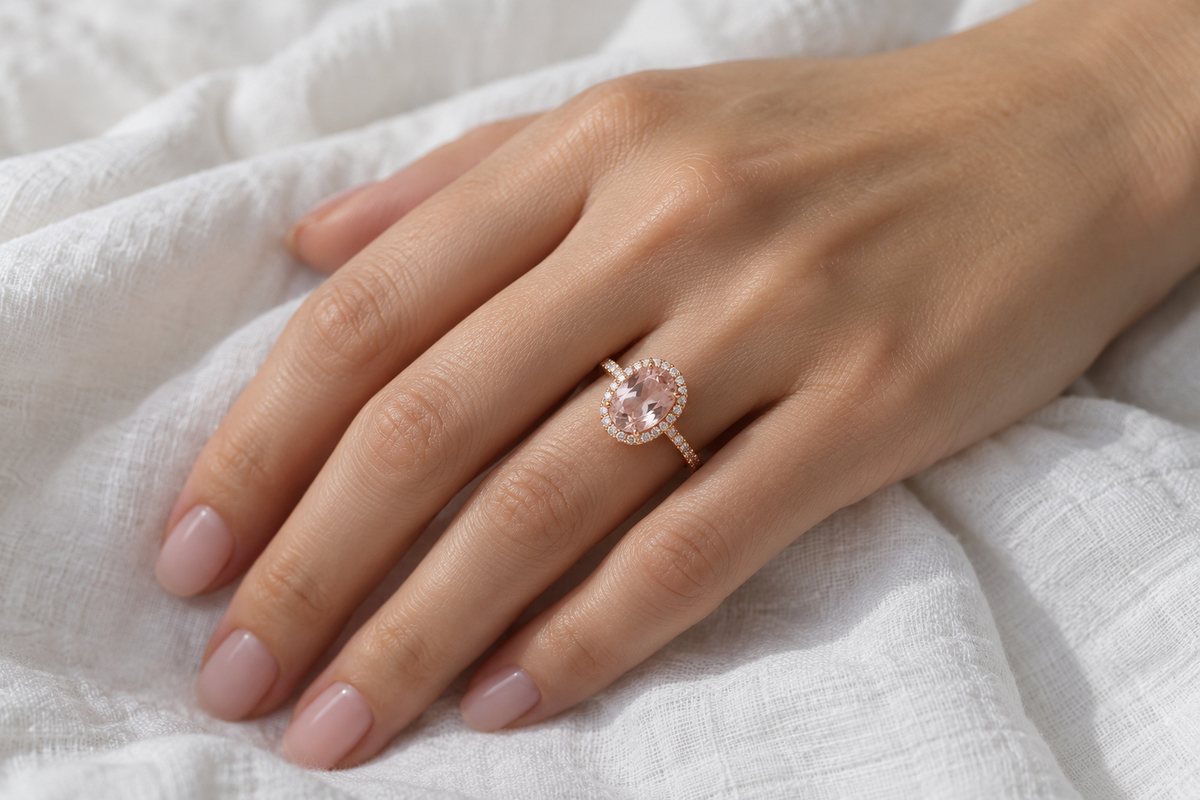
A morganite engagement ring can be a good choice if you love its soft pink colour and accept that it needs more care than a diamond or sapphire. Morganite is 7.5 to 8 on the Mohs hardness scale, so GIA rates it suitable for everyday wear when handled carefully, but it scratches and chips more easily than harder stones and looks dull quickly if it is not cleaned.
This guide includes a few product links near the end. As an Amazon Associate, Diamond Taire earns from qualifying purchases, at no extra cost to you.
This guide answers the question people ask most, often after buying: is morganite a good engagement ring stone, and what causes the regret some owners describe? It covers durability, why morganite goes cloudy and how to clean it, colour and heat treatment, the settings that protect it, and how it compares with pink sapphire and lab-grown pink diamond.
At a glance
- Durability: 7.5 to 8 on the Mohs scale; good, but clearly below sapphire (9) and diamond (10).
- Cloudiness is usually dirt, not damage. A film of skin oil, lotion and soap on the back of the stone stops light returning. Regular cleaning fixes it.
- Colour is stable. Nearly all morganite is heat-treated to improve the pink, and GIA says its colour is stable to light and does not fade.
- Setting matters most. A bezel or a well-made halo protects the stone far better than tall, open prongs.
- If daily hard wear is likely, pink sapphire is the more durable pink choice.
What is morganite?
Morganite is the pink to orangy-pink variety of beryl, the same mineral family as emerald and aquamarine. GIA’s morganite guidance describes its colour range as soft pink, purplish pink and orangy pink, with stronger pink tones the most desirable. The name honours the American financier and gem collector J. P. Morgan; GIA notes that the gem expert George Kunz proposed it in 1910 after examining early pink beryl from Madagascar.
Morganite is often clean, with no inclusions visible to the eye in many faceted stones, and it is found in large sizes. That combination is why it offers a large, bright centre stone for a fraction of the cost of a coloured diamond.
Is morganite a good engagement ring stone?
It can be, for the right person. Hardness measures resistance to scratching. Everyday dust contains particles of quartz, which sits at 7 on the Mohs scale, so stones harder than that resist the worst everyday scratching. Morganite clears that bar, which is why it is far more practical than opal or pearl. But it is less hard and less tough than sapphire, ruby or diamond, so over years its facet edges can show wear, and a hard knock can chip it.
Our guide to the best gemstones for engagement rings compares hardness, toughness and stability across all the common choices. The short version for morganite: a good stone with a protective setting and some care, not a stone to ignore for twenty years.
Who morganite suits, and who it does not
| Morganite suits you if | Consider something harder if |
|---|---|
| You love soft, pastel pink and peach tones | You want a stone that looks the same after decades with little care |
| You want a large centre stone on a moderate budget | You work with your hands, play contact sports or rarely take your ring off |
| You are happy to clean your ring regularly | You dislike regular cleaning |
| You are open to a bezel or protective halo | You want a tall, open, four-claw setting |
| You see the ring as something you may re-polish or reset one day | You expect resale value |
Why morganite goes cloudy, and how to clean it
The most common complaint about morganite engagement rings is that the stone stops sparkling and looks milky or flat after a few weeks. In most cases nothing is wrong with the stone. Light colours show grime more than dark ones, and a film of skin oil, hand cream, soap and dust builds up on the pavilion (the underside). Light that should bounce back to your eye is scattered instead, and a pale pink stone looks grey or cloudy.
GIA’s care guidance says warm, soapy water is always a safe way to clean morganite. Ultrasonic and steam cleaners are usually safe, but not for stones with fractures or liquid inclusions, and GIA advises that heat exposure is not recommended. Some acids can attack morganite, so avoid harsh household cleaners.
How to clean a morganite engagement ring at home: step by step
- Fill a small bowl with warm (not hot) water and a few drops of mild washing-up liquid.
- Soak the ring for 10 to 20 minutes to soften the film.
- Brush gently with a soft toothbrush, paying most attention to the back of the stone and under the claws.
- Rinse in clean warm water, with the plug in or over a bowl.
- Dry with a soft, lint-free cloth.
- Repeat weekly if you wear the ring every day, and take it off before applying lotion or sunscreen.
- Ask your jeweller before using an ultrasonic or steam cleaner, and have them check the stone for fractures first.
- Book a professional check of the claws or bezel about once a year.
If a halo of diamonds surrounds the morganite, the same gentle method suits both; our guide to cleaning diamonds safely has more detail on the diamond side.
Colour, heat treatment and fading
According to GIA, morganite is nearly always heat-treated to improve its pink colour by removing yellow or orange tints, and the treatment is not detectable. It is routine and stable, so it is not a reason to avoid morganite, but a seller should still disclose that it is likely. Untreated morganite, especially from Brazil, tends to show a salmon or orange-pink tone.
On fading, GIA’s care guidance states that morganite’s colour is stable to light. If a stone seems to have lost colour, check first whether it simply needs cleaning; a dirty stone looks paler. Colour also tends to look stronger in larger stones, so a small morganite will usually look lighter than a large one of the same material.
Settings that protect morganite
The setting does more than any other choice to decide how a morganite ring ages. GIA’s morganite guidance calls a bezel an excellent choice because the metal surrounds and protects the stone, and notes that four- and six-prong settings are common but offer less protection.
| Setting | Protection | Look | Good for |
|---|---|---|---|
| Full bezel | Highest | Clean, modern rim of metal | Active wearers and daily wear |
| Halo | Good; the halo takes knocks at the edge | Larger, sparkling outline | A bigger look with extra protection |
| Six claws, low profile | Moderate | Classic, shows more of the stone | Careful daily wearers |
| Four claws, high profile | Lowest | Open, light and tall | Occasional wear or very careful owners |
For metal, GIA notes that rose gold enhances morganite’s pink, yellow gold brings out any warm tones, and white metals create a cooler contrast. The rose gold and pink morganite engagement ring is popular for that reason. Rose gold gets its colour from copper in the alloy; see how to choose the right gold karat for how karat affects colour and wear, and our settings guide for the full comparison.
Morganite vs pink sapphire vs lab-grown pink diamond
If you want a pink engagement ring, these are the three most common choices. Prices vary widely by size, quality and country, and prices change, so the table compares them in relative terms only.
| Factor | Morganite | Pink sapphire | Lab-grown pink diamond |
|---|---|---|---|
| Mineral | Beryl | Corundum | Diamond (carbon) |
| Mohs hardness | 7.5 to 8 | 9 | 10 |
| Typical colour | Soft pastel pink to peach | Light pink to vivid, hot pink | Light to strong pink |
| Brilliance | Moderate; shows dirt quickly | Good | Highest |
| Common treatment | Heat (routine, stable) | Heat is common; ask about others | Ask whether the colour has been treated; the grading report should say |
| Relative cost for a large stone | Lowest | Higher | Varies widely; compare like-for-like quotes |
| Daily-wear durability | Good with a protective setting | Excellent | Excellent |
The honest trade-off: morganite gives the biggest, softest pink for the money; pink sapphire gives far better durability and stronger colour; a lab-grown pink diamond gives the most sparkle and hardness. Natural pink diamonds are in a different price class altogether, as the pink diamond ring guide explains.
Buying checklist
- View the stone in daylight and indoor light; pale stones can look very different in each.
- Look for an even pink with no strong brown or grey tone.
- Check the stone is well cut: no large dark or washed-out “window” in the centre.
- Ask whether the stone is natural morganite. Pink glass and synthetic materials are sometimes sold as “pink stones”.
- Ask about treatment and get it on the receipt.
- Choose a bezel, halo or low six-claw setting if you plan to wear it every day.
- Confirm the returns policy and whether the jeweller offers cleaning and claw checks.
- Insure the ring once you have it; see how to insure jewellery.
Common mistakes
- Thinking a cloudy stone is ruined. It almost always needs cleaning, not replacing.
- Choosing tall four-claw settings for a hard-working hand. This is the most common route to chips.
- Wearing it for gardening, gym or housework. GIA recommends removing it for strenuous activity.
- Using harsh cleaners or a steam cleaner without a check. Acids and heat are the risks; warm soapy water is safe.
- Storing it loose with diamonds. Harder stones scratch morganite. See how to store jewellery.
- Buying the palest stone to save money. Very pale morganite can look almost colourless once worn; stronger pink is worth the difference for most buyers.
- Expecting resale value. Morganite is bought to enjoy, not as a store of value.
Sources this guide draws on: GIA morganite care and cleaning guidance; GIA 4Cs morganite engagement ring buying guide; GIA morganite buyer’s guide and quality factors; the Mohs hardness scale.
Useful tools for this guide
Practical picks for choosing, checking and caring for jewellery. As an Amazon Associate, Diamond Taire earns from qualifying purchases, at no extra cost to you. Prices and availability are set by Amazon and may vary by country.
- Gemstones of the World by Walter Schumann (5th edition)
A classic illustrated reference to more than 1,900 gemstones.
View on Amazon - Foldable 30x Jeweller’s Loupe
Pocket magnifier for checking stones, settings and hallmarks up close.
View on Amazon - KElofoN Travel Jewellery Case
Compact case with ring rolls and earring slots so pieces do not scratch each other.
View on Amazon
Frequently asked questions
Is morganite a good engagement ring stone?
Yes, for careful wearers who love its colour. At 7.5 to 8 on the Mohs scale it suits daily wear in a protective setting, but it is less durable than sapphire or diamond and needs regular cleaning to keep its sparkle.
Why does my morganite ring look cloudy?
Usually because of a film of skin oil, lotion and soap on the underside of the stone. Soak it in warm soapy water and brush gently; the sparkle normally returns straight away.
Does morganite fade over time?
GIA states that morganite’s colour is stable to light and does not fade. A stone that looks paler is most often dirty, so clean it before worrying.
Can you clean morganite in an ultrasonic cleaner?
GIA says ultrasonic and steam cleaners are usually safe, except for stones with fractures or liquid inclusions. Warm soapy water is always safe, so use that unless a jeweller has checked the stone.
Morganite vs pink sapphire: which is better?
Pink sapphire is harder (9 versus 7.5 to 8) and better for hard daily wear. Morganite usually costs less for a large stone and has a softer, pastel colour. Choose on lifestyle first, then colour and budget.
What setting is best for a morganite engagement ring?
A bezel gives the most protection, and a halo also guards the edge of the stone. If you want claws, choose six low, sturdy claws and have them checked yearly.
A morganite engagement ring is a beautiful, affordable choice when it is chosen with open eyes: a protective setting, a weekly clean and a little care in daily life. If that sounds like too much, pink sapphire offers a similar mood with far more toughness. For the wider decision, our engagement ring buying guide walks through every step.