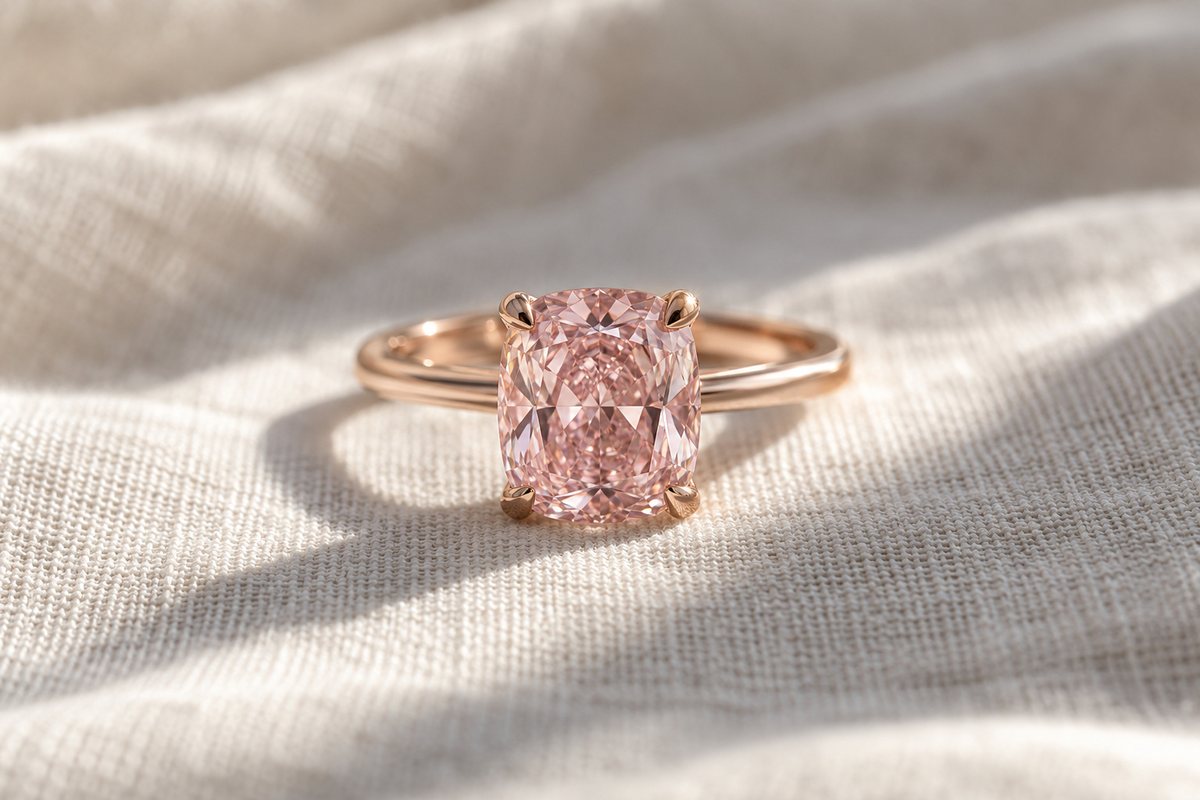
A diamond ring with a pink diamond can hold one of three very different stones: a natural pink, a natural diamond whose pink colour was added by treatment, or a lab-grown pink. They can look alike across a table, but they differ enormously in rarity and price, so the single most important thing to know before you buy is which of the three you are looking at, and to have that confirmed in writing by an independent laboratory report.
This guide includes a few product links near the end. As an Amazon Associate, Diamond Taire earns from qualifying purchases, at no extra cost to you.
This guide explains where pink, yellow and blue colour in diamonds comes from, how fancy colour is graded, why natural pinks became even scarcer after Australia’s Argyle mine closed, how treated and lab-grown pinks are made and identified, and how to choose a ring you will be happy with for decades.
At a glance
- Natural pink diamonds are among the rarest gems; GIA research attributes the colour of the vast majority to distortion in the crystal structure, not a trace element.
- The Argyle mine in Western Australia, long the main source of strong pinks, stopped mining on 3 November 2020.
- Many pinks on the market are treated natural diamonds or lab-grown diamonds whose colour was created or improved after growth.
- Fancy colour is graded face-up on a scale from Faint to Fancy Vivid, judged on hue, tone and saturation together.
- Always ask for a report that states both whether the diamond is natural or lab-grown and whether its colour is natural or treated.
Natural, treated or lab-grown: the three kinds of pink
When someone searches for a pink diamond ring, they are usually picturing the soft rose or vivid bubblegum colour seen in celebrity and auction pieces. That look can be reached in three ways, and each one deserves a different price and a different set of questions.
| Type | Where the colour comes from | Rarity | Relative price | What the report should say |
|---|---|---|---|---|
| Natural pink | Formed in the earth, usually linked to distortion of the crystal lattice | Extremely rare | Highest by a wide margin | Natural diamond, natural colour |
| Treated natural pink | A natural diamond (often brown or pale) given colour by processes such as HPHT, irradiation and annealing | Uncommon but available | Far below natural-colour pinks | Natural diamond, treated colour |
| Lab-grown pink | Grown by HPHT or CVD, with pink usually produced by post-growth treatment | Readily available | Usually the lowest of the three | Laboratory-grown diamond, with any treatment noted |
None of these is a bad choice in itself. A treated or lab-grown pink can be beautiful and durable, because it is still diamond. The problems arise only when the type is unclear or misdescribed, or when someone pays a natural-colour price for a stone that is not one.
Why natural pink diamonds are so rare
What makes a diamond pink
Most coloured diamonds owe their colour to an impurity. GIA explains that nitrogen makes diamonds yellow and that boron is often responsible for natural blue. Pink is different. GIA researchers studying a large number of natural pinks found that the colour of the overwhelming majority comes from distortion in the crystal structure associated with plastic deformation deep in the earth, and that this kind of deformation cannot be reproduced by any known laboratory treatment or growth process. The exact atomic defect responsible is still not fully understood.
In many natural pinks the colour is concentrated in fine parallel bands, often called pink graining, which a gemmologist can see under magnification. A small share of natural pinks, which are very pure type IIa diamonds, show a smoother, more even colour instead.
How rare is fancy colour overall?
According to GIA, only about one in every 10,000 carats of polished diamond shows fancy colour at all. Browns and yellows are the most common fancy colours; reds, greens, purples and oranges are among the rarest. Strong, pure pinks sit firmly in the rare end of that range.
The Argyle mine closure
For decades, the Argyle mine in the East Kimberley region of Western Australia was the world’s most consistent source of strongly coloured pink, purplish-pink and red diamonds. Published accounts commonly credit it with roughly 90 per cent or more of the world’s pink and red supply. Owner Rio Tinto stopped mining there on 3 November 2020 after 37 years, and the mine’s invitation-only pink diamond tender, which offered only a tiny fraction of its output each year, held its final sales around the closure.
GIA’s researchers expected a substantial drop in the supply of highly saturated pinks after Argyle closed. Other sources exist, including Russia and occasional finds in Africa and South America, but none has reported regular production on the same scale. For buyers, this means two things: natural-colour pinks are likely to stay scarce, and documentation matters even more.
How fancy colour is graded
Colourless diamonds are graded on the D to Z scale, face-down, where less colour is better. Fancy-coloured diamonds are judged the opposite way: face-up, against a neutral background, where stronger, purer colour is generally more valuable. If you have read our guide to diamond colour grades, think of fancy colour as a separate system that starts where the D to Z scale ends.
Hue, tone and saturation
- Hue is the colour itself, such as pink, purplish-pink or orangy pink. GIA recognises 27 hues.
- Tone is how light or dark the colour appears.
- Saturation is how strong or intense the colour is.
The grader weighs all three together to arrive at a single grade description.
The fancy colour grades
GIA’s coloured diamond reports use these grade terms, broadly from weakest to strongest colour: Faint, Very Light, Light, Fancy Light, Fancy, Fancy Intense and Fancy Vivid, with Fancy Dark and Fancy Deep describing darker or deeper colour. A Fancy Vivid pink is at the top of the desirability range; a Faint or Very Light pink may look only faintly blushed, especially in a small stone.
Secondary colours matter
A pink may carry a modifier such as purplish, orangy or brownish. Many buyers prefer a pure pink or purplish pink, and a brownish modifier is often seen as less desirable. Two stones with the same intensity word can therefore look quite different, so read the full colour description, not just the grade.
Treated and lab-grown pinks: what you are buying
Treated natural diamonds
Pink colour can be added to natural diamonds through combinations of high-pressure, high-temperature (HPHT) processing, irradiation and low-temperature annealing. These processes create colour centres that absorb light in a way that reads as pink. The result is still a natural diamond, but the colour is not natural, and that difference has a large effect on value.
Lab-grown pinks
Lab-grown diamonds are made by HPHT or chemical vapour deposition (CVD). GIA notes that pink and red lab-grown colours usually come from radiation and heating after growth. In GIA’s laboratory notes on pink CVD diamonds, the samples had been HPHT processed, irradiated and then annealed to create nitrogen-vacancy colour centres. Our CVD vs HPHT comparison explains the two growth methods in more detail, and the lab-grown diamond buyer’s guide covers grading and value.
How labs tell them apart
Laboratories use advanced spectroscopy, fluorescence imaging and magnification to separate natural, treated and lab-grown pinks. Signs such as the type of colour centres present, the pattern of fluorescence and the presence or absence of natural pink graining all help. This testing is not something a jeweller’s handheld tester can do reliably, which is why an independent report is essential for any pink sold as natural.
Disclosure rules
Rules vary by country. In the United States, the Federal Trade Commission’s Jewelry Guides expect sellers to disclose treatments that are not permanent, that create special care needs or that significantly affect value, and to describe lab-grown diamonds clearly with words such as laboratory-grown or laboratory-created. Other countries have their own consumer laws and trade codes. Wherever you buy, ask for the treatment and origin in writing on the receipt as well as the report.
Yellow and blue diamond rings: a quick comparison
Pink often gets the attention, but yellow and blue are popular alternatives, and the same three-way split applies to each.
| Colour | Usual natural cause | Availability | Treated and lab versions | Buying note |
|---|---|---|---|---|
| Pink | Crystal lattice distortion | Very scarce, especially strong colours | Common | Origin of colour makes the largest price difference |
| Yellow | Nitrogen | The most available fancy colour alongside brown | Available | A good entry point to natural fancy colour |
| Blue | Often boron | Rare in natural form | Common; boron can be added during HPHT growth | Ask about origin and any irradiation |
A natural yellow diamond ring is often the most realistic way to own a natural-colour fancy diamond, because yellow is far more available than pink or blue. Intensity still drives price, so a Fancy Intense or Fancy Vivid yellow commands much more than a Fancy Light.
Realistic price expectations
This guide does not quote price lists, because coloured diamond prices vary widely by colour grade, size, origin and market, and prices change. What holds true at the time of writing (October 2026) is the order of magnitude between types: natural-colour pinks of strong colour are priced in a different league from treated pinks of similar appearance, and lab-grown pinks are usually the most affordable of all. For a deeper look at value and resale, see whether fine diamonds hold their value. Neither a pink diamond nor any other jewellery purchase should be treated as an investment.
Choosing a pink diamond ring: a step-by-step checklist
These steps apply whether you want a pink solitaire or a white diamond ring with pink diamond side stones or accents.
- Decide which type you want. Natural colour, treated or lab-grown. Set your budget around that choice, not the other way round.
- Ask for an independent report. It should state natural or laboratory-grown, the colour grade and description, and whether the colour is natural or treated. Our guide to reading a diamond grading report shows what each line means.
- Check the report matches the stone. Compare the report number with any laser inscription on the girdle, and check measurements and weight.
- Look at the colour in different lights. View the stone in daylight, warm indoor light and under shop lights. Pinks can shift noticeably.
- Consider size versus intensity. Colour shows less in small stones, so a tiny Faint pink may barely read as pink on the hand.
- Think about the metal. Rose gold can warm and deepen the look of a pale pink; white metals give a cooler contrast. Many designers set the pink in a rose gold head and the band in another metal.
- Choose a protective setting. Pinks are often set as a centre with a white diamond halo or as side stones. Our ring setting guide compares the options.
- Get treatment and origin on the receipt. This protects you if you ever need to insure, resell or make a claim.
- Ask about care. Some treated stones need care with high heat, for example during jewellery repair. Ask the seller and tell any jeweller who works on the ring.
Who each option suits
- Natural-colour pink: suits buyers who value geological rarity and are comfortable with a very high price for a small stone, with full documentation.
- Treated natural pink: suits buyers who want a mined diamond with strong pink colour at a much lower cost and are happy with disclosed treatment.
- Lab-grown pink: suits buyers who want a larger, more saturated pink for the budget and do not need natural origin. If ethics and traceability matter to you, our ethical diamond checks apply to coloured stones too.
- Not a diamond at all: if you mainly want the colour, a pink sapphire or another gemstone may suit; see the best gemstones for engagement rings.
Common mistakes
- Assuming pink means natural. Most pinks you see for sale are treated or lab-grown. Never assume.
- Relying on a seller’s own certificate. For a natural-colour claim, an independent laboratory report is the minimum.
- Reading only the intensity word. The hue modifier, such as brownish or purplish, changes both look and value.
- Judging colour under one light. Shop lighting can flatter colour; check in daylight too.
- Paying an Argyle premium without proof. Ask for documentation that ties the stone to Argyle before paying more for the name.
- Buying as an investment. Rare pinks have sold for remarkable sums at auction, but retail buyers rarely resell at those levels.
- Forgetting insurance and appraisal. Coloured diamonds need specialist valuation; update cover when you buy.
Sources this guide draws on: GIA research on why pink diamonds are pink; GIA’s overview of fancy coloured diamonds and coloured diamond grading reports; GIA Gems and Gemology lab notes on treated pink CVD laboratory-grown diamonds; GIA’s explanation of HPHT and CVD growth processes; published accounts of the Argyle diamond mine and its closure by Rio Tinto; the US Federal Trade Commission’s Jewelry Guides.
Useful tools for this guide
Practical picks for choosing, checking and caring for jewellery. As an Amazon Associate, Diamond Taire earns from qualifying purchases, at no extra cost to you. Prices and availability are set by Amazon and may vary by country.
- Foldable 30x Jeweller’s Loupe
Pocket magnifier for checking stones, settings and hallmarks up close.
View on Amazon - CONNOISSEURS Premium Jewellery Cleaner
Gentle dip cleaner with a brush and tray for diamonds, gold and platinum. Check the label for stones it should not be used on.
View on Amazon - Ring Sizer Measuring Tool Kit (27 pieces)
Sizing rings plus a mandrel, to check a size at home before you buy or resize.
View on Amazon
Frequently asked questions
Are pink diamonds real diamonds?
Yes. Natural, treated and lab-grown pinks are all real diamond, made of carbon with the same hardness. The difference is whether the stone formed in the earth or a laboratory, and whether its colour is natural or the result of treatment.
Why are pink diamonds so expensive?
Natural-colour pinks are expensive because they are extremely rare, and the closure of the Argyle mine in 2020 removed the most consistent source of strong pinks. Treated and lab-grown pinks cost much less because their colour can be produced on demand.
How can I tell if a pink diamond is natural?
You cannot tell reliably by eye or with a basic tester. An independent gemmological laboratory report stating natural diamond and natural colour is the only dependable confirmation for most buyers.
What is the best fancy colour grade for a pink diamond ring?
There is no single best grade; it depends on taste and budget. Fancy Intense and Fancy Vivid show the strongest colour, while Fancy Light or Light pinks give a softer blush at a lower price. Look at the stone itself, not just the grade.
Is a yellow diamond ring a good alternative?
For many buyers, yes. Natural yellow diamonds are much more available than pinks, so a natural-colour yellow can be a realistic way to own a fancy-coloured diamond. The same advice about reports and treatment disclosure applies.
Do lab-grown pink diamonds fade?
Colour from treatment is generally stable in normal wear, but some treated colours can be affected by very high heat, such as a jeweller’s torch during repair. Ask the seller about care and tell any jeweller about the treatment before work is done.
A pink diamond ring can be a joyful, lasting choice at almost any budget once you know which kind of pink you are buying. Decide on natural, treated or lab-grown first, insist on independent paperwork, and choose the colour you love in real light.