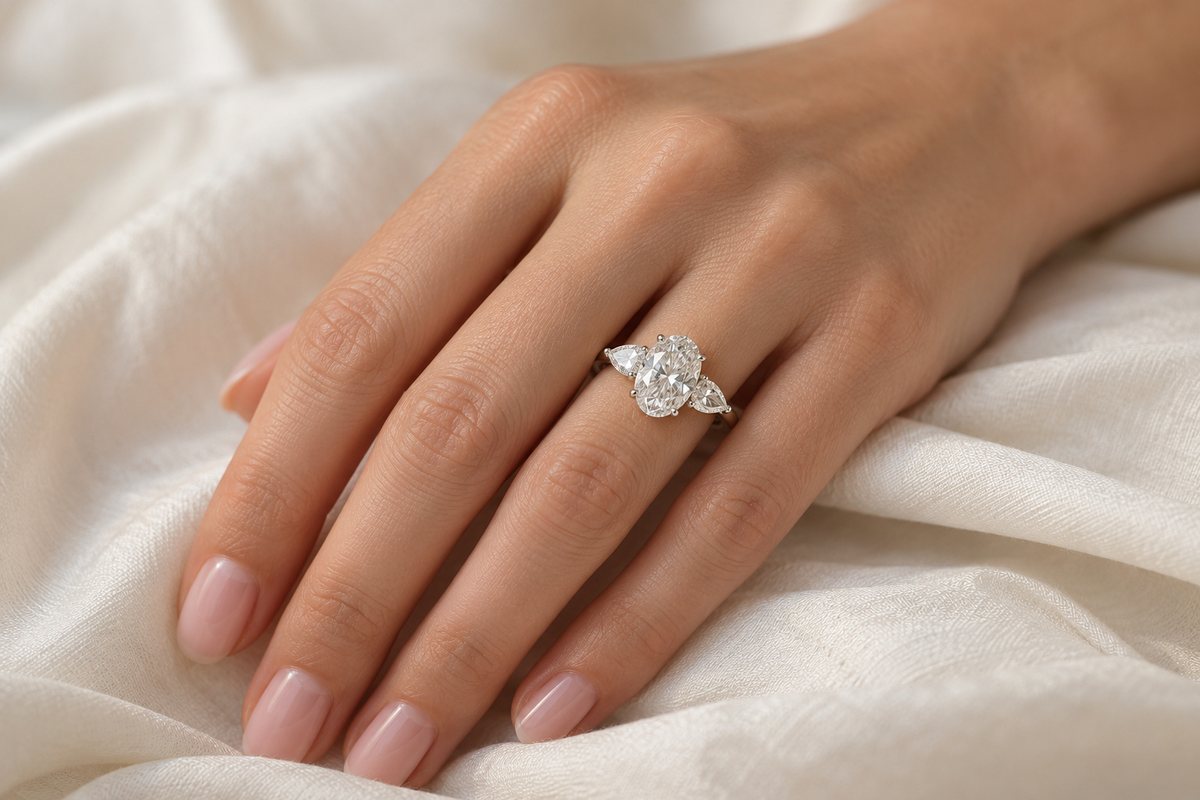
A three stone engagement ring has one centre gem flanked by a smaller (or equal) stone on each side, and it is most often said to stand for a couple’s past, present and future. To choose a beautiful one, get three things right: side stones sized in proportion to the centre, colour and clarity that match closely enough to look like a set, and a setting that keeps all three secure. Get those right and a three stone ring can look larger and sparkle more than a solitaire at a similar budget.
This guide includes a few product links near the end. As an Amazon Associate, Diamond Taire earns from qualifying purchases, at no extra cost to you.
This guide covers the meaning and history, how to balance stone sizes (with a simple sizing table), how closely the stones need to match, the best side-stone shapes for each centre shape, where lab-grown side stones save money, and how the two-stone toi et moi style compares.
At a glance
- Meaning: commonly past, present and future; GIA lists other readings such as friendship, love and fidelity.
- Proportion: side stones are usually noticeably smaller than the centre; a common designer guideline is side stones about half to two-thirds the centre’s width.
- Matching: GIA notes designers often keep side stones within a colour grade or two of the centre, with similar (not identical) clarity.
- Shape pairings: pears, tapered baguettes, trapezoids and trilliants are classic partners because they frame the centre without competing.
- Toi et moi is the two-stone cousin: two main stones, often in different shapes or colours.
What a three stone ring means
The best-known meaning is past, present and future: the left stone for the life you have shared, the centre for now, and the right for what is ahead. GIA’s buying guide notes other interpretations too, including “yesterday, today and tomorrow”, “friendship, love and fidelity”, parent, parent and child, and the Holy Trinity. Some couples simply choose three stones because they like the look, and that is reason enough.
The style is not new. GIA traces three stone rings back at least to the 17th century, and the Victorian era produced many with old mine cut diamonds set in gold. The design had a high-profile revival when the Duchess of Sussex wore one.
Three stone vs solitaire vs halo vs toi et moi
| Style | Look | Sparkle | Budget effect | Upkeep |
|---|---|---|---|---|
| Solitaire | Single stone, clean and classic | All from one stone | Most of the money goes into one larger stone | Lowest; fewest claws to check |
| Three stone | Wider, more presence across the finger | GIA notes more sparkle than a solitaire of equal size and quality | Spread across three stones; the centre is usually smaller than a solitaire for the same spend | Moderate; more claws and gaps to keep clean |
| Halo | Centre ringed by small stones | Lots of small-stone glitter | Makes a smaller centre look larger | Higher; many tiny stones |
| Toi et moi | Two main stones side by side or crossing over | Depends on the pair | Two stones of similar importance | Moderate |
GIA also points out that the same budget may buy a significantly larger solitaire than the combined three stones, so decide whether you value one big centre or the overall spread. The site’s guide on choosing an engagement ring style compares other designs if you are still undecided.
How to balance the centre and side stones
There is no single correct ratio, and GIA’s own examples range widely, from a 1.70 carat oval centre with side stones totalling 0.78 carats to a 3.03 carat cushion with sides totalling 0.54 carats. What matters is that the centre clearly leads. A widely used designer guideline is that each side stone should be about half to two-thirds of the centre’s width.
Why carat weight is misleading here
Carat is weight, and weight grows with volume, so halving the carat weight does not halve the size you see. As a rough geometric rule, a stone with half the carat weight of the centre is still around four-fifths of its width. That means side stones that seem “small” on paper can look almost equal on the hand. Always compare millimetre measurements.
| Centre stone | Subtle sides (each) | Balanced sides (each) | Bold sides (each) |
|---|---|---|---|
| 0.50 ct | about 0.10 ct | about 0.15 to 0.20 ct | about 0.25 ct |
| 1.00 ct | about 0.15 to 0.20 ct | about 0.25 to 0.35 ct | about 0.50 ct |
| 1.50 ct | about 0.25 ct | about 0.40 to 0.50 ct | about 0.75 ct |
| 2.00 ct | about 0.30 to 0.35 ct | about 0.50 to 0.70 ct | about 1.00 ct |
These are illustrative starting points for round or similar shapes, not rules. Elongated side stones such as pears look larger for their weight, so you can go lighter. Hand size matters too: GIA suggests side stones should not be hidden by the neighbouring fingers, and very wide rings can feel bulky on slim fingers.
Matching colour and clarity across three stones
When three stones sit side by side, differences you would never notice in a solitaire can show. GIA’s side-stone guidance says side stones can be within a colour grade or two of the centre, and its three stone guide notes that designers often choose side colour identical or close to the centre. Clarity should be similar but does not need to match exactly, since most inclusions are invisible to the naked eye above the I grades. In one GIA example of a very high-grade ring, the side stones were matched exactly because even a small feather would have spoiled the look.
Two practical points make matching easier. First, colour shows more in larger stones and in step cuts, so the centre usually deserves the closest attention. Second, cut quality affects how bright each stone looks; a poorly cut side stone can look darker than its colour grade suggests. The site’s diamond colour guide explains how grades look in practice.
Popular side-stone shapes and what they pair with
| Side-stone shape | Pairs well with | Effect |
|---|---|---|
| Round | Round, oval, cushion | Uniform, classic; the most common combination |
| Pear | Round, oval, cushion | Points taper away, framing the centre and slimming the finger |
| Tapered baguette | Emerald, radiant, princess, round | Clean, tailored lines |
| Trapezoid | Emerald, Asscher, radiant | Straight edges continue the step-cut outline |
| Trilliant (triangle) | Princess, marquise, oval, round | Strong geometry; GIA highlights trilliants framing marquise, oval and princess centres |
| Half-moon | Oval, cushion, round | Curved inner edge hugs the centre |
| Coloured gems (sapphire, ruby) | Any diamond centre | Personal colour; GIA notes both rate 9 on the Mohs scale, so they wear well |
If you like coloured stones, the best gemstones for engagement rings explains which are durable enough for daily wear.
Saving money with lab-grown side stones
Because lab-grown diamonds are physically and chemically the same as natural ones, some buyers choose a natural centre with lab-grown sides, or an all lab-grown ring for maximum size. At the time of writing (October 2026), lab-grown diamonds cost substantially less than natural stones of similar grades; prices change and vary by country, so compare quotes on the day. If stones are mixed, make sure the receipt and any reports state which is which, as this matters for insurance and any future resale. The site’s lab-grown diamond buyer’s guide covers reports and disclosure in detail.
Settings and metal for a three stone ring
GIA notes that prongs and bezels are the most common settings. Prongs show more of each stone but leave edges more exposed; bezels protect the stones and suit active lifestyles. Shared prongs between stones keep the ring compact, while individual baskets give each stone its own space. Pointed side stones such as pears and trilliants benefit from V-prongs at their tips. Also think ahead to the wedding band: a wide three stone head may need a curved or notched band to sit flush. The site’s guides to ring settings and matching wedding bands go further.
Toi et moi rings: the two-stone alternative
“Toi et moi” is French for “you and me”. These rings have two main stones, often of different shapes or colours, set side by side or on a crossover band, to represent two people. The best-known historic example is the ring Napoleon Bonaparte gave Joséphine in 1796, set with a sapphire and a diamond; it sold at auction in France in 2013 for close to one million US dollars. Toi et moi designs suit couples who want something personal and asymmetric, while a three stone ring gives a more balanced, traditional look.
Three stone ring buying checklist
- Decide what matters more: the largest possible centre, or overall spread and sparkle.
- Pick the centre shape first, then choose side shapes that complement it.
- Compare millimetre sizes, not just carat weights, and try the proportions on your hand.
- Ask for the centre’s grading report and the side stones’ colour and clarity grades (reports or a written specification).
- View all three stones together in daylight and indoor light to check colour matching.
- Check that cut quality is consistent so no stone looks darker.
- Confirm prong style, especially V-prongs on pointed tips.
- Check how a wedding band will sit against the ring.
- Get mixed lab-grown and natural stones disclosed in writing.
- Insure the ring and ask how often the setting should be checked.
Common mistakes
- Side stones that compete. Sides close to the centre’s size can blur the focus unless that is the look you want.
- Judging by carat weight alone. Weight and visible size do not scale evenly.
- Ignoring colour matching. A whiter centre beside warmer sides makes the sides look tired, and vice versa.
- Overspending on side-stone clarity. Side stones rarely need top clarity; eye-clean is usually enough.
- Forgetting the wedding band. Some three stone heads leave a gap against a straight band.
- Skipping maintenance. Three stones mean more claws; a periodic check prevents losses.
For overall budgeting, see how much an engagement ring should cost.
Sources this guide draws on: GIA’s three stone engagement ring buying guide; GIA guidance on selecting diamond side stones; GIA colour grading scale; trade design guidance on side-stone proportions; historical records of the Napoleon and Joséphine toi et moi ring.
Useful tools for this guide
Practical picks for choosing, checking and caring for jewellery. As an Amazon Associate, Diamond Taire earns from qualifying purchases, at no extra cost to you. Prices and availability are set by Amazon and may vary by country.
- Gemstones of the World by Walter Schumann (5th edition)
A classic illustrated reference to more than 1,900 gemstones.
View on Amazon - Foldable 30x Jeweller’s Loupe
Pocket magnifier for checking stones, settings and hallmarks up close.
View on Amazon - KElofoN Travel Jewellery Case
Compact case with ring rolls and earring slots so pieces do not scratch each other.
View on Amazon
Frequently asked questions
What does a three stone engagement ring symbolise?
Most commonly the couple’s past, present and future. Other meanings include friendship, love and fidelity, or a family of three. Many couples simply choose it for its balanced look.
How big should the side stones be on a 3 stone engagement ring?
A common guideline is side stones about half to two-thirds of the centre’s width. In carat terms that is often well under half the centre’s weight each, because weight grows faster than visible size. Try a few proportions on your hand before deciding.
Do the side stones need to be the same colour and clarity as the centre?
Not exactly. GIA notes side stones can sit within a colour grade or two of the centre and clarity should be similar. The goal is that all three look like a set in normal light.
Is a three stone ring more expensive than a solitaire?
It depends on the stones. For the same total spend you get a smaller centre with a three stone ring, but more overall spread. GIA notes the same budget can often buy a significantly larger solitaire.
What is the difference between a toi et moi ring and a three stone ring?
A toi et moi has two main stones representing “you and me”, often in different shapes or colours. A three stone ring has a centre and two flanking stones, usually symmetrical. Both are long-established designs.
A three stone ring rewards a little planning: let the centre lead, match the stones closely, and choose a setting that protects every edge. Do that, and the ring will look balanced and meaningful for a lifetime.