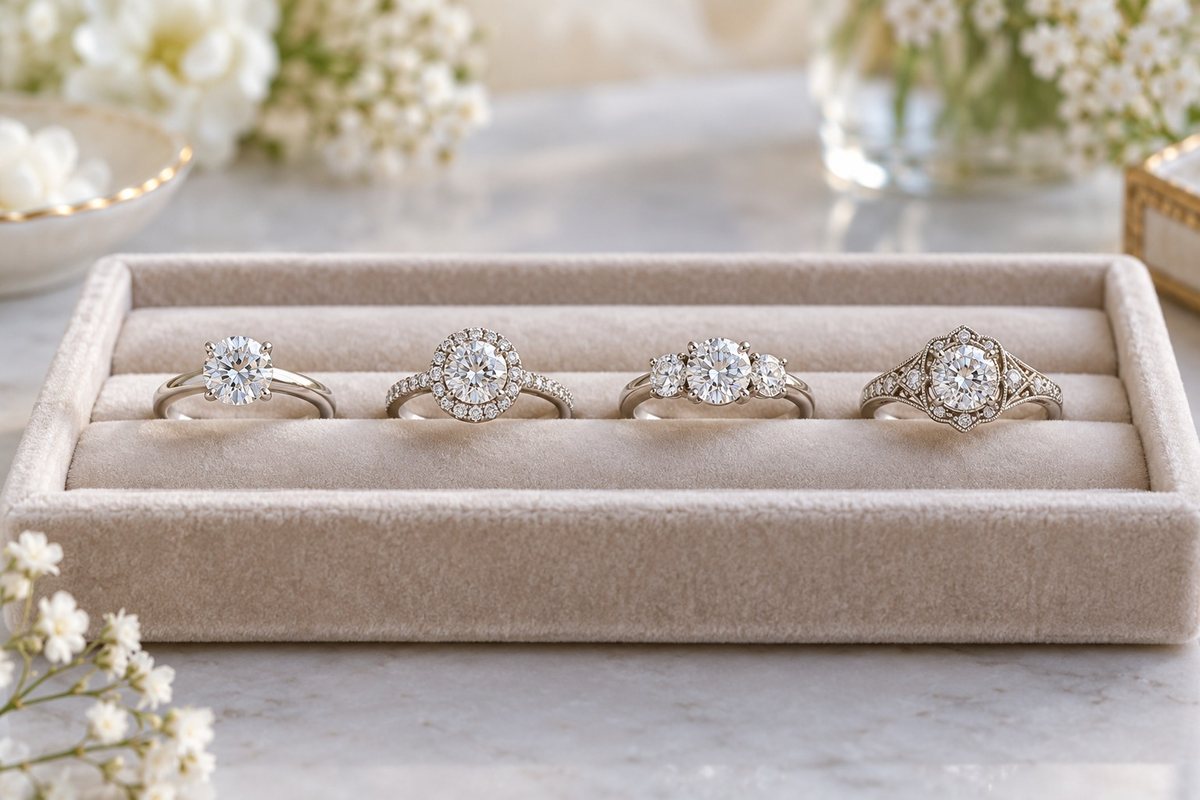
To choose an engagement ring style they will love, start with the jewellery they already wear: their usual metal colour, how bold or delicate their pieces are, and whether they lean modern or vintage. Then match that taste to one of six main style families (solitaire, halo, three-stone, vintage, bezel or modern) and check it against their daily life, so the ring is as comfortable on an ordinary day as it is at the proposal.
This guide includes a few product links near the end. As an Amazon Associate, Diamond Taire earns from qualifying purchases, at no extra cost to you.
This guide shows how to read a partner’s taste without giving the game away, what each main style looks like in real life, how lifestyle should shape the choice, and which questions to ask before you commit. A calm, well-informed choice almost always ages better than a rushed one.
At a glance
- Their existing jewellery is the best clue. Watch what they reach for over a few weeks, not a single evening out.
- Minimal taste suits a solitaire or bezel; a love of sparkle suits a halo or pavé; a love of history suits vintage or vintage-inspired detail.
- Lifestyle decides the profile. Hands-on jobs and sport call for a lower, smoother setting.
- Think about the wedding band now. Some styles need a shaped or custom band to sit flush.
- Check the exchange or resetting policy before buying a surprise ring.
Start with what they already wear
The most reliable clue to someone’s taste is the jewellery they choose for themselves. A ring they will wear every day for decades should sit comfortably alongside the pieces they reach for without thinking. Look at their jewellery over a few weeks and notice patterns:
- Metal colour. Do they wear mostly yellow, white or rose tones? Mixed metals suggest flexibility; a strong preference is worth respecting.
- Scale. Fine chains and small studs point towards slimmer bands and modest settings. Chunky rings and bold earrings suggest they will be comfortable with more presence on the hand.
- Shapes and lines. Clean geometric pieces hint at a modern taste; filigree, engraving and old-fashioned details suggest a love of vintage design.
- What they never wear. If they own almost no jewellery, a low, simple, comfortable ring is usually a safer starting point than an elaborate one.
Their wider style matters too. Someone whose wardrobe is minimal and neutral may find a heavily detailed ring distracting, while someone who loves colour and pattern may find a plain solitaire a little understated.
Taste clues and the styles they point to
| If they usually wear… | Styles worth a closer look |
|---|---|
| Tiny studs, fine chains, one everyday ring | Classic solitaire, slim band, bezel or low-profile setting |
| Statement earrings, stacked rings, sparkle | Halo, pavé band, cluster or three-stone |
| Antique or second-hand pieces, engraving, filigree | Vintage or vintage-inspired, milgrain edges, old-cut stones |
| Architectural, minimalist, monochrome style | Bezel, east-west, emerald or Asscher cut in a clean setting |
| Colour, mixed metals, unusual pieces | Coloured centre stone, toi et moi, asymmetric designs |
The main engagement ring styles
Most engagement rings fall into a handful of style families. Knowing them gives you a vocabulary for talking to jewellers and for comparing options. For a closer look at how each setting holds the stone, see ring settings explained.
Solitaire
A single centre stone on a plain band. The solitaire is the classic for good reason: it is timeless, easy to pair with a wedding band and puts all the attention on the centre stone. Variations include a pavé band (small diamonds set along the band), a hidden halo beneath the stone, or a cathedral setting where the shoulders rise to meet the head.
Halo
A ring of smaller diamonds surrounds the centre stone, making it look larger and adding sparkle. Halos suit people who enjoy a little glamour. They need slightly more care, because small pavé stones can occasionally loosen with hard wear.
Three-stone
A centre stone flanked by two side stones, often read as past, present and future. Side stones can be the same shape or a contrasting one, and can be diamonds or coloured gemstones; if you prefer colour, choose gemstones hard enough for daily wear, such as sapphire or ruby.
Vintage and vintage-inspired
Milgrain edges, engraving, filigree and old cuts give a ring character and a sense of history. Some people want a genuine antique; others prefer a new ring in an older style. If this direction appeals, the guide to antique and vintage diamond jewellery explains the periods, the cuts and how to judge condition.
Bezel and low-profile
A thin rim of metal wraps around the stone instead of prongs. Bezel settings are smooth, modern and practical, rarely catching on clothing or gloves. They suit active people and anyone who works with their hands.
Modern and unconventional
East-west settings (an elongated stone turned sideways), two-stone toi et moi designs, asymmetric clusters and coloured centre stones all sit here. These rings are distinctive, but they reward certainty about the wearer’s taste.
Comparing styles side by side
| Style | Overall look | Everyday practicality | Upkeep | Pairs easily with a wedding band? |
|---|---|---|---|---|
| Solitaire | Clean, timeless | Good; higher settings can snag | Low; prong check yearly | Yes, very easily |
| Halo | Glamorous, extra sparkle | Moderate | Medium; small stones need checking | Usually; sometimes needs a shaped band |
| Three-stone | Balanced, meaningful | Good with a sensible profile | Low to medium | Usually |
| Vintage-inspired | Romantic, detailed | Moderate; fine detail can wear | Medium; milgrain and engraving soften over time | Often needs a custom or curved band |
| Bezel | Modern, sleek | Excellent; very secure | Low | Yes |
| Unconventional | Distinctive, personal | Varies by design | Varies | Often needs a custom band |
Let lifestyle shape the design
A ring that looks wonderful in a display case can be frustrating in daily life. Before falling for a design, think honestly about how the wearer spends their days.
People who garden, cook professionally, care for young children, work in healthcare, climb or play sport often prefer a lower profile and a secure setting. Tall prongs can catch on knitwear and gloves; a bezel or a well-made four- or six-prong setting sitting close to the finger is calmer to live with. Someone who works at a desk and loves a bit of drama may be perfectly happy with a raised setting and a halo.
Comfort matters as much as security. Comfort-fit bands, which are slightly rounded on the inside, slide on and off more easily. Very thin bands look elegant but can bend or wear thin over many years, so a sensible band width is worth discussing.
Metal colour and skin tone
Metal choice changes the whole personality of a ring. Yellow gold reads warm and classic, white metals look crisp and modern, and rose gold feels soft and romantic. Many people simply prefer one over the others regardless of any rule about skin tone, so their existing jewellery is a better guide than any chart.
Durability and upkeep differ too. Platinum is dense and develops a soft patina, while white gold is usually rhodium plated and may need replating from time to time. For a side-by-side, see platinum vs white gold.
Diamond shape and the hand
Shape has a large effect on style. A round brilliant is the most traditional and sparkles intensely. Ovals, pears and marquises are elongated and can make fingers look longer. Emerald and Asscher cuts have a cool, architectural look with broad, mirror-like facets. Cushion and radiant cuts sit somewhere between, combining brilliance with a softer outline.
Proportion is personal. A stone that looks small on one hand can look generous on another, so try to see shapes on a hand of similar size. For a full rundown, read diamond shapes explained.
Gathering clues without spoiling the surprise
- Look at saved images. Pinned photos, saved posts and wedding inspiration boards can be revealing.
- Ask a trusted friend or relative. Someone close may already know their preferences, or can raise the topic casually.
- Window-shop together. Browsing jewellery for another reason, such as a friend’s gift, can prompt honest reactions.
- Borrow a ring for sizing. A ring they wear on the right finger can be measured; the guide to measuring ring size explains how to do it accurately.
- Consider a placeholder. Some couples propose with a simple ring or loose stone and choose the setting together afterwards.
Classic versus trend-led
Trends come and go in engagement rings just as they do in clothing. That does not mean avoiding anything fashionable; it means choosing details the wearer genuinely loves, not ones that are simply popular this year. A good test is whether the ring would still feel right in twenty years, at a different age and with a different wardrobe. The guide to engagement ring trends looks at which details have lasted.
If you are torn, a classic setting with one personal detail, such as a hidden stone, a coloured side stone or a subtle engraving, often gives the best of both.
Common mistakes
- Buying for your own taste instead of theirs. The ring is for the wearer’s hand, not the buyer’s.
- Choosing a tall setting for someone who works with their hands. It will snag, knock and need more repairs.
- Forgetting the wedding band. A curved or custom band can add cost and limit choice later.
- Following a trend they have never mentioned. Popular this year is not the same as right for them.
- Guessing the size. Resizing is possible for many rings but not all; eternity and some patterned bands are hard to alter.
- Not checking the exchange policy. A surprise is lovely; a surprise you cannot change is a gamble.
Questions to ask the jeweller
- How high does this setting sit, and is a lower version available?
- How many prongs hold the stone, and how thick are they?
- Will a straight wedding band sit flush against this ring, or will it need a shaped band?
- What metal and purity is the ring made from, and what upkeep will it need?
- Can the setting be resized later, and are there any limits on that?
- Is there an independent grading report for the centre stone?
- What is the returns, exchange or resetting policy if the style is not right?
Style is one of several decisions; the engagement ring buying guide walks through the rest, from budget to grading reports.
Related guide: Three Stone Engagement Ring: How to Choose a Beautiful One.
Sources this guide draws on: GIA educational material on ring settings, diamond shapes and gemstone durability; Platinum Guild International information on platinum’s wear characteristics; and general jewellery trade guidance on setting heights, prongs and band fit.
Useful tools for this guide
Practical picks for choosing, checking and caring for jewellery. As an Amazon Associate, Diamond Taire earns from qualifying purchases, at no extra cost to you. Prices and availability are set by Amazon and may vary by country.
- Gemstones of the World by Walter Schumann (5th edition)
A classic illustrated reference to more than 1,900 gemstones.
View on Amazon - Foldable 30x Jeweller’s Loupe
Pocket magnifier for checking stones, settings and hallmarks up close.
View on Amazon - KElofoN Travel Jewellery Case
Compact case with ring rolls and earring slots so pieces do not scratch each other.
View on Amazon
FAQ
Should the engagement ring be a surprise?
That depends on the couple. Many people are happy to be surprised; others would rather choose together. If you are unsure, a surprise proposal with a ring that can be exchanged or reset is a sensible middle path.
What is the most popular engagement ring style?
The solitaire has been the most enduring choice for generations because it is simple, versatile and easy to pair with a band. Halo and three-stone rings are also long-standing favourites. Popularity is a poor guide on its own, though; the right style is the one that suits the wearer.
Is a solitaire too plain?
Not if it suits the wearer. A solitaire can be personalised with a hidden halo, a pavé band, an unusual shape or an engraving while keeping its timeless outline.
Do engagement rings and wedding bands have to match?
No. Matching sets are convenient, but mixed metals and contrasting bands are common. What matters is that the two sit comfortably together; the guide to matching and stacking wedding bands covers the options.
What if they dislike the style?
It happens, and it is fixable. Before buying, check whether the jeweller allows exchanges or resetting of the centre stone into a new design.
Is it better to choose the stone or the setting first?
Either works. Choosing the setting style first helps narrow the shape and size of stone that will look balanced, while choosing the stone first gives more freedom with setting design.
Choosing an engagement ring style is an act of attention more than expertise. Watch what they wear, think about how they live, learn the main styles and ask clear questions. A ring chosen that way will feel like theirs from the first day.