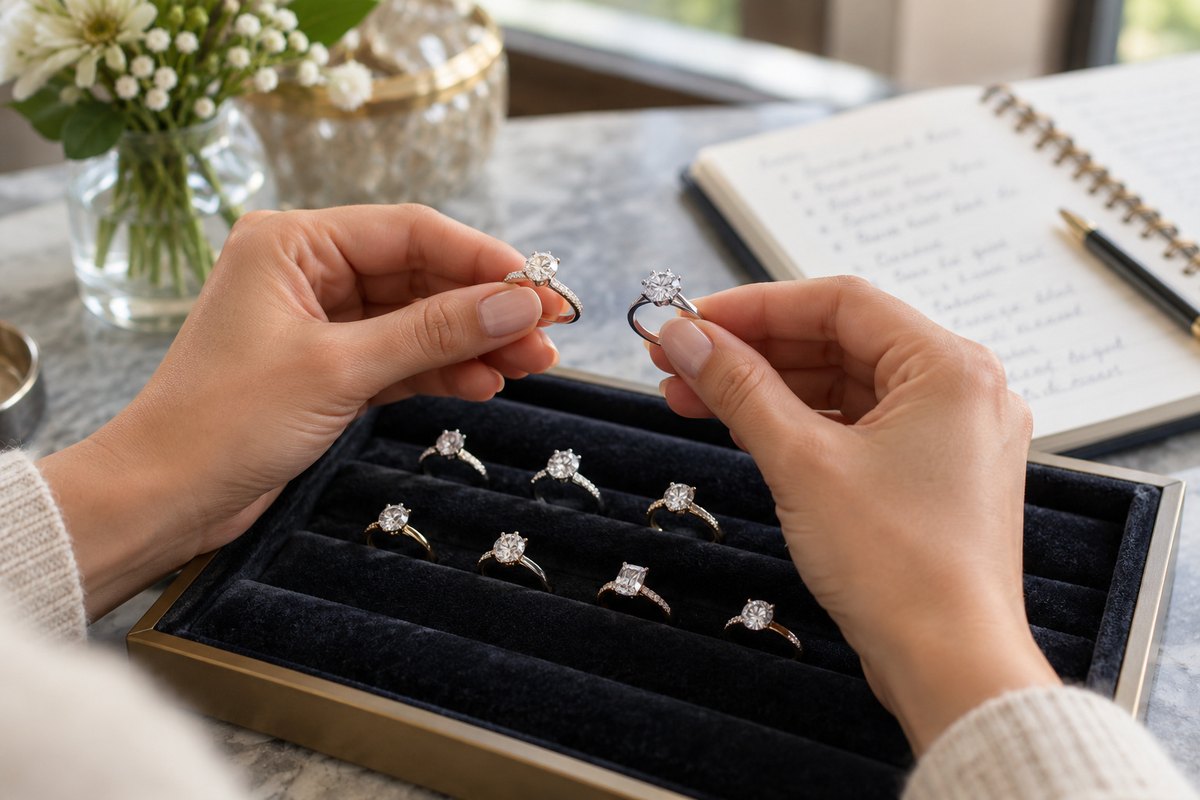
There is no correct amount to spend on an engagement ring. The “months’ salary” rules came from diamond advertising, not etiquette, and the sensible figure is whatever you can pay without debt for a ring the wearer will love. Lab-grown diamonds have also changed the maths: at the time of writing (October 2026), a lab-grown centre stone costs a small fraction of a natural one of the same size and grade.
This guide includes a few product links near the end. As an Amazon Associate, Diamond Taire earns from qualifying purchases, at no extra cost to you.
This guide explains where the salary rule came from, what surveys say people actually spend, where the money goes inside a ring, and what different budgets realistically buy in lab-grown and natural diamonds, using listed retail prices sampled in October 2026. It then gives a three-step way to set your own budget, a worked example, the mistakes to avoid and answers to the most common questions. Prices change, and they vary by country and retailer.
- The salary rules were marketing. De Beers advertising promoted one month’s, then two months’ salary.
- Averages are not targets. The Knot’s 2026 Real Weddings Study put the US average at $4,600, and averages are pulled up by a minority of big spenders.
- The centre stone takes most of the budget. Carat weight, cut and origin decide most of the price.
- Lab-grown costs far less for the same look, but resale value is very different.
- Set the number before you shop, and avoid financing a ring you cannot comfortably afford.
At a glance
- There is no correct amount to spend; the months’ salary rules came from diamond advertising, not etiquette.
- Set a figure you can pay without debt for a ring the wearer will love, before you start shopping.
- The Knot’s 2026 study put the US average at $4,600, but an average is context, not a target.
- The centre stone takes most of the budget, and lab-grown costs a small fraction of natural for the same size and grade.
- Prioritise cut first, then colour and clarity, then carat.
- Avoid financing at high interest and forgetting extras such as the setting, tax, resizing and insurance.
Where the “three months’ salary” rule came from
The diamond engagement ring as a near-universal custom is largely a twentieth-century creation. De Beers hired the advertising agency N.W. Ayer, which created the slogan “A Diamond Is Forever” in 1947. Accounts of the campaigns describe early advertising suggesting a man should spend one month’s salary on a ring, and 1980s advertising asking how two months’ salary could “last forever”. The three-month version is often repeated today, but it is a stretched version of an advertising line, not a tradition.
The practical problem with any salary rule is that it ignores everything that matters: savings, debt, rent, other goals and what the wearer actually wants. A rule that fits one couple can be reckless for another.
What people actually spend: survey figures
The best-known figures come from The Knot, a US wedding-planning company that surveys couples each year. Its Real Weddings Study 2026, covering more than 10,000 US couples married in 2025 and reported by the trade magazine JCK in February 2026, found:
- an average engagement ring spend of $4,600;
- lab-grown centre stones in 61 per cent of engagement ring purchases;
- an average centre stone of about 1.9 carats.
For comparison, The Knot’s 2019 Jewelry and Engagement Study, reported by National Jeweler, put the average at $5,900. The lower recent average sits alongside the rapid shift to lab-grown centre stones, which cost far less for a given size.
Two cautions apply. First, an average (mean) is pulled upwards by a smaller number of very expensive rings, so the typical buyer, the median, usually spends less than the average. The Knot’s headline figure is an average, and no median is published in the coverage this guide relied on. Second, these are US figures. Surveys in the UK, Australia and elsewhere use different methods, currencies and samples, and local prices, taxes and wages differ, so treat any national average as context, not a benchmark.
Spending more does not appear to buy a better marriage, either. Emory University economists Andrew Francis and Hugo Mialon, in a study published in Economic Inquiry, reported that marriage duration was either not associated or inversely associated with spending on the engagement ring and wedding. That is a correlation in survey data, not proof that a cheaper ring causes anything, but it is a useful antidote to the idea that the price signals commitment.
Where the money goes in an engagement ring
- The centre stone: usually the largest share. Carat weight, cut, colour, clarity and origin (lab-grown or natural) all move the price; see what really drives a diamond’s price.
- The setting and metal: plain solitaires cost least; halos, pavé bands and hand-finished designs cost more, and platinum generally costs more than gold. At one large online retailer in October 2026, setting-only listings in 14k gold ran from about $750 for plain styles to around $2,800 for diamond-set designs. See how the setting changes the price.
- Side stones: accent diamonds add sparkle and cost; small natural accents are often modestly priced compared with the centre.
- Extras: resizing, engraving, a grading report if one is not included, local sales tax or GST/VAT, and insurance.
What different budgets realistically buy
The table below is built from listed prices for loose diamonds sampled on 17 October 2026 from two large online diamond retailers and one diamond price-comparison marketplace that aggregates listings from many sellers. They are US dollar prices before tax. They are a snapshot of the market at the time of writing (October 2026); prices change, often quickly for lab-grown stones, and they differ by country and retailer. Stone prices exclude the setting.
| Total budget (USD) | Natural diamond: what the stone can be | Lab-grown diamond: what the stone can be | Setting that fits | Notes |
|---|---|---|---|---|
| Under $1,000 | Small stones, roughly 0.25 to 0.40 carat; natural stones around 0.30 carat were listed from about $160 to $220 | Around 1 carat in high colour and VS clarity; 1 carat stones were listed from about $360 | Simple solitaire in gold or silver from lower-cost jewellers | Branded settings alone can use most of this budget |
| $1,000 to $2,500 | About 1 carat in lower colour or clarity (1 carat stones in K to H colour, SI2 clarity were listed from about $890 to $1,650), or a smaller higher-grade stone | 2 to 3 carats; 2 carat stones in G to J colour, VS clarity were listed at about $700 to $1,000 | Plain or simple solitaire, often in 14k gold | Natural: prioritise cut over size |
| $2,500 to $5,000 | About 1 carat in near-colourless grades (a 1.01 carat F VS2 was listed at $3,590), or about 1.5 carats in H VS2 with a very good cut ($4,470) | 3 to 5 carats in good grades at marketplace prices; 3 carat J VS1 stones were listed from about $1,400 | Any style, including pavé or hidden halo | Very large lab stones raise setting and insurance questions |
| $5,000 to $10,000 | 1 carat in top grades (D to E, VVS: about $4,900 to $7,000), or 2 carats in J to K colour, SI to VS clarity (about $7,200 to $9,800) | Almost any size or grade; more of the budget can go to the setting or platinum | Platinum or designer settings | Compare grading reports, not just carat weight |
| $10,000 and over | 2 carats in G to H colour, or 3 carats in J to K colour, SI clarity (mostly about $16,000 to $28,000) | Rarely needed for the stone itself | Any | Independent report and insurance are essential |
The striking gap is between lab-grown and natural. On the marketplace sampled, the median listed 2 carat natural stone was $12,406 and the median lab-grown one $1,574. For more detail by size, see the best value diamond combinations by budget.
How to set your own budget in three steps
Step 1: The number you can pay without debt
Start from your savings and monthly cash flow, not a rule or an average. Decide on a figure you could pay in cash, or clear within a short interest-free period, without dipping into an emergency fund. High-interest store finance or a credit card balance can add a great deal to the real cost. This is general information rather than financial advice; your own circumstances should decide it.
Step 2: What the wearer cares about
Find out, openly or quietly, what matters most: size, sparkle, shape, metal colour, lab-grown or natural origin, or an heirloom or ethical story. A ring that matches their taste is worth more than a bigger stone they would not have chosen. Our engagement ring buying guide covers style, shape and metal in more depth.
Step 3: Where to trade off
- Cut first. A well-cut stone looks brighter and can look larger than a poorly cut, heavier one.
- Then colour and clarity. Choose an “eye-clean” clarity and a colour that suits the metal. GIA notes that yellow or rose gold makes a slightly warmer colour grade less noticeable.
- Then carat. GIA points out that stones just under the “magic” weights such as 0.50, 0.75 and 1.00 carat can offer savings for a size difference you probably will not notice.
Worked example: one budget, two rings
Take a total budget of about $5,000 and a plain 14k gold solitaire setting at about $750, the entry price at one large online retailer in October 2026. That leaves roughly $4,250 for the centre stone.
- Natural: the money buys about a 1 carat round in near-colourless, VS clarity with an excellent cut; a 1.01 carat F VS2 super ideal cut was listed at $3,590. Alternatively, a 1.50 carat H VS2 with a very good cut was listed at $4,470, slightly over budget.
- Lab-grown: the same money covers a 2 carat round in D colour and VVS2 clarity from a premium retailer ($3,870 listed), or a 3 to 4 carat stone in good grades from marketplace sellers, with change left over.
Neither ring is the “right” one. The natural ring is smaller but rarer and has a resale market, although at well below retail. The lab-grown ring is far larger for the money but has little resale value. Which matters more is a personal choice.
Lab-grown vs natural: the cost and value trade-off
Lab-grown and natural diamonds are both diamond, and they look the same to the eye. The price gap reflects rarity and supply, and lab-grown prices have fallen sharply as production has grown. If you like the idea of a stone that may hold some resale value, natural is the more likely choice, but no diamond should be bought as an investment. See lab-grown vs natural, side by side and an honest look at diamond resale value. If a diamond is not essential, moissanite as a budget alternative is worth understanding too.
How much should a wedding ring cost?
Wedding bands vary even more than engagement rings. The main price drivers are the metal (platinum generally costs more than gold, and tungsten or titanium bands generally cost less), the width and weight of the band, whether it carries diamonds, and whether it is shaped to sit against an engagement ring. A plain band is usually a small fraction of the engagement ring’s cost, while a full eternity band can rival it. Agree on both rings together so one does not squeeze the other. Our guide to choosing wedding bands covers matching and stacking.
Budget checklist
- Agree a number you could pay from savings or cash flow.
- Learn the wearer’s preferred shape, metal and setting style.
- Decide lab-grown or natural before comparing prices.
- Price the setting separately from the stone.
- Add resizing, engraving, tax and insurance to the total.
- Insist on an independent grading report for any significant centre stone.
- Read the return, resizing and upgrade policy before you pay.
Engagement ring cost myths vs what is actually the case
| Myth | What is actually the case |
|---|---|
| You should spend three months’ salary. | That idea grew out of diamond advertising. There is no etiquette rule. |
| The average spend is what you are expected to spend. | An average is skewed by big spenders and differs by country. It is not a target. |
| A bigger budget means a bigger commitment. | Research by Francis and Mialon found no positive link between ring spending and marriage length. |
| A diamond is a good investment. | Resale prices are usually well below retail, especially for lab-grown stones. |
| Carat is the most important C. | Cut decides sparkle; a well-cut smaller stone often looks better than a poorly cut bigger one. |
Common mistakes
- Treating a survey average as a target instead of starting from your own finances.
- Financing at high interest, which can add substantially to the real cost.
- Spending everything on carat and ending up with a poorly cut, lifeless stone.
- Forgetting the extras: setting, tax, resizing and insurance.
- Buying natural “as an investment” without understanding resale realities.
- Comparing lab and natural prices as if they were the same product.
- Not checking the return or upgrade policy before committing.
To see what those budgets buy, compare our guides to the 1 carat diamond ring and to 2 to 5 carat diamond rings.
Sources this guide draws on: The Knot Real Weddings Study 2026 as reported by JCK (February 2026); The Knot 2019 Jewelry and Engagement Study as reported by National Jeweler; published histories of De Beers and N.W. Ayer advertising, including Al Jazeera’s 2025 feature on the invention of the diamond engagement ring; Francis and Mialon, “‘A Diamond is Forever’ and Other Fairy Tales: The Relationship between Wedding Expenses and Marriage Duration” (Economic Inquiry); GIA guidance on carat weight, colour and saving money on a diamond; and listed retail prices for loose diamonds and ring settings sampled on 17 October 2026 from large online retailers and a diamond price-comparison marketplace.
Useful tools for this guide
Practical picks for choosing, checking and caring for jewellery. As an Amazon Associate, Diamond Taire earns from qualifying purchases, at no extra cost to you. Prices and availability are set by Amazon and may vary by country.
- Gemstones of the World by Walter Schumann (5th edition)
A classic illustrated reference to more than 1,900 gemstones.
View on Amazon - Foldable 30x Jeweller’s Loupe
Pocket magnifier for checking stones, settings and hallmarks up close.
View on Amazon - KElofoN Travel Jewellery Case
Compact case with ring rolls and earring slots so pieces do not scratch each other.
View on Amazon
FAQ
How much should I spend on an engagement ring?
Spend what you can pay without debt for a ring the wearer will love. Start from your savings, decide lab-grown or natural, then trade off cut, colour, clarity and size within that number.
What is the average engagement ring cost?
The Knot’s Real Weddings Study 2026, covering US couples married in 2025, put the average at $4,600, with lab-grown centre stones in 61 per cent of purchases. Averages vary by country and are pulled up by high spenders, so the typical spend is lower.
Is the three months’ salary rule real?
No. It traces back to De Beers advertising, which promoted one month’s and later two months’ salary as a guide. It has no basis in etiquette or personal finance.
How much does a 1 carat engagement ring cost?
At the time of writing (October 2026), a 1 carat lab-grown diamond was listed from a few hundred dollars, while a natural 1 carat ranged from under $1,000 in low grades to several thousand dollars in top grades, before the setting. Prices change; the setting typically adds several hundred dollars or more.
Are lab-grown engagement rings cheaper?
Yes, much cheaper for the same size and grade. In October 2026 samples, the median 2 carat lab-grown stone on one marketplace was listed at about one-eighth of the median natural 2 carat. The trade-off is very limited resale value.
How much should a wedding ring cost?
There is no rule. Plain bands in gold, titanium or tungsten usually cost far less than the engagement ring, while platinum and diamond eternity bands cost more. Budget for both rings together.
The best amount is the one that leaves you debt-free and buys a ring the wearer is happy to wear every day. Decide the number first, then let the 4Cs and the lab-grown or natural choice work for you.