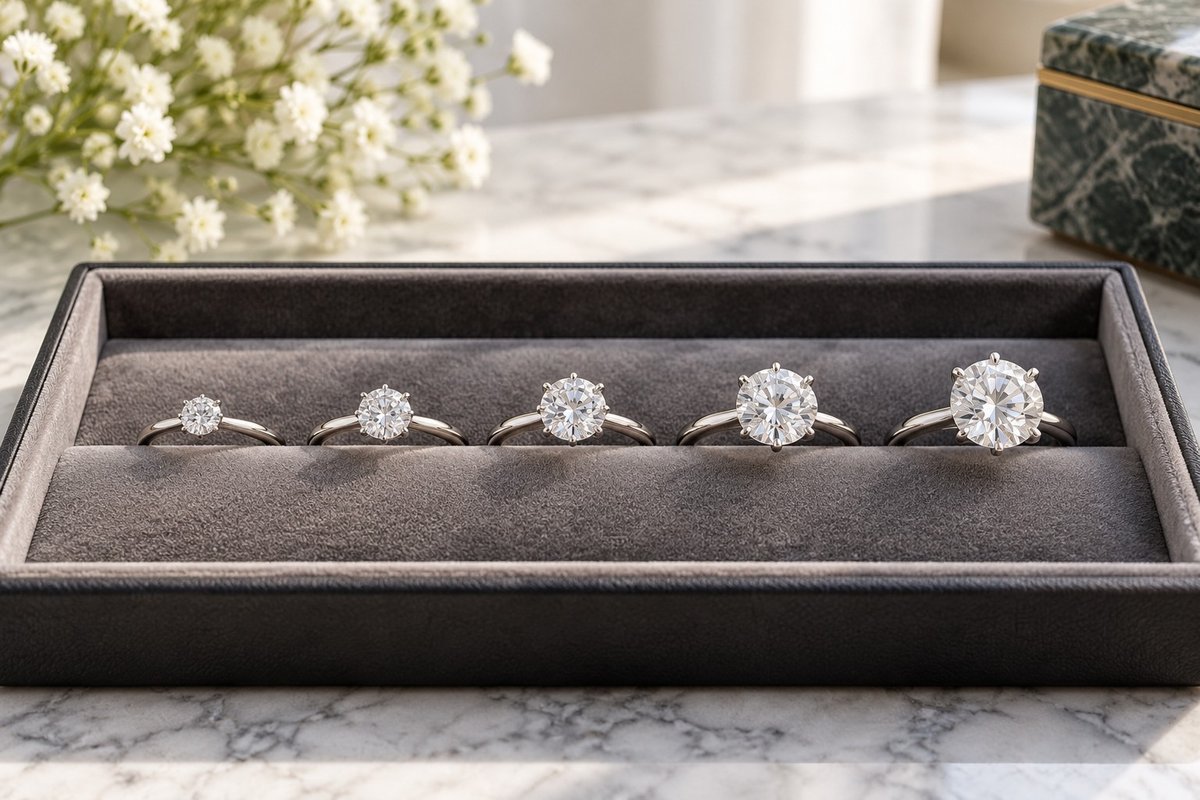
The best value diamond combination for most buyers is an excellent cut, a near-colourless colour grade (roughly G to H, or I to J in yellow or rose gold) and an eye-clean clarity grade (often VS2 or SI1 for round stones), at a carat weight just below a popular “round number”. That mix looks almost identical to far more expensive grades once the stone is set and worn. Exactly where you land depends on your budget, the shape you love and the metal you choose.
This guide includes a few product links near the end. As an Amazon Associate, Diamond Taire earns from qualifying purchases, at no extra cost to you.
This guide explains why those combinations work, then shows worked examples of the trade-offs at different budget levels, from tight to generous. It deliberately avoids quoting prices, because diamond prices change and vary by country. Instead, it teaches you how to rank your options so you can apply the logic to any listing, in any market, at any time.
At a glance
- Cut first, always. Cut decides sparkle. A top-cut stone in modest colour and clarity outshines a poorly cut stone with perfect grades.
- Buy what your eye sees, not what the report brags about. Colour and clarity above the “looks white and clean” line cost a lot and show very little.
- Shop just under weight thresholds. A stone slightly under 1 carat (or 0.5, 1.5, 2) can look the same size and cost noticeably less.
- Shape and metal move the line. Step cuts need higher clarity; yellow and rose gold forgive lower colour.
- Size versus quality is a personal choice, not a right answer. Decide which one matters more before you shop.
Why some combinations are better value than others
Diamond prices do not rise in a straight line. They jump at certain grades and weights, mostly because of rarity and demand rather than visible beauty. The value sweet spot sits where you get the most visible beauty for each unit of money spent. That happens where three things meet:
- The stone is cut well enough to return lots of light. Cut has the biggest effect on how bright and lively a diamond looks.
- Colour and clarity are just good enough that nobody can see a difference without instruments. Going higher costs more but does not look better on the hand.
- Carat weight is chosen with thresholds in mind, so you are not paying a premium simply for a number on the report.
If any of the 4 Cs are unfamiliar, the overview of the 4 Cs of diamonds covers the basics, and what really drives a diamond’s price explains the pricing jumps in more detail.
The value logic for each factor
Cut: the one place not to save
For round brilliants, GIA and IGI reports give an overall cut grade. Aim for the top grade on that laboratory’s scale (Excellent on GIA reports). Older AGS reports, which used Ideal or 0 as the top grade, still circulate, although the AGS laboratory closed at the end of 2022 and its work moved to GIA. One step down can still look good, but the saving is usually modest compared with the visible loss of sparkle. For fancy shapes, most reports do not give an overall cut grade, so you judge proportions, symmetry and video instead. The guide to diamond cut quality explains what to look for.
Colour: buy the grade your setting needs
Colour is graded from D (colourless) to Z (light yellow or brown). In white gold or platinum, most people see no tint from G or H when the stone is face up and set. In yellow or rose gold, the warm metal reflects into the stone, so I, J or even K can look perfectly natural. Larger stones and step cuts show colour a little more readily, so you might move one grade higher for those. See how to choose a diamond colour grade for the full scale.
Clarity: aim for eye-clean, not flawless
Clarity grades describe inclusions and blemishes seen under ten-times magnification. Most VS2 and many SI1 round diamonds are eye-clean, meaning you cannot see anything at normal viewing distance. SI2 stones can be eye-clean too, but you have to check each one individually. Where the inclusion sits matters as much as the grade: a small crystal near the edge, hidden by a prong, is better than a dark one under the table. The guide to diamond clarity and inclusions explains how to judge this.
Carat: shop the thresholds
Prices tend to step up at popular weights such as 0.50, 0.75, 1.00, 1.50 and 2.00 carats. A stone of, say, 0.90 to 0.97 carats is only fractionally smaller in diameter than a 1.00 carat stone and is very hard to tell apart once set, yet it usually costs less per carat. Carat is weight, not size, so a well-cut stone can also look larger than a deep, heavy one of the same weight.
Shape: some shapes give more look for less
Round brilliants usually cost the most per carat, partly because cutting them typically wastes more rough and partly because demand for them is highest. Fancy shapes such as oval, pear, cushion and emerald often cost less for the same weight, and elongated shapes like oval and pear tend to look larger face up. Brilliant-style fancy shapes hide inclusions well; step cuts such as emerald and Asscher show them more clearly. Compare all the options in the guide to diamond shapes on this site.
Value combinations at a glance
| Your situation | Cut | Colour | Clarity | Why it works |
|---|---|---|---|---|
| Round stone, white metal | Top grade | G to H | VS2 to SI1, checked eye-clean | Looks white and clean; avoids the steepest premiums |
| Round stone, yellow or rose gold | Top grade | I to J (sometimes K) | VS2 to SI1 | Warm metal hides a faint tint; savings can go into size |
| Oval, pear or marquise | Strong proportions, minimal bow-tie | G to H in white metal | VS2 to SI1 | Brilliant faceting hides inclusions; elongation looks larger |
| Cushion or radiant | Strong proportions, checked on video | F to H (these shapes hold colour) | VS2 to SI1 | Allows a little more colour care without paying for flawless |
| Emerald or Asscher (step cuts) | Clean symmetry, good “hall of mirrors” | F to H | VS1 to VS2 | Open facets show inclusions, so clarity needs to be higher |
| Small accent or side stones | Good to excellent | Match the centre | SI range is often fine | Tiny stones hide inclusions; matching colour matters most |
These are starting points, not rules. A specific stone can be better or worse than its grades suggest, which is why you always check the individual diamond.
Worked examples: trade-offs at different budgets
The examples below use relative budgets rather than prices, so they stay useful whatever the market is doing. In each, imagine the same buyer looking at several stones that cost roughly the same amount.
Example 1: a tight budget, round solitaire in white gold
The choice: a 0.70 carat, top-cut, H colour, SI1 stone that is eye-clean, or a 0.80 carat, lower-cut-grade, J colour, SI2 stone with a visible dark inclusion.
The trade-off: the second stone is bigger on paper, but a weaker cut makes it look less bright, J colour may show slight warmth in white gold, and the inclusion is visible. The first stone will look livelier and cleaner, and the size difference is modest on the hand.
Better value: the 0.70 carat stone. On a tight budget, cut and eye-clean clarity give you the most beauty per unit spent. If size is very important, a third option is to keep the cut and clarity but drop to I colour and move to yellow gold, which can buy a little more weight without visible cost.
Example 2: a moderate budget, close to the 1 carat mark
The choice: a 1.00 carat, top-cut, G, VS2 stone, or a 0.92 carat, top-cut, G, VS2 stone with the same report type, plus money left over.
The trade-off: the two stones differ in diameter by only a fraction of a millimetre and are very hard to tell apart once set. The 1.00 carat stone carries the “round number” premium.
Better value: the 0.92 carat stone, with the saving put towards a better setting, a matching band or simply kept. Choose the 1.00 carat only if the number itself matters to you, which is a perfectly valid personal reason.
Example 3: a moderate budget, colour versus clarity
The choice: a 1.10 carat, top-cut, F, VVS2 stone, or a 1.25 carat, top-cut, H, VS2 stone, both eye-clean, both for about the same money, set in platinum.
The trade-off: both look white and clean to the eye in a white metal. The F, VVS2 stone’s advantages are only visible under magnification or in side-by-side grading conditions. The H, VS2 stone is noticeably larger.
Better value: for most people, the 1.25 carat H, VS2. If the wearer is very sensitive to colour, or simply values knowing the grades are high, the smaller stone is the right choice for them. Value is about what you will actually notice.
Example 4: a generous budget, size versus perfection
The choice: a 2.00 carat, top-cut, D, internally flawless stone, or a 2.50 carat, top-cut, G, VS1 stone, for a similar amount.
The trade-off: at higher budgets, colour and clarity premiums become very steep. A D, IF stone is rare and that rarity is what you pay for; it will not look brighter or cleaner than a top-cut G, VS1 to the naked eye.
Better value: the 2.50 carat G, VS1 if visible size and presence matter most. The D, IF stone may suit someone who values rarity for its own sake. Neither is wrong, but understand that you are paying for a grade, not for something you will see. Note that larger stones show colour and inclusions more readily than small ones, which is why G and VS1 are sensible here rather than lower grades.
Example 5: changing shape to stretch any budget
The choice: a round brilliant at your target weight, or an oval with similar colour and clarity at the same weight for noticeably less, or a slightly heavier oval for the same money.
The trade-off: ovals usually cost less per carat than rounds and look larger face up, but they come with the bow-tie effect and no overall cut grade on most reports, so you need to judge them more carefully.
Better value: the oval, if you like the shape and can review good video. The round remains the most predictable option if you want the safest sparkle with the least effort in choosing.
Example 6: natural versus lab-grown for the same budget
The choice: a natural diamond at a modest size, or a lab-grown diamond that is considerably larger or higher in grade for the same spend.
The trade-off: lab-grown diamonds give far more size and grade per unit spent, but carry very little resale value and do not have the rarity of a mined stone. The same value rules apply: cut first, eye-clean, sensible colour. Note that report styles differ for lab-grown stones: IGI uses the usual colour and clarity grades, while GIA now places lab-grown stones in broad “Premium” or “Standard” categories instead, so compare like with like.
Better value: depends on what you value. Read lab-grown or natural diamond before deciding. If you choose lab-grown, resist the temptation to buy D, flawless simply because it is affordable; spend on cut and the setting instead.
A step-by-step way to find your own best combination
- Fix your total budget, including the setting, taxes, resizing and insurance.
- Choose shape and metal first. They decide how much colour and clarity you need.
- Decide your priority: size or grades. Write it down so the sales pitch does not change your mind.
- Filter for top cut (or strong proportions for fancy shapes).
- Set colour at the lowest grade that looks white in your metal, using the table above.
- Set clarity at VS2 to SI1 (VS1 to VS2 for step cuts) and check every candidate on video for eye-cleanness.
- Look just below weight thresholds such as 0.90 to 0.99 rather than exactly 1.00.
- Compare three to five finalists with the same report type, side by side.
- Verify each report number on the laboratory’s own website and confirm the details match.
Common mistakes when chasing value
- Buying the biggest stone the budget allows, whatever the cut. A poorly cut large stone can look smaller and duller than a well-cut smaller one.
- Paying for grades you cannot see. D to F colour and VVS to flawless clarity are lovely to own, but they rarely improve the look on the hand.
- Trusting the clarity grade alone. Two SI1 stones can look very different. Always check the individual stone for eye-cleanness.
- Comparing reports from different laboratories as equal. Grading standards vary, so compare like with like.
- Forgetting the setting. A halo makes a centre stone look larger; a bezel can hide colour at the edges; yellow gold warms colour. See diamond ring settings explained.
- Thinking of value as future resale. Value here means beauty for the money you spend now. Diamonds, especially lab-grown ones, should not be bought expecting to sell at a profit.
- Buying in a hurry. If you are shopping online, read how to buy a diamond online without getting burned first.
If you have settled on about a carat, see what a 1 carat diamond ring really costs in lab-grown and natural.
Before choosing a combination, it helps to start with setting an engagement ring budget you can pay without debt.
Sources this guide draws on: GIA (Gemological Institute of America) education on the 4 Cs, cut grading and fluorescence; GIA’s 2025 announcements on laboratory-grown diamond assessment; trade reporting in National Jeweler on the closure of the AGS laboratory; and IGI (International Gemological Institute) report formats.
Useful tools for this guide
Practical picks for choosing, checking and caring for jewellery. As an Amazon Associate, Diamond Taire earns from qualifying purchases, at no extra cost to you. Prices and availability are set by Amazon and may vary by country.
- Foldable 30x Jeweller’s Loupe
Pocket magnifier for checking stones, settings and hallmarks up close.
View on Amazon - Gemstones of the World by Walter Schumann (5th edition)
A classic illustrated reference to more than 1,900 gemstones.
View on Amazon - KElofoN Travel Jewellery Case
Compact case with ring rolls and earring slots so pieces do not scratch each other.
View on Amazon
Frequently asked questions
What is the best colour and clarity combination for the money?
For a round diamond in white metal, G or H colour with VS2 or SI1 clarity is the most common value choice, provided the stone is eye-clean and has a top cut grade. In yellow or rose gold you can usually go to I or J colour. For emerald and Asscher cuts, move clarity up to VS1 or VS2.
Is colour or clarity more important?
For most people colour is easier to notice than clarity, once the stone is eye-clean. A faint warm tint can be visible in white metal, whereas a VS2 inclusion usually cannot be seen without magnification. So once clarity reaches eye-clean, extra money is often better spent on colour or cut than on higher clarity.
Is SI1 clarity good enough for an engagement ring?
Often, yes, especially in round and other brilliant-style shapes. Many SI1 stones are eye-clean, but not all, so check each stone on video or in person. Avoid SI1 with dark inclusions under the table, and be more cautious with step cuts.
Is it better to buy a bigger diamond or a better quality one?
It depends on what the wearer will notice and value. If cut is excellent and colour and clarity are already at the “looks white and clean” level, extra money usually shows more as size. If the stone is already a satisfying size, spending more on colour gives a subtle improvement in white metal.
Does fluorescence affect value?
Fluorescence can affect price, and in some colour grades a stone with fluorescence is offered at a discount. Most fluorescence has no visible effect, but strong fluorescence in some stones can make them look slightly hazy. Check the individual stone and ask about it before you rely on any discount.
The best value diamond is not the one with the most impressive grades or the biggest number on the report. It is the one with an excellent cut and grades that look white and clean on the hand, at a weight chosen with thresholds in mind, in the shape and metal you love. Use the worked examples as a template, and you can find that sweet spot at any budget.