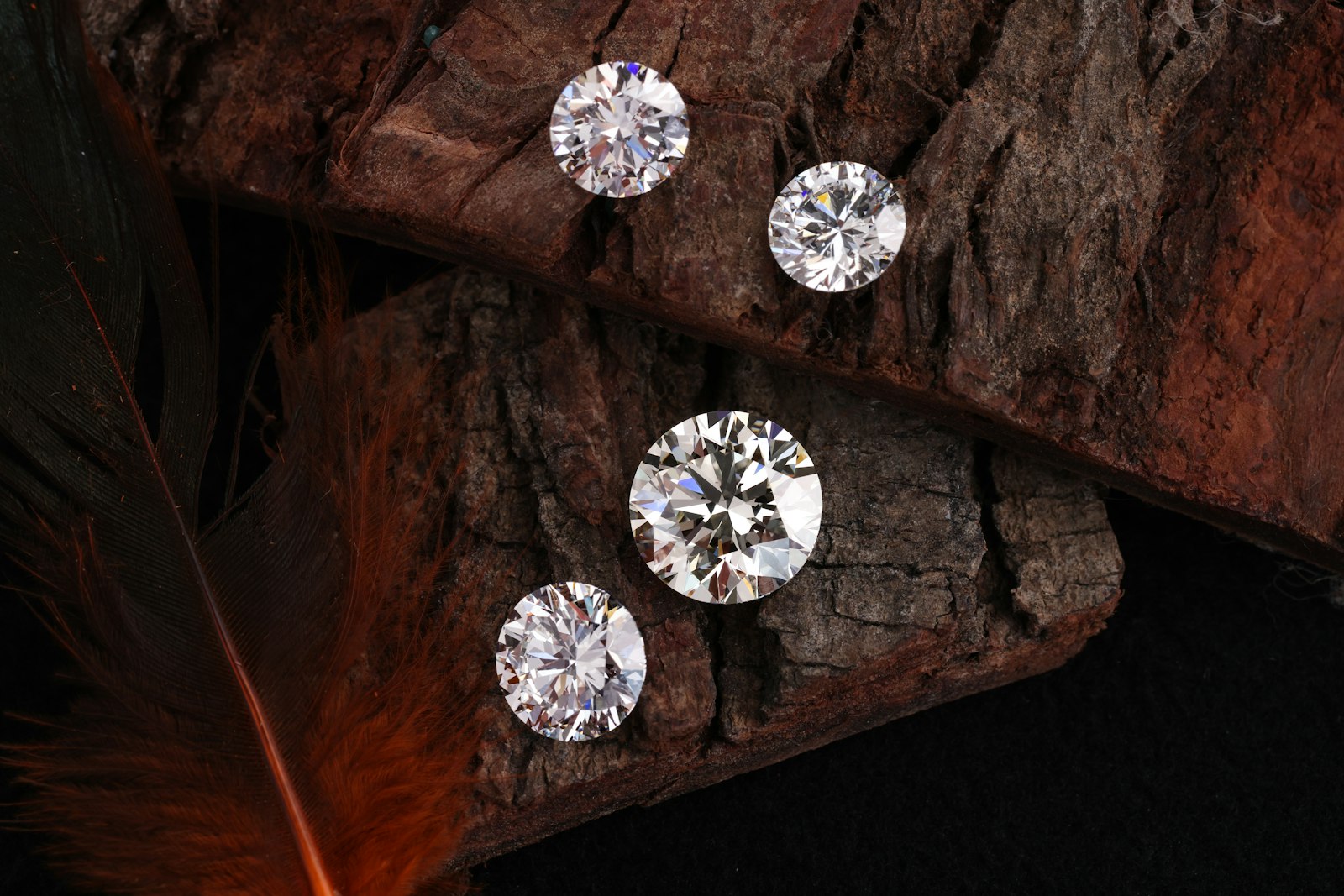
Of the Four Cs — cut, color, clarity and carat weight — clarity is often the most misunderstood by diamond shoppers. Many people believe that any diamond with an inclusion is flawed or inferior, which leads them to pay for higher clarity grades than they actually need. Understanding what clarity really means can help you make a smarter purchase and avoid paying for invisibility you’ll never see.
This is a deep dive into one of the Four Cs. For how clarity sits alongside cut, color and carat weight, start with The 4 Cs of Diamonds.
What Creates Inclusions in Diamonds?
Inclusions aren’t defects that occur during cutting or handling. They form during the diamond’s creation deep within the Earth, over billions of years. As a diamond crystallizes under extreme heat and pressure, it sometimes traps other mineral crystals, tiny pockets of gas, or distortions in its crystal lattice. These are inclusions — and virtually every natural diamond has at least one.
In fact, the complete absence of inclusions is rare enough that a truly flawless diamond commands a significant price premium. Many jewellers never see a flawless diamond in their entire careers. For most shoppers, chasing the rarest clarity grades means paying for differences that cannot be seen.
The GIA Clarity Scale Explained
The Gemological Institute of America (GIA) uses an 11-point clarity scale:
- FL (Flawless): No inclusions or blemishes visible under 10x magnification. Extraordinarily rare.
- IF (Internally Flawless): No inclusions visible under 10x magnification, though there may be insignificant surface blemishes.
- VVS1 and VVS2 (Very, Very Slightly Included): Minute inclusions that are extremely difficult to see even under magnification.
- VS1 and VS2 (Very Slightly Included): Minute inclusions that are difficult to see under 10x magnification. At this grade, inclusions are generally invisible to the naked eye.
- SI1 and SI2 (Slightly Included): Inclusions noticeable under magnification. SI1 diamonds are often eye-clean; SI2 diamonds sometimes are, depending on the type and location of the inclusion.
- I1, I2 and I3 (Included): Inclusions visible to the naked eye. These diamonds are noticeably less transparent.
The “Eye-Clean” Sweet Spot
Here’s where understanding clarity becomes practical: many diamonds at VS1 and a good number at SI1 are “eye-clean,” meaning you cannot see the inclusions without magnification. If you cannot see an inclusion with your naked eye under normal lighting, it doesn’t affect your diamond’s beauty when you’re wearing it.
An eye-clean SI1 diamond typically costs meaningfully less than a VS2 of the same carat weight, color and cut. Those savings can be enough to move up in carat weight instead, which has a far more visible effect on how a diamond looks.
The key is knowing where each inclusion sits. An inclusion near the edge of the stone is less visible than one in the centre. A small feather or cloud is less obvious than a large crystal. If you’re shopping for a diamond online, ask the seller specifically whether the stone is eye-clean and request a high-magnification image that shows the inclusion’s location.
How Inclusion Type Affects Visibility
Not all inclusions are equally visible. Some types are easier to spot than others:
- Clouds are groups of tiny particles that can look like a haze. They are sometimes more visible than a single larger inclusion.
- Feathers are fractures with a branching appearance — usually very difficult to detect unless they’re large or reach the surface.
- Crystals (other minerals trapped in the diamond) vary widely in visibility depending on the mineral, size and color. A dark carbon crystal is more obvious than a colorless one.
- Internal graining is a disruption in the crystal structure and can sometimes be seen as faint lines or clouds. It is usually subtle.
- Twinning wisps are often harder to see in person than under magnification, because they’re translucent rather than opaque.
Your jeweller should be able to tell you not just the clarity grade, but specifically what you’re looking at and whether it will be visible.
The Price-to-Value Relationship
The jump in price between clarity grades is not linear. The step from a flawless stone down to VVS1 is the largest, and it buys an improvement nobody can perceive without a loupe. The step from VVS2 to VS1 is smaller. The step from VS1 to SI1 is where the real savings appear, because it is the point at which the grade drops while the appearance, on an eye-clean stone, does not.
Put practically: for a fixed budget, an eye-clean stone one or two grades lower can free up enough to buy a visibly larger diamond. Size is the most noticeable characteristic in a diamond. Ask your jeweller to show you the trade-off with real stones at real prices rather than working from a rule of thumb — premiums move with the market, and with the particular stone.
Making Your Decision
Before you settle on a clarity grade, consider these questions:
Are you buying for yourself or someone else? A diamond you’re wearing yourself will catch light differently than one you’re looking at across a table. Sparkle and scintillation, which depend on cut, matter more than inclusions you’ll never see.
What’s your actual budget? If you have a fixed amount to spend, you’ll often get a more beautiful diamond by choosing an eye-clean SI1 rather than upgrading to VS1.
Does the specific stone read as eye-clean? This matters more than the grade. Some SI1 diamonds are eye-clean; some SI2 diamonds are too. It depends on the individual stone.
How important is resale value? If you ever plan to sell or trade the diamond, higher clarity grades are easier to resell. But if this is your forever stone, that concern is secondary.
The Professional’s Approach
Experienced jewellers often recommend VS1 as the clarity sweet spot for most buyers. It offers the reassurance of no visible inclusions, a reasonable price point, and good resale value. But if you’re spending a significant amount, ask your jeweller to show you eye-clean SI1 and SI2 options in the same carat weight. You may find that a larger, slightly less flawless diamond makes you happier than a smaller, perfectly clear one.
Whatever grade you choose, insist on an independent grading report. Understanding Diamond Certification explains what GIA, AGS and IGI reports actually verify and how to read one.
Reading the Clarity Plot on a Grading Report
Most full grading reports include a clarity plot: a diagram of the diamond seen from above and below, with its inclusions marked as symbols. Red symbols usually show internal characteristics and green symbols show surface blemishes. A key beside the plot names each type, such as crystal, feather, cloud, needle or pinpoint. The report also lists the characteristics in order of their effect on the grade, so the first item on that list is usually the feature that set the grade.
The plot is a map, not a photograph. Symbols are drawn larger than the features they represent, so a stone with a busy-looking plot can still be eye-clean. Use the plot to find where an inclusion sits, then judge it by looking at the diamond itself or at high-resolution video.
Clarity Treatments You Should Know About
Some diamonds are treated to improve their apparent clarity. The two common methods are laser drilling, where a fine laser channel reaches a dark inclusion so it can be lightened, and fracture filling, where a glass-like substance is introduced into a feather to make it less visible. Laser drilling is permanent and is noted on major laboratory reports. Fracture filling is not permanent: the filler can be damaged by the heat of a jeweller’s torch, by some cleaning methods and by certain chemicals, and some leading laboratories will not grade fracture-filled stones at all.
Any treatment should be disclosed by the seller and reflected in the price. If a listing does not say whether a stone is treated, ask, and get the answer in writing.
How Shape and Size Change What You See
Clarity does not behave the same way in every diamond. Brilliant cuts such as round, oval and cushion break light into many small flashes, which helps disguise small inclusions. Step cuts such as emerald and Asscher have long, open facets that act like windows, so the same inclusion is easier to see. Buyers choosing a step cut often move one or two clarity grades higher than they would for a round stone.
Size matters too. Inclusions grow with the stone, so a feature that is invisible in a half-carat diamond can be noticeable in a much larger stone of the same grade. For bigger diamonds, check eye-cleanliness directly rather than assuming it from the grade.
Clarity in Lab-Grown Diamonds
Lab-grown diamonds are graded on the same clarity scale as natural diamonds, but their inclusions can look different. Stones grown by the high-pressure, high-temperature method can contain small metallic inclusions from the growth process, while stones grown by chemical vapour deposition can show dark pinpoints or faint growth lines. Lab-grown diamonds are often sold at higher clarity grades, but the same rule applies: pay for what you can see, not for the letters on the report.
A Quick Clarity Checklist
- Decide whether you need a stone that is eye-clean at normal viewing distance, or a higher grade for its own sake.
- Check the type and position of the grade-setting inclusion, not just the grade.
- Look more closely at step cuts and at larger stones.
- Ask whether any clarity treatment has been applied, and get the answer in writing.
- Confirm the report number with the laboratory’s own online verification service.
The Bottom Line
Clarity is important, but it’s not the most important C. A beautifully cut diamond with excellent color but slightly visible inclusions will outshine a poorly cut diamond with perfect clarity. And a larger diamond in SI1 clarity will look more impressive than a smaller one in VVS1.
Understanding the clarity scale means you can confidently choose a stone that delivers beauty and value, rather than paying for invisible perfection. The clarity of the diamond you choose should reflect what you can actually see and what matters to you — not fear of flaws you’ll never notice.