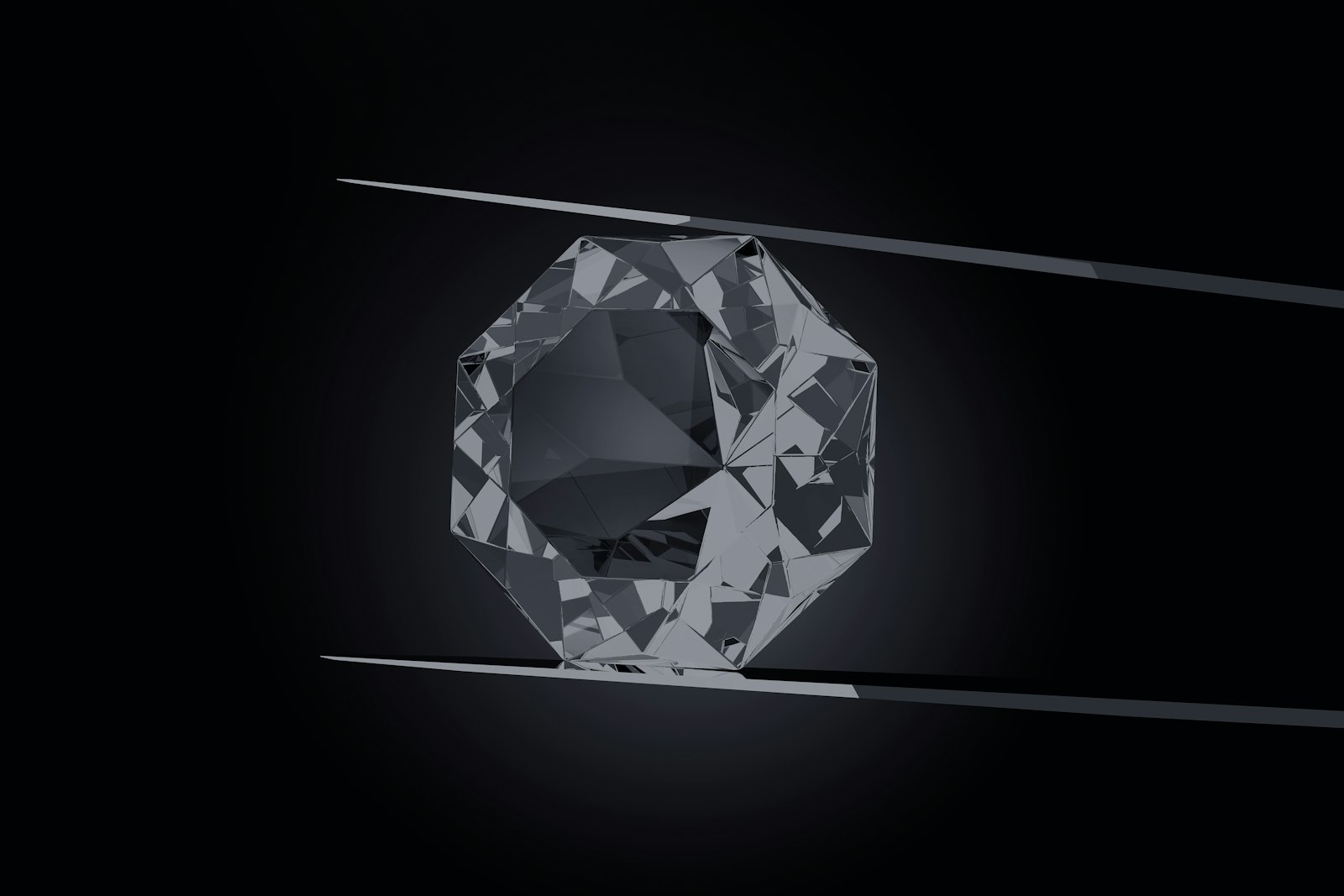
Two diamonds can weigh the same, sit at the same colour and clarity grade, and still look nothing alike across a table. Almost every time the difference is cut quality — not the shape the cutter chose, but how well the stone was proportioned, angled and finished once that choice was made.
Cut is the one quality factor that is entirely human. Colour, clarity and carat weight were settled underground long before anyone found the crystal, and a grader simply describes what nature produced; our guide to the 4 Cs covers those three in full. Cut is different. Every angle on a polished diamond was decided by a person, working against the weight they were willing to give up. That makes cut the most revealing line on a grading report, and the thing that usually explains why a stone you loved in the hand outshone one that looked better on paper.
Cut quality and diamond shape are two different questions
Worth separating these first, because the trade uses the word cut for both. Shape is the outline and faceting style — round brilliant, oval, emerald, pear and the rest — and it is largely a matter of taste, which we cover separately. Cut quality is a judgement of how well that chosen shape has been executed: whether the angles work together, whether light comes back to the eye, whether the finish is clean. Shape tells you what a diamond looks like; cut quality tells you how alive it looks.
What light actually does inside a diamond
The cut is arguably the most important factor because it directly affects how much light the diamond reflects back to your eye. A well-cut diamond will sparkle brilliantly, while a poorly cut diamond of higher carat weight might look dull.
Light entering through the table and crown should strike a pavilion facet at an angle steep enough to reflect internally, bounce across to a second pavilion facet, and leave through the crown towards the viewer. Gemmologists describe the result in three parts, and the Gemological Institute of America grades against exactly these terms:
- Brightness, often called brilliance, is the total internal and external reflection of white light — what makes a stone look bright rather than glassy.
- Fire is the dispersion of white light into the colours of the spectrum: the flashes of red, orange and blue that appear when the stone moves under a point source.
- Scintillation is the pattern of light and dark areas across the face of the stone, and the sparkle that pattern produces in motion.
Contrast matters more here than most people expect. A stone with no dark areas at all looks flat and washed out; the dark patches give the bright ones something to flash against. A good cut is not the one that returns the greatest quantity of light, but the one that organises light and dark into a lively, even pattern that holds up as the hand moves.
The failure mode is light leakage. When a pavilion angle is wrong, light striking that facet from inside meets it too shallowly to reflect, passes out through the bottom of the stone and is lost into the setting. You read it as dullness, or as windows: patches where the stone looks transparent rather than luminous.
The proportions that decide it, and how they interact
A round brilliant has a small number of measurements that do most of the work. None of them is meaningful alone.
- Table size, the flat top facet, expressed as a percentage of the stone’s diameter. A large table lets in a lot of light but leaves less crown to disperse it into fire.
- Crown angle, the slope of the upper facets. The crown is where fire is generated, so a crown flattened to save weight tends to give brightness without much fire.
- Pavilion angle, the slope of the lower facets. This is the single most sensitive number in the stone. A fraction of a degree either side of the workable range and light stops reflecting cleanly.
- Total depth, measured against diameter. Depth is a symptom rather than a cause: it tells you weight has gone somewhere, and the crown and pavilion angles tell you where.
- Girdle thickness, the band around the widest point. Too thin and the stone chips at the setting; too thick and weight is hidden in a rim that contributes nothing to appearance.
- Culet, the point or tiny facet at the bottom. A large one shows through the table as a grey spot.
The crucial idea is that these are a system, not a scorecard. Crown and pavilion angles trade against each other: a slightly steeper crown can be balanced by a slightly shallower pavilion, and both stones can look excellent. GIA is explicit that a nearly unlimited combination of proportions can produce an attractive diamond, which is why no laboratory publishes a single set of correct numbers. Judging a stone by one measurement in isolation is the commonest mistake buyers make with a report in hand.
When the angles go wrong: the fisheye and the nailhead
Two classic faults show what happens when the system is pushed out of balance, and both are visible without a loupe.
A fisheye appears when a stone is cut with a shallow pavilion and a wide table, usually to make a given weight spread as far across the finger as possible. The reflection of the girdle becomes visible through the table as a dull grey ring, sitting inside the stone like the iris of an eye. The diamond looks bigger and reads as flat and watery.
A nailhead is the opposite error. When the pavilion is too deep, light is reflected back down and out rather than returned to the eye, and a dark shadow settles under the table. The stone looks smaller than its weight and has a heavy, blocked centre.
Both come from a cutter chasing something other than beauty, and both are why cut is assessed at all.
The cutter’s real trade-off: weight against beauty
Rough diamond is bought by weight and polished diamond is sold by weight, and a great deal is lost in between. A cutter looking at a piece of rough can usually see more than one stone in it: a heavier one with compromised angles, or a lighter one cut to the proportions that make light behave.
The commercial pressure runs one way. Weight is the easiest thing to sell and to compare, so rough is often cut to hold a number rather than to perform. Deep pavilions, thick girdles and outsized tables are all ways of keeping weight the eye never sees. A well-cut stone is one where someone chose to throw material away, and you are paying for that decision as much as for the diamond.
How cut is actually graded
Diamond cuts range from Excellent to Poor ratings: GIA’s scale runs Excellent, Very Good, Good, Fair and Poor. It is not a simple measurement of proportions. Seven components are assessed and grouped into three areas: face-up appearance, covering brightness, fire and scintillation; design, covering weight ratio and durability; and craftsmanship, covering polish and symmetry. Polish describes the smoothness of the facet surfaces, symmetry the exactness with which facets are shaped and aligned. Both are reported as their own grades, so a stone can be well proportioned but carelessly finished, and the report will say so.
The American Gem Society ran the other well-known system, scoring cut on a numerical scale where zero is the top grade rather than using words. AGS Laboratories closed at the end of 2022 and GIA acquired its technology; GIA now offers an AGS Ideal report as a supplementary document for qualifying stones, though it applies GIA’s own light performance measures rather than the old AGS methodology. HRD Antwerp assesses cut on its reports and offers a separate Hearts and Arrows assessment for precision-cut rounds.
Why fancy shapes have no overall cut grade
The round brilliant is currently the only shape that receives an official cut grade on a GIA report. Ovals, pears, cushions, emeralds and princesses are assessed for polish and symmetry only. A round brilliant is one design with one geometry, so a model can predict how light will behave in it. Fancy shapes have no agreed outline — ovals vary in length, cushions in roundness, emeralds in how many steps — so a single grade would compare objects that are not the same object.
This has a practical consequence. For fancy shapes you cannot outsource the judgement to a letter grade. Look at the stone in more than one light, and look for even light return across the whole face rather than a bright rim with a dead centre, or the dark bow-tie that stretches across the waist of a poorly angled oval or marquise.
Reading the proportion diagram on a report
Most reports carry a small profile drawing of the stone with the key measurements labelled around it. It is the most useful picture on the page and the one buyers skip.
Read it in this order. Start with the outline: how much of the stone sits below the girdle compared with above. Then the crown and pavilion angles together, as a pair, since they compensate for each other. Then the table percentage, in the context of that crown angle. Then the girdle, described in words such as thin, medium or thick and often as a range, which tells you how evenly it was cut. Then the culet. Finally the polish and symmetry grades, which are the cutter’s handwriting and the quickest indication of how much care went in.
Why two stones that match on paper look different
Once the proportion diagram is in view, the question that opens this article answers itself. Two stones can carry identical carat, colour and clarity grades and still differ in table, crown angle, pavilion angle, girdle, polish and symmetry — six independent variables a summary listing rarely shows. One spreads wide and returns grey; the other sits deeper and returns light. The three natural factors tell you what the crystal was. Cut quality tells you what someone made of it, and that is what you see from across the room.
What to do with this
Compare stones by their proportion diagram rather than their headline grades. Treat any single measurement as a question rather than a verdict, and check what the other numbers are doing to balance it. Read polish and symmetry alongside the cut grade. For anything other than a round brilliant, trust your own eye, and view the stone against a plain background, away from the concentrated overhead lighting that flatters everything. And if a stone looks unexpectedly large for its weight, look for the grey ring of a fisheye before congratulating yourself on the find.