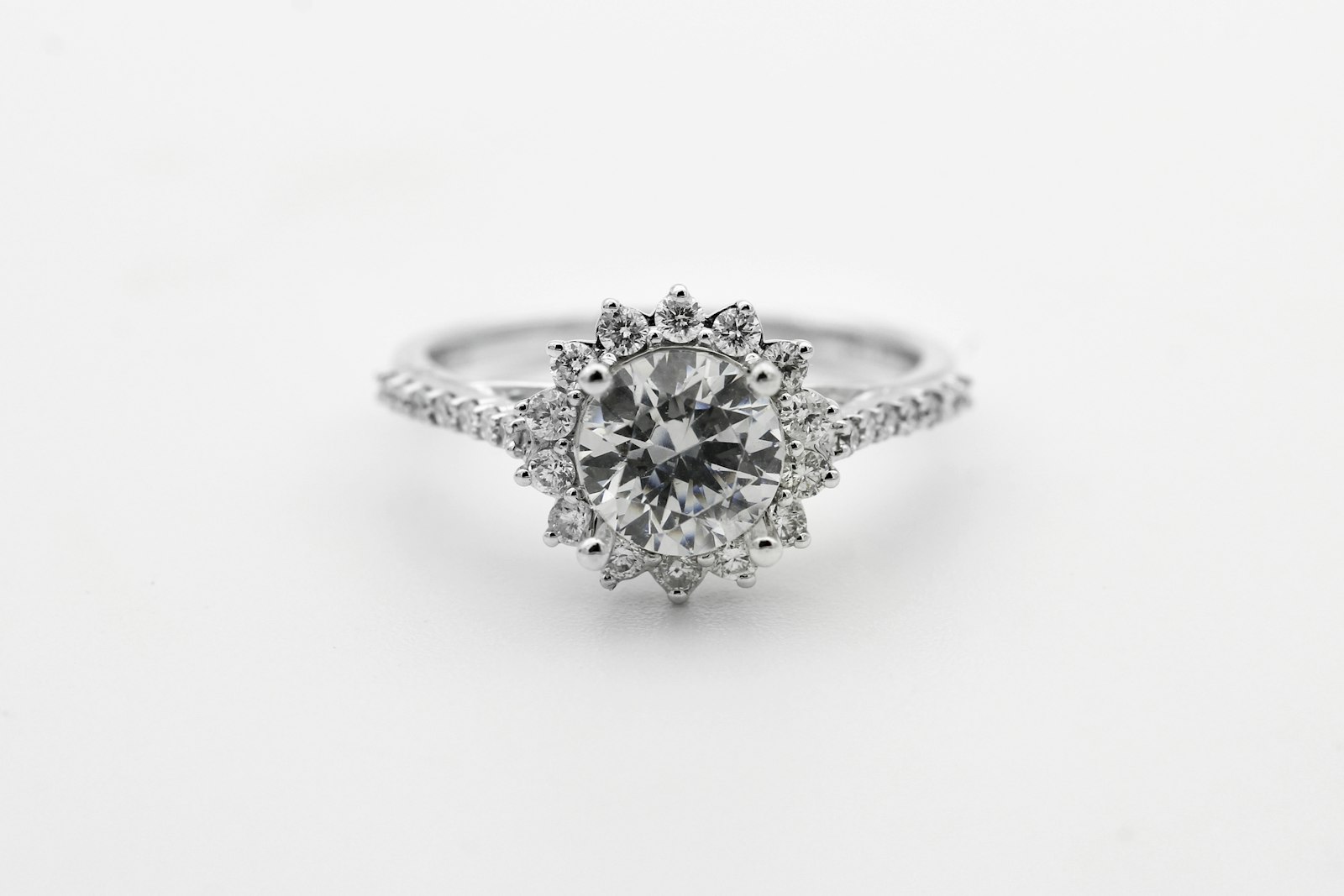
Moissanite is the most misrepresented stone in the jewellery trade, and it is misrepresented in both directions. Sellers call it “better than diamond”. Traditionalists call it a fake. Neither is accurate. Moissanite is a distinct gemstone with genuinely different optical and physical properties, some of which are advantages and some of which are not.
Here is what those properties actually are, and who each stone suits.
What moissanite is
Moissanite is silicon carbide (SiC). Diamond is pure crystallised carbon (C). They are different minerals with different crystal structures — moissanite is hexagonal, diamond is cubic — and they behave differently as a result.
Naturally occurring moissanite was first identified in 1893 by the French chemist Henri Moissan, in fragments of a meteorite crater in Arizona. He initially took the crystals for diamonds. Natural moissanite is vanishingly rare and exists only in microscopic quantities in meteorites and a handful of geological settings. Every moissanite sold as jewellery is laboratory-created. That is not a caveat; it is simply what the market is.
This distinguishes moissanite from both natural diamond and lab-grown diamond in an important way. A lab-grown diamond is a diamond — same mineral, same properties, different origin. Moissanite is a different mineral entirely, and is correctly described as a diamond alternative rather than a diamond substitute or simulant of the cubic zirconia kind.
The physical comparison
| Property | Diamond | Moissanite |
|---|---|---|
| Composition | Carbon | Silicon carbide |
| Mohs hardness | 10 | 9.25 |
| Refractive index | ~2.42 | ~2.65 – 2.69 |
| Dispersion (fire) | 0.044 | ~0.104 |
| Thermal conductivity | Very high | High |
| Density (specific gravity) | ~3.52 | ~3.21 |
| Origin of market supply | Natural and lab-grown | Lab-grown only |
Three numbers in that table explain almost everything people notice about the two stones.
Hardness: 10 versus 9.25
Diamond is the hardest known natural material at 10 on the Mohs scale. Moissanite at 9.25 is the second-hardest material in common jewellery use — harder than sapphire and ruby at 9, and very substantially harder than anything it will encounter in daily life.
In practice this difference is close to meaningless for wear. Both stones resist scratching from dust, keys, benchtops and everything else a ring meets. Neither will visibly abrade over decades. The Mohs scale is also not linear — the gap between 9 and 10 is far larger than the gap between 1 and 2 — but the absolute performance of both stones is already so far beyond everyday hazards that the practical difference is negligible.
Where hardness is not the whole story is toughness — resistance to chipping and fracture, which is a different property. Diamond has cleavage planes along which a sharp, well-placed impact can split it. Moissanite has no comparable cleavage and is, in that specific sense, somewhat less prone to chipping. Both are set in metal for a reason.
Refractive index: 2.65 versus 2.42
Refractive index measures how much a material bends light. Moissanite’s is meaningfully higher than diamond’s. Higher RI means more total internal reflection, which means more light returned to the eye — moissanite is, measurably, a brighter stone.
Whether that is desirable is a matter of taste, and it interacts with the next number.
Dispersion: 0.104 versus 0.044
Dispersion — “fire” — is a material’s tendency to split white light into spectral colours. Moissanite’s dispersion is roughly two and a half times that of diamond.
This is the single most visible difference between the two stones and the one people react to. Under direct or point-source lighting — sunlight, spotlights, restaurant downlights — a moissanite throws noticeably more coloured flashes: rainbows of red, green and blue. Enthusiasts call it fire. Critics call it the “disco ball effect”.
Some observations that are fairly consistent:
- In diffuse light — an overcast day, an office, indoor ambient lighting — the two stones are difficult for most people to tell apart.
- In direct light, the difference is obvious to anyone who has been told what to look for, and invisible to most people who have not.
- The effect scales with size. A 0.5 carat moissanite reads as a sparkly stone. A 3 carat moissanite reads unmistakably as moissanite to a trained eye.
- Cut quality matters as much as material. A well-cut moissanite in a design that manages its fire looks far more refined than a poorly cut one.
If you dislike the look, no amount of price advantage will change that. If you like it — and many people specifically prefer it — it is an advantage, not a compromise.
Colour
Modern moissanite is produced in colour ranges broadly comparable to diamond grading, with the best material described as colourless and equivalent to roughly D–F.
Older and cheaper moissanite frequently shows a faint grey, green or yellow cast, most visible in larger stones and under fluorescent light. This was a common complaint with earlier generations of the material and is much less of an issue with premium contemporary production — but it varies significantly by producer, and it is the main reason to buy from a named brand with a stated colour grade rather than an unlabelled stone.
If you are buying moissanite, look at the actual stone or a video of it in more than one lighting condition. Colour cast is the defect most likely to disappoint, and it does not show in a studio photograph.
Price
This is the reason most people are reading this comparison.
Moissanite costs a small fraction of what a natural diamond of comparable size and appearance costs — typically an order of magnitude less, though exact ratios move with the market and with stone size. Lab-grown diamond sits between the two and has fallen substantially in price over recent years as production has scaled.
The practical consequence: a budget that buys a modest natural diamond buys a very large moissanite. For a buyer whose priority is visual presence, that is a real and legitimate advantage.
The corresponding fact: moissanite has essentially no resale market. Neither, increasingly, does lab-grown diamond. Natural diamond has a resale market, but it is worth being clear-eyed about it — retail markups mean that reselling a diamond commonly returns a fraction of what was paid, and diamonds are not a liquid asset in the way the marketing has sometimes implied.
Neither stone should be bought as an investment. If value retention is genuinely the objective, jewellery of any kind is a poor vehicle compared with actual financial instruments, and that is a conversation for a licensed financial adviser rather than a jeweller. Buy the stone because you want to wear it.
Identification
Moissanite is straightforward to identify with the right instrument and impossible to identify reliably by eye at a glance.
- Thermal testers — the traditional handheld “diamond tester” — read thermal conductivity. Moissanite conducts heat well enough that older thermal testers register it as diamond. This is a known limitation and the source of many misidentifications.
- Combination testers measure electrical conductivity as well and separate the two reliably. Any competent jeweller has one.
- Double refraction. Moissanite is doubly refractive; diamond is singly refractive. Viewed through the crown under magnification at the right angle, moissanite shows visible facet doubling — the back facet edges appear as two lines rather than one. This is the classic gemmological identification and it is definitive.
For consumers, the point is simply this: moissanite is not sold to deceive and reputable sellers label it clearly. If a seller is vague about what a stone is, that is the problem, not the stone.
Which one suits whom
Moissanite is the better choice if:
- Maximum visual size for the budget is the priority.
- You like or don’t mind strong fire.
- The ring will see hard daily wear and you want a stone you would be less devastated to damage or lose.
- You want a travel or holiday ring, or a duplicate of a valuable piece.
- Origin ethics matter to you and a fully laboratory-produced stone resolves that cleanly.
- You are buying a fashion or statement piece rather than an heirloom.
Diamond is the better choice if:
- The tradition and the meaning of a diamond specifically matter to you or to the person receiving it — and this is a completely valid reason that no amount of specification comparison overrides.
- You prefer the more restrained white brilliance of diamond over strong coloured fire.
- The piece is intended as an heirloom to be passed on.
- You may want some resale or trade-in option, however imperfect.
- You want a stone whose grading is standardised and independently certifiable by GIA or AGS against a system the whole market prices against.
Lab-grown diamond is worth considering if you want an actual diamond, with diamond’s optical character and certifiable grading, at a substantially lower price than natural — accepting low resale value in exchange.
Living with either stone
Both are easy to care for and the routine is the same:
- Warm water, a drop of mild dish soap, a soft toothbrush around the underside of the setting where oils and product build up. Rinse and dry with a lint-free cloth. Do this fortnightly and the stone will look considerably better than most people’s.
- Take the ring off for gym work, gardening, swimming in chlorine and applying hand cream or sunscreen.
- Have the setting checked annually. Prongs are what fail, not stones — this is true regardless of which stone you chose.
- Ultrasonic cleaners are generally safe for both, but not for a stone with a significant fracture or for certain treated stones. Ask your jeweller before using one on a specific piece.
The honest conclusion
Moissanite is not a cheap diamond and it is not a fake diamond. It is a harder-wearing, brighter, far more fiery, far less expensive stone that looks different from diamond in direct light and largely the same in diffuse light.
There is no technically correct answer here. There is only what you want to wear, what you want it to mean, and what you want to spend. Anyone who tells you one of these stones is objectively the right choice is selling something.
This article is educational and general in nature and is not investment or financial advice. Gemstone properties cited are standard published values; individual stones vary. Always buy from a seller who discloses stone type and origin in writing.
Sources consulted: GIA 4Cs education library (https://4cs.gia.edu/); Charles & Colvard — Moissanite vs Diamond (https://www.charlesandcolvard.com/blog/moissanite-vs-diamond-whats-the-difference-moissanite-faqs/).