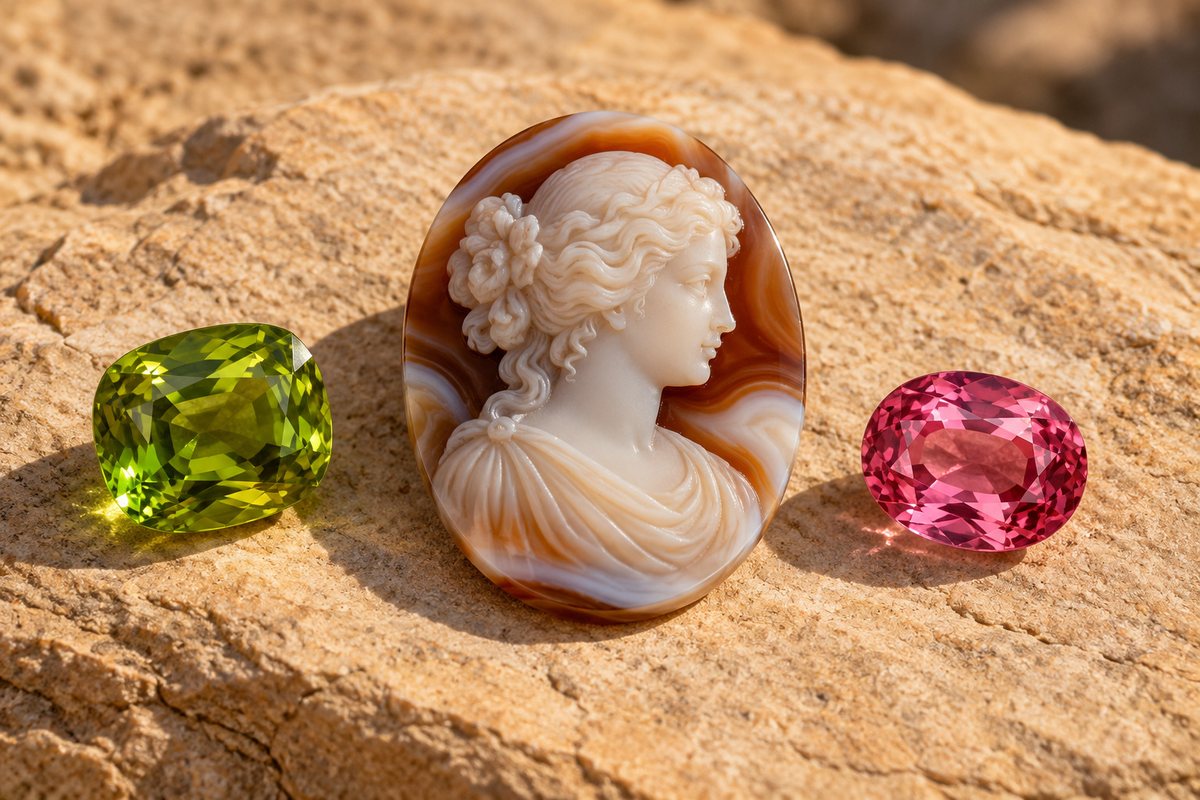
August has three birthstones: peridot, spinel and sardonyx. Peridot, the yellowish-green gem variety of olivine, is the stone most people mean by the August birthstone; spinel was added as an official August birthstone in 2016, and sardonyx is the oldest of the three. If you want the most durable August birthstone for a ring worn every day, spinel is the strongest choice, at 8 on the Mohs scale according to GIA.
This guide includes a few product links near the end. As an Amazon Associate, Diamond Taire earns from qualifying purchases, at no extra cost to you.
This guide compares all three August birthstones on colour, durability and price, explains why spinel joined the list, covers peridot’s particular sensitivity to heat and acids, and finishes with a buying checklist, care advice and the mistakes to avoid.
At a glance
- What is the August birthstone? Peridot, spinel and sardonyx. Peridot is the best known; spinel is the newest; sardonyx is the traditional stone.
- August birthstone colour: peridot is yellowish green to green; spinel comes in red, pink, orange, purple, blue and more; sardonyx is banded reddish brown and white or black.
- Durability: GIA lists spinel at 8, and peridot and sardonyx at 6.5 to 7, on the Mohs scale.
- Peridot needs gentle care: GIA advises against ultrasonic and steam cleaners and notes that some acids, and long-term acidic perspiration, can damage it.
- Best value: small peridot is inexpensive; fine red, pink and cobalt-blue spinel costs much more.
Why does August have three birthstones?
The 1912 list adopted by the National Association of Jewelers, now Jewelers of America, gave sardonyx and peridot for August. In June 2016, the American Gem Trade Association and Jewelers of America announced spinel as an additional official August birthstone. It was only the third update to that modern list, following changes in 1952 and 2002, when tanzanite was added for December. Some national lists outside the United States still give only peridot and sardonyx, so it is worth knowing that spinel is an addition rather than a replacement.
The practical result is a genuinely broad choice. Peridot gives the classic bright green August look. Spinel adds colour options and the toughness for daily rings. Sardonyx suits carved, engraved and signet-style pieces. All three are authentic August birthstones.
Peridot, spinel and sardonyx compared
| Factor | Peridot | Spinel | Sardonyx |
|---|---|---|---|
| Mineral | Olivine | Spinel | Chalcedony (banded sard and onyx) |
| Colour | Yellowish green to pure green | Red, pink, orange, purple, violet, blue, bluish green, black | Reddish brown to orange bands with white or black bands |
| Mohs hardness (GIA) | 6.5 to 7 | 8 | 6.5 to 7 |
| Toughness and wear (GIA) | Fair to good | Good | Needs care, especially in rings |
| Common treatments | Not covered in GIA’s care guidance; ask the seller | Some heated (stable in normal wear); rarely fracture filled | Commonly dyed, like other chalcedony |
| Daily ring? | GIA does not recommend it for daily ring wear | Yes, typically durable for rings | Occasional wear; best in signet or protected styles |
| Ultrasonic or steam cleaning | No | Usually safe unless fractured or filled | Use caution; warm soapy water is safest |
| Relative price | Affordable in small sizes; higher above about 10 x 8 mm | Moderate for pale colours; high for fine red, pink and cobalt blue | Usually affordable |
Peridot: the classic August birthstone
Peridot is the gem variety of olivine, and GIA notes that iron causes its colour. GIA describes the finest peridot as pure green with no yellow or brown, while most stones on the market are yellowish green. Lower-quality peridot looks brownish. GIA adds that the best colours tend to appear in stones of 10 carats and above, so a small peridot will often be a lighter, more yellowish green.
Clarity and the “lily pad” clue
Most fine peridot is eye clean. Under magnification, GIA notes that tiny black mineral crystals and reflective, disc-shaped inclusions known as “lily pads” are common. These are natural features. What hurts value is visible dark inclusions, especially in light-coloured stones.
Why peridot can look “fuzzy” up close
Peridot has very strong double refraction. GIA explains that this makes the back facets appear doubled when you look closely into the stone. It is a normal property of peridot and one of the features a gemmologist uses to identify it, not a sign of poor cutting.
Where peridot comes from
GIA lists sources including China, Myanmar, Pakistan, Tanzania, Vietnam and the United States, where the San Carlos Apache Reservation in Arizona is a notable producer. The oldest recorded source is the Red Sea island of Zabargad, once known as Topazios. GIA notes that the finest large stones come from Myanmar and, more recently, Pakistan, while standard sizes come mostly from Arizona and China. Peridot has even been found in pallasite meteorites, though meteoritic peridot is a collector curiosity rather than an everyday jewellery stone.
Peridot’s weak points
Peridot is pretty but not tough enough for hard daily wear in a ring. GIA notes that rapid or uneven heat can make it fracture, that sulfuric acid attacks it easily and hydrochloric acid less easily, and that long-term exposure to acidic perspiration can also damage it. For many people, that makes peridot an ideal earring, pendant or occasional ring stone rather than a daily ring.
Spinel: the tough newcomer
Spinel is the most durable August birthstone. GIA rates it 8 on the Mohs scale with good toughness, and describes it as typically durable for rings. It is singly refractive, meaning it looks the same colour from every direction, and GIA notes it is stable to light and chemicals, though high heat can fade some colours.
Spinel colours and value
According to GIA, the most valued spinel colours are bright red, cobalt blue, and vivid pink and orange, while pale lavender stones are more affordable. Fine-colour spinel is rare above five carats. GIA also notes that red spinel rivals ruby’s colour but costs much less, which makes it a strong option for anyone who loves red but wants a lower price than fine ruby. The July birthstone guide explains how spinel, garnet and ruby are told apart.
Treatments and lab-grown spinel
GIA notes that some spinel is heat treated to alter colour, and that this is stable under normal wear. Fracture filling is rare. Lab-grown spinel also exists, so ask the seller in writing whether a stone is natural or lab-grown, and whether it has been treated. For a valuable spinel, an independent laboratory report is the clearest answer.
Sardonyx: the original August birthstone
GIA describes sardonyx as the oldest August birthstone, with a history of more than 4,000 years. It combines two types of chalcedony: sard, in brownish red to dark orange, and onyx, in white or black. The alternating bands make it ideal for cameos and intaglios, where a design is carved through one layer to reveal the colour beneath. GIA notes that Roman seals and signet rings were made from sardonyx because hot wax would not stick to it.
Sardonyx, like other chalcedony, is commonly dyed, and GIA notes that high heat from manufacturing or repair work may affect dyed colour. At 6.5 to 7 on the Mohs scale, it needs care in rings. It is an excellent choice for a signet ring, a carved pendant or vintage-inspired jewellery; the guide to what a signet ring is explains the style.
Which August birthstone should you choose?
Match the stone to the piece
- Daily ring or engagement ring: spinel. It is the hardest and toughest of the three. The guide to the best gemstones for engagement rings compares it with other options.
- Earrings or a pendant in classic August green: peridot. It is protected from knocks in these settings and offers a bright colour at a modest price.
- A signet ring, cameo or carved piece: sardonyx, the traditional choice for engraving.
- A child’s or teenager’s first birthstone: small peridot in silver keeps costs sensible; see sterling silver gemstone jewellery.
- Someone who dislikes green: spinel in pink, red, blue or purple is still a true August birthstone.
A simple worked example
Imagine choosing between a peridot ring and a pink spinel ring for someone who works with their hands. The peridot may cost less at the same size, but at 6.5 to 7 on the Mohs scale, with sensitivity to acids and heat, it is more likely to show wear and need replacing or repolishing. The spinel, at 8 with good toughness, is the more practical daily choice even at a higher starting price. If the same person wanted earrings instead, the balance would tip back towards peridot.
How to buy an August birthstone: checklist
- Decide how the piece will be worn before choosing the stone.
- For peridot, check the colour in daylight and indoor light. Look for a lively green rather than a brownish or very yellow tone.
- Check peridot clarity face-up. Small lily pads under magnification are normal; visible dark spots lower value.
- For spinel, ask whether it is natural or lab-grown and whether it has been heated.
- For sardonyx, ask whether it is dyed. Tell your jeweller before any repair that involves heat.
- Choose a protective setting for softer stones. The guide to ring settings explains which styles protect a stone best.
- Do not rely on seller grades such as “AAA”; they are not a shared standard between shops.
- Get an independent report for valuable spinel or large peridot.
- Keep receipts and treatment disclosures for insurance and future work.
How to clean and care for August birthstones
- Peridot: warm, soapy water and a soft brush. GIA advises avoiding ultrasonic and steam cleaners. Take peridot rings off before using household cleaners or acids, and wipe the stone after heavy sweating.
- Spinel: warm, soapy water is always safe. GIA says ultrasonic and steam cleaners are usually safe, but fractures can cause problems, and fracture-filled stones should be cleaned only with warm soapy water or a damp cloth.
- Sardonyx: warm, soapy water and a soft brush are safest; GIA advises caution with ultrasonic and steam cleaners.
- Storage: keep peridot and sardonyx away from harder gems, including spinel, that could scratch them. The guide on how to store jewellery shows simple options.
Common mistakes
- Choosing peridot for a heavy-wear daily ring without accepting that it will need more care.
- Ultrasonic or steam cleaning peridot, which GIA advises against.
- Expecting deep green in a small peridot. GIA notes the best colours tend to appear in larger stones.
- Assuming spinel is a cheap ruby substitute. It is a valuable gem in its own right, and fine colours are priced accordingly.
- Not asking whether spinel is lab-grown. Both natural and lab-grown spinel exist; the price should reflect which one you are buying.
- Letting a jeweller apply heat to dyed sardonyx without warning them.
- Ignoring sardonyx and spinel because the recipient “does not like green”.
More birthstone guides in this series: January birthstone: garnet.
Related guide: Green Gemstones: How to Choose the Right One Without Regret.
Sources this guide draws on: GIA’s August birthstones page; GIA’s peridot and spinel gem encyclopedia entries; GIA peridot quality factors; GIA peridot and spinel care and cleaning guides; the June 2016 American Gem Trade Association and Jewelers of America announcement naming spinel an August birthstone; published accounts of the 1912 National Association of Jewelers birthstone list.
August birthstone FAQs
What is the birthstone for August?
August has three birthstones: peridot, spinel and sardonyx. Peridot is the best known, spinel was added in 2016, and sardonyx is the oldest traditional choice.
What colour is the August birthstone?
Most people think of peridot’s yellowish green. Spinel adds red, pink, orange, purple and blue, and sardonyx is banded reddish brown with white or black.
Why was spinel added as an August birthstone?
The American Gem Trade Association and Jewelers of America named spinel an official August birthstone in June 2016, the first change to the modern list since 2002. It gives August a harder, more colourful option alongside peridot and sardonyx.
Can you wear peridot every day?
In earrings and pendants, yes. GIA does not recommend peridot for daily ring wear because, at 6.5 to 7 on the Mohs scale and with sensitivity to heat and acids, it shows wear sooner than harder stones.
Is peridot expensive?
Small peridot is usually inexpensive. GIA notes prices rise for stones larger than about 10 x 8 mm, and the finest pure-green large stones cost considerably more. Prices change and vary by country and seller.
Which August birthstone is the most durable?
Spinel. GIA rates it 8 on the Mohs scale with good toughness, compared with 6.5 to 7 for peridot and sardonyx.
With three birthstones, August offers something for almost everyone: peridot’s bright summer green, spinel’s hard-wearing colour range and sardonyx’s ancient carved tradition. Match the stone to how it will be worn, ask clear questions about treatment and origin, and an August birthstone can be a happy, lasting gift. For more on building pieces that last, see the guide to building a jewellery collection.
Useful tools for this guide
Practical picks for choosing, checking and caring for jewellery. As an Amazon Associate, Diamond Taire earns from qualifying purchases, at no extra cost to you. Prices and availability are set by Amazon and may vary by country.
- Gemstones of the World by Walter Schumann (5th edition)
A classic illustrated reference to more than 1,900 gemstones.
View on Amazon - Foldable 30x Jeweller’s Loupe
Pocket magnifier for checking stones, settings and hallmarks up close.
View on Amazon - KElofoN Travel Jewellery Case
Compact case with ring rolls and earring slots so pieces do not scratch each other.
View on Amazon