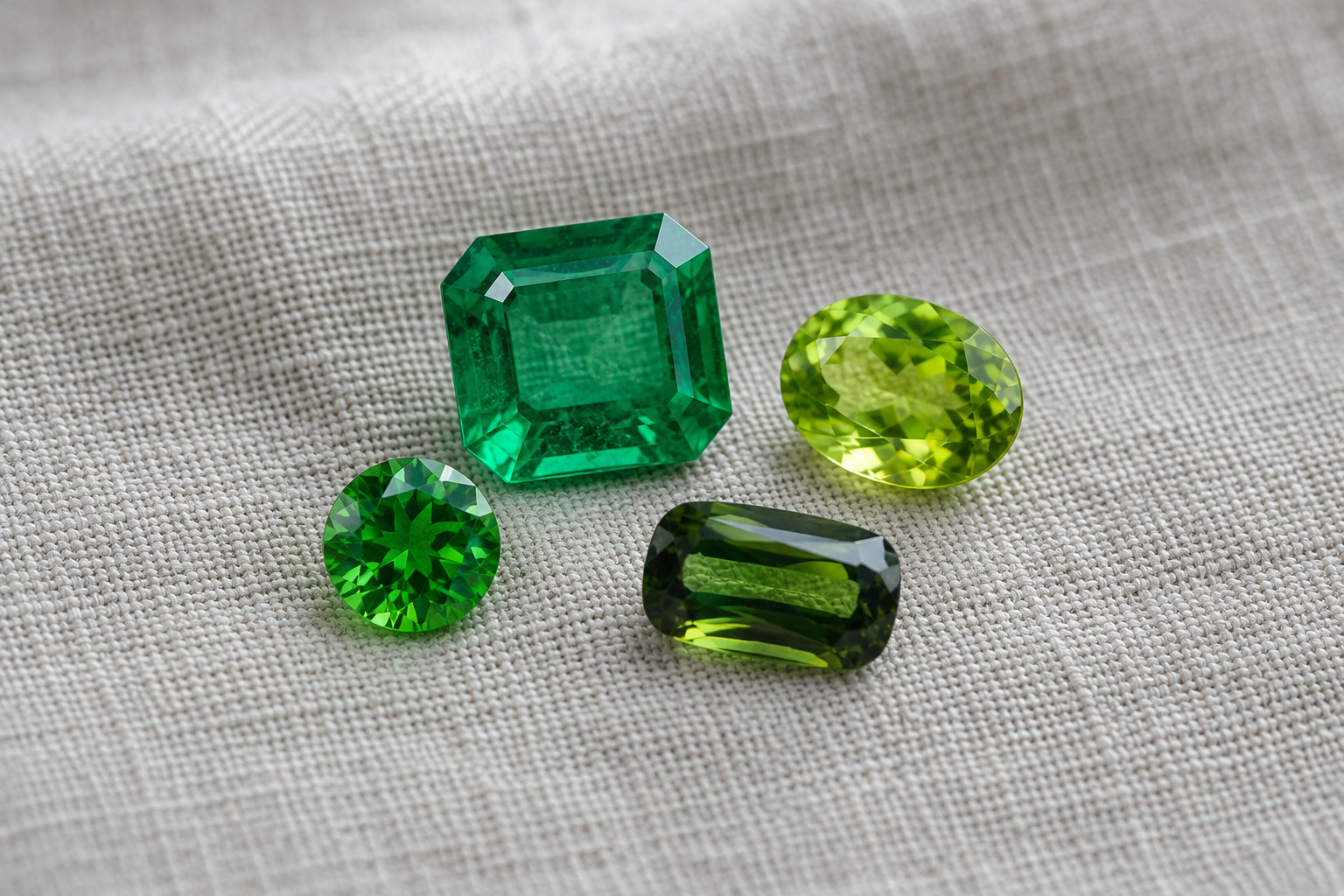
The best-known green gemstones are emerald, tsavorite and demantoid garnet, peridot, green sapphire, green tourmaline, jade, green quartz (sold as prasiolite) and malachite. For a ring worn every day, green sapphire, tsavorite and jade are the safest choices, while emerald is the classic but needs gentler handling because most emeralds have filled fractures. Price follows rarity and colour: fine emerald and demantoid sit at the top, while peridot, green tourmaline and green quartz give a strong green for far less.
This guide includes a few product links near the end. As an Amazon Associate, Diamond Taire earns from qualifying purchases, at no extra cost to you.
This guide compares each green stone on the things that decide whether you will still love it in ten years: how hard and tough it is, how it is usually treated, where it sits on price, and which pieces of jewellery it suits. It ends with a “look of emerald for less” section, a buying checklist and the mistakes that cost people money.
At a glance
- Toughest for daily rings: green sapphire (Mohs 9) and jade (exceptionally tough, though softer at 6 to 7).
- Emerald is beautiful but fragile: Mohs 7.5 to 8, fair to good toughness, and GIA notes estimates that 90 percent or more are fracture-filled with oils or resins.
- Best “emerald look” for less: tsavorite garnet, which GIA describes as durable and usually free of inclusions.
- Usually untreated: peridot and tsavorite; usually treated: emerald, much jadeite and most green quartz.
- Keep out of rings: malachite (soft, and damaged by long water exposure); keep peridot and demantoid for pieces that take fewer knocks if you are hard on your hands.
What makes a gemstone green?
Most green gems owe their colour to small amounts of chromium, vanadium or iron in the crystal. According to GIA, emerald is coloured by chromium or vanadium, tsavorite by vanadium, demantoid by chromium, peridot by iron, and green jadeite by chromium. Green diamonds are a special case: their colour comes from natural radiation exposure, often only in a thin surface layer, and they are exceedingly rare.
The cause matters to you as a buyer for one reason: it explains the shade. Chromium and vanadium stones tend towards a pure or slightly bluish green, which is the colour most people mean by “emerald green”. Iron-coloured peridot leans yellowish green. If you want the deep, cool green, look first at emerald, tsavorite and demantoid. If you like a bright, lime or olive green, peridot and some tourmaline will suit you better.
Green gemstones compared
Hardness is resistance to scratching (the Mohs scale, where higher is harder). Toughness is resistance to chipping and breaking, and it matters just as much in a ring. Price bands below are relative to each other, not quotes, because prices vary with size, quality, country and retailer.
| Stone | Mineral | Mohs hardness | Toughness | Usual treatment | Relative price | Everyday ring? |
|---|---|---|---|---|---|---|
| Emerald | Beryl | 7.5 to 8 | Fair to good | Fracture filling with oil or resin is very common | High to very high | With a protective setting and care |
| Green sapphire | Corundum | 9 | Good | Heating is common in sapphire; ask | Moderate | Yes |
| Tsavorite | Grossular garnet | 7 to 7.5 | Fair to good | Rarely treated | Moderate to high | Yes, with reasonable care |
| Demantoid | Andradite garnet | Softer than tsavorite | Fair to good | Rarely treated | High for fine colour | Better in earrings and pendants |
| Peridot | Olivine | 6.5 to 7 | Fair to good | No known colour or clarity treatment | Low to moderate | Occasional wear |
| Green tourmaline | Tourmaline | 7 to 7.5 | Fair | Heating can lighten dark stones | Low to moderate | With care |
| Jadeite jade | Jadeite | About 6.5 to 7 | Exceptional | Waxing common; bleaching plus polymer is controversial | Wide range; fine imperial green is very high | Yes, if untreated or properly disclosed |
| Nephrite jade | Nephrite | About 6 to 6.5 | Even tougher than jadeite | Can be dyed | Low to moderate | Yes |
| Green quartz (prasiolite) | Quartz | 7 | Good | Usually produced by heat or irradiation | Low | Occasional wear |
| Malachite | Copper carbonate | About 3.5 to 4 | Low | Ask the seller | Low | No |
Hardness and toughness figures for emerald, peridot, garnet, tourmaline, jade and quartz follow GIA’s care and cleaning guides; sapphire’s 9 is the standard Mohs value for corundum.
The main green gemstones, one by one
Emerald: the classic, with conditions
Emerald is the green variety of beryl and the May birthstone. Its weakness is not hardness but inclusions. Nearly every emerald has internal fractures, and the trade routinely fills the surface-reaching ones with oils, waxes or resins so they show less. GIA’s care guide quotes estimates that 90 percent or more of emeralds are fracture-filled. That is normal and acceptable when disclosed, but fillers are not permanent: heat, solvents, ultrasonic cleaners and steam can draw them out or change their appearance, and a fracture that was invisible can suddenly look like a crack.
What to ask for: how much filling the stone has and what was used, and, for a valuable stone, an independent laboratory report that states it. Choose a bezel or a setting with protective prongs at the corners, and expect to take it off for gardening, gym work and cleaning jobs. The gemstone engagement ring guide covers emerald’s daily-wear trade-offs in more depth.
Green sapphire: the hard-wearing option
Sapphire is corundum, the same mineral as ruby, and at 9 on the Mohs scale it is far harder than any other stone in this guide. Green sapphire often has a slightly blue or yellow undertone and is rarely as saturated as fine emerald. If you want a green ring you never have to think about, this is the strongest candidate. Heat treatment is common across sapphire, so ask whether the stone has been heated; heating is stable and widely accepted, but it should be disclosed.
Tsavorite and demantoid: the two green garnets
GIA explains that tsavorite is green grossular garnet and demantoid is green andradite garnet. Their colours overlap, so the difference shows in the details.
- Tsavorite was discovered in the 1960s and is named after the Tsavo area of Kenya, with Tanzania another important source. GIA describes it as durable and usually free of inclusions. Vivid bluish green to green is prized over yellowish green. Large clean stones are uncommon, so price climbs steeply with size.
- Demantoid has a higher refractive index and higher dispersion than tsavorite, which gives it noticeable fire. It is also softer. GIA notes it is the only green gem that can contain “horsetail” inclusions (radiating fibres), which collectors often value. Rare intense green demantoid can rival emerald in price.
Garnet in general is rarely treated. The January guide covers the wider garnet family if you are comparing colours across it.
Peridot: bright, affordable and untreated
Peridot is iron-coloured olivine, so it is always some shade of yellowish to pure green, and GIA notes no known treatments to improve its colour or clarity. It is softer (6.5 to 7) and sensitive to rapid heat and to acids, so it is a lovely choice for earrings, pendants and occasional rings rather than a ring worn through daily chores. The August birthstone guide covers peridot quality, the “lily pad” inclusions and care in detail, so this guide does not repeat it.
Green tourmaline: the widest range of greens
Tourmaline covers a very wide range of greens, from minty pale greens to deep bottle greens. It is 7 to 7.5 on the Mohs scale with fair toughness. GIA notes heating is used to lighten dark green tourmaline and is stable, but irradiated colours in tourmaline can fade with heat or bright light. Ask, and avoid ultrasonic and steam cleaners.
Jade: tough, but read the label
“Jade” covers two different materials. Jadeite is the more valuable, with semi-transparent “imperial green” the most prized colour; most comes from Myanmar, and GIA notes the United States bans imports of Myanmar jade (rules differ by country, so check where you are). Nephrite is subdued, darker and less expensive. Both are slightly soft for scratches but extremely tough: GIA’s durability article gives nephrite a fracture toughness far above diamond’s, which is why carved jade bangles survive decades of wear.
The risk is treatment. Light surface waxing is routine. Jadeite that has been bleached and impregnated with polymer, or dyed, is worth much less and can weaken or discolour over time. For any jade sold as natural and priced as such, ask for an independent laboratory report.
Green quartz and malachite: budget and fashion pieces
Green quartz is often marketed as prasiolite or “green amethyst”. GIA’s treatment overview explains that green quartz is produced by combining irradiation and heating, and amethyst can be heated into other colours, so assume a green quartz has been treated unless a lab says otherwise. It is fine for pendants and earrings at a low price. Malachite, with its banded opaque green, is a decorative material rather than a ring stone: it is soft, and GIA notes long water exposure damages it and ammonia dulls its polish.
The look of emerald for less
If you love emerald green but not emerald’s price or fragility, these are the honest alternatives, in order of how closely they get there.
- Tsavorite: the closest natural match in colour, cleaner than most emeralds and rarely treated. Best for smaller stones, as large tsavorite gets expensive.
- Lab-grown emerald: real emerald, grown by flux or hydrothermal methods (GIA dates commercial flux-grown emerald to the late 1930s and hydrothermal emerald for jewellery to 1960). It costs much less than a natural stone of the same look. It should be clearly labelled as lab-grown or synthetic.
- Saturated green tourmaline: a good saturated green at a modest price, though the colour often looks slightly darker or more olive.
- Green sapphire: not the same colour, but if you want a green ring that shrugs off daily life, nothing on this list is tougher in practice.
Avoid green glass and dyed quartz sold as “emerald”. Under the guidance of bodies such as the US Federal Trade Commission, and similar rules in many other countries, a seller must not describe a lab-made or imitation stone in a way that suggests it is natural.
Which green gemstone suits which piece?
| Piece | Best choices | Think twice |
|---|---|---|
| Engagement or daily ring | Green sapphire, tsavorite, jadeite or nephrite | Emerald unless well protected; peridot; demantoid |
| Occasional cocktail ring | Emerald, tourmaline, peridot, tsavorite | Malachite |
| Earrings and pendants | Any stone on the list, including demantoid and green quartz | Very porous or dyed material near perfume and hairspray |
| Bracelets and bangles | Jade, green sapphire | Emerald and peridot in exposed settings |
Setting style changes the answer. A bezel or a halo protects a softer stone’s edges; a tall, open four-prong setting exposes them. The ring settings guide explains which settings protect best. If you are setting a green stone in silver, the sterling silver gemstone guide explains how silver wears alongside it.
How to choose a green gemstone: checklist
- Decide where it will be worn. Daily ring, occasional ring or earrings. This alone rules several stones in or out.
- Pick a shade. Cool, pure green (emerald, tsavorite, demantoid), yellowish green (peridot) or a wide range (tourmaline).
- Ask what the stone is, exactly. Mineral name, natural or lab-grown, and the full name (for example “tsavorite garnet”, not just “green stone”).
- Ask about treatment in writing. For emerald, the degree of filling; for jade, whether it is untreated; for quartz and tourmaline, whether heated or irradiated.
- Get a laboratory report for valuable stones. Especially fine emerald, demantoid and jadeite, where treatment and origin change value the most.
- Look at colour in daylight and indoor light. Some greens turn olive or grey under warm lighting.
- Check the setting. Protective prongs or a bezel for softer stones; secure claws for all of them.
- Get the care instructions from the seller and keep them with the receipt and report.
- Insure higher-value pieces and keep a description and photographs. The jewellery insurance guide explains what appraisals should include.
Caring for green gemstones
Warm soapy water and a soft brush are safe for every stone on this list. The differences are in what to avoid:
- Emerald: no ultrasonic, no steam, no solvents, no hot water. Fillers can sweat out or change.
- Peridot, tourmaline, demantoid: avoid ultrasonic and steam cleaners and sudden temperature changes.
- Jade: ultrasonic and steam are considered safe for untreated jade only, so soapy water is the safer default.
- Malachite: wipe with a damp cloth; never soak; keep away from ammonia-based cleaners.
Store pieces separately so harder stones and metal cannot scratch softer ones; the jewellery storage guide has simple ways to do that.
Common mistakes
- Treating emerald like diamond. Cleaning it in an ultrasonic machine or wearing it for heavy work is the most common way to damage one.
- Paying natural-emerald prices for an undisclosed lab stone. Lab-grown emerald is real emerald and a fair purchase at the right price; the mistake is buying it without knowing.
- Assuming “jade” means one thing. Nephrite, jadeite and treated jadeite are priced very differently.
- Buying green quartz as a rare stone. “Green amethyst” is attractive and affordable, but it is usually treated quartz.
- Choosing by hardness alone. Jade is softer than emerald yet far harder to break. Look at hardness and toughness together.
- Setting a soft stone in an exposed ring. A high, open setting makes knocks far more likely.
Sources this guide draws on: GIA green gemstones buying guide; GIA care and cleaning guides for emerald, garnet, peridot, tourmaline and jade; GIA FAQ on tsavorite and demantoid; GIA article on gem durability beyond the Mohs scale; GIA introduction to gem treatments; GIA introduction to synthetic gem materials; US Federal Trade Commission jewellery guidance as summarised by GIA.
Green gemstones: frequently asked questions
What is the most popular green gemstone?
Emerald is the best-known and most traditional green gemstone, and it is the May birthstone. Peridot is also widely worn because it is affordable and is the main August birthstone. For buyers wanting durability, green sapphire and tsavorite have grown in popularity.
What dark green gemstones are there?
Dark green options include deep emerald, dark green tourmaline, nephrite jade, some green sapphire and darker tsavorite. Very dark tourmaline is sometimes heated to lighten it, so ask about treatment. Malachite is dark green too, but it is soft and best kept for decorative pieces.
Which green gemstone is best for an engagement ring?
Green sapphire is the most durable everyday choice, with tsavorite and jade close behind for people who are reasonably careful. Emerald can work in a protective setting if you accept extra care. Peridot and demantoid are better kept for pieces that take fewer knocks.
How can I tell if a green gemstone is an emerald?
You usually cannot tell reliably by eye, because tsavorite, tourmaline, glass and lab-grown emerald can all look similar. Typical emeralds show inclusions under magnification, but a gemmologist needs instruments to confirm identity and treatment. For a valuable stone, ask for an independent laboratory report.
Is green sapphire cheaper than emerald?
Often, though not always. Green sapphire tends to cost less than fine emerald of similar size, partly because its colour is rarely as saturated. Prices change and depend on quality, so compare stones of similar size and clarity before deciding.
Are green gemstones natural or treated?
It depends on the stone. Peridot and most garnets are usually untreated, while most emeralds are fracture-filled and most green quartz is colour-treated. Treatment is acceptable when it is disclosed, so always ask and get the answer in writing.
The right green gemstone is the one whose colour you love and whose durability matches how you live. Decide where you will wear it, ask the treatment question every time, and a green stone can stay beautiful for a lifetime.
Useful tools for this guide
Practical picks for choosing, checking and caring for jewellery. As an Amazon Associate, Diamond Taire earns from qualifying purchases, at no extra cost to you. Prices and availability are set by Amazon and may vary by country.
- Gemstones of the World by Walter Schumann (5th edition)
A classic illustrated reference to more than 1,900 gemstones.
View on Amazon - Foldable 30x Jeweller’s Loupe
Pocket magnifier for checking stones, settings and hallmarks up close.
View on Amazon - KElofoN Travel Jewellery Case
Compact case with ring rolls and earring slots so pieces do not scratch each other.
View on Amazon