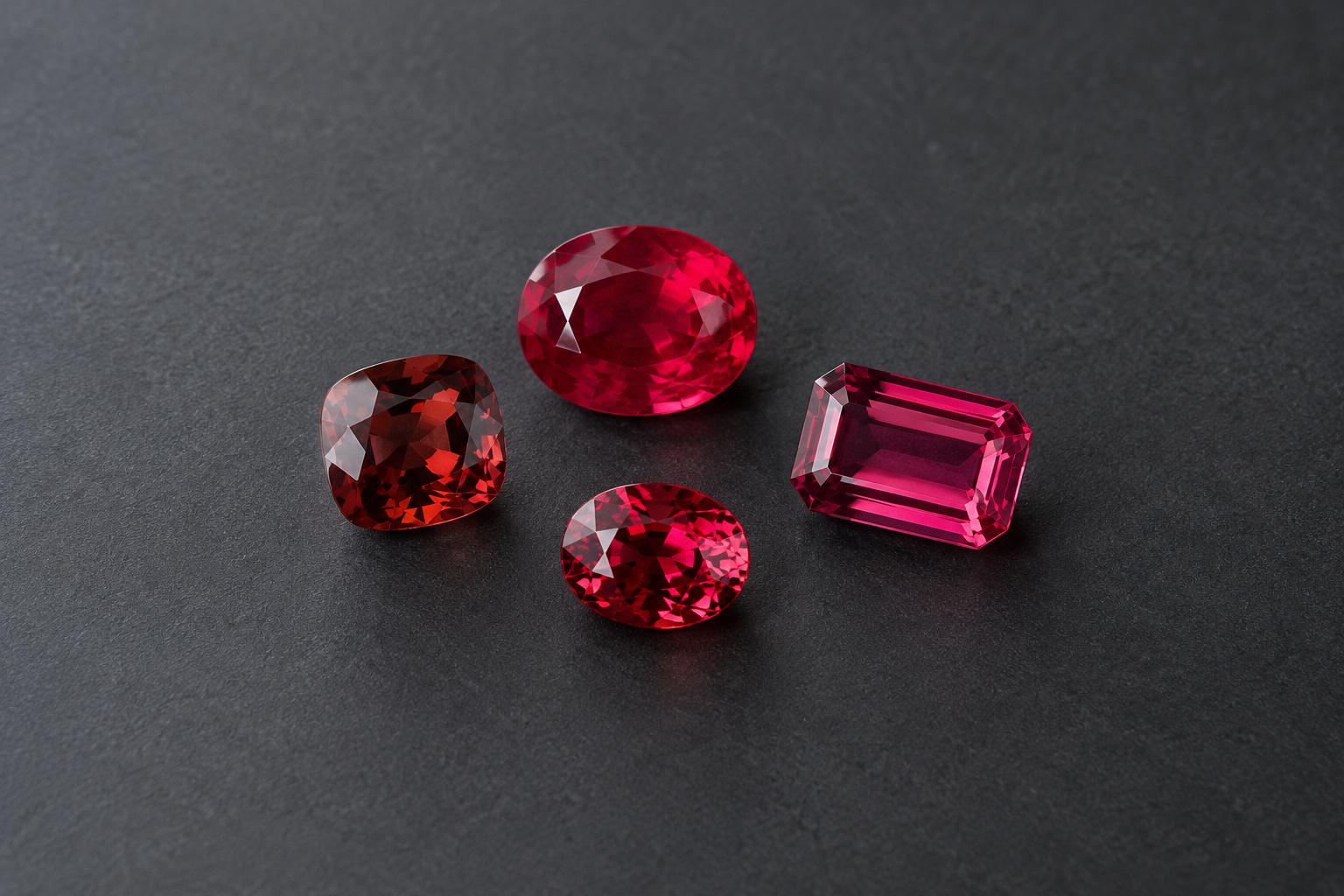
The main red gemstones are ruby, red spinel, red garnet, rubellite (red tourmaline), red beryl and red coral. Ruby and spinel are the most durable for everyday rings, garnet is the best-value red, and rubellite suits careful wear; red beryl is a collector’s rarity and red coral is soft and raises sustainability questions. The biggest buying risks with red stones are heavily glass-filled rubies, garnets or spinels sold as ruby, and dyed or imitation coral.
This guide includes a few product links near the end. As an Amazon Associate, Diamond Taire earns from qualifying purchases, at no extra cost to you.
This guide compares red stones side by side on durability, typical treatments and relative price, then shows how to protect yourself against the most common red-stone traps, with a checklist and answers to the questions people ask most.
At a glance
- Toughest reds: ruby (corundum, Mohs 9) and red spinel (Mohs 8, good toughness, per GIA).
- Best value: red garnet, which is rarely treated and sits at 7 to 7.5 for the common red types.
- Biggest trap: lead-glass-filled ruby, which GIA describes as having significant glass in some stones and which reacts readily with solvents.
- History lesson: several famous crown-jewel “rubies”, including the Black Prince’s Ruby, are actually spinel.
- Coral: about 3.5 on the Mohs scale, often dyed or imitated, and some Pacific precious coral species are listed under CITES.
Red gemstones compared
Hardness (Mohs) is resistance to scratching; toughness is resistance to chipping and breaking. Price bands compare the stones with each other and are not quotes, because prices change and vary with size, quality and country.
| Stone | Mineral | Mohs hardness | Toughness | Typical treatment | Relative price | Everyday ring? |
|---|---|---|---|---|---|---|
| Ruby | Corundum | 9 | Good | Heating common; some glass-filled | Moderate to very high | Yes (avoid heavily filled stones) |
| Red spinel | Spinel | 8 | Good | Sometimes heated; filling rare | Moderate to high | Yes |
| Red garnet (pyrope, almandine) | Garnet | 7 to 7.5 | Fair to good | Rarely treated | Low to moderate | Yes, with reasonable care |
| Rubellite | Tourmaline | 7 to 7.5 | Fair | Heating and irradiation possible | Moderate | With care |
| Red beryl | Beryl | 7.5 to 8 | Fair to good | Ask the seller | Very high (very rare) | Collector pieces |
| Red coral | Organic (calcium carbonate) | About 3.5 | Low | Dyeing and impregnation common in lower grades | Wide range | No |
Figures for ruby, spinel, garnet and tourmaline follow GIA’s care guides and durability article; red beryl shares beryl’s hardness with emerald; coral’s hardness comes from the CIBJO coral information sheet.
The main red gemstones, one by one
Ruby: the benchmark red
Ruby is red corundum, the same mineral as sapphire, and at 9 on the Mohs scale it is the hardest of the coloured stones here. Heat treatment is widespread; GIA explains that heating removes purplish tones and can dissolve fine “silk” inclusions, and that heat treatment is stable under normal wear. Lab-grown ruby is real ruby: GIA records that the first lab-made gem, a ruby produced by flame fusion, was announced in 1902. It is a fair purchase when it is labelled and priced as lab-grown. Ruby colour, origin and the full treatment ladder are covered in the July birthstone guide, so this guide focuses on the comparisons.
Red spinel: the stone that fooled royalty
For centuries red spinel was mistaken for ruby. GIA notes that the Black Prince’s Ruby in England’s Imperial State Crown and the Timur Ruby of over 350 carats are both spinel, and that large spinels from ancient Asian mines were known as “balas rubies”. Today spinel is valued on its own merits: GIA rates it 8 with good toughness, and fracture filling is rare. Some spinel is heated; a 2026 GIA lab note describes a heated red spinel that had been submitted as ruby and says heating spinel is considerably less common than heating ruby. For more on spinel’s other colours, see the August birthstone guide.
Red garnet: the value red
Most red garnet is pyrope or almandine, which GIA places at the harder end of garnet’s 6.5 to 7.5 range, with fair to good toughness. Garnet is rarely treated, so the colour you see is usually natural. Its reds tend to be darker and sometimes brownish or purplish compared with fine ruby, which is why it costs far less. The January birthstone guide covers garnet types and how to tell garnet from ruby in more detail.
Rubellite: red tourmaline
Rubellite is the trade name for red to pinkish-red tourmaline. Tourmaline is 7 to 7.5 with fair toughness. GIA notes heating is used to improve tourmaline colour and is stable, while irradiated colour can fade with heat or bright light. Avoid ultrasonic and steam cleaning. The October birthstone guide covers tourmaline quality factors.
Red beryl: rare enough to be a curiosity
Red beryl is the red variety of the mineral that gives us emerald and aquamarine. GIA’s review of the Utah deposit describes the Wah Wah Mountains mine as the only known commercial occurrence of gem-quality red beryl in the world, and estimates that only about 10 percent of the material produced was facetable. Treat any red beryl offer, especially online, as something to verify with an independent laboratory before money changes hands.
Red coral: beautiful, soft and worth thinking about
Precious coral is an organic material with a Mohs hardness of about 3.5, according to CIBJO’s coral information sheet, so it scratches easily and should never go in an ultrasonic cleaner or near perfume, solvents or acids. Lower grades are often bleached, dyed and impregnated, and lace and sponge corals are dyed to imitate precious coral; dyeing must be disclosed.
On sustainability, the picture is mixed. China listed four Pacific red and pink precious coral species (Corallium elatius, C. japonicum, C. konojoi and C. secundum) under CITES Appendix III in 2008, which means international trade in those species needs CITES paperwork. Mediterranean red coral (Corallium rubrum) is not listed in any CITES appendix, and CIBJO notes it is harvested only below 50 metres. Trade rules differ by country, so check local import rules before buying or travelling with coral. If sustainability matters to you, ask the seller what species the coral is and where it came from, or choose vintage coral or a red stone instead.
How to avoid fakes and nasty surprises
Lead-glass-filled ruby
Some low-grade ruby with many fractures is filled with lead glass, which makes it look far more transparent than it naturally is. GIA’s research describes stones in which the amount of glass is significant. Under a gemmologist’s microscope these stones show a “flash effect” and gas bubbles in the filled areas, but the filler’s surface lustre is close to ruby’s, so it is hard to spot without magnification. GIA also found the filler reacts readily with solvents, and its treatment overview advises avoiding heat, pressure changes and chemicals with filled stones.
Practical protection:
- Be very wary of large, bright, “eye-clean” rubies at very low prices.
- Ask directly: “Is this ruby glass-filled or composite?” and get the answer in writing.
- For any ruby of real value, ask for an independent laboratory report that states treatment.
- Tell any jeweller doing repairs that the stone may be filled before they apply heat or cleaning solutions.
Garnet or spinel sold as ruby
Garnet and spinel can look very similar to ruby, and spinel was sold as ruby for centuries. A gemmologist separates them with instruments: garnet and spinel are singly refractive, while ruby is doubly refractive and shows different shades of red from different angles. These checks need equipment and training, so for a valuable stone the answer is a laboratory report, not a home test. The guide to reading grading reports explains what a laboratory report should show.
Lab-grown and imitation stones
Lab-grown ruby and lab-grown red spinel are real gem materials and fair buys when labelled. The problem is non-disclosure. GIA notes that US Federal Trade Commission guides require lab-made stones to be described so there is no doubt they are not natural, and many other countries have similar rules. Red glass and dyed quartz are imitations, not gemstones, and should be priced accordingly.
Which red gemstone suits which piece?
| Piece | Best choices | Think twice |
|---|---|---|
| Engagement or daily ring | Ruby, red spinel | Heavily glass-filled ruby; coral |
| Budget everyday ring | Red garnet, lab-grown ruby | Rubellite in exposed settings |
| Occasional cocktail ring | Rubellite, garnet, ruby, spinel | Coral |
| Earrings, pendants, brooches | Any red stone, including coral | Coral near perfume and hairspray |
If you are weighing red against other colours for a ring, the gemstone engagement ring guide ranks durability across all the main options.
How to buy a red gemstone: step by step
- Choose by wear first. Daily ring: ruby or spinel. Budget: garnet. Occasional: rubellite. Decorative: coral.
- Ask exactly what the stone is. Mineral name, natural or lab-grown, and the species for coral.
- Ask about treatment in writing. Heat, glass filling, irradiation, dye or impregnation.
- Compare colour in daylight and indoor light. Many reds look darker or browner under warm lamps.
- Be sceptical of bargains. A large, clean, vivid “ruby” at a low price is more likely to be filled, lab-grown or another stone.
- Get a laboratory report for valuable stones. Particularly ruby, spinel and red beryl.
- Check the setting. Secure claws or a bezel for every stone; protective settings for softer ones.
- Keep paperwork and photos and insure higher-value pieces. The jewellery insurance guide explains what an appraisal should list.
Caring for red gemstones
- Ruby and spinel: warm soapy water is always safe; untreated or heat-only stones are generally fine with other methods, but filled stones need soapy water only.
- Garnet: warm soapy water; ultrasonic is usually safe except for fractured stones; avoid steam.
- Rubellite: warm soapy water only; no ultrasonic or steam.
- Coral: wipe with a soft damp cloth; keep away from heat, solvents, perfume and acids.
Store softer reds such as coral and tourmaline away from rubies and diamonds; the jewellery storage guide shows simple ways to keep pieces apart.
Common mistakes
- Buying a cheap “ruby” without asking about glass filling. It is the most common red-stone disappointment.
- Using an ultrasonic or harsh cleaner on a filled ruby or coral. Both can be damaged.
- Assuming spinel is a “lesser” ruby. It is a separate gem with good durability and a royal history.
- Paying ruby prices for garnet. Without testing, the two can be confused.
- Buying coral without asking the species or origin. It affects both ethics and, in some countries, legality of import.
- Taking a red beryl offer at face value. With a single known commercial source, verification matters.
Sources this guide draws on: GIA introduction to gem treatments; GIA research on the identification and durability of lead-glass-filled rubies; GIA care and cleaning guides for spinel, garnet and tourmaline; GIA article on gem durability beyond the Mohs scale; GIA spinel history and lore; GIA lab note on heat-treated red spinel (2026); GIA review of red beryl from Utah; GIA introduction to synthetic gem materials; CIBJO information sheet on coral, including CITES status.
Red gemstones: frequently asked questions
What is the most valuable red gemstone?
Fine natural ruby is the best-known valuable red gemstone, and top untreated stones are among the most expensive coloured gems. Red beryl is rarer still, with only one known commercial source. Value depends heavily on colour, clarity, size and treatment, so compare like with like.
What are dark red gemstones called?
Dark red stones include almandine and pyrope garnet, darker ruby and some red spinel and rubellite. Garnet is the most common and affordable dark red. Ask for the mineral name, because dark red stones are easily confused.
Is red spinel a real ruby?
No. Red spinel is a different mineral from ruby, which is corundum. It was confused with ruby for centuries, which is why some famous historic “rubies” are actually spinel. It is a valuable gem in its own right.
Is red coral a gemstone?
Red coral is an organic gem material made by marine animals, not a mineral. It is soft, at about 3.5 on the Mohs scale, and is often dyed or imitated. Some Pacific precious coral species are listed under CITES Appendix III, so ask the seller about species and origin.
How can I tell if a ruby is glass-filled?
A gemmologist can usually see a flash effect and gas bubbles in filled fractures using a microscope. Without magnification it is difficult, because the glass’s surface lustre is similar to ruby’s. For any ruby of value, ask for an independent laboratory report that states treatment.
Red gemstones offer everything from everyday garnet to museum-grade ruby. Choose the stone for how you will wear it, ask the treatment and identity questions every time, and you can buy red with confidence rather than regret.
Useful tools for this guide
Practical picks for choosing, checking and caring for jewellery. As an Amazon Associate, Diamond Taire earns from qualifying purchases, at no extra cost to you. Prices and availability are set by Amazon and may vary by country.
- Gemstones of the World by Walter Schumann (5th edition)
A classic illustrated reference to more than 1,900 gemstones.
View on Amazon - Foldable 30x Jeweller’s Loupe
Pocket magnifier for checking stones, settings and hallmarks up close.
View on Amazon - KElofoN Travel Jewellery Case
Compact case with ring rolls and earring slots so pieces do not scratch each other.
View on Amazon