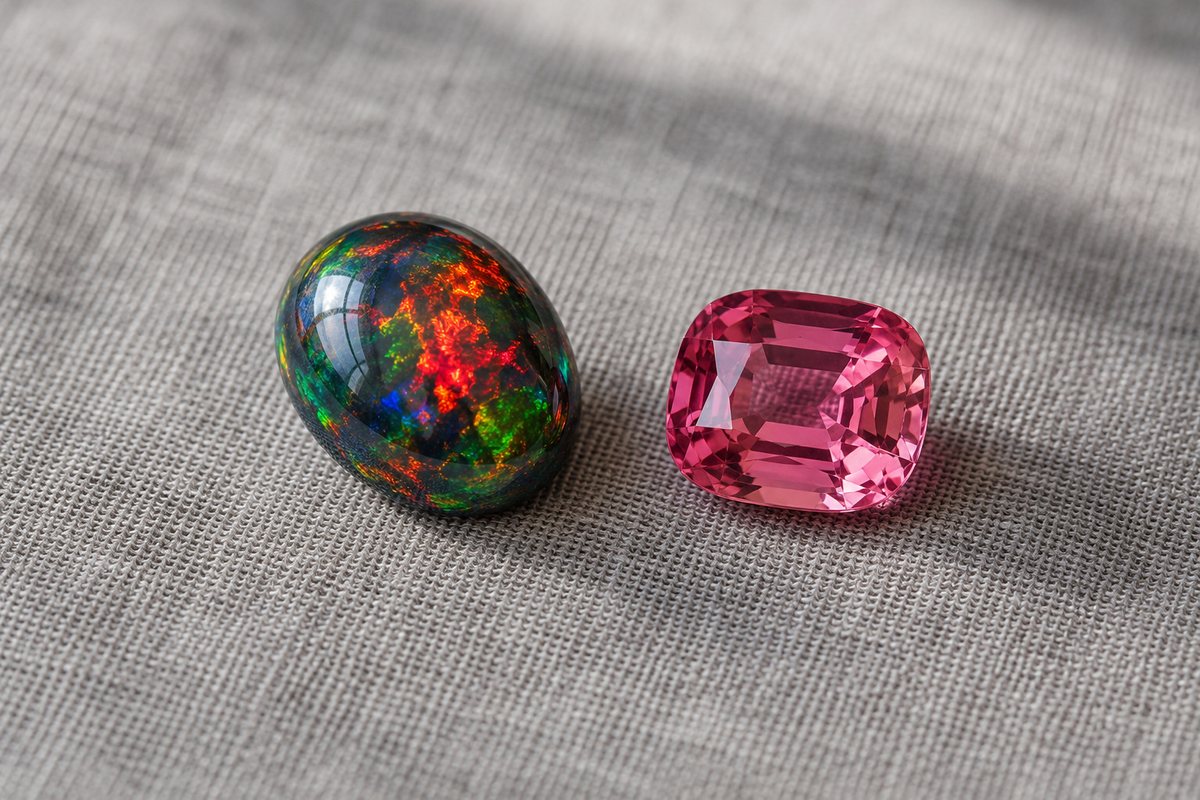
October has two birthstones: opal and tourmaline. Opal is the traditional October birthstone, famous for its shifting flashes of rainbow colour, while tourmaline is the newer choice and comes in almost every colour, with pink and green the best known. The biggest practical difference is durability: tourmaline handles daily wear far better than opal, which is softer and more easily cracked.
This guide includes a few product links near the end. As an Amazon Associate, Diamond Taire earns from qualifying purchases, at no extra cost to you.
This guide explains both October birthstones, which one suits the piece you have in mind, how to recognise opal doublets, triplets and lab-grown opal, which treatments to ask about, and how to care for each stone so it stays beautiful.
At a glance
- What is the birthstone for October? Opal and tourmaline. Opal is the traditional stone; tourmaline is the modern alternative.
- Durability: GIA lists opal at 5 to 6.5 on the Mohs scale with very poor to fair toughness, and tourmaline at 7 to 7.5 with fair toughness. Tourmaline is the safer pick for an everyday ring.
- Colour: opal is prized for play-of-colour; tourmaline is valued for body colour, from pink and red to green, blue and two-colour stones.
- Know what you are buying: doublets and triplets contain only a thin slice of opal and are worth far less than solid opal of a similar look.
- Cleaning rule: warm, soapy water for both. GIA advises against ultrasonic and steam cleaners for opal and tourmaline.
Why does October have two birthstones?
The modern birthstone list used by most jewellers in the United States and many other countries traces back to 1912, when the National Association of Jewelers (now Jewelers of America) adopted a standard list. Opal has been October’s stone on that list from the start. Tourmaline, and in particular pink tourmaline, was added as an alternative later; the Jewelry Industry Council of America’s 1952 revision is usually cited for this. Lists in some other countries differ slightly, so in a few places opal alone is given for October.
In practice, having two stones is useful. Opal offers a one-of-a-kind look but needs gentle handling. Tourmaline is tougher and comes in so many colours that it is easy to match to someone’s taste. Both are authentic October birthstones, so the choice can be made on looks, lifestyle and budget rather than tradition.
October birthstone colours
If you are wondering what colour the October birthstone is, the honest answer is “almost any”. The two stones get their colour in completely different ways.
Opal: play-of-colour
Precious opal is made of tiny, stacked spheres of silica. GIA explains that light diffracts between these spheres to produce the flashes of spectral colour called play-of-colour. Opal that lacks this effect is called common opal. Opal also contains water: GIA notes that up to about 20 per cent of its structure can be water, which helps explain why it is sensitive to heat and drying out.
Behind the flashes is the body colour. GIA’s quality guidance describes the main opal types:
- Black opal: a dark body colour that makes play-of-colour stand out; considered the rarest type and generally favoured by buyers.
- White opal: a light, translucent to opaque body colour; more common and more affordable.
- Crystal opal: transparent to semi-transparent with a clear background, and capable of excellent play-of-colour.
- Boulder opal: opal left attached to its host rock, which becomes part of the finished gem. GIA notes Queensland, Australia, as the source of boulder opal.
- Fire opal: transparent to translucent with a yellow, orange or red body colour, sometimes with play-of-colour. It is often called Mexican opal in the trade.
GIA states that about 90 per cent of the world’s opal comes from Australia, with Ethiopia and Mexico among other important sources.
Tourmaline: colour in the stone itself
Tourmaline’s name comes from the Sinhalese word toramalli, which GIA translates as “stone with mixed colours”, because a single crystal often shows more than one colour. Well-known names include rubellite (pink to red), chrome tourmaline (emerald green), watermelon tourmaline (pink in the centre, green outside) and Paraíba or Paraíba-type tourmaline, whose vivid neon blue to green colours come from copper. GIA notes that Paraíba-type stones cost more than other tourmalines because of their saturated colour and rarity.
Tourmaline also shows pleochroism, meaning its colour can look different depending on the viewing direction. GIA’s buying guide explains that cutters orient stones to make the colour appear darker or lighter, which is one reason tourmaline is so often cut in long rectangles.
Opal vs tourmaline: which October birthstone suits you?
The table compares the two stones on the points that matter most when buying.
| Factor | Opal | Tourmaline |
|---|---|---|
| Mohs hardness (GIA) | 5 to 6.5 | 7 to 7.5 |
| Toughness (GIA) | Very poor to fair | Fair |
| What you pay for | Brightness and pattern of play-of-colour, body tone, stability | Body colour, clarity and cut |
| Main risks | Scratches, chips, crazing from heat, dryness or intense light | Heat can alter colour or cause fractures |
| Common assembled or treated forms | Doublets, triplets; impregnation with oil, wax or plastic; sugar and smoke treatments | Heat and irradiation; most tourmaline is not routinely treated |
| Cleaning (GIA) | Warm, soapy water only | Warm, soapy water and a soft brush; no ultrasonic or steam |
| Best for | Earrings, pendants, occasional-wear rings | Everyday rings, earrings, pendants |
| Relative price | Very wide: assembled and white opal affordable; fine black opal very high | Wide: most colours moderate; fine Paraíba-type stones very high |
Who opal suits, and who it may not
A good fit if you love a stone that looks different every time it moves, and the piece is a pendant, earrings or a ring worn for occasions. Opal’s low density also means large stones are comfortable to wear.
Think twice if the ring will be worn every day on busy hands, in a dry climate with lots of sun, or around heat. A protective bezel setting helps, but it does not change opal’s nature.
Who tourmaline suits, and who it may not
A good fit if you want a colourful October birthstone for daily wear, or want to match a favourite colour exactly. Tourmaline is generally suitable for everyday jewellery, according to GIA.
Think twice if you expect the hardness of sapphire or diamond. Tourmaline is harder than opal but will still show wear over many years in a ring. The guide to the best gemstones for engagement rings compares harder options.
Solid opal, doublets, triplets and lab-grown opal
The single most expensive mistake with opal is paying a solid-opal price for something that is not solid opal. Here is what you may be offered.
| Type | What it is | How it often looks | Value compared with solid opal |
|---|---|---|---|
| Solid natural opal | Opal all the way through (or on its host rock, for boulder opal) | Play-of-colour varies naturally; often freeform shapes for fine stones | The benchmark |
| Doublet | A thin layer of opal cemented to a backing such as obsidian, dyed black chalcedony, black glass, common opal or plastic | Can look like black opal from the front; a flat, even join line may be visible from the side | A fraction of the price |
| Triplet | A thin opal layer between a dark backing and a clear domed top of quartz or glass | Glassy, very even dome; side view shows layers | A fraction of the price |
| Lab-grown (synthetic) opal | Opal created in a laboratory; GIA notes it has been made since the 1970s in black, white and fire types | Can be hard to tell from natural opal without testing | Low; should always be disclosed |
| Imitations | Glass (sold as Slocum Stone) and plastic | Can look convincing in photos | Very low |
GIA points out that assembled opals still have value because they contain real precious opal. They can be a sensible, affordable way to enjoy the look, as long as they are sold and priced as doublets or triplets. Because assembled stones are glued, GIA also warns that prolonged contact with water may weaken the adhesive, so take them off before swimming or washing up.
None of these clues is a reliable home test, and a stone in a closed-back setting can hide its side view entirely. GIA evaluates opal but does not grade it; its identification reports can state whether a stone is natural or lab-grown and list any detectable treatments. For a significant purchase, ask for that kind of independent report.
Judging opal and tourmaline quality
Opal quality factors
- Brightness first: GIA ranks the brightness of play-of-colour as the most important factor, ahead of the range of colours shown.
- Colour range: red is traditionally the most prized flash colour, followed by orange and then green, though fashion shifts.
- Pattern: trade names include pinfire (small, close patches), harlequin (broad, angular patches), flame and peacock. Large, closely arranged patches are usually preferred to tiny scattered dots.
- Dead spots: areas without play-of-colour lower value.
- Stability: GIA notes that a cloudy or milky body colour lowers value and can signal instability.
- Cut: a well-rounded cabochon dome shows colour best; a very flat cabochon can break easily, especially during setting.
Tourmaline quality factors
- Colour: intensity and evenness matter most; Paraíba-type and fine chrome greens and rubellites sit at the top.
- Clarity: GIA notes that pink to red tourmalines often show more visible inclusions than green to blue stones, so expectations differ by colour.
- Cut: GIA’s buying guide stresses cut quality; stones that reflect light evenly are worth more, and poorly cut gems sell at a discount.
- Size: large fine stones often cost considerably more per carat because facet-quality rough becomes scarce at bigger sizes.
- Origin: a famous locality alone does not guarantee quality. Origin claims, especially “Paraíba”, need a laboratory report to mean much.
Treatments to ask about
GIA lists impregnation with oil, wax or plastic for opal, along with surface treatments known as sugar and smoke treatments, which darken the background to make play-of-colour stand out. These change both value and care needs, so ask directly whether the opal has been treated.
For tourmaline, GIA names heating and irradiation as the two important treatments. Heat treatment results are described as stable, while GIA notes that colour produced by irradiation can fade with heat or bright light. GIA’s buying guide adds that most tourmaline is not routinely treated, that pink and yellow stones can be irradiated, and that Paraíba-type material from Africa is often heated. Treated stones are legitimate when disclosed and priced accordingly.
How to buy an October birthstone: checklist
- Decide how the piece will be worn. Daily ring: lean to tourmaline. Pendant, earrings or special-occasion ring: either stone works.
- Choose opal type or tourmaline colour before comparing prices, because each type is priced differently.
- Ask whether an opal is solid, a doublet or a triplet, and get the answer on the receipt.
- Ask whether the stone is natural or lab-grown, and whether it has been treated.
- Look at opal from several angles and in different light. The best stones show play-of-colour from all viewing angles.
- Check tourmaline colour face-up. Make sure the colour you love is the one you see from the top, not just the side.
- Choose a protective setting for opal. A bezel or a raised rim guards edges; the guide to ring settings explained compares the options.
- Do not compare seller grades between shops. GIA does not grade opal or tourmaline, and labels such as “AAA” are each seller’s own system.
- Request an independent report for valuable stones, especially black opal and Paraíba-type tourmaline.
- Pick the metal last. Silver keeps costs down for gifts; see sterling silver gemstone jewellery for how to choose pieces that last.
Caring for opal and tourmaline
Opal care
GIA describes warm, soapy water as the only safe cleaning method for opal. Avoid ultrasonic and steam cleaners, high heat and sudden temperature changes. GIA explains that intense light, heat or dryness can cause crazing, a fine network of cracks caused by moisture loss, and that crazed opal has little durability in jewellery. Keep opal out of sunny windowsills, hot cars and saunas.
Tourmaline care
GIA notes that tourmaline is usually stable in light and most chemicals, but heat can damage it, and thermal shock can cause fractures. Clean it with warm, soapy water and a soft brush, and skip ultrasonic and steam cleaners.
Storage for both
Store each piece separately. GIA notes that diamonds, rubies, sapphires and emeralds can all scratch opal. The guide to how to store jewellery shows simple ways to keep pieces apart.
Common mistakes
- Buying a “black opal” that is really a doublet or triplet at a solid-opal price.
- Choosing opal for a daily ring on hands that garden, lift weights or do a lot of cleaning.
- Using an ultrasonic or steam cleaner on opal or tourmaline.
- Leaving opal in strong light or heat, such as a window display or a car dashboard, which can lead to crazing.
- Soaking assembled opal, which can weaken the glue between layers.
- Paying for a locality name such as “Paraíba” without a laboratory report to support it.
- Judging tourmaline from a side photo when its colour can look different face-up.
More birthstone guides in this series: January birthstone: garnet and July birthstone: ruby.
Sources this guide draws on: GIA’s October birthstones page; GIA’s opal and tourmaline gem encyclopedia entries; GIA opal quality factors; GIA opal and tourmaline care and cleaning guides; GIA’s tourmaline buying guide; GIA’s FAQ on opal grading; published accounts of the 1912 National Association of Jewelers birthstone list and its later revisions.
October birthstone FAQs
What is October’s birthstone?
October has two birthstones: opal and tourmaline. Opal is the traditional stone and tourmaline is the modern alternative, so either is a correct choice for an October birthday.
What colour is the October birthstone?
Opal shows flashes of many colours over a white, black, clear or orange body, while tourmaline comes in nearly every colour, with pink and green the most familiar.
Is opal bad luck?
That idea is folklore, not fact. Historically opal was associated with hope, purity and truth in Europe, and it remains a popular birthstone. The practical concern is durability, not luck.
Can you wear an opal ring every day?
You can, but it needs care. At 5 to 6.5 on the Mohs scale with poor to fair toughness, opal scratches and chips more easily than most gems. A protective setting and taking it off for rough tasks will help it last.
How can I tell if an opal is a doublet or triplet?
Look at the side of the stone for a flat, straight join line between layers, and be wary of a glassy, very even dome. Closed-back settings can hide these clues, so for a valuable piece ask a gemmologist or request a laboratory report.
Which October birthstone is more durable?
Tourmaline. GIA rates it 7 to 7.5 on the Mohs scale and generally suitable for everyday wear, while opal is softer and more fragile.
Opal and tourmaline give October one of the most colourful choices on the birthstone calendar. Choose opal for its living play-of-colour and treat it gently; choose tourmaline when you want colour that keeps up with daily life. Either way, ask what the stone is, what has been done to it and how to care for it, and an October birthstone can be a happy, lasting gift.
Useful tools for this guide
Practical picks for choosing, checking and caring for jewellery. As an Amazon Associate, Diamond Taire earns from qualifying purchases, at no extra cost to you. Prices and availability are set by Amazon and may vary by country.
- Gemstones of the World by Walter Schumann (5th edition)
A classic illustrated reference to more than 1,900 gemstones.
View on Amazon - Foldable 30x Jeweller’s Loupe
Pocket magnifier for checking stones, settings and hallmarks up close.
View on Amazon - KElofoN Travel Jewellery Case
Compact case with ring rolls and earring slots so pieces do not scratch each other.
View on Amazon