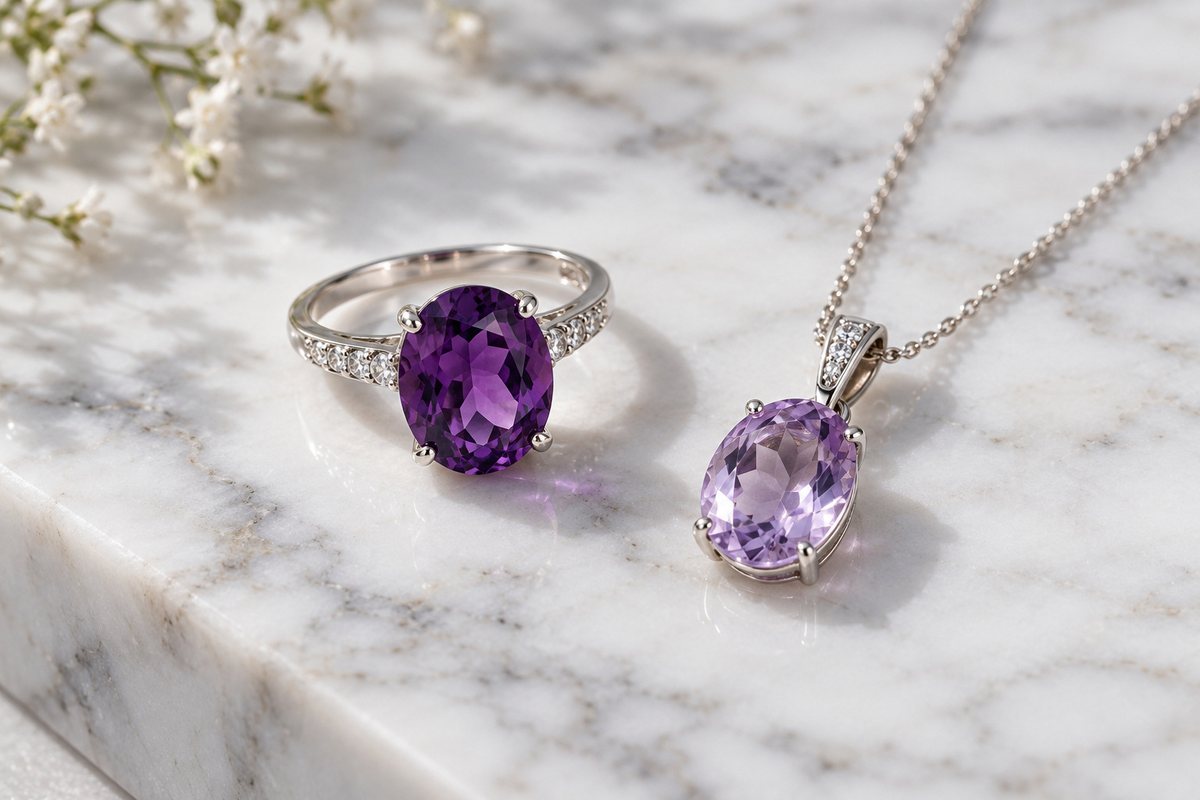
The February birthstone is amethyst, the purple variety of quartz. It ranges from pale lilac to deep royal purple, and GIA describes the finest colour as a strong reddish purple to purple with no visible colour zoning. At 7 on the Mohs scale, amethyst suits everyday jewellery, and because its price per carat does not rise sharply with size, it is one of the best-value ways to wear a large, rich-coloured gem.
This guide includes a few product links near the end. As an Amazon Associate, Diamond Taire earns from qualifying purchases, at no extra cost to you.
This guide explains how amethyst colour is judged, what trade names such as “Siberian” and “Rose de France” really mean, why some amethyst fades, how amethyst relates to citrine, what lab-grown amethyst is, how durable it is in a ring, and how to buy and care for a February birthstone without regret.
At a glance
- What is February’s birthstone? Amethyst, the purple variety of quartz. It is February’s only birthstone on the standard modern list.
- Best colour: strong reddish purple to purple, even across the stone, without brown tints or obvious zoning.
- Fading: GIA notes that some amethyst can fade with prolonged exposure to intense light.
- Lab-grown amethyst has existed since the 1970s and has the same properties as natural; separating them often needs advanced testing.
- Value: colour drives price far more than size. Pale stones are inexpensive; saturated, evenly coloured stones cost more.
What is the February birthstone?
Amethyst has been the February birthstone since the first standard list was adopted in 1912 by the National Association of Jewelers, now Jewelers of America, and it has stayed in place through every later revision. Unlike March, August or October, February has just one modern birthstone.
GIA explains that the name comes from the Greek amethystos, meaning “a remedy against drunkenness”, and that the early Greeks linked the stone with Bacchus, god of wine, because of its wine-like colour. Those beliefs are part of amethyst’s story, but they are folklore, not a reason to buy. Amethyst is also the traditional gem for the sixth wedding anniversary.
Historically, Russia was the main source until large deposits were found in Brazil in the 19th century. GIA notes that the main sources today are in South America and Africa, including Bolivia’s Anahí mine and Zambia’s Kariba mine, with the Four Peaks mine in Arizona also producing dark purple to purplish red crystals.
February birthstone colour: what to look for
Amethyst can be cool and bluish purple or a warmer reddish purple that GIA says is sometimes called “raspberry”. It runs from light lilac to deep royal purple and from brownish to vivid. Three things decide how good a colour is.
1. Saturation and tone
GIA notes that dealers prefer strongly saturated reddish purple to dark purple, as long as the stone stays bright. Paler colours cost less. Go too dark, though, and an amethyst can look almost black under dim lighting, so always check a stone indoors as well as in daylight.
2. Brown or bronze tints
According to GIA, brownish or bronze tints can lower value dramatically. The ideal is purple with no muddiness.
3. Colour zoning
Amethyst commonly shows colour zoning, usually angular bands of lighter and darker purple. GIA notes that visible zoning lowers value, and that dealers check for it by placing loose stones table-down on a white surface. A well-cut stone can hide mild zoning face-up, which is why you should judge the stone from the top as well as the side.
“Siberian” and “Rose de France” explained
You will often see amethyst described with trade names. They are colour descriptions used by sellers, not grades from an independent laboratory.
- “Siberian” is generally used for the deepest, most saturated purples. Russia was historically an important source, but the term is widely used today as a colour description rather than a promise of Russian origin.
- “Rose de France” is generally used for pale, pinkish lavender amethyst. It describes a colour, not a place or a special variety.
Because these names are not standardised, two sellers can use them differently. GIA notes that there is no standard grading scale for amethyst and that labels such as “AAA” are set by individual companies. Compare stones side by side rather than comparing names.
| Colour description | Typical look | Who it suits | Relative price |
|---|---|---|---|
| Pale lilac (often sold as “Rose de France”) | Soft, light pinkish lavender | Pastel and vintage-style jewellery, rose gold settings | Usually the most affordable |
| Medium purple | Clear, even mid-purple | Everyday pieces and gifts | Affordable to moderate |
| Strong reddish purple to purple | Rich, bright, even colour; GIA’s finest range | Centre stones, statement rings, heirloom pieces | Moderate to higher |
| Very dark purple (sometimes sold as “Siberian”) | Deep purple; can look black in dim light if too dark | Buyers who want maximum saturation and check it in low light first | Higher, if the stone stays bright |
| Brownish, zoned or patchy | Muddy or uneven purple | Beads, carvings, budget pieces | Low |
Prices change and vary widely by country, seller and setting, so treat these bands as a guide to relative value only.
Does amethyst fade?
Some amethyst can. GIA notes that prolonged exposure to intense light can fade the colour of some stones. This is not a reason to avoid amethyst, but it is a reason not to leave amethyst jewellery on a sunny windowsill or in a window display for long periods. Storing it in a box or drawer when not worn is a simple safeguard.
Heat is a separate risk. GIA advises that amethyst should not be subjected to heat, and that abrupt temperature changes can make it fracture. Tell your jeweller about any amethyst in a piece before resizing or repair work that involves a torch.
Heat treatment, citrine and “green amethyst”
GIA lists heat treatment as the most common treatment for amethyst. It can lighten very dark stones and remove some brownish tints, but it cannot darken a pale stone. GIA also notes that some amethyst turns yellow when heated, producing citrine; the change is permanent, but too much heat can make the stone more brittle or remove the colour entirely.
GIA also notes that light amethyst, and even light quartz, are sometimes dyed purple. Dyed stones need gentler cleaning and are worth much less, so ask directly whether a stone has been dyed if the colour looks unusually intense for the price.
You may also see green quartz sold as “green amethyst”. Because amethyst is by definition the purple variety of quartz, that label is misleading. Green quartz can be attractive and affordable, but it should be named and priced as green quartz, not amethyst.
Natural or lab-grown amethyst?
According to GIA, lab-created amethyst has been known since the 1970s and has the same chemical and physical properties as natural amethyst. Separating the two often requires advanced laboratory testing, and GIA notes that sellers are required to disclose whether a stone is natural or synthetic.
Lab-grown amethyst is a real quartz gem, not glass, and is an honest choice for a pretty piece at a low price. The issue is paying a natural price for it. For a significant purchase, GIA recommends an independent laboratory report to confirm the stone is natural.
Is amethyst durable enough for a ring?
Yes, with sensible expectations. GIA rates amethyst 7 on the Mohs scale with good toughness, so it suits all types of jewellery, including rings. It can be scratched by harder gems such as ruby, sapphire and diamond, and GIA notes that ordinary dust and sand, which are mostly quartz, can also scratch it. Over many years of daily wear, facet edges may soften and the stone may need repolishing.
A protective setting helps a daily ring last longer; the guide to ring settings explained shows which styles guard a stone best. For an engagement ring, the guide to the best gemstones for engagement rings compares amethyst with harder choices. Earrings and pendants avoid most knocks, and a slim amethyst pendant works well with other chains, as the guide to how to layer jewellery shows.
Who amethyst suits, and who it may not
A good fit if you want a large, richly coloured gem at a sensible price, love purple, or want a meaningful February birthstone that can be worn every day as earrings or a pendant.
Think twice if you want a ring that will look factory-fresh after decades of hard daily wear without any repolishing. A harder stone will hold its polish longer.
How to buy a February birthstone: checklist
- Choose your colour range first: pale lilac, medium purple or deep reddish purple.
- View the stone in daylight and indoor light. Make sure deep stones stay bright and do not turn black.
- Check for brown tints and visible zoning face-up and from the side.
- Judge the cut. GIA notes that well-cut amethyst reflects light evenly and that poorly cut gems sell at a discount.
- Ask whether it is natural or lab-grown, and get the answer in writing.
- Ask whether it has been heated or dyed.
- Do not pay extra for a trade name such as “Siberian” or for an origin claim alone. GIA’s buying guide notes that origin alone does not add value; colour is the most important factor.
- Consider going bigger. Because price per carat does not rise sharply with size, a larger amethyst is often affordable.
- Choose the metal: yellow gold warms reddish purples; white metals suit cooler, bluish purples; silver keeps costs low. See sterling silver gemstone jewellery and gold karats explained.
- Get a lab report for a valuable or very large stone.
How to clean and care for amethyst
GIA’s care guidance is straightforward. Warm, soapy water with a soft brush is always safe. Ultrasonic cleaners are usually safe, except for dyed or fracture-filled stones. Steam cleaning is not recommended. Keep amethyst away from heat and harsh chemicals, and store it out of strong sunlight. Store it separately from harder gems that can scratch it; the guide on how to store jewellery covers simple ways to do this.
Common mistakes
- Paying a premium for the word “Siberian” without comparing the actual colour side by side.
- Choosing the darkest stone without checking it in dim light, where it may look black.
- Ignoring brownish tints or zoning, which GIA says can lower value dramatically.
- Leaving amethyst in strong sunlight for long periods, which can fade some stones.
- Steam cleaning amethyst or exposing it to sudden temperature changes.
- Buying “green amethyst” at an amethyst price when it is green quartz.
- Paying a natural price for lab-grown amethyst, or assuming lab-grown means fake.
- Comparing “AAA” grades between sellers as if they were a shared standard.
More birthstone guides in this series: January birthstone: garnet and July birthstone: ruby.
Related guide: Purple Gemstones: How to Pick the Right One Without Regret.
Sources this guide draws on: GIA’s February birthstone page; GIA’s amethyst gem encyclopedia entry and description; GIA amethyst quality factors; GIA’s amethyst buying guide; GIA’s amethyst care and cleaning guide; published accounts of the 1912 National Association of Jewelers birthstone list.
February birthstone FAQs
What is February’s birthstone?
Amethyst, the purple variety of quartz. It is the only February birthstone on the standard modern list and has held that place since 1912.
What colour is the February birthstone?
Purple, from pale lilac to deep royal purple. GIA describes the finest colour as strong reddish purple to purple with no visible zoning.
Is amethyst expensive?
Usually not, compared with many coloured gems. Pale stones are inexpensive, and GIA notes that price per carat does not rise dramatically with size, so larger stones stay within reach. Prices change and vary by country and seller.
Does amethyst lose its colour?
Some amethyst can fade with prolonged exposure to intense light, according to GIA, and too much heat can remove colour. Store it away from strong sunlight and heat, and it should keep its colour for many years.
Can you wear an amethyst ring every day?
Yes. At 7 on the Mohs scale with good toughness, GIA considers amethyst suitable for all jewellery, including rings. Expect some wear over the years, and choose a protective setting for daily use.
How can I tell if my amethyst is real?
Home tests are not reliable, and lab-grown amethyst has the same properties as natural. A trained gemmologist can separate amethyst from glass and other purple stones, and an independent laboratory report is the best way to confirm natural origin.
Amethyst gives February a rich, wearable birthstone with real value for money. Choose the shade of purple you love, check it in more than one light, ask clear questions about treatment and origin, and keep it out of strong sun, and a February birthstone can be a beautiful gift that lasts for generations.
Useful tools for this guide
Practical picks for choosing, checking and caring for jewellery. As an Amazon Associate, Diamond Taire earns from qualifying purchases, at no extra cost to you. Prices and availability are set by Amazon and may vary by country.
- Gemstones of the World by Walter Schumann (5th edition)
A classic illustrated reference to more than 1,900 gemstones.
View on Amazon - Foldable 30x Jeweller’s Loupe
Pocket magnifier for checking stones, settings and hallmarks up close.
View on Amazon - KElofoN Travel Jewellery Case
Compact case with ring rolls and earring slots so pieces do not scratch each other.
View on Amazon