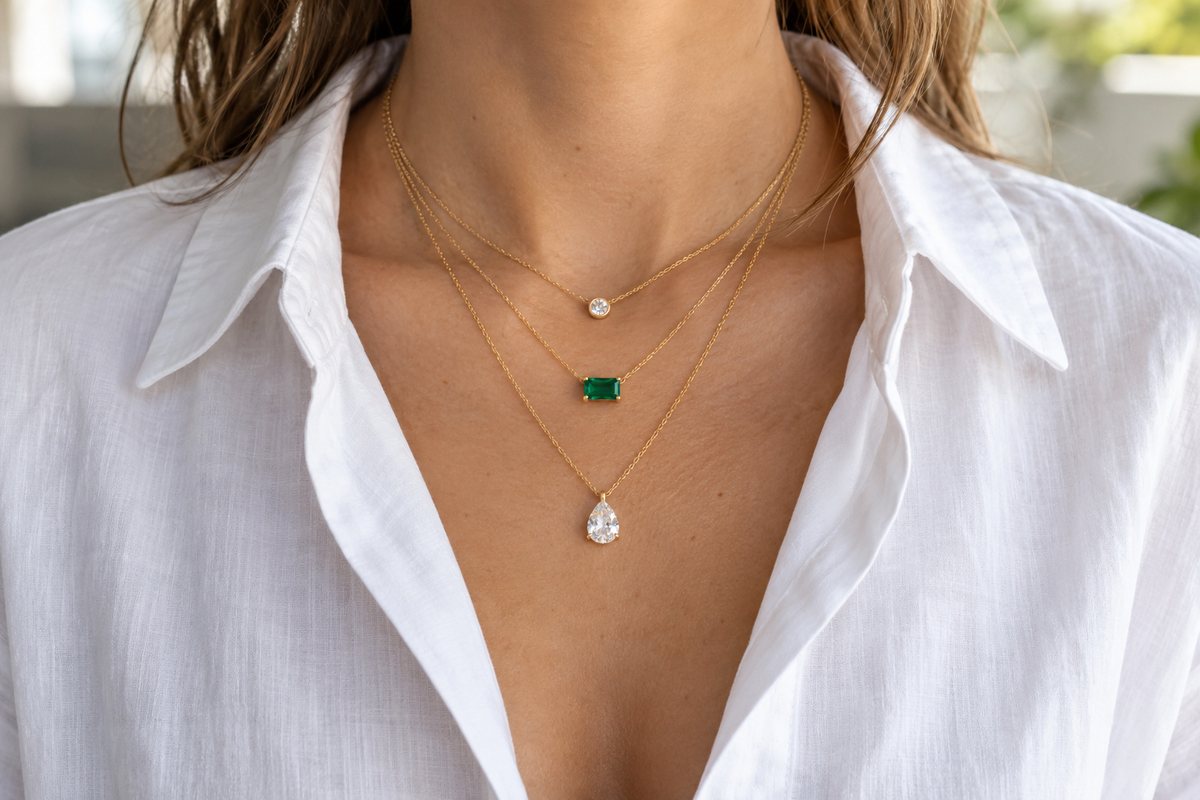
To layer jewellery well, choose pieces of clearly different lengths or sizes, keep a common thread such as metal colour or style, and give each piece its own space. For necklaces, that usually means starting with a short chain around 40 cm (16 inches), adding a longer one about 5 cm (2 inches) below it, and finishing with a pendant or longer chain, so every layer can be seen.
This guide includes a few product links near the end. As an Amazon Associate, Diamond Taire earns from qualifying purchases, at no extra cost to you.
This guide covers how to layer jewelry (or jewellery, as it is spelt outside the US) from neck to wrist: a necklace length chart in inches and centimetres, how to measure a necklace, which lengths suit which necklines, how to stop chains tangling, how to mix metals and textures, and how to layer rings, bracelets and earrings without damaging fine diamond pieces.
At a glance
- Space necklace layers about 5 cm (2 inches) apart so each one shows.
- Measure a necklace flat from end to end, including the clasp; a pendant adds extra drop.
- Vary chain weight and texture, with the finest chain highest and the heaviest or longest lowest.
- Pick one anchor piece, such as a diamond pendant, and build around it.
- Diamonds can scratch softer metals, gems and even each other, so stack fine pieces with care.
Necklace length chart
Necklace lengths are sold in standard sizes, and the trade names below are widely used. Where a length actually sits depends on your neck size, build and the weight of any pendant, so treat this as a starting guide. Centimetres are converted from inches and rounded.
| Length (inches) | Length (cm) | Common name | Where it usually sits | Works well with |
|---|---|---|---|---|
| 14 or less | 35 or less | Collar | High on the neck | Off-the-shoulder and V-necklines |
| 14 to 16 | 35 to 41 | Choker | Around the base of the neck | Scoop, strapless and open necklines |
| 18 | 46 | Princess | Just below the collarbone | Crew and boat necklines; the classic pendant length |
| 20 to 24 | 51 to 61 | Matinee | Around or just above the bust | Higher necklines and open-collar shirts |
| 24 to 30 | 61 to 76 | Opera | Below the bust | Turtlenecks and evening wear |
| Over 30 | Over 76 | Rope | Mid-torso or lower; can be doubled | Simple tops and dresses |
An 18-inch (46 cm) chain is the most common everyday length for many women. On a larger neck, or on most men, the same chain will sit noticeably higher, which is why measuring yourself matters.
How to measure necklace length
Measuring a necklace you already own
- Undo the clasp and lay the necklace flat in a straight line.
- Measure from one end to the other, including the clasp, with a ruler or tape.
- If it has a pendant, measure the pendant’s drop separately. A pendant typically adds anywhere from about 1 cm to several centimetres to how low the necklace hangs, and a heavier pendant can pull the chain lower.
Measuring yourself
- Wrap a piece of string or a soft tape where you want the necklace to sit.
- Adjust until it lies comfortably without pulling, then mark where the ends meet.
- Lay the string flat and measure it. That is your target chain length.
- Repeat for each layer you are planning, so you know your real spacing before buying.
Chains with an extender, or adjustable slider chains, make it much easier to fine-tune spacing in a layered look.
How to stack necklaces step by step
- Choose an anchor. Start with the piece you most want to show, often a pendant. Our diamond pendant guide covers how to choose one.
- Set your lengths. A simple three-layer set is 16, 18 and 20 inches (about 41, 46 and 51 cm). Two layers can be 16 and 20 inches for a more open gap.
- Keep about 5 cm between layers. Closer than that and chains crowd and tangle; further and the look can feel disconnected.
- Grade the weight. Put the finest chain at the top and heavier, longer or pendant pieces lower. Heavier chains lower down help hold their place.
- Vary the texture. Mix a fine cable chain with a paperclip, rope or bead chain so the layers read separately.
- Limit focal points. One or two pendants usually look better than three competing ones.
- Check in a mirror and in movement. Walk around, sit, lean forward. Adjust lengths if chains drift together.
Necklines and layering
| Neckline | Layering approach | Lengths to try |
|---|---|---|
| V-neck | Follow the V with graduated chains, a pendant at the lowest point | 16, 18, 20 inches |
| Scoop or square | Keep layers inside the neckline | 14 to 18 inches |
| Crew | Sit layers just above or well below the neckline, not on it | 16 to 18 inches, or 24 inches and longer over the top |
| Strapless or off-shoulder | Shorter, finer layers to frame the collarbone | 14 to 18 inches |
| Turtleneck or high neck | Wear layers over the fabric, longer and bolder | 24 to 36 inches |
| Button-down shirt | Short layers at an open collar, or long chains over a buttoned shirt | 16 to 18 inches open; 24 inches and longer closed |
How to stop layered necklaces tangling
- Keep at least 5 cm between lengths; most tangling happens when chains are too close.
- Mix chain weights, as two very fine chains of similar length tend to twist together.
- Use a heavier pendant or chain on the lowest layer to keep it settled.
- A layering clasp or connector, which holds several chains at the back, can help keep them in order.
- Put the necklaces on one at a time, shortest first, and take them off in reverse.
- Store each chain separately, fastened, so they do not knot in the drawer. Our guide to storing jewellery has more ideas.
Mixing metals and textures
Mixing yellow, white and rose metals is a widely accepted style today. It looks deliberate when there is a link between pieces: a two-tone piece that bridges the colours, a repeated texture, or a balance such as two yellow pieces and one white. If you prefer a single metal, vary texture instead, for example a smooth snake chain with a twisted rope chain.
Durability matters too. Plated and vermeil pieces wear differently from solid gold when they rub together; our comparison of gold vermeil and gold filled explains the difference, and the gold karat guide covers how karat affects hardness and colour.
Layering rings, bracelets and earrings
Rings
Ring stacks work on the same principles as necklaces: an anchor ring, contrasting widths and textures, and space for comfort. Stack on one finger or spread across several. Bands that will be worn against an engagement ring for life are covered in our guide to matching and stacking wedding bands, and our full vs half eternity ring guide explains why half eternity bands can be easier to size and stack.
Bracelets
Mix a watch or bangle with finer chain bracelets, and aim for three to five pieces of different widths. Heavier pieces sit nearer the hand. Be aware that a metal watch and diamond bracelets worn together can rub and mark each other.
Earrings
Ear stacks pair a larger piece in the main lobe with smaller studs, hoops or cuffs above. Keep the largest or most sparkling piece lowest and scale down as you go up the ear.
Layering fine diamond pieces safely
Diamond is the hardest natural material, which is exactly why layering needs care. A diamond rubbing against a softer gemstone, a gold band or a pearl can scratch it, and diamonds can scratch one another.
- Keep diamond tennis bracelets and eternity bands from grinding against softer metals and gems during long wear.
- Do not layer pearls tightly against diamond chains; see our guide to wearing pearls and diamonds together.
- Check prongs regularly on stacked rings, as constant contact can wear metal.
- Take layered pieces off for sport, gardening and cleaning to avoid catching chains.
- Store diamond pieces apart from everything else.
A worked example: building a three-layer necklace stack
Imagine someone who owns one 18-inch (46 cm) diamond solitaire pendant and wants to turn it into a layered look for work and weekends.
- Measure first. With string, they find the pendant sits just below the collarbone, as expected for an 18-inch chain on their neck.
- Add a shorter layer. A plain, fine 16-inch (41 cm) chain sits about 5 cm above the pendant. Because it is plain, the diamond stays the star.
- Add a longer layer. A slightly heavier 20 or 22-inch (51 or 56 cm) chain with a different texture, such as a paperclip link, sits below the pendant and anchors the stack.
- Test it. They wear it for a day. If the pendant and long chain drift together, they swap the long chain for a 22-inch or add an extender to the top chain.
- Adapt it. For a crew-neck jumper, they drop the top chain and wear the pendant with a 24-inch chain over the fabric instead.
The result is three pieces that work in at least two combinations, built around something they already own, and only one new purchase needs to be made at a time.
Questions to ask before buying layering pieces
- What is the exact chain length, and is the clasp included in that figure?
- Does the chain have an extender or adjustable slider?
- What is the metal, and is it solid, plated, vermeil or filled?
- Is the clasp strong enough for daily wear, and is it easy to fasten alone?
- Will the chain fit through the bail of a pendant I already own?
- Can the length be shortened or extended later if my stack changes?
Common mistakes
- Layers too close together. Similar lengths blur into one and tangle.
- All the same chain. Without contrast in weight or texture, a stack looks like one heavy chain.
- Too many focal points. Several pendants compete; choose one star.
- Buying lengths by guesswork. Measure yourself first, especially if standard lengths sit high on you.
- Ignoring the neckline. A chain that sits right on a neckline edge looks accidental.
- Stacking fine pieces carelessly. Diamonds rubbing on softer metals and gems cause slow damage.
- Buying a whole set at once. Layering looks most personal when built over time; our guide to building a jewellery collection that lasts shows how.
Related guide: What Is Permanent Jewellery? How to Choose It Without Regret.
Sources this guide draws on: standard jewellery trade necklace length charts and length names; jewellery retailer measuring guidance for chains and pendants; common jewellery care guidance on diamond hardness and storage.
Useful tools for this guide
Practical picks for choosing, checking and caring for jewellery. As an Amazon Associate, Diamond Taire earns from qualifying purchases, at no extra cost to you. Prices and availability are set by Amazon and may vary by country.
- CONNOISSEURS Premium Jewellery Cleaner
Gentle dip cleaner with a brush and tray for diamonds, gold and platinum. Check the label for stones it should not be used on.
View on Amazon - Foldable 30x Jeweller’s Loupe
Pocket magnifier for checking stones, settings and hallmarks up close.
View on Amazon - KElofoN Travel Jewellery Case
Compact case with ring rolls and earring slots so pieces do not scratch each other.
View on Amazon
Frequently asked questions
How do you measure the length of a necklace?
Lay it flat and measure from end to end, including the clasp. If there is a pendant, measure its drop separately, because it will make the necklace hang lower than the chain length alone.
What lengths should I use to layer necklaces?
A reliable starting set is 16, 18 and 20 inches (about 41, 46 and 51 cm). Keep roughly 5 cm between each layer and adjust for your neck size and neckline.
How many necklaces should I layer?
Two or three is easiest to wear every day. Four or more can work with very fine chains and plenty of spacing, but the risk of tangling rises.
Can you mix gold and silver when layering?
Yes, mixed metals are widely worn. It looks most intentional when something links the pieces, such as a two-tone piece, a repeated texture or a balanced number of each colour.
How do I choose a pendant for layering?
Pick a pendant that suits the length it will hang on, usually 18 inches or longer, and let it be the focal point. Keep other layers finer so the pendant stands out, and check it will not knock against other pieces.
Is it safe to layer diamond jewellery?
It can be, with care. Diamonds can scratch softer metals, pearls and other gems, and each other, so give fine pieces space, check settings regularly and store them separately.
Layering is less about rules than about rhythm: clear spacing, contrast and one piece that leads. Measure once, build slowly and your stack will feel like yours rather than a set.