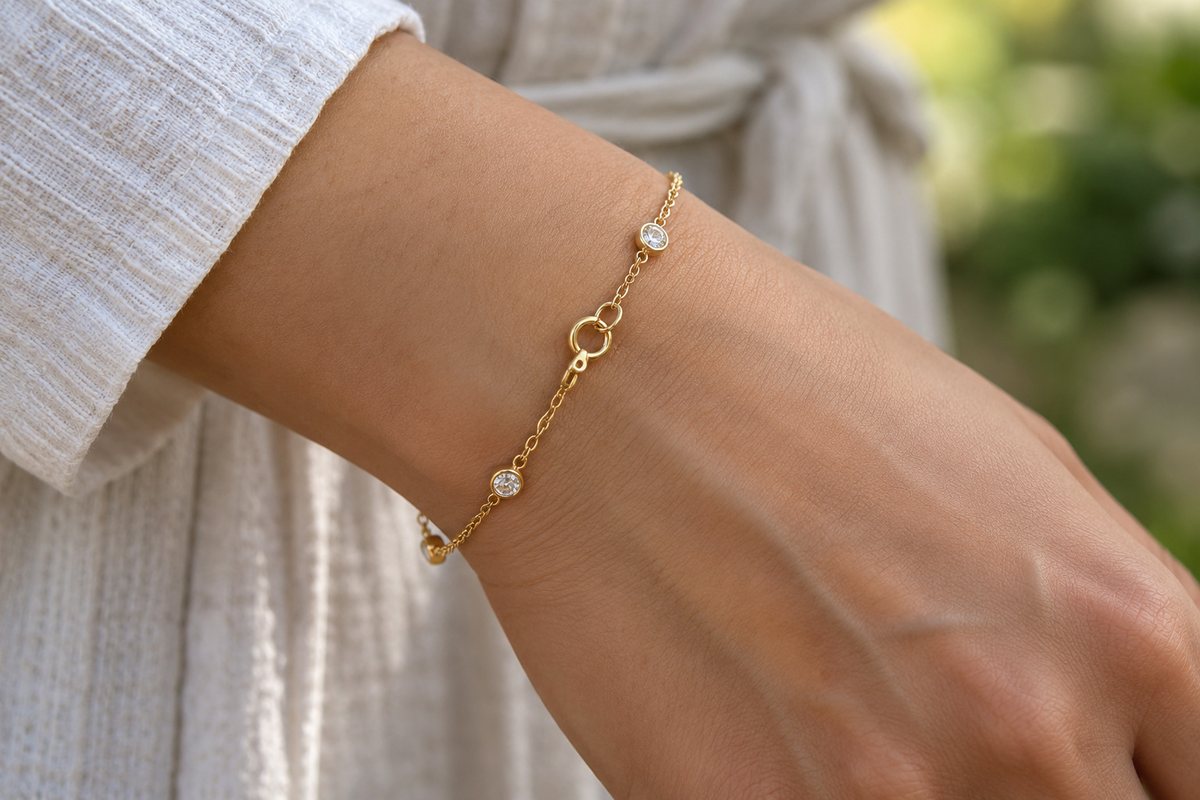
Permanent jewellery is a fine chain, usually a bracelet, that is fitted to your wrist, ankle or neck and closed with a tiny weld instead of a clasp, so you wear it day and night. It is not truly permanent: it can be cut off in seconds with small clippers and often re-welded later. What matters most is the chain’s metal, because it will be on your skin around the clock.
This guide includes a few product links near the end. As an Amazon Associate, Diamond Taire earns from qualifying purchases, at no extra cost to you.
This guide explains how the welding works, how solid gold, gold-filled and sterling silver chains compare for constant wear, what it typically costs, how to remove it safely (including before an MRI or surgery), what to know about skin and allergies, and what to ask a studio before you book.
At a glance
- How it works: a jump ring links the chain ends and is closed with a small, low-heat weld, usually in a few minutes.
- Best for 24/7 wear: solid gold (often 14 carat) lasts longest; gold-filled is a durable mid-price option; sterling silver is affordable but tarnishes.
- Typical cost: at the time of writing (October 2026), studio price lists checked for this guide put silver and gold-filled bracelets at roughly 70 to 160 in local currency, and solid gold from about 150 to 550, depending on chain and country. Prices change.
- Removal: snip the jump ring with clippers or small scissors; keep the chain so it can be re-welded.
- MRI: take it off. Radiology departments ask for all jewellery to be removed, and loop-shaped pieces carry the highest burn risk.
What is permanent jewellery?
Permanent jewellery is a clasp-free chain measured to fit and then closed directly on your body. Bracelets are by far the most popular, but studios also make anklets, necklaces and rings the same way. People choose it for the low-maintenance feel of a piece they never have to take on and off, and often to mark a friendship, relationship or milestone, with friends or family getting matching chains together.
The word “permanent” describes how it is closed, not how long it lasts. There is no lock and nothing you cannot undo; you simply cannot unclasp it the way you would a normal bracelet.
How permanent jewellery is welded
The process is quick and, done properly, painless. Equipment suppliers to the industry describe the steps like this:
- Choose a chain. You pick the chain style and metal from the studio’s range.
- Measure the fit. The chain is wrapped around your wrist and cut to size. Most people want room for about one finger underneath.
- Add the jump ring. A small open ring links the two ends of the chain.
- Protect the skin. A small leather or similar patch is placed between your skin and the ring.
- Weld. The jeweller pinches the ring closed with pliers and touches it with a micro welder, which creates a very small, brief spark. Many use argon gas for a cleaner weld. You should look away or wear the eye protection offered.
- Finish. The weld is cleaned and checked. The whole appointment typically takes around ten minutes per piece.
You may feel a faint warmth or nothing at all. The weld is on the jump ring, not the chain itself, which is why removing and re-welding is easy.
Solid gold vs gold-filled vs sterling silver for 24/7 wear
This is the decision that matters most, and the one most studio menus explain least.
What the labels legally mean
In the United States, the Federal Trade Commission’s Jewelry Guides define the main terms:
- Gold-filled: a base metal with a layer of gold alloy of at least 10 carat bonded to it, where the gold layer makes up at least one twentieth of the item’s total metal weight. That is why you see markings such as “1/20 14K GF”.
- Gold electroplate: a much thinner layer, with a minimum of 0.175 microns of fine gold; “heavy gold electroplate” needs at least 2.5 microns.
- Vermeil: sterling silver plated with gold of at least 10 carat and at least 2.5 microns thick.
- Solid gold: the alloy is gold all the way through, labelled by karat (for example 14K or 585).
Rules and terms differ between countries, so if you are outside the US, ask the studio what the chain is made of, not just what it is called. Our guide to gold vermeil vs gold filled explains these layers in more depth.
| Metal | What it is | 24/7 wear | Watch for | Relative cost |
|---|---|---|---|---|
| 14K solid gold | Gold alloy all the way through | Best; does not wear through, keeps colour | Rose gold can darken a little from copper; white gold may be rhodium plated | Highest |
| Gold-filled | Thick gold layer (at least 1/20 by weight) over base metal | Good for years with care | Layer can eventually wear at friction points; base metal may affect sensitive skin | Mid |
| Sterling silver | 92.5% silver alloy | Fine, but tarnishes with sweat, pools and sea water | Darkening, softer chain links | Lowest |
| Gold plated | Thin gold layer | Poor; wears through quickly with constant wear | Discolouration, irritation | Low, but often a false economy |
For a piece you never take off, solid gold is the most reliable choice if your budget allows. Gold-filled is the sensible middle option. Silver suits you if you are happy to polish it now and then. Plated chains are generally not worth welding on. See how gold karats differ and whether gold tarnishes for more detail.
How much does permanent jewellery cost?
Most studios charge by the inch of chain, sometimes plus a welding fee, so larger wrists and anklets cost more. At the time of writing (October 2026), published price lists from three studios in different countries showed:
| Studio location | Sterling silver | Gold-filled | Solid gold |
|---|---|---|---|
| Brisbane, Australia (AUD) | 99 to 159 | 119 to 149 | 14K: 329 to 499 |
| Toronto, Canada (CAD, before tax) | About 70 to 100 | About 70 to 100 | 10K to 14K: 150 to 550 |
| Minneapolis, USA (USD) | Not offered | Not offered | 14K: 160 to 400 |
Prices change and vary by city and chain thickness, so use these as a rough guide only. Extras such as charms or gemstone links usually cost more, and re-welding after removal is often charged separately.
Is permanent jewellery worth it?
It is worth it if you want a simple chain you will genuinely wear every day and you choose a metal that will survive that. It is less good value if you buy a cheap plated chain that discolours within months, or if your work or hobbies mean you will need to cut it off often. Think of it as jewellery, not an investment: resale value is close to the scrap value of the metal.
How to remove permanent jewellery safely
Removing it is simple. Use small nail clippers, fine scissors or jewellery pliers to snip the jump ring, which is the small ring at the join. Cutting the ring rather than the chain keeps the chain intact, so a studio can usually re-weld it with a new ring. Keep the chain somewhere safe in a small bag.
MRI scans
Take it off before an MRI. Radiology departments, including the UCSF radiology department, ask patients to remove all jewellery, including gold, because metal can conduct electrical current during the scan and cause burns, and they note that circular or loop-shaped pieces carry the highest risk. A welded bracelet is exactly that shape. If you know an MRI is coming, some studios will remove it for you, or you can cut the jump ring yourself.
Surgery, X-rays and hospital stays
Hospitals commonly ask for jewellery to be removed before surgery and some imaging, and staff may need to cut it off in an emergency. Follow the instructions you are given, and do not refuse removal for the sake of a chain that can be re-welded.
Airport security and work rules
Airport screening is not the same as an MRI. Everyday jewellery is not usually something you are asked to remove, but rules and scanners vary by country and airport, and officers may ask for additional screening if a scanner alerts. Some workplaces, such as food production, health care or jobs around machinery, have rules against wearing jewellery, so check yours before you book.
Skin and allergy questions
Because the chain never comes off, small irritations can build up.
- Known metal allergy: if you react to nickel or other metals, ask exactly which alloy the chain and jump ring are made of, and whether the gold-filled base metal or white gold contains nickel. Solid yellow gold is often the easiest option for sensitive skin.
- Green or dark marks: copper in rose gold, silver and some base metals can react with sweat, lotions and chlorine.
- Trapped moisture and lotion: wash under the chain with mild soap and water and dry it well.
- Snagging: fine chains can catch on clothing or hair; a looser fit can make this worse, a tight one less comfortable.
If you develop a rash, redness or swelling under the chain, take it off and get advice from a pharmacist or doctor.
Questions to ask the studio before you book
- What exactly is the chain and jump ring made of, and how is it marked?
- Is the gold-filled chain at least 1/20 by weight, and which karat is the gold layer?
- Do you charge per inch, a flat price or a welding fee?
- What eye and skin protection do you use during welding?
- What is your re-weld fee if I need it removed?
- What happens if the chain breaks soon after welding?
- Do you offer solid gold for sensitive skin?
- Can I see the chain under the light before it is cut?
If you are weighing how a welded chain fits with your other pieces, our guide on how to layer jewellery covers mixing chains and bracelets, and how to tell if jewellery is real gold explains what markings mean.
Common mistakes
- Choosing plated chain for constant wear. A thin plating wears through fast. Pay for gold-filled or solid gold, or choose silver.
- Getting it too tight. Wrists swell in heat and during the day. Leave room for a finger.
- Cutting the chain instead of the jump ring. Snip the small ring so the chain can be reused.
- Forgetting about scans and surgery. Plan to remove it before an MRI; it can be re-welded later.
- Ignoring allergies. Ask about alloy content before welding, not after a rash.
- Assuming “permanent” means it will never break. Fine chains can snap if caught hard; that is a safety feature as much as a weakness.
Sources this guide draws on: US Federal Trade Commission Guides for the Jewelry, Precious Metals and Pewter Industries; UCSF Radiology MRI safety guidance for patients; SingHealth patient information on MRI preparation; a welding equipment supplier’s guide to the permanent jewellery process; published price lists from permanent jewellery studios in Australia, Canada and the United States, checked in October 2026.
Permanent jewellery FAQs
Does permanent jewellery hurt?
It should not. The spark is tiny and brief, and a protective patch sits between the ring and your skin. Most people feel nothing or only faint warmth.
Can you shower and swim with permanent jewellery?
Yes, solid gold and gold-filled chains handle daily showering well. Chlorine, hot tubs and salt water can dull or darken some metals, especially silver and rose gold, so rinse with fresh water afterwards.
How long does permanent jewellery last?
Solid gold can last for many years with occasional cleaning. Gold-filled typically lasts years before any wear shows. Sterling silver lasts but needs polishing, and thin plated chains may discolour within months of constant wear.
Is gold-filled or solid gold better for permanent jewellery?
Solid gold is better for lifelong wear and sensitive skin, because it is the same metal throughout. Gold-filled is a good, lower-cost option with a thick gold layer, but it can eventually wear at the points that rub most.
Can permanent jewellery be put back on after removal?
Usually, yes. If the jump ring was cut and the chain kept, a studio can add a new ring and weld it closed again, often for a small fee.
Before you book
Permanent jewellery is a simple idea done well when the chain is the right metal, the fit is comfortable and you know how to take it off when you need to. Choose solid gold or gold-filled for true everyday wear, ask the studio the questions above, and keep a pair of small clippers in mind for scan days.
Useful tools for this guide
Practical picks for choosing, checking and caring for jewellery. As an Amazon Associate, Diamond Taire earns from qualifying purchases, at no extra cost to you. Prices and availability are set by Amazon and may vary by country.
- KElofoN Travel Jewellery Case
Compact case with ring rolls and earring slots so pieces do not scratch each other.
View on Amazon - CONNOISSEURS Premium Jewellery Cleaner
Gentle dip cleaner with a brush and tray for diamonds, gold and platinum. Check the label for stones it should not be used on.
View on Amazon - Sunshine Polishing Cloths (5 Pack)
Pre-treated cloths that lift tarnish from sterling silver, gold and brass.
View on Amazon