Pure gold does not tarnish, because gold itself barely reacts with air, water or sweat. Gold jewellery can tarnish, though, because most of it is an alloy, and the copper and silver mixed in can darken over time. The lower the karat, the more of those metals there are, so 9K and 10K gold discolour more readily than 18K, and gold-plated pieces can look tarnished simply because the thin gold layer has worn away.
This article contains affiliate links. As an Amazon Associate I earn from qualifying purchases, at no extra cost to you. Affiliate disclosure.
This guide gives a karat-by-karat answer, explains what is really happening when gold darkens or marks your skin, shows how to tell tarnish from worn plating, and sets out safe ways to clean and store gold so it stays bright.
At a glance
- 24K gold is essentially tarnish-proof; it is also soft and scratches easily.
- 18K, 14K, 10K and 9K can develop a dull or dark film, with lower karats more prone because they contain more copper and silver.
- Plated, vermeil and gold-filled pieces behave differently: once the gold layer wears through, the metal underneath shows and may tarnish.
- Tarnish wipes off; worn plating does not. A polishing cloth removes tarnish, but it will only make worn plating worse.
- Prevention is simple: take jewellery off for swimming, cleaning and showering, wipe it after wear and store it dry and separately.
Why gold itself does not tarnish but gold jewellery can
Tarnish is a thin layer of corrosion that forms when a metal reacts with its surroundings. Gold is one of the least reactive metals there is, which is why ancient gold objects are often found still shining. The metals alloyed with it are a different story. Silver reacts with sulphur compounds in the air (from sources such as eggs, wool, rubber and some pollution) to form black silver sulphide, the same film you see on old cutlery. Copper forms darker oxides and sulphides and can produce green compounds when exposed to moisture and salt.
So the question is never really “does gold tarnish?” but “how much non-gold metal is in this piece, and is it exposed?” According to the World Gold Council, typical alloys use silver and copper for yellow gold, copper (with some silver at lower karats) for rose gold, and palladium or silver for white gold, with zinc in some formulations.
Does gold tarnish? Karat by karat
| Type | Gold content | Tarnish risk | What usually happens |
|---|---|---|---|
| 24K | Pure gold (99.9%) | Very low | Stays bright; scratches and dents easily |
| 22K | About 91.7% | Very low | Rarely darkens; still soft for rings |
| 18K | 75% | Low | May dull slightly with skin oils and lotions; cleans up easily |
| 14K | About 58.3% to 58.5% | Low to moderate | Can develop a faint film, especially with sweat, chlorine or perfume |
| 10K | About 41.7% | Moderate | More likely to darken or leave marks on some people’s skin |
| 9K | 37.5% | Moderate | Similar to 10K; very common in the UK and parts of Europe |
| Gold-plated | Very thin gold layer over another metal | High once worn | Base metal shows through at edges and contact points |
| Gold vermeil | Thicker gold layer over sterling silver | Moderate once worn | Silver underneath can tarnish dark where the gold wears |
| Gold-filled | Bonded layer, at least 1/20 of total weight | Low to moderate | Layer is thick enough to last years with care |
Gold percentages follow the World Gold Council’s figures. Legal minimums for what can be sold as “gold” differ by country: the World Gold Council notes 10K is the US minimum, 9K is the minimum in countries including the UK, Ireland and France, and 8K is allowed in Denmark and Greece. For help choosing a karat for everyday wear, see how to choose the right gold karat.
Does 14K gold tarnish?
Solid 14K gold can lose some shine or develop a faint film, but it does not usually turn black the way silver does. Most dullness on 14K comes from skin oils, soap residue, lotion and hairspray rather than true corrosion, and a gentle wash brings it back.
Does 18K gold tarnish?
Rarely. With three-quarters gold, 18K has the least exposed alloy metal of the common karats used for rings. Any dullness is usually surface grime. The trade-off is that 18K is softer than 14K, so it scratches more readily.
Does 10K gold tarnish?
It is the most likely of the solid golds to darken, because well over half of it is other metals. It is still a durable, practical choice for many people; it simply benefits from more regular cleaning.
Does white gold tarnish?
The gold alloy itself behaves much like yellow gold of the same karat. What changes over time is the bright white finish, which usually comes from rhodium plating. GIA notes that as rhodium wears, white gold can look warmer or slightly yellow, and it may need re-plating every few years. That is wear, not tarnish. The site’s guide to white gold explains the plating in more detail.
Plated, vermeil and gold-filled: what the labels mean
Much “gold” jewellery is not solid gold, and the wording matters. In the United States, the Federal Trade Commission’s Jewelry Guides set out how these terms should be used:
- Gold electroplate needs a gold layer of at least 10K and at least 0.175 microns thick. “Heavy gold electroplate” needs at least 2.5 microns.
- Gold vermeil means sterling silver coated on all significant surfaces with gold of at least 10K and at least 2.5 microns thick.
- Gold-filled means a layer of at least 10K gold bonded to a base metal, making up at least 1/20 of the item’s total metal weight. Rolled gold plate can use a thinner layer (at least 1/40) if labelled as such.
Other countries use different rules. In the UK, for example, articles over small exemption weights must be hallmarked by an assay office before they can be described as gold, silver or platinum. If you are unsure what you own, the comparison in Gold Vermeil vs Gold Filled covers the differences, and how to tell if jewellery is real gold walks through safe checks.
Tarnish or worn plating? How to tell
| Clue | Tarnish | Worn plating |
|---|---|---|
| Colour | Even darkening, dull brown, grey or black film | Patches of a different metal colour: silvery, pinkish, coppery or grey |
| Where it shows | Often in recesses and crevices first | High-wear spots: ring undersides, clasp edges, raised details |
| Polishing cloth test | Black comes off on the cloth and shine returns | No improvement; polishing may wear more gold away |
| Fix | Gentle cleaning | Re-plating by a jeweller, or accepting the change |
Why gold can mark your skin green or black
A green ring around the finger usually comes from copper in the alloy, or in the base metal under plating, reacting with sweat and moisture. Dark grey or black marks have a few likely causes. Metal oxides and sulphides formed from copper or silver are often black. Gold is also soft, so tiny metal particles can rub off, and some people find marks appear mainly where make-up or lotion is in contact with the jewellery, though this explanation is debated. Sweat, salt and the body’s own chemistry make some people more prone than others.
A rash or itch is different. That is a skin reaction, most often linked to nickel in some white gold or base-metal alloys. GIA suggests palladium-based white gold, nickel-free yellow or rose gold, or platinum for sensitive skin. If you have a persistent reaction, speak to a doctor or pharmacist.
How to clean tarnished gold safely
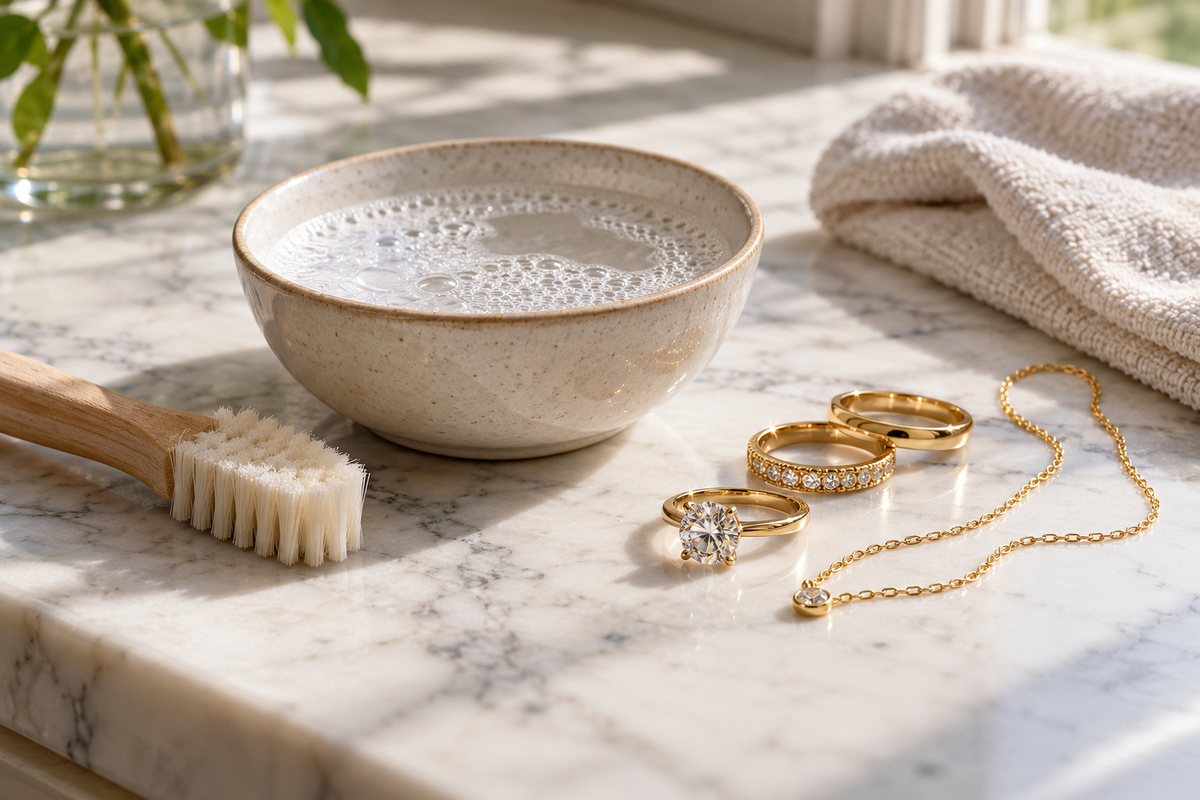
- Fill a bowl with warm (not hot) water and add a few drops of mild washing-up liquid.
- Soak solid gold for 10 to 15 minutes; give plated or vermeil pieces just a few minutes.
- Brush gently with a very soft toothbrush, paying attention to crevices and the backs of settings.
- Rinse in clean water (put the plug in or use a strainer).
- Pat dry with a lint-free cloth and let it air-dry fully before storing.
- Buff solid gold with a jewellery polishing cloth. Use only light pressure, or skip this step, on plated items.
- If darkening remains on solid gold, a jeweller can professionally clean and polish it.
If the piece is set with diamonds or other stones, check that the cleaning method suits them too. The site’s diamond care guide covers what is safe for set stones.
How to prevent gold from tarnishing
- Take jewellery off before swimming in pools or hot tubs; chlorine can damage gold alloys over time.
- Remove it for cleaning with household chemicals, including bleach.
- Put jewellery on after perfume, hairspray, sunscreen and lotion have dried.
- Wipe pieces with a soft cloth after wearing to remove sweat and oils.
- Store each piece separately in a dry, closed pouch or lined box.
- For silver-based pieces like vermeil, or low-karat gold, anti-tarnish bags or strips designed to absorb sulphur gases can help.
- Keep jewellery out of humid bathrooms when you can.
For storage ideas that also stop scratching and tangling, see how to store jewellery so it stays beautiful.
Our picks on Amazon: gentle gold care
Simple tools for the safe cleaning steps above.
- Weiman Fine Jewelry Cleaner with Brush: a liquid cleaner with a soft brush for settings.
- Sunshine Polishing Cloths: treated cloths for a quick shine on solid gold (avoid using on plated pieces).
Prices and availability change. For valuable, antique or sentimental pieces, ask a professional jeweller before cleaning or treating them.
Common mistakes
- Polishing plated jewellery hard. Abrasive cloths and creams remove the thin gold layer faster.
- Using toothpaste or baking soda pastes. These are abrasive and can scratch soft gold.
- Using silver dips on gold. Products made for silver can be harsh on other metals and on gemstones.
- Wearing gold in chlorinated water. Repeated exposure can weaken and discolour alloys.
- Ultrasonic cleaning plated or fragile pieces. Vibration can loosen stones and stress worn plating.
- Assuming darkening means fake. Real 9K or 10K gold can darken; a hallmark and a jeweller’s test are better guides than colour alone.
Sources this guide draws on: World Gold Council guidance on gold jewellery alloys and karat purity; US Federal Trade Commission Guides for the Jewelry, Precious Metals, and Pewter Industries (16 CFR Part 23); GIA guidance on ring metals for everyday wear; UK assay office hallmarking guidance; general chemistry references on silver and copper sulphide tarnish.
Frequently asked questions
Can real gold tarnish?
Pure 24K gold does not tarnish. Real gold alloys such as 14K, 10K and 9K can, because the copper and silver mixed in can react with sulphur, moisture and chemicals. Lower karats are more prone.
Will 14K gold tarnish if I wear it every day?
Solid 14K gold can lose some shine and pick up a light film, but it rarely tarnishes badly. Regular wiping and an occasional wash in warm soapy water usually keep it bright. Gold-plated items labelled “14K” behave differently once the plating wears.
Does gold tarnish in the shower?
Water alone does not harm solid gold, but soap and shampoo leave a dulling film, and hot water and products speed wear on plated pieces. Taking jewellery off for showers keeps it brighter for longer.
Do anti-tarnish bags work for gold?
They are most useful for silver and silver-based pieces like vermeil, and can help low-karat gold. They work by absorbing the sulphur-containing gases that cause tarnish. High-karat gold needs little more than dry, separate storage.
Can tarnished gold be restored?
Yes, if it is solid gold: gentle cleaning removes most tarnish, and a jeweller can polish it professionally. If the problem is worn plating, the only real fix is re-plating.
Why does my gold ring turn my finger black?
Usually because of the other metals in the alloy forming dark compounds with sweat, or because of tiny particles rubbing off soft gold. Keeping the ring and skin clean and dry often helps. If you notice irritation, see a doctor or pharmacist.
Solid gold is one of the most forgiving metals you can wear, and most dullness comes off with warm water and a soft brush. Know your karat and whether a piece is plated, and you will know exactly how much care it needs.