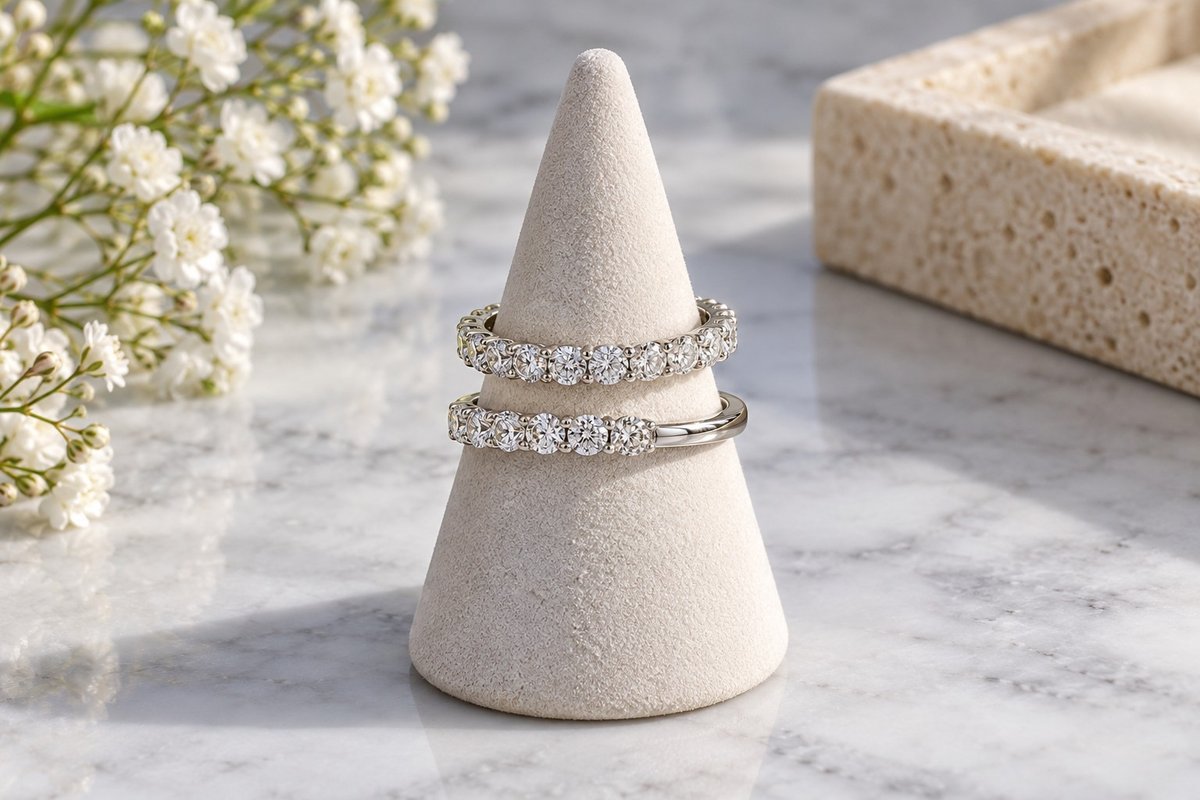
A full eternity ring has stones set all the way around the band; a half eternity ring has stones across the top only, with plain metal underneath. Full eternity gives unbroken sparkle from every angle but is difficult or impossible to resize and puts stones on the palm side where they take knocks. Half eternity is usually more comfortable, more affordable for the same stones, and can be resized like an ordinary band.
This guide includes a few product links near the end. As an Amazon Associate, Diamond Taire earns from qualifying purchases, at no extra cost to you.
This guide compares the two side by side, explains the main setting styles and how stones are matched, covers wear and comfort in daily life, and describes, without inventing customs, the occasions when people commonly give an eternity ring.
At a glance
- Full eternity: continuous stones, the most sparkle, but made to one size with very little or no room for resizing later.
- Half eternity: stones across the visible top, a plain shank that can be resized, and fewer stones to buy, match and maintain.
- Three-quarter eternity is a middle option: stones most of the way round, with a short plain section for resizing.
- Setting style (shared prong, channel, bezel and others) affects sparkle, security, comfort and how easily stones snag.
- There is no single rule about when to give one; anniversaries and family milestones are common occasions in many places.
Full vs half eternity: the comparison
| Factor | Full eternity | Half eternity |
|---|---|---|
| Stone coverage | All the way round the band | Across the top, roughly the visible half |
| Look | Sparkle from every angle, even if the ring turns | Sparkle where it is seen; plain metal underneath |
| Resizing | Difficult or impossible; often means remaking | Usually possible through the plain shank, within limits |
| Comfort | Stones sit between the fingers; can rub, especially in wider bands | Smooth metal against the palm and between the fingers |
| Wear on stones | Stones on the palm side take knocks and abrasion | Stones sit on the top, where they are better protected |
| Number of stones | More, so more to match and check | Fewer |
| Cost for the same stone size and quality | Higher, because more stones and labour are involved | Lower |
| Stacking with an engagement ring | Works well; can feel bulkier | Works well; often slimmer under the hand |
| Best suited to | Stable ring size, lower-impact daily life, maximum sparkle | Everyday wear, changing ring size, active hands |
Resizing: the biggest practical difference
A normal ring is resized by cutting the band at the bottom, adding or removing a small piece of metal, and rejoining it. A full eternity ring has no plain metal to work with, so that method is not available. Stretching or compressing the band risks loosening stones and disturbing the setting. Most jewellers will make at most a very small adjustment, and many will not attempt it.
If a full eternity ring no longer fits, the usual options are:
- Sizing beads or an inner guard for a ring that is slightly loose. These are reversible but only suit small adjustments.
- A thin fitted liner inside the band, which reduces the size slightly.
- Remaking the ring at the new size, which can need extra matched stones and costs more than a normal resize.
Finger size changes over a lifetime and from season to season. Heat, pregnancy, weight changes, arthritis and age can all affect fit. That is the strongest argument for half or three-quarter eternity if there is any doubt. If you are choosing full eternity, take extra care with sizing: measure late in the day when fingers are larger, and at a comfortable temperature. The guide to ring sizing at home explains how to measure accurately. Half eternity bands can be resized, but large changes can still strain the stones nearest the plain section, so expect limits.
Setting styles for eternity rings
Eternity rings use the same basic setting methods as other diamond jewellery, arranged in a continuous line. Each style balances sparkle against security and comfort.
| Setting style | How it works | Strengths | Trade-offs |
|---|---|---|---|
| Shared prong | Each prong holds the edges of two neighbouring stones | Minimal metal, so maximum sparkle and light | Prongs can catch and wear; stones more exposed at the edges |
| Channel | Stones sit in a groove between two walls of metal | Smooth sides, low-snag, protective | Less light from the sides; a damaged wall can loosen several stones |
| Bezel | A rim of metal surrounds each stone | Very protective; smooth; modern look | More metal shows, so less sparkle; wider band for the stone size |
| Pavé or micro-pavé | Many small stones held by tiny beads of metal | Glittering surface; works on slim bands | Small stones can loosen and need regular checks |
| French or U-cut | Metal cut away in a V or U below each stone | Lets light in from the side; delicate look | Less metal around each stone |
The broader trade-offs between setting styles are covered in diamond ring settings explained. For a full eternity ring worn daily, channel and bezel settings are often chosen because they protect the stones on the palm side. For half eternity, shared prong is popular because the stones sit on top, where they are less exposed.
Stone matching and shape
An eternity ring looks its best when every stone appears the same. Matching covers:
- Size: stones are cut to closely matched diameters so the line looks even.
- Colour: a single stone that looks warmer or whiter than its neighbours stands out in a row.
- Clarity and cut: a stone that looks dull or included breaks the line of sparkle.
- Shape: round brilliants are the most common; emerald, oval, princess and other shapes give a different rhythm but can be harder to match and set.
A full eternity ring needs more matched stones than a half eternity, so matching is more demanding and replacing a lost stone later can be harder. Ask whether a record of the stone size and quality is provided, so a jeweller can find a close match if one is ever needed. Eternity rings are usually sold with a total carat weight rather than an individual grading report for each small stone, so a clear written description matters.
Coloured gemstones are also used in eternity rings. Sapphires and rubies are durable enough for daily wear; softer gems wear faster on the palm side of a full eternity band. The guide to the best gemstones for engagement rings covers durability by stone.
Wear on the underside of the band
The palm side of a ring meets door handles, railings, steering wheels, weights, keyboards and kitchen benches. On a full eternity ring, that is where stones sit. Diamond is the hardest natural material, but it can still chip if struck at the wrong angle, and the metal holding the stones wears faster than metal on top.
- Shared prongs on the underside can thin over time, loosening stones.
- Channel walls on the underside can wear or bend.
- Stones can collect grime more quickly on the palm side, dulling sparkle.
Half eternity avoids most of this by placing plain metal where the knocks land. If you choose full eternity, plan for regular checks and take the ring off for gym, gardening and heavy work.
Comfort in daily wear
Comfort depends on band width, stone height and how the ring sits next to other rings. Full eternity bands can feel wider between the fingers because the stones and their settings add height all the way round. Lower settings, a slimmer band and a comfort-fit (slightly rounded) inside edge all help. Half eternity bands usually feel like a plain band against the palm. If the eternity ring will sit next to an engagement ring and wedding band, try the full stack on, because what feels fine alone can feel crowded with three rings. The guide to wedding bands, matching and stacking covers how bands sit together.
When to give an eternity ring
The name reflects the idea of an unbroken circle standing for lasting love, which is how these rings are widely described. There is no fixed rule about when to give one, and customs differ between countries, communities and families. Occasions people commonly choose include:
- A significant wedding anniversary.
- The birth or adoption of a child.
- Renewing vows.
- Marking a milestone birthday or a hard year come through together.
- As a wedding band in place of a plain one, or as the main ring where a couple prefers not to have a solitaire.
Some people wear an eternity ring on the same finger as their engagement and wedding rings; others wear it on the other hand or a different finger. Both are perfectly acceptable. The most meaningful choice is the one that suits the couple.
Who each style suits
Full eternity suits
- Wearers whose ring size has been stable for some time.
- Those who love sparkle all round and do not mind a ring that turns on the finger.
- People whose hands do less heavy or abrasive work.
Half eternity suits
- Anyone whose ring size may change.
- Active hands, sport, manual work or caring roles.
- Buyers who want larger or higher-quality stones for the same budget.
- People who prefer a smooth band against the palm.
Decision checklist
- Has the wearer’s ring size been stable, and has it been measured accurately?
- Will the ring be worn daily, and what do the wearer’s hands do most of the day?
- Which setting style balances sparkle and protection for that lifestyle?
- Will it be stacked, and has the full stack been tried for comfort?
- Are the stones well matched in size, colour and cut, and is that recorded in writing?
- Is the metal the same as, or deliberately different from, the other rings? See platinum vs white gold.
- What are the returns, resizing and repair terms?
- Is the ring insured and appraised? See jewellery insurance and appraisals.
Common mistakes
- Guessing the size for a full eternity ring. Because it cannot easily be resized, a surprise gift in the wrong size can mean remaking it.
- Choosing high prongs for daily wear. Raised settings catch on clothing and wear quickly on the palm side.
- Ignoring the stack. An eternity ring that does not sit flush against an engagement ring can rub and wear both rings.
- Accepting vague stone descriptions. Without a written record of size and quality, matching a lost stone later is harder.
- Skipping checks. Small stones in a row loosen quietly; a quick inspection now and then prevents losses.
Caring for an eternity ring
Clean it gently with warm water, mild washing-up liquid and a soft brush, paying attention to the underside where grime collects. Avoid harsh chemicals, and check with a jeweller before using an ultrasonic cleaner on pavé or channel settings. Have the stones and settings checked periodically, more often for a full eternity ring worn daily. More detail is in how to clean and maintain your diamonds.
For rings given earlier in a relationship, see our guide to promise rings and how they compare with eternity bands.
Sources this guide draws on: GIA’s consumer guidance on ring settings and ring sizing, published jewellery-trade guidance on resizing eternity bands, and widely accepted gemmological knowledge of diamond and gemstone durability.
Useful tools for this guide
Practical picks for choosing, checking and caring for jewellery. As an Amazon Associate, Diamond Taire earns from qualifying purchases, at no extra cost to you. Prices and availability are set by Amazon and may vary by country.
- Foldable 30x Jeweller’s Loupe
Pocket magnifier for checking stones, settings and hallmarks up close.
View on Amazon - CONNOISSEURS Premium Jewellery Cleaner
Gentle dip cleaner with a brush and tray for diamonds, gold and platinum. Check the label for stones it should not be used on.
View on Amazon - Ring Sizer Measuring Tool Kit (27 pieces)
Sizing rings plus a mandrel, to check a size at home before you buy or resize.
View on Amazon
Frequently asked questions
Can a full eternity ring be resized?
Usually not in the normal way, because there is no plain metal to cut and rejoin. Some jewellers can make a very small adjustment, but stretching risks loosening stones. Options include sizing beads or a liner for a loose ring, or remaking the ring at the new size.
Is a full eternity ring uncomfortable?
Some people find the stones between their fingers rub, especially on wider bands or with high settings. A low setting, a slim band and a rounded inner edge help. Many wearers are perfectly comfortable, so try one on before deciding.
Is half eternity cheaper than full eternity?
For the same stone size and quality, a half eternity usually costs less because it uses fewer stones and less setting work. Prices vary by country, metal and stone quality, so compare like for like.
Which hand do you wear an eternity ring on?
Customs differ, and there is no single correct answer. Many people stack it with their engagement and wedding rings; others wear it on the other hand or a different finger. Wear it where it is comfortable and meaningful.
Can an eternity ring be used as a wedding band?
Yes, many couples choose an eternity band as the wedding ring itself. Half eternity is often preferred for this because it is worn every day and can be resized. The engagement ring buying guide covers how the rings in a set work together.
Do the stones fall out of eternity rings?
Well-made eternity rings hold their stones securely, but small stones in a continuous row can loosen with wear, especially on the palm side. Regular checks and taking the ring off for heavy work greatly reduce the risk.
Full and half eternity rings carry the same meaning; the difference is practical. Choose full eternity for all-round sparkle when the size is settled and the hands lead a gentle life. Choose half eternity for comfort, resizing and everyday resilience. Either way, an accurate size, well-matched stones and a protective setting will keep it beautiful for many years.