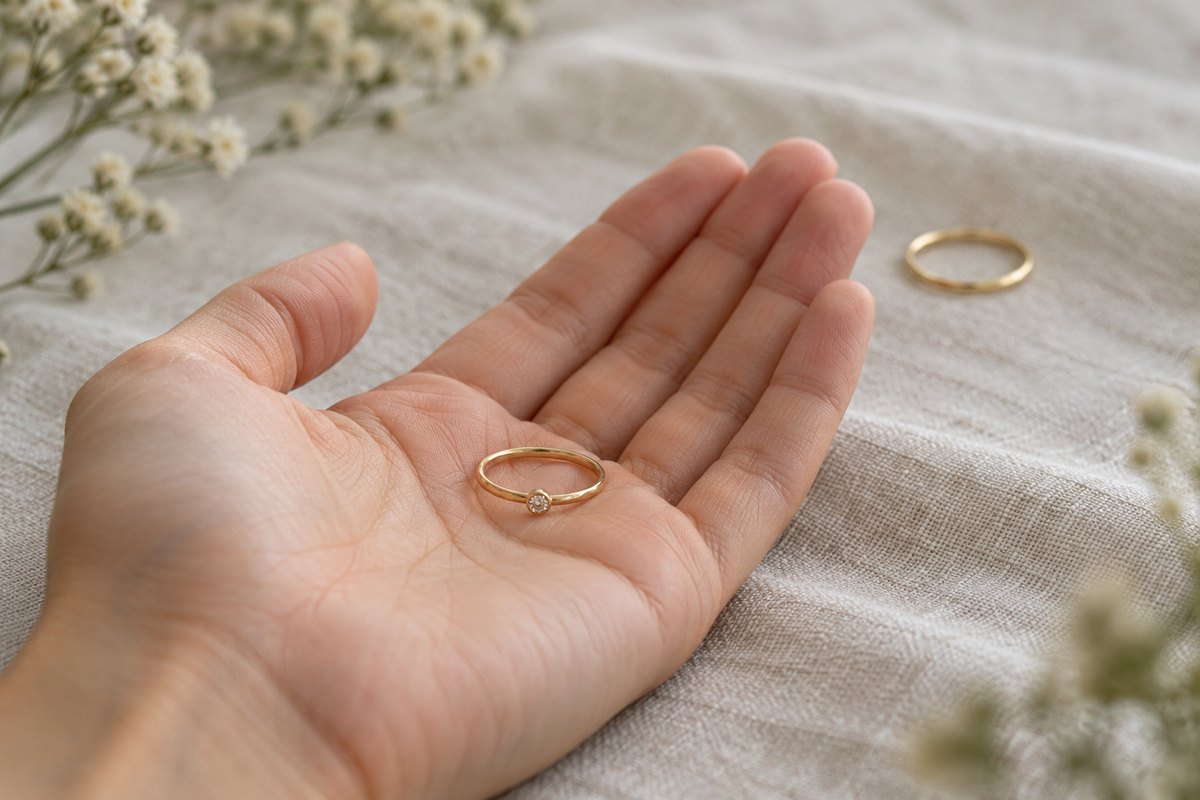
A promise ring is a ring given as a sign of commitment between two people, most often a couple who are not ready to get engaged but want to mark that the relationship is serious. It is commonly worn on the ring finger of the left hand, or on the right hand to avoid any confusion with an engagement ring, but there is no fixed rule. What it means is whatever the two of you agree it means.
This guide includes a few product links near the end. As an Amazon Associate, Diamond Taire earns from qualifying purchases, at no extra cost to you.
This guide explains the main meanings people attach to promise rings, their history, how they compare with engagement, wedding and eternity rings, which finger and hand to use in different countries, when to give one, how to choose a ring that lasts, and what promise rings typically cost. It ends with a checklist for giving one without confusion, common mistakes and quick answers to the questions people ask most.
- Meaning: a commitment, often before engagement, though it can also mark friendship or a personal vow.
- Finger: usually the left ring finger, often moved when an engagement ring arrives. The right hand is common too.
- Not an engagement ring: say clearly what it means when you give it.
- Usually simple and modest in price: engraving and birthstones add meaning without adding much cost.
What a promise ring means
A promise ring is sometimes called a pre-engagement ring, and in many places the two terms are used interchangeably. The promise behind it varies:
- A couple’s commitment: the most common meaning. The ring says “we are serious and exclusive” without being a proposal.
- A step towards engagement: some couples treat it as a promise to get engaged later, for example once studies finish or once they live in the same city.
- Friendship: close friends sometimes exchange rings to mark a lasting bond.
- A personal or faith-based pledge: some people wear a ring to mark a personal vow; rings worn as a pledge of abstinence before marriage are often called purity rings.
Because the meanings differ so much, the words you say when you give the ring matter more than the ring itself. A promise ring given without explanation is easily mistaken for a proposal, or for something less serious than you intended.
A short history of promise rings
Rings as tokens of love are far older than the name “promise ring”. The Victoria and Albert Museum describes posy rings as gold hoops engraved with a romantic motto, named after the French word poésie (poem). Some mottoes were standard phrases a jeweller could suggest or a buyer could copy from a book of mottoes; others were chosen by the giver. The V&A’s collection includes a seventeenth-century example inscribed inside the hoop “LOYALTE NE PEUR” (loyalty, not fear), and the British Museum holds English gold posy rings from the seventeenth and eighteenth centuries with inscriptions on the inner face.
The V&A also notes that it is often hard to say which old love rings were wedding rings, because any ring could serve as one, and that its curators describe gimmel rings, two interlocking hoops, as symbolising the joining of two people. The modern term “promise ring” is much more recent and became widely used in the second half of the twentieth century.
Engraving a short message inside a band is still one of the most meaningful ways to personalise a promise ring, and it connects directly to that posy-ring tradition.
Promise, pre-engagement, engagement, wedding and eternity rings compared
| Ring type | What it signals | Usual finger and hand | Typical timing | Typical style | Typical price level |
|---|---|---|---|---|---|
| Promise ring | Commitment to each other, not a proposal | Left ring finger, or right hand to avoid confusion | Once a relationship is serious | Simple band, small stone, birthstone or engraving | Low |
| Pre-engagement ring | Usually the same as a promise ring; sometimes a promise to get engaged | As for a promise ring | Before an expected engagement | Similar to a promise ring | Low |
| Engagement ring | Agreement to marry | Left ring finger in many countries, right hand in some | At the proposal | Centre stone, often a diamond | Medium to high |
| Wedding band | Marriage | Same hand as the engagement ring in most traditions | At the ceremony | Plain or diamond-set band | Low to medium |
| Eternity ring | Lasting love, often marking an anniversary or a birth | Often stacked with the wedding and engagement rings | Years into a marriage or partnership | Band of matching stones, full or half way round | Medium to high |
| Friendship or purity ring | Friendship, or a personal or faith pledge | Any finger | Any time | Simple band, often silver | Low |
For more on anniversary bands, see eternity rings explained.
Which finger and hand?
There is no rule, but there are conventions:
- Left ring finger: the most common choice in countries where engagement and wedding rings are worn on the left, including the UK, US and Australia.
- Right ring finger: a popular choice for people who want it understood that the ring is not an engagement ring.
- Another finger or a necklace: perfectly acceptable, especially for friendship rings or where a ring would get in the way at work.
Customs differ by country. In several Eastern European countries, including Bulgaria, Poland and Russia, and in the Eastern Orthodox tradition, wedding rings are traditionally worn on the right hand. In the Netherlands the hand has traditionally reflected religion, while in Sweden and Finland both engagement and wedding rings are worn on the left. If you live where wedding rings go on the right, a left-hand promise ring may be the clearer signal, and the other way round.
When an engagement ring arrives, people commonly move the promise ring to the right hand, wear it stacked with the new ring, or keep it as a keepsake.
When to give a promise ring
There is no correct moment. People often choose an anniversary, a birthday, a holiday, a graduation, or a time when they will be apart, such as a move or a long trip. Many guides suggest waiting until the relationship has been serious for some months. More important than timing is the conversation: ask, don’t assume. If you are unsure whether your partner would welcome a promise ring, or whether they would prefer to wait for an engagement ring, talk about it first.
How to choose a promise ring
Metal
A promise ring is often worn every day, so durability matters.
- Sterling silver: affordable and attractive, but softer and prone to tarnish, so it needs occasional polishing. See sterling silver gemstone rings that last.
- Solid gold: 9k, 10k and 14k are harder and more scratch-resistant than higher karats, which is why they suit daily wear. See which gold karat suits everyday wear.
- Gold vermeil and gold-plated: a gold layer over silver or base metal. They look like gold for less, but the layer can wear through on a ring worn every day; compare gold vermeil vs gold filled.
Stones
Birthstones, small diamonds, lab-grown diamonds and moissanite are all popular. For a ring worn daily, choose a stone hard enough to resist scratches and set low enough not to snag; softer gems such as opal and pearl need more care. Our guide to gemstones tough enough for daily wear applies just as well to promise rings.
Engraving and personal touches
A date, initials, a short phrase or a symbol engraved inside the band adds meaning at little or no extra cost. Matching engraved bands are a popular choice for couples who both want to wear a ring.
Getting the size right
Fingers change size through the day and with temperature, and fingers on your dominant hand are often slightly larger. Borrow a ring they already wear on the intended finger, or see how to measure ring size at home. Check that the retailer will resize or exchange the ring.
How much should a promise ring cost?
Promise rings are usually modest purchases, and there is no expected amount. To give a sense of the range, here are listed prices sampled from retailers’ promise-ring categories at the time of writing (October 2026), in US dollars; prices change and differ by country and retailer:
- At one large international jewellery chain, promise rings in sterling silver, gold-plated or 14k gold finishes were listed from about $55 to $160, with a two-ring set at about $196.
- At one online fine-jewellery retailer, 14k gold promise rings with small diamonds, lab-grown diamonds or gemstones were listed from about $750 to about $1,490.
In practice that means a meaningful promise ring can cost very little. Spend what feels comfortable and keep something back for the day an engagement ring might follow.
Promise rings for him and matching sets
Promise rings are not only for women, and they are not only exchanged in one direction. Couples of any gender often buy matching or complementary bands, sometimes engraved with the same date. For men’s rings, plain or brushed bands in gold, titanium or tungsten are common, and some prefer a ring worn on a chain. Friends can exchange promise or friendship rings in the same spirit.
Checklist: giving a promise ring without confusion
- Decide what the ring means to you, in one sentence.
- Say it out loud when you give it, including that it is not a proposal, if it is not.
- Choose a finger together, or suggest the right hand to avoid mix-ups.
- Find the ring size discreetly before you buy.
- Pick a metal and stone suited to everyday wear.
- Consider engraving a date or a word that matters to you both.
- Keep the receipt and check the resizing and exchange policy.
Common mistakes
- Giving it without explaining it, so it is mistaken for a proposal.
- Overspending on something meant to be a modest, personal gesture.
- Choosing thin plating for a ring worn every day, so the colour wears off quickly.
- Guessing the size and leaving the ring in a drawer.
- Following a stranger’s “rules” about the finger instead of agreeing together.
- Choosing a fragile gem for a ring that will see daily knocks.
When the time comes for the next step, our guides cover choosing a ring style they will love and when you’re ready for an engagement ring.
Sources this guide draws on: Victoria and Albert Museum collection records for a seventeenth-century posy ring and a gimmel ring of about 1600; the British Museum’s collection record for an English gold posy ring of the seventeenth to eighteenth century; published reference summaries of pre-engagement rings and of wedding-ring customs by country; and listed retail prices for promise rings sampled in October 2026.
Useful tools for this guide
Practical picks for choosing, checking and caring for jewellery. As an Amazon Associate, Diamond Taire earns from qualifying purchases, at no extra cost to you. Prices and availability are set by Amazon and may vary by country.
- Foldable 30x Jeweller’s Loupe
Pocket magnifier for checking stones, settings and hallmarks up close.
View on Amazon - CONNOISSEURS Premium Jewellery Cleaner
Gentle dip cleaner with a brush and tray for diamonds, gold and platinum. Check the label for stones it should not be used on.
View on Amazon - Ring Sizer Measuring Tool Kit (27 pieces)
Sizing rings plus a mandrel, to check a size at home before you buy or resize.
View on Amazon
FAQ
What does a promise ring mean?
Most often it means a couple are committed to each other and serious about the future, without being engaged. It can also mark a friendship or a personal or faith-based pledge. The meaning is whatever the giver and wearer agree.
What finger do you wear a promise ring on?
Usually the ring finger. Many people wear it on the left ring finger and move it when an engagement ring arrives, while others choose the right ring finger from the start to avoid confusion.
What hand does a promise ring go on?
Either. Where engagement and wedding rings go on the left hand, the right hand makes it clear the ring is not an engagement ring. In countries where wedding rings are traditionally worn on the right, the left may be the clearer choice.
Is a promise ring the same as an engagement ring?
No. An engagement ring marks an agreement to marry; a promise ring marks commitment without a proposal. It is usually simpler and less expensive, and some couples see it as a step before engagement.
How much should you spend on a promise ring?
There is no rule. At the time of writing (October 2026), retail promise rings were listed from about $55 in sterling silver to around $1,500 in 14k gold with small diamonds or gemstones. Prices change, and a simple engraved band carries as much meaning as an expensive one.
Can guys wear promise rings?
Yes. Promise rings are worn by people of any gender, and many couples exchange matching bands. Men often choose plain gold, titanium or tungsten bands, or wear the ring on a chain.
A promise ring is about the words that come with it more than the ring itself. Choose something simple and wearable, agree on the finger, and say clearly what it means.