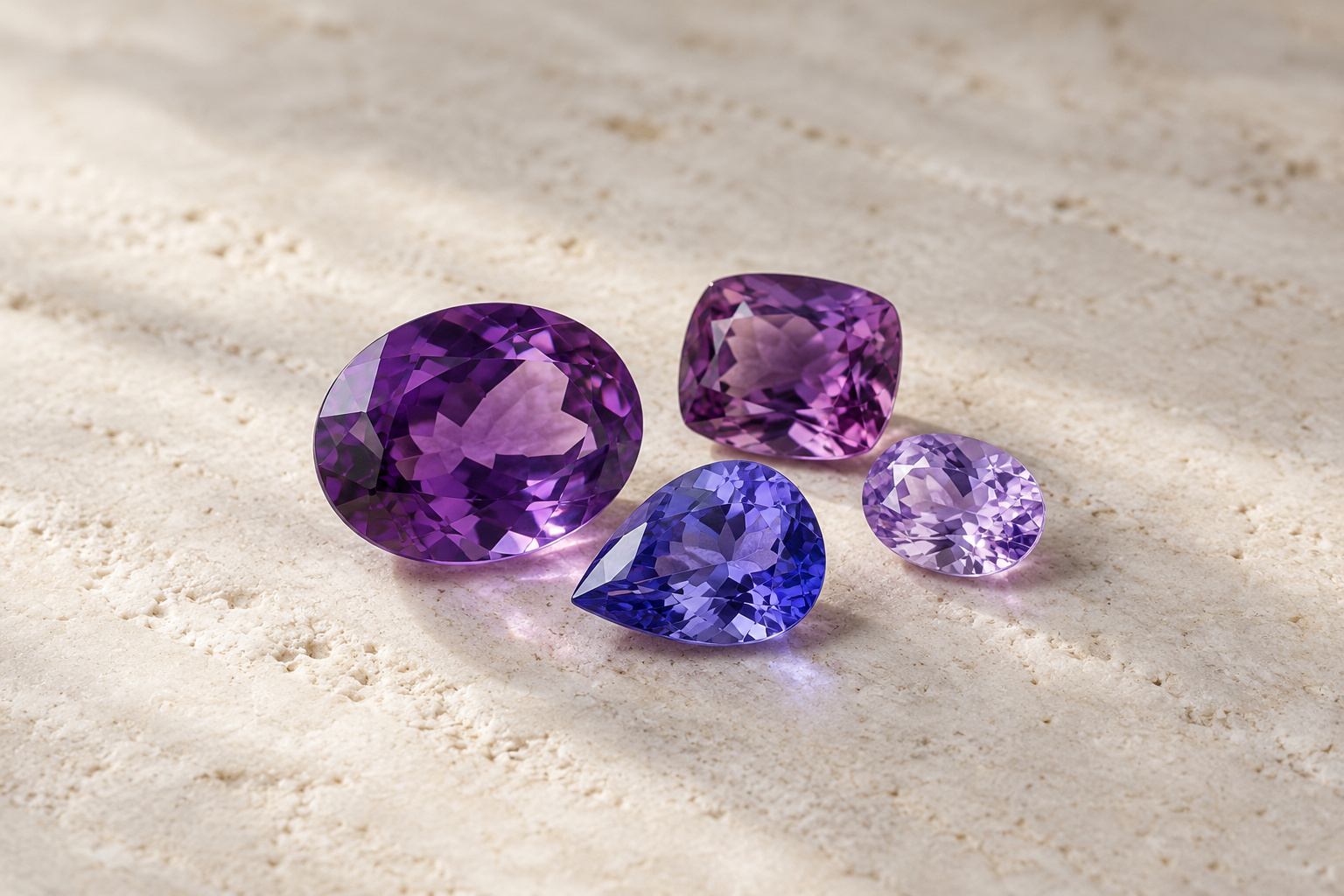
The main purple gemstones are amethyst, purple sapphire, purple spinel, tanzanite, purple garnet, kunzite, iolite and lavender jade. For a ring worn every day, purple sapphire and spinel are the most durable choices; amethyst is the affordable classic, while tanzanite, kunzite and iolite are beautiful but better suited to earrings, pendants or careful wear. The biggest practical differences between them are toughness, whether the colour can fade in strong light, and how routinely each one is treated.
This guide includes a few product links near the end. As an Amazon Associate, Diamond Taire earns from qualifying purchases, at no extra cost to you.
This guide compares purple stones side by side, explains how tanzanite differs from purple sapphire, shows what can and cannot be said about synthetic amethyst, and finishes with a buying checklist, the most common mistakes and answers to the questions people search most.
At a glance
- Toughest purple stones: purple sapphire (Mohs 9) and spinel (Mohs 8, good toughness, per GIA).
- Best value: amethyst, a quartz rated 7 with good toughness, though some amethyst can fade after long exposure to intense light.
- Handle with care: tanzanite (6 to 7, fair to poor toughness), kunzite (poor toughness, colour can fade) and iolite (cleaves easily).
- Treatments to expect: heating is routine for tanzanite and common across sapphire; kunzite may be irradiated; iolite is not typically treated.
- Synthetic amethyst exists and a flawless lab-grown stone can be very hard to tell from natural by eye, so a valuable claim needs a laboratory.
Purple gemstone names: what each one actually is
Many purple stones are varieties of better-known minerals, which is why the names can confuse people. Knowing the mineral tells you most of what you need about durability.
- Amethyst is purple quartz and the February birthstone.
- Purple sapphire is corundum, the same mineral as ruby and blue sapphire. The colour can range from violet to reddish purple.
- Purple spinel is spinel, which also occurs in red, pink and blue. Some spinel is a soft lavender or grey-violet.
- Tanzanite is the blue to violet variety of the mineral zoisite.
- Purple garnet usually means rhodolite or other purplish-red garnets, which belong to the harder end of the garnet family.
- Kunzite is pink to violet spodumene.
- Iolite is the gem variety of cordierite, typically violet-blue.
- Lavender jade is jadeite in a lilac colour; GIA notes lavender is usually the second most desirable jadeite colour after green.
Purple gemstones compared
Hardness (Mohs) is resistance to scratching. Toughness is resistance to chipping and breaking. Price bands are relative to each other, not quotes, because prices change and vary widely by size, quality and country.
| Stone | Mohs hardness | Toughness | Colour stability | Usual treatment | Relative price | Everyday ring? |
|---|---|---|---|---|---|---|
| Purple sapphire | 9 | Good | Stable | Heating common in sapphire; ask | Moderate to high | Yes |
| Spinel | 8 | Good | Stable | Sometimes heated; fracture filling rare | Moderate to high | Yes |
| Amethyst | 7 | Good | Some can fade in long intense light | Heating used to lighten dark stones | Low | Yes, with care for scratches |
| Purple garnet | 7 to 7.5 | Fair to good | Stable | Rarely treated | Low to moderate | Yes, with reasonable care |
| Iolite | 7 to 7.5 | Not very tough; perfect cleavage | Stable | Not typically treated | Low | Better in earrings and pendants |
| Jadeite (lavender) | About 6.5 to 7 | Exceptional | Stable unless dyed | Can be dyed, bleached or impregnated | Wide range | Yes, if untreated |
| Kunzite | 6.5 to 7 | Poor; perfect cleavage in two directions | Can fade with heat and intense light | May be irradiated then heated | Low to moderate | No; pendants and occasional wear |
| Tanzanite | 6 to 7 | Fair to poor; has cleavage | Stable under normal wear | Heating is routine | Moderate to high | Only with a protective setting and care |
Hardness, toughness and stability figures come from GIA’s care and cleaning guides for each stone; sapphire’s 9 is the standard Mohs value for corundum.
The main purple gemstones, one by one
Amethyst: the affordable classic
Amethyst gives the most purple for the money and is tough enough for rings, provided you accept that quartz at 7 can be scratched by everyday dust and grit over time. GIA notes that some amethyst can fade after prolonged exposure to intense light, and that heat and sudden temperature changes should be avoided. Heating is used to lighten very dark stones, and some amethyst is heated to turn it into citrine. Colour, zoning and the “Siberian” and “Rose de France” trade names are covered in the February birthstone guide, so they are not repeated here.
Purple sapphire: the long-term choice
Purple sapphire combines a 9 on the Mohs scale with good toughness, which is why it suits engagement rings and bands worn daily. Its colour is stable. As with all sapphire, heating is common and is considered stable, but it should be disclosed. Lab-grown corundum has been made since the early 1900s (GIA dates the first lab-made ruby to 1902), and lab-grown purple sapphire is available; it is real corundum but should be clearly labelled and priced as lab-grown.
Spinel: tough and often untreated
GIA rates spinel 8 on the Mohs scale with good toughness, making it durable for everyday jewellery. Some spinel is heat-treated, which GIA describes as stable, and fracture filling is rare. That combination makes purple and lavender spinel a quietly smart choice if you want a durable stone that is less familiar than sapphire. Spinel’s wider story, including why it became an August birthstone, is in the August birthstone guide.
Tanzanite: striking colour, real fragility
Tanzanite’s violet-blue is unlike any other stone, but GIA rates its hardness 6 to 7 and its toughness fair to poor, with cleavage that lets it break if struck. Heat treatment is routine: it changes the colour from mostly brown to blue or purple, and GIA says this treatment is stable. Rarely, tanzanite is coated to deepen its colour, and coatings can wear off. Never put it in an ultrasonic or steam cleaner, and avoid sudden temperature changes.
Purple garnet: underrated value
Rhodolite and other purplish garnets sit at the harder end of the garnet range and are rarely treated, so what you see is generally what the stone is. They are a sensible budget choice for rings worn regularly. The January birthstone guide covers garnet types and colours if you want to compare them.
Kunzite and iolite: lovely, but not for hard wear
Kunzite’s soft pink-violet colour comes with poor toughness, perfect cleavage in two directions, and colour that can fade with heat and intense light, whether natural or treated. It is best in pendants and earrings, worn in the evening rather than in strong sun. Iolite is harder (7 to 7.5) and not typically treated, but GIA notes it has perfect cleavage in one direction and is not very tough, so jewellers often put it in protective settings or earrings. Iolite also changes colour noticeably as you turn it, so look at it from several angles before buying.
Tanzanite vs purple sapphire: how they differ
These two are the stones most often compared, because a violet sapphire and a purplish tanzanite can look similar in a photograph.
| Factor | Tanzanite | Purple sapphire |
|---|---|---|
| Mineral | Zoisite | Corundum |
| Mohs hardness | 6 to 7 | 9 |
| Toughness | Fair to poor, with cleavage | Good |
| Typical treatment | Heating is routine | Heating is common |
| Colour behaviour | Shifts strongly between blue and violet as the stone moves | More even colour, depending on cut |
| Cleaning | Warm soapy water only | Warm soapy water; ask your jeweller about other methods |
| Best use | Earrings, pendants, protected occasional rings | Any jewellery, including daily rings |
If the ring will be worn every day for decades, purple sapphire is the practical answer. If you want tanzanite’s particular colour, choose a bezel or halo, and read the gemstone engagement ring guide before committing.
Synthetic amethyst: what you can and cannot check
Lab-grown amethyst is real quartz, grown by the hydrothermal method, and GIA notes it entered jewellery after being developed for industrial uses. It has the same hardness and appearance as natural amethyst, which is exactly why claims need care.
- By eye, you usually cannot tell. Inclusions help with included stones, but a flawless natural stone and a flawless lab stone look alike. A GIA research paper describes using a polariscope to look for “Brazil twinning” patterns, combined with colour zoning, which is a gemmologist’s test, not a home test.
- Price is a clue, not proof. Amethyst is inexpensive either way, so the risk is mainly in larger, very clean, high-priced stones or antique pieces sold as natural.
- Ask for disclosure in writing. Under the US Federal Trade Commission guides, summarised by GIA, lab-made stones must be described so there is no doubt they are not natural; many other countries have similar rules.
- For a costly piece, ask for a laboratory report. It is the only reliable way to settle the question.
Which purple gemstone suits which piece?
| Piece | Best choices | Think twice |
|---|---|---|
| Engagement or daily ring | Purple sapphire, spinel, purple garnet | Tanzanite, kunzite, iolite |
| Fashion or occasional ring | Amethyst, tanzanite in a protective setting | Kunzite |
| Earrings and pendants | Any purple stone, including kunzite and iolite | Long sun exposure for kunzite |
| Bracelets | Sapphire, spinel, jadeite bangles | Tanzanite and kunzite in exposed settings |
A bezel, halo or recessed setting protects softer stones much better than a tall open prong; the ring settings guide compares them. If you are buying a purple stone in silver, the sterling silver gemstone guide explains how silver wears.
How to buy a purple gemstone: checklist
- Decide how often you will wear it. Daily rings narrow the list to sapphire, spinel and garnet; occasional wear opens up everything.
- Confirm the mineral. “Purple stone” or “violet gem” is not enough; get the exact name and whether it is natural or lab-grown.
- Ask about treatment. Heating for sapphire and tanzanite, irradiation for kunzite, dye or polymer for jade, coating for tanzanite.
- Check colour in different light. Some purples look bluer in daylight and redder under warm lamps; tanzanite and iolite also change as they move.
- Look for evenness. Strong colour zoning or brownish tints usually lower value.
- Match the setting to the stone. Protective settings for tanzanite, kunzite and iolite.
- Get a laboratory report for high-value sapphire, spinel or tanzanite, and for any amethyst sold at a premium as natural.
- Get care instructions in writing and keep them with your receipt.
Caring for purple gemstones
Warm soapy water and a soft brush are always safe. Beyond that:
- Tanzanite, kunzite, iolite: never ultrasonic or steam; avoid sudden temperature changes.
- Amethyst: ultrasonic is usually safe for untreated stones; avoid steam and heat; store away from strong sunlight.
- Spinel: ultrasonic and steam are usually safe, but not for fractured or filled stones.
- Kunzite: keep out of long, intense light to protect its colour.
Store softer purple stones separately from diamonds and sapphires so they cannot be scratched; the jewellery storage guide explains simple ways to do this.
Common mistakes
- Choosing tanzanite for a daily ring without a protective setting. Its cleavage makes chips and breaks more likely than most buyers expect.
- Leaving kunzite or amethyst on a sunny windowsill or dressing table. Long intense light can fade some stones.
- Using an ultrasonic cleaner on everything. It is unsafe for tanzanite, kunzite and iolite.
- Paying a premium for “natural” amethyst without evidence. A flawless stone may be lab-grown, and only a lab can confirm.
- Assuming all purple jade is natural colour. Lavender jadeite can be dyed; ask for proof of untreated colour.
- Judging colour from one photograph. Purple stones vary more with lighting than most colours.
Sources this guide draws on: GIA care and cleaning guides for amethyst, tanzanite, spinel, kunzite, iolite and jade; GIA introduction to gem treatments; GIA introduction to synthetic gem materials; GIA research paper on separating natural from synthetic amethyst by twinning; GIA green gemstones buying guide (jadeite colours); GIA article on gem durability beyond the Mohs scale; US Federal Trade Commission jewellery guidance as summarised by GIA.
Purple gemstones: frequently asked questions
What is a purple gemstone called?
The most common purple gemstone is amethyst, which is purple quartz. Other purple gems include purple sapphire, spinel, tanzanite, purple garnet, kunzite, iolite and lavender jade. The right name depends on the mineral, so ask the seller exactly which one it is.
Which purple gemstone is the most durable?
Purple sapphire is the most durable, at 9 on the Mohs scale with good toughness. Spinel, at 8 with good toughness, is the next best choice. Both suit rings worn every day.
Is tanzanite the same as purple sapphire?
No. Tanzanite is a variety of zoisite, while purple sapphire is corundum. Sapphire is much harder and tougher, and tanzanite shows a stronger shift between blue and violet as it moves.
Does amethyst lose its colour?
Some amethyst can fade after prolonged exposure to intense light, and heat can change its colour. Normal wear is fine. Store it away from strong sunlight when you are not wearing it.
Is purple sapphire rare?
Purple sapphire is less familiar than blue sapphire but is available from several sources and in lab-grown form. Fine, evenly coloured natural stones in larger sizes are harder to find and cost more. Prices change, so compare similar sizes and qualities before deciding.
What purple gemstone is cheapest?
Amethyst is generally the most affordable purple gemstone, with iolite and purple garnet also low in price. Kunzite is usually moderately priced. Sapphire, spinel and fine tanzanite cost more.
Purple stones reward a little homework. Pick the mineral first, match it to how you will wear it, ask the treatment question, and your purple gemstone can stay as rich as the day you chose it.
Useful tools for this guide
Practical picks for choosing, checking and caring for jewellery. As an Amazon Associate, Diamond Taire earns from qualifying purchases, at no extra cost to you. Prices and availability are set by Amazon and may vary by country.
- Gemstones of the World by Walter Schumann (5th edition)
A classic illustrated reference to more than 1,900 gemstones.
View on Amazon - Foldable 30x Jeweller’s Loupe
Pocket magnifier for checking stones, settings and hallmarks up close.
View on Amazon - KElofoN Travel Jewellery Case
Compact case with ring rolls and earring slots so pieces do not scratch each other.
View on Amazon