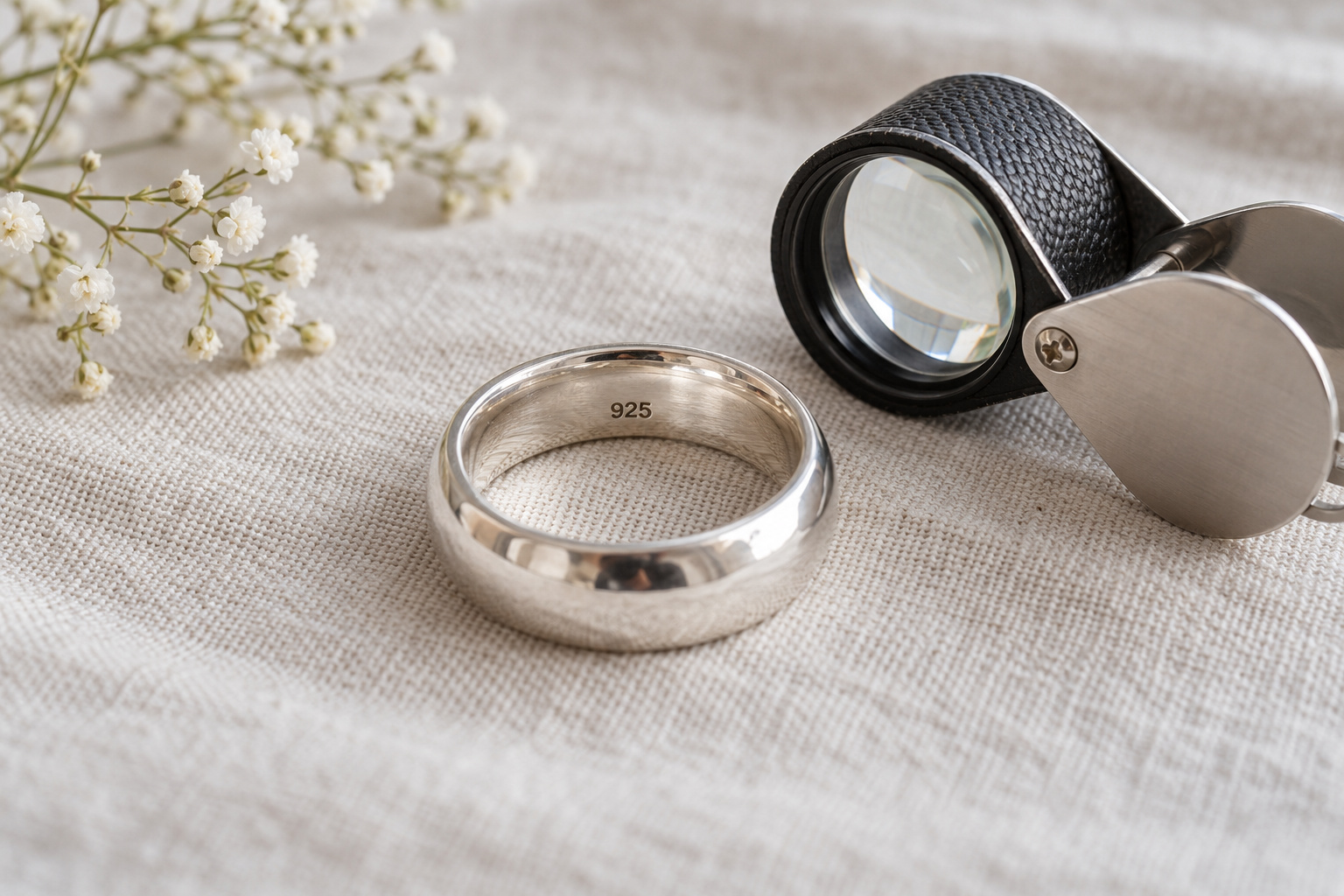
A 925 stamp on jewellery means the metal is meant to be sterling silver: 925 parts in every 1,000 are pure silver, or 92.5 percent, and the other 7.5 percent is usually copper added for strength. The number is a claim of fineness, not a guarantee. Who stamped it, and whether anyone independent checked it, depends on the country where the piece was made or sold.
This article contains affiliate links. As an Amazon Associate I earn from qualifying purchases, at no extra cost to you. Affiliate disclosure.
This guide decodes the silver stamps you are most likely to find (925, STER, 800, 958, 999, “Italy 925” and vermeil), shows how they sit alongside platinum, palladium and gold marks, explains how hallmarking differs between the UK and places such as the US and Australia, and gives you a step-by-step way to judge whether a stamp can be trusted.
At a glance
- 925 = sterling silver: 92.5 percent silver. In the US, “Sterling”, “Sterling Silver” and “Ster.” may only be used for metal that is at least 925 parts per thousand silver.
- Other silver numbers: 999 is fine silver, 958 is Britannia silver, 900 is coin silver and 800 is a lower standard common on older European pieces.
- A stamp is not proof: in most countries the maker applies it. Only some systems, such as the UK’s, require independent testing by an assay office.
- Plated pieces should not carry 925 alone: “SP”, “EP” and “silver tone” mean a coating or a colour, not solid silver.
- When it matters, test: a jeweller or assay service can confirm silver content in minutes without damaging the piece.
What the 925 number actually tells you
Precious metal purity is written in parts per thousand. Pure silver would be 1000, but it is soft enough to bend and scratch in daily wear, so jewellers alloy it. Sterling silver keeps 925 parts silver and adds 75 parts of another metal, traditionally copper. That small addition helps rings, chains and clasps hold their shape.
So when you see 925 inside a ring, on a clasp tag or on an earring post, the maker is telling you the piece is sterling. It is the same idea as 750 on gold, which means 75 percent gold. The number does not tell you anything about the gemstones, the craftsmanship, or whether the piece has a plated surface on top. Many sterling pieces are rhodium-plated for extra brightness, and some are gold-plated; the 925 describes only the silver underneath.
What does it mean when 925 appears with other letters?
Marks are often combined. “925 Italy” or “Italy 925” usually means sterling silver made in Italy. “925 CZ” often appears on pieces set with cubic zirconia. A small logo or set of initials beside the number is normally a maker’s mark or trademark, which identifies who is responsible for the claim. A lone “925” is common on mass-produced jewellery; it is not a red flag, but lean on the seller’s reputation or a test rather than the stamp alone.
Silver stamps decoded: a reference table
These are the marks you are most likely to meet on silver jewellery, with what each one means in practice.
| Stamp or wording | What it means | Silver content | What to keep in mind |
|---|---|---|---|
| 999, FS, Fine Silver | Fine silver | 99.9% | Very soft; used for bullion, some hand-made pieces and charms |
| 958, Britannia | Britannia silver | 95.84% | A UK and Convention standard; softer than sterling |
| 925, Sterling, STER, Ster. | Sterling silver | 92.5% | The standard for most silver jewellery worldwide |
| 900, Coin, Coin Silver | Coin silver | 90% | Seen on older American pieces; under the US Jewelry Guides “coin silver” means at least 900 |
| 835 or 800 | Lower European standards | 83.5% or 80% | Common on older continental European and Italian pieces; 800 is a recognised UK and Convention standard |
| Vermeil | Gold over sterling silver | Sterling base | In the US the gold layer must be at least 2.5 microns thick |
| SP, Silver Plated, EP | A silver coating over another metal | Surface only | The plating can wear through to the base metal |
| EPNS | Electroplated nickel silver | Surface only | Common on cutlery and older plated items |
| Nickel silver, German silver, Alpaca | Names for copper, nickel and zinc alloys | None | Despite the name, there is no silver in the alloy |
| Silver tone, silver colour | A colour description | None guaranteed | Describes the look, not the metal |
Informal trade names such as “Tibetan silver” are names, not fineness marks; without a number such as 925 and a clear description, assume no guaranteed silver content.
For a buyer’s view of what makes a good silver piece once you know it is genuine, including stone choice and quality checks, see our guide to choosing sterling silver gemstone jewellery that lasts. If you are weighing gold-coloured silver, our comparison of gold vermeil vs gold filled explains how the layers differ.
Stamps across metals: how silver marks compare
Silver marks follow the same parts-per-thousand logic as other precious metals, which makes it easier to read a piece that mixes metals, such as a silver pendant on a gold chain.
| Metal | Common marks | How to read them |
|---|---|---|
| Silver | 999, 958, 925, 900, 800 | Parts per thousand silver; 925 is sterling |
| Gold | 375 (9ct), 585 (14K), 750 (18K), 916 (22K), 999 | Parts per thousand gold, or karats out of 24 |
| Platinum | 950, 900, 850, Plat., Pt. | In the US, unqualified “Platinum” means at least 950 parts per thousand |
| Palladium | 500, 950, 999, Pd | Parts per thousand palladium; 500, 950 and 999 are the UK standards |
Gold marks have their own quirks, such as karat versus carat spelling and filled or plated codes like GF, RGP and GP. Rather than repeat them here, our guide on how to tell if jewellery is real gold walks through gold stamps and safe checks, and choosing the right gold karat explains what each karat is like to wear. For platinum against white gold, see our platinum or white gold comparison.
Hallmarks versus stamps: why the country matters
A “stamp” or “quality mark” is usually applied by the maker. A “hallmark”, in the strict sense, is a mark applied by an independent testing office after the metal has been checked. Many people use the words interchangeably, but the difference matters when you want to know how much to trust a mark.
The United Kingdom
Under UK hallmarking law, it is an offence for a trader to describe an unhallmarked article as wholly or partly silver, gold, platinum or palladium, unless it falls under a weight exemption. For silver the exemption is 7.78 grams, so most silver rings and earrings below that weight may be sold as silver without a hallmark, while heavier pieces such as bangles and chunky chains must carry one.
According to UK government hallmarking guidance, a full UK hallmark has three compulsory parts: a sponsor’s or maker’s mark of at least two letters in a surround, a metal and fineness mark showing parts per thousand in a shape that identifies the metal, and the mark of the assay office that tested it. There are four UK assay offices: London, Birmingham, Sheffield and Edinburgh. The approved silver standards are 800, 925, 958 and 999.
Older British silver often carries pictorial symbols too, such as the walking lion (the lion passant) used by English offices for sterling and the seated Britannia figure for 958 silver. These traditional marks can still be added voluntarily. A date letter was compulsory until 1999 and is now optional, which is why antique pieces can often be dated from their marks.
International Convention marks
The UK has been part of the International Convention on Hallmarks since 1972. Pieces tested in a member country can carry a Common Control Mark (CCM), a pair of scales, together with a fineness mark and maker’s mark, and these are recognised across member countries without retesting. The recognised Convention silver standards are 800, 925, 958 and 999.
The United States
The US has no independent assay system for jewellery. Instead, federal stamping law and the Federal Trade Commission’s Jewelry Guides set the rules for what a mark may say. Under those guides, “Sterling”, “Sterling Silver” and the abbreviation “Ster.” may only describe metal that is at least 925 parts per thousand silver, and the unqualified word “silver” should be paired with an accurate fineness figure. Silver-plated items may not be stamped “sterling” or “coin”. The guides refer to the stamping law’s tolerances: for sterling, four parts per thousand on parts without solder, and ten parts per thousand when the tested part includes solder. Vermeil must have a sterling base with a gold coating at least 2.5 microns thick.
Italy
Italian silver often carries two marks. The fineness, such as 925 or 800, typically sits inside an oval. Beside it is a maker’s identification mark introduced under a 1968 law: a polygon containing a star, a registration number and the letters of the province where the maker is registered (for example, MI for Milan or AR for Arezzo). Together they tell you the declared fineness and which registered workshop made the piece. A plain “Italy” next to 925 is a country-of-origin mark.
Australia and other markets
Australia, Canada and many other countries do not have a compulsory independent hallmarking system like the UK’s. Marks such as 925 are applied by the maker or importer and are a claim backed by general consumer protection law rather than by an independent test. That does not make them unreliable, but it means the seller’s reputation and your own checks matter more.
Why a 925 stamp is not proof
A punch that strikes “925” costs very little, so counterfeit and mislabelled pieces do circulate, especially through anonymous online marketplaces. Some are base metal with a thin silver plating; some are low-grade alloys. A stamp also cannot tell you whether a piece has been repaired with lower-grade solder or a replacement clasp.
Genuine pieces sometimes have no stamp at all. Very small or delicate items may be too fine to mark, older hand-made pieces may predate local rules, and resizing can polish a mark away. Missing marks mean “unknown”, not automatically “fake”.
How to check a 925 piece: step by step
- Find every mark. Use a 10x loupe or your phone’s zoom in good light. Look inside ring bands, on clasp tags, on the back of pendant bails, and on earring posts and backs.
- Read the whole mark, not just the number. Note any maker’s mark, country name, scales symbol, assay office mark or plating code such as SP or EP.
- Check consistency. Is the stamp crisp and evenly struck? Does it appear on every major part, such as both the chain and its clasp?
- Look at wear points. On edges and the underside of rings, a different colour showing through (yellow, pink or grey) can mean plating has worn away.
- Try a magnet. Silver is not magnetic, so a strong pull suggests a ferrous base metal. A lack of pull proves nothing, because many non-silver alloys are not magnetic either.
- Notice tarnish. Sterling slowly darkens with a grey or black film that polishes off. This is consistent with silver, but plated pieces can tarnish too.
- Compare with the description. Does the seller’s listing name the metal clearly, such as “925 sterling silver”, or hide behind “silver tone” or “silver colour”?
- Test if it matters. For valuable, heirloom or resale pieces, ask a jeweller or assay office for a non-destructive test such as X-ray fluorescence (XRF), or a discreet acid test on a hidden spot.
If you are planning to sell older silver, it is worth having it tested first so you can describe it accurately; our guide to selling jewellery online safely covers what buyers expect to see.
Who should rely on the stamp, and who should test
For an inexpensive pair of everyday studs from a seller with a clear returns policy, a 925 stamp plus a clear listing is a reasonable basis to buy. For a heavy bangle, a vintage piece of unknown origin, or anything bought or sold for its metal value, a test is worth paying for.
Our picks on Amazon: caring for 925 silver
Sterling silver tarnishes over time. These help keep it bright between wears.
- Town Talk Silver Polishing Cloth: a treated cloth for sterling silver.
- Connoisseurs Jewelry Cleaner (silver formula available): choose the silver version for 925 pieces.
- Rosenthal Collection Anti-Tarnish Strips: slow tarnish while silver is stored.
- 10x Jewellery Loupe: for reading small 925 stamps and hallmarks.
Prices and availability change. For valuable, antique or sentimental pieces, ask a professional jeweller before cleaning or treating them.
Common mistakes
- Treating “925” as an independent guarantee. Outside hallmarking countries, it is the maker’s claim.
- Assuming “German silver” or “nickel silver” contains silver. These are copper, nickel and zinc alloys.
- Reading 925 on a plated piece as solid sterling. A piece marked “925” and gold-plated is sterling underneath; a piece marked “SP” or “silver plated” is not sterling at all.
- Confusing silver standards with gold fineness. 925 on its own refers to silver; gold marks are 375, 585, 750 and so on.
- Using the magnet test as proof. It can rule some pieces out but cannot confirm silver.
- Scratching or filing to “check”. DIY acid kits and files can permanently damage a piece. Leave invasive tests to a professional.
- Dismissing unmarked pieces. Small, old or resized items may be genuine without any visible stamp.
Silver does need a little care to stay bright; our guide on how to store jewellery covers anti-tarnish storage.
Sources this guide draws on: the US Federal Trade Commission’s Guides for the Jewelry, Precious Metals, and Pewter Industries (16 CFR Part 23) and the National Gold and Silver Stamping Act; UK government hallmarking guidance notes on the Hallmarking Act 1973 and the UK Assay Offices; the International Convention on Hallmarks; and reference material on the post-1968 Italian silver marking system.
Frequently asked questions
Is 925 jewellery real silver?
Yes, if the mark is honest. Sterling silver is real silver alloyed with a small amount of another metal for strength, and it is the standard for most silver jewellery. Because a stamp can be faked, buy from sellers who state the metal clearly or have valuable pieces tested.
What does 925 Italy mean on jewellery?
It usually means the piece is sterling silver made in Italy. Italian silver may also carry a maker’s mark with a star, a number and province letters, which identifies the registered workshop. On its own, “925 Italy” is still a maker’s or country claim rather than an independent test.
Can 925 sterling silver be gold-plated?
Yes. Many gold-coloured pieces are sterling silver with a gold layer. If the layer meets the US vermeil standard (at least 2.5 microns of gold over sterling), it may be sold as vermeil. The gold will wear over time, revealing white silver underneath.
What does STER mean on jewellery?
STER is an abbreviation of sterling. Under the US Jewelry Guides, “Ster.” should only be used on metal containing at least 925 parts per thousand silver, the same as a 925 stamp.
Does 925 silver tarnish or turn skin green?
Sterling tarnishes slowly because of the copper and the silver’s reaction with sulphur in the air, and it polishes back easily. Some wearers notice a faint dark or green mark on the skin, which is usually linked to the copper content, moisture and skin chemistry. It washes off and is not a sign the piece is fake.
Is 925 better than 999 silver for jewellery?
For most everyday jewellery, yes. Fine silver (999) is purer but much softer, so rings and chains made from it bend and scratch more easily. Sterling’s small copper content makes it more durable for daily wear.
A 925 stamp is a helpful starting point: it tells you what the maker says the metal is. Read it alongside the other marks, the seller’s description and the country’s rules, and test anything valuable, and you will rarely pay silver prices for anything else.