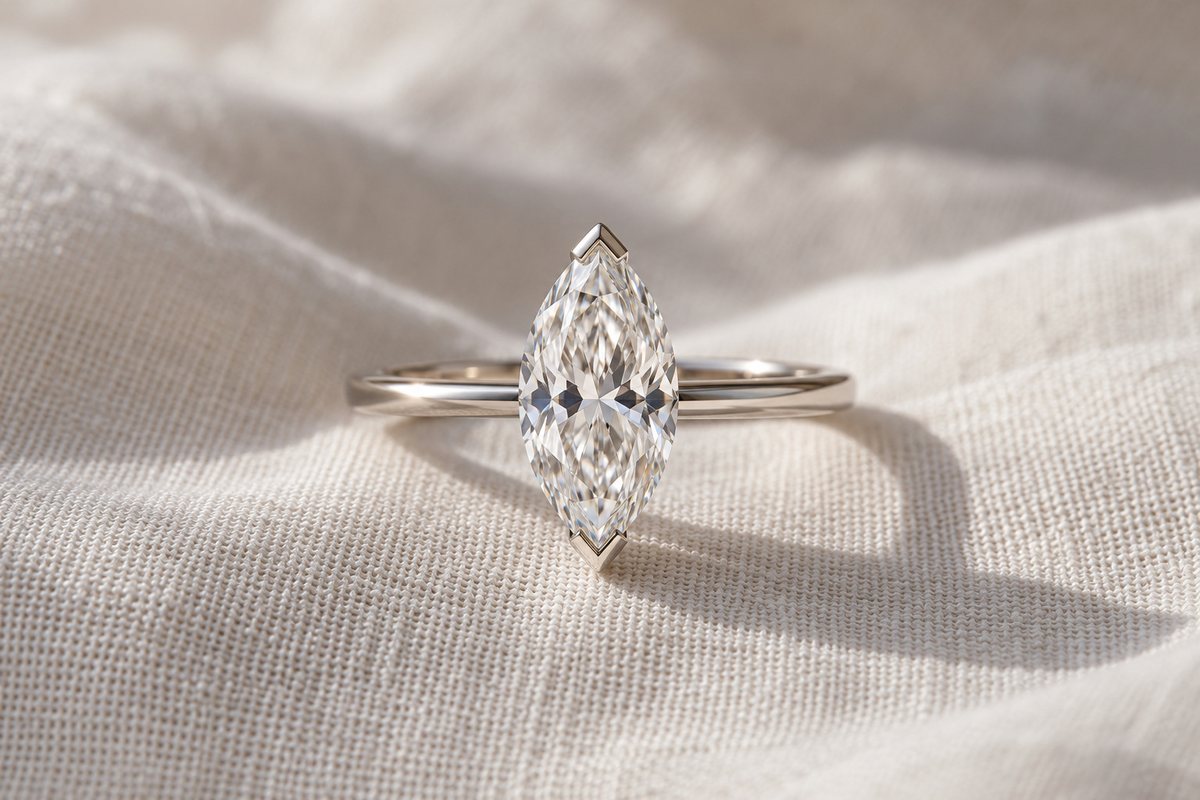
A marquise diamond ring sets a long, boat-shaped diamond with two pointed ends, also called a navette, as its main stone. A classic marquise is about twice as long as it is wide, and its elongated outline makes it look larger face-up than a round diamond of the same carat weight. The trade-offs are a dark “bow-tie” across the centre and two fragile points that need protecting.
This guide includes a few product links near the end. As an Amazon Associate, Diamond Taire earns from qualifying purchases, at no extra cost to you.
This guide covers what product pages tend to skip: how to judge bow-tie severity, which length-to-width ratios suit which look, how V-prongs and other settings protect the points, what a “Dutch marquise” really is, and a step-by-step checklist for choosing a marquise engagement ring that wears well every day.
At a glance
- Classic ratio: about 2:1. GIA reports that most marquises submitted to its lab fall between roughly 1.6:1 and 2.2:1.
- Bow-tie: nearly every marquise has one. A soft, grey, shifting bow-tie is normal; a wide, near-black one is a reason to keep looking.
- Protect the points: GIA notes the tips are the most vulnerable areas, so V-prongs, a bezel or other protective tips are worth it.
- Size for money: the long outline spreads the weight, so a marquise looks big for its carat.
- “Dutch marquise” is a trade name, not a standardised cut: it usually means an elongated hexagon with straight sides.
What a marquise diamond is
The marquise is a brilliant-style fancy shape, faceted to sparkle in a similar way to a round brilliant, but with a long outline that comes to a point at each end. GIA describes the shape as believed to have originated in 18th-century France, and the popular legend says King Louis XV had it cut and named for the Marquise de Pompadour. Its other name, navette, is Old French for “little ship”, a nod to its boat-like hull.
Marquises were especially fashionable in the later twentieth century, and they are popular again now with people who want something less common than a round or oval. Spellings vary: you will see “marquis diamond” as well as “marquise”, but they mean the same shape.
Length-to-width ratio: choosing your look
The length-to-width ratio (L:W) is the stone’s length divided by its width, both measured on the grading report. It decides whether the marquise looks short and plump or long and slender.
| L:W ratio | How it looks | Things to know |
|---|---|---|
| Under about 1.75 | Shorter, wider, softer | Can look “stubby” to some eyes; often brighter in the centre; a good match for wider bands |
| About 1.75-2.00 | Balanced, classic | The look most people picture when they say marquise |
| About 2.00-2.25 | Long and slender | Dramatic and finger-slimming; can be harder to cut for even brightness |
| Above about 2.25 | Very long, needle-like | Unusual; points are thinner and more exposed |
There is no correct ratio, and GIA says the choice is a matter of personal preference. A useful way to decide: look at photos of stones at 1.8, 2.0 and 2.2 side by side on a hand, then filter for the band you liked. Remember that the setting changes the look too: claws at the tips add length visually, and a halo can make a stone look plumper.
The bow-tie: how to judge it
The bow-tie is a darker, hourglass-shaped area that runs across the width of the stone, through the centre. It appears in elongated brilliant shapes because of the way light leaks out of the middle of the pavilion. GIA notes it can range from light grey to nearly black, and that a slight bow-tie is normal.
Use this simple scale when you watch a video or see the stone in person:
| Bow-tie severity | What you see | Verdict |
|---|---|---|
| Faint | A soft grey band that flickers and changes as the stone moves | Normal and often adds contrast; a good buy if other factors are right |
| Moderate | A visible darker band that stays present at most angles but is not black | Acceptable for many buyers; compare with alternatives at a similar price |
| Strong | A wide, dark or near-black band that dominates the face of the stone | Usually best avoided; no discount makes it look bright |
Bow-ties are hard to judge from one still photo, because lighting can hide or exaggerate them. Ask for rotating video, or look at the stone in different lighting: under a desk lamp, by a window and in softer room light. Our guide to the bow-tie effect in ovals explains the same principle in more detail.
Protecting the points
The two tips are the thinnest parts of a marquise, and GIA identifies them as the most vulnerable areas for chipping. That is not a reason to avoid the shape, but it is a reason to choose the setting carefully.
- V-prongs (chevron prongs): a V-shaped claw wraps each tip, covering the point. This is the most common and recommended way to protect a marquise.
- Bezel: a rim of metal surrounds the entire stone. It offers the most protection and suits very active hands, with a slightly smaller-looking face-up stone.
- Half-bezel or tip guards: metal covers the tips while leaving the sides open for light.
- Six-prong designs: two V-prongs at the tips plus side prongs, often used for larger stones.
Ask the jeweller to show you exactly how the tips are covered, and check that the stone sits level and does not wobble. A marquise set with ordinary round claws at the ends leaves the points exposed. For a broader look at how settings trade security against sparkle, see ring settings explained.
East-west, north-south and other layouts
A marquise is usually set north-south, with the long side running along the finger. Setting it east-west, across the finger, gives a modern, unusual look but leaves the points more exposed to knocks on either side. Marquises are also common as side stones or in clusters, such as “toi et moi” designs and flower or leaf shapes, which suit the vintage revival.
Dutch marquise vs classic marquise
The term “Dutch marquise” appears in many listings, but it is a merchant name rather than a cut defined by any grading laboratory. It usually describes an elongated hexagon: a long stone with straight, angled sides that meet at points at its widest section and taper to points at each end, instead of the smooth curved sides of a classic marquise. Grading reports describe such stones by their geometry, for example as a hexagonal modified brilliant, not as a “Dutch marquise”.
| Feature | Classic marquise | Dutch marquise (trade name) |
|---|---|---|
| Outline | Smooth curved sides, two points | Straight angled sides; elongated hexagon |
| On a grading report | “Marquise brilliant” or similar | Named by geometry (for example hexagonal), not “Dutch marquise” |
| Availability | Widely available, natural and lab-grown | Less common; often lab-grown or custom cut |
| Look | Classic, romantic, vintage-friendly | Geometric, modern, Art Deco feel |
| Comparing prices | Plenty of comparable stones | Harder to compare because definitions vary between sellers |
Because there is no agreed definition, compare Dutch marquise stones on their actual measurements, report details and video, not on the name.
Why a marquise looks big for its carat weight
GIA notes that the marquise’s elongated shape can make it look larger face-up than a round diamond of the same carat weight. The weight is spread along a long outline rather than concentrated in a deep cone, so more of what you pay for is visible from above. That makes marquise one of the strongest shapes for “size for money”, alongside ovals and pears. Our guide to diamond shapes compares face-up size across all the main shapes, and round vs oval explains the same effect in the most popular elongated shape.
Not every marquise spreads equally well. Compare length and width in millimetres between stones of the same weight; a stone that is unusually deep will look smaller for its carat.
Colour and clarity for marquise diamonds
Elongated shapes often show body colour more noticeably towards the tips than in the centre. If you are setting a marquise in platinum or white gold and you notice warmth easily, consider a slightly higher colour grade than you would for a round. In yellow or rose gold, warmer grades look natural. See how to choose a diamond colour grade.
For clarity, pay attention to where inclusions sit. An inclusion near a tip is not only more visible to some eyes, it can also matter for durability if it reaches the surface at a point. Ask about any feather or cleavage near the tips. The plot diagram on your report shows where inclusions are; our guide to reading a grading report explains how to read it.
Checklist: choosing a marquise diamond ring
- Pick your ratio band after comparing photos at about 1.8, 2.0 and 2.2.
- Insist on video. Judge the bow-tie at several angles and lighting conditions.
- Check symmetry. Both halves should look like mirror images, with the points lined up and the “wings” equally curved.
- Read the report plot. Check for inclusions or feathers near the tips.
- Compare spread. Look at length times width across stones of the same weight.
- Choose a protective setting. V-prongs, bezel or tip guards; confirm the tips are fully covered.
- Decide orientation. North-south for everyday security, east-west only if you accept more exposure.
- Plan the band. A marquise can sit awkwardly against a straight band; ask about contoured or curved bands that sit flush.
Common mistakes
- Judging the bow-tie from a single photo. Lighting can hide or exaggerate it.
- Leaving the points exposed. Round claws at the ends do not protect the tips.
- Buying a crooked stone. Poor symmetry is especially obvious in a marquise because of its two points.
- Assuming “Dutch marquise” means the same thing everywhere. It is a trade name with no lab definition.
- Ignoring inclusions at the tips. These can matter for both looks and durability.
- Forgetting the wedding band. Check early how a band will sit beside a long stone with pointed ends.
If you love the vintage feel of a marquise, our guide to antique diamond jewellery covers older cuts and the eras they came from.
Sources this guide draws on: GIA’s education on the marquise cut, including its history, typical length-to-width ratios, the bow-tie effect and point vulnerability; GIA’s definition of fancy shapes; and published jeweller guidance on the Dutch marquise as a trade name. Ratio bands here are typical ranges, not rules.
Useful tools for this guide
Practical picks for choosing, checking and caring for jewellery. As an Amazon Associate, Diamond Taire earns from qualifying purchases, at no extra cost to you. Prices and availability are set by Amazon and may vary by country.
- Foldable 30x Jeweller’s Loupe
Pocket magnifier for checking stones, settings and hallmarks up close.
View on Amazon - CONNOISSEURS Premium Jewellery Cleaner
Gentle dip cleaner with a brush and tray for diamonds, gold and platinum. Check the label for stones it should not be used on.
View on Amazon - Ring Sizer Measuring Tool Kit (27 pieces)
Sizing rings plus a mandrel, to check a size at home before you buy or resize.
View on Amazon
Frequently asked questions
What is the best ratio for a marquise diamond?
The classic marquise is about 2:1, and GIA reports most marquises fall between 1.6:1 and 2.2:1. Many people prefer something around 1.8 to 2.1, but the right ratio is the one you like the look of on your hand.
Do marquise diamonds chip easily?
The pointed tips are the most vulnerable parts and can chip if they take a hard knock while exposed. A setting that covers the tips, such as V-prongs or a bezel, greatly reduces the risk.
Does a marquise diamond look bigger?
Yes, generally. Its long outline spreads the weight so it tends to look larger face-up than a round diamond of the same carat weight. Compare millimetre measurements to be sure.
What is a Dutch marquise diamond?
It is a trade name, usually for an elongated hexagon with straight sides and pointed ends. Grading laboratories do not use the name, so reports describe the stone by its actual geometry.
Is a marquise diamond ring old-fashioned?
Marquises have gone in and out of fashion since at least the 1700s and are popular again. A modern setting, such as a slim solitaire, east-west orientation or a toi et moi design, can make the shape feel very current.
A marquise rewards careful choosing: pick a ratio you love, accept only a soft bow-tie, and make sure both points are protected. Do that, and you get a beautiful, distinctive ring that looks generous for its weight.