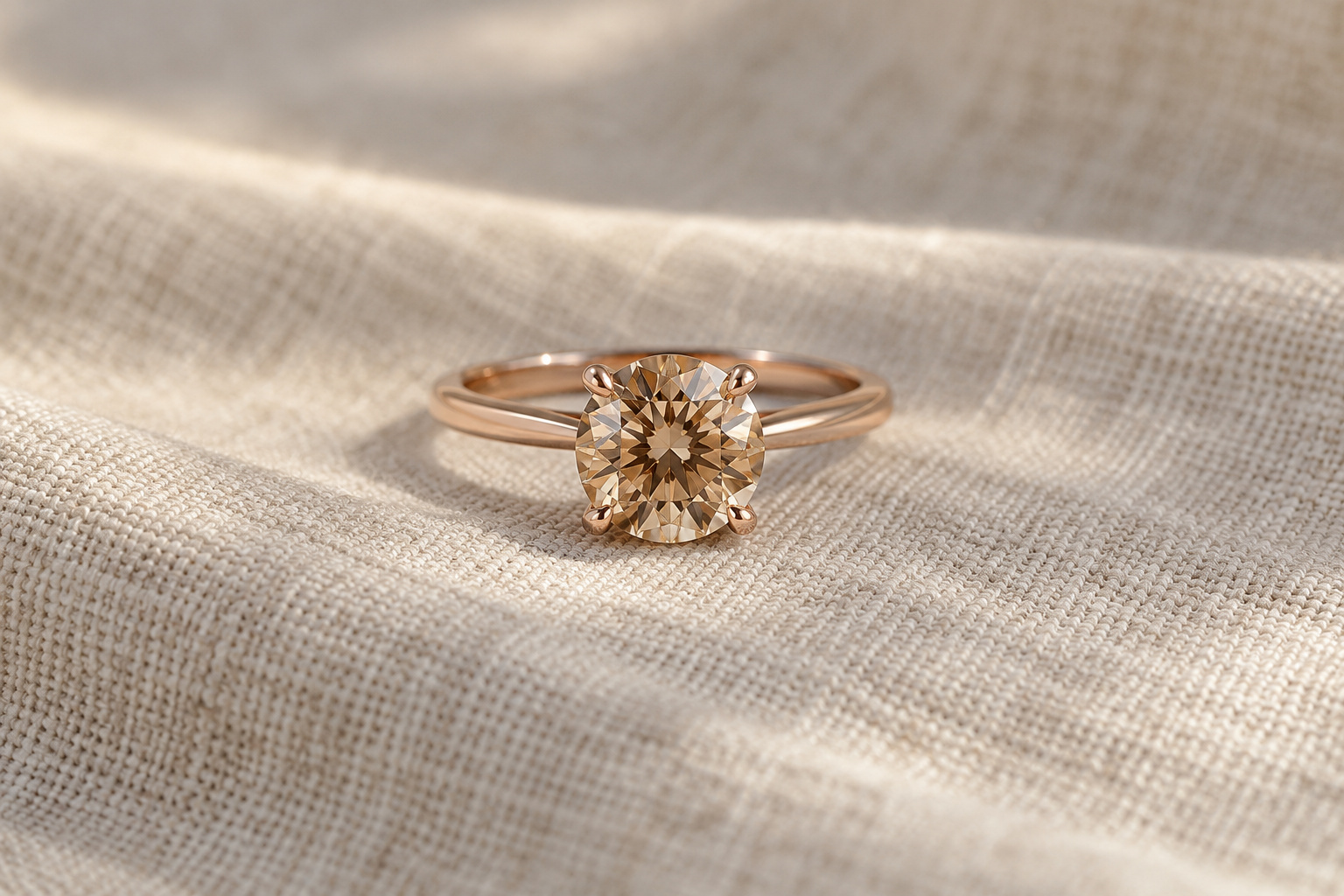
A champagne diamond is a diamond with a light to medium brown body colour. “Champagne” is a trade name rather than a grading term: on a laboratory report the colour is described as brown. Because brown is the most common natural diamond colour, champagne diamonds usually cost far less than pink, blue or bright yellow diamonds, and often less than colourless diamonds of similar size.
This guide includes a few product links near the end. As an Amazon Associate, Diamond Taire earns from qualifying purchases, at no extra cost to you.
This guide explains where the brown colour comes from, how the two grading systems work (GIA fancy colour terms and the Argyle C1 to C7 scale), what names such as cognac and chocolate actually mean, how treated and lab-grown versions fit in, what prices looked like at the time of writing, and who a champagne diamond suits.
At a glance
- Champagne, cognac and chocolate are marketing names. A GIA report will say brown, often with a modifier such as yellowish or orange.
- The colour usually comes from natural deformation of the crystal, not from an impurity, according to GIA research.
- They are among the most affordable fancy colours, because brown is so common in mined diamonds.
- Treated and lab-grown browns exist. Ask for an independent report that states the colour origin.
- Buy one because you love the warm look, not as a store of value: resale for brown diamonds is limited.
What a champagne diamond actually is
Every champagne diamond is a brown diamond. The jewellery trade began giving browns more appealing names in the 1980s, when GIA notes that stones once used mainly for industrial purposes were marketed as champagne, cognac and chocolate. The names stuck because they describe the look well: pale browns can resemble sparkling wine, while deeper browns look like brandy or cocoa.
Brown diamonds are still diamonds in every physical sense. They have the same hardness, the same durability and the same care needs as a colourless diamond, so they are perfectly practical for an engagement ring worn every day.
Trade names versus grading terms
The table below shows how the common names line up with what you will see on paper. Trade names are not standardised, so two sellers may use the same word for slightly different stones. The report wording is what counts, and the right-hand column is only a rough guide because the scales do not map exactly.
| Name you may see | What it usually describes | What to look for on a report |
|---|---|---|
| Champagne / light champagne | Pale to medium brown, often with a yellow or pinkish tint | Light brown or Fancy Light brown wording, or Argyle C1 to C4 |
| Dark champagne | Medium to deep warm brown | Fancy brown or Fancy Dark brown wording, or Argyle C5 to C6 |
| Cognac | The deepest, richest brown, often orangy | Fancy Deep or Fancy Dark brown wording, or Argyle C7 |
| Chocolate | Dark brown; “Chocolate Diamond” is a trademark of one jewellery company | Brown colour wording; the trademark itself is not a grade |
| Coffee, mocha, cinnamon and similar | Seller descriptions with no fixed meaning | Ignore the name and read the colour grade |
Where the brown colour comes from
Most coloured diamonds owe their colour to a trace element: nitrogen for yellow, boron for blue. Brown is different. According to GIA research published in Gems & Gemology, most brown colour is caused by plastic deformation, the slow bending and shearing of the crystal under heat and pressure deep in the Earth. That deformation leaves behind clusters of missing carbon atoms (vacancy clusters, thought to involve roughly 40 to 60 vacant sites) which absorb light and give the stone a brown tone.
This is also why brown is so common. GIA describes plastic deformation as one of the most prevalent features in natural diamond, and one study it cites reported a brownish tinge in 98% of as-mined diamonds. Most of those are never cut as fancy browns; a faint tint simply lowers a stone’s grade on the normal colour scale.
Two practical consequences follow:
- Colour can be uneven. Deformation-related colour often appears as fine parallel lines called graining. In a well-chosen stone you will not notice it; in a weaker one, it can make the colour look streaky. Look at the stone in person or on video.
- Brown can be removed or altered. High-pressure, high-temperature (HPHT) treatment can repair the lattice and reduce or remove brown colour. Some colourless diamonds on the market started out brown, which is why disclosure matters (more on this below).
A smaller share of brown diamonds get their colour from other causes, such as high nitrogen content or tiny inclusions, but deformation is the main one.
How champagne diamonds are graded
There are two systems you are likely to meet, and they do not translate perfectly into each other.
GIA fancy colour grading
GIA grades fancy colour diamonds by hue, tone and saturation. Its coloured diamond reports use the terms Faint, Very Light, Light, Fancy Light, Fancy, Fancy Dark, Fancy Intense, Fancy Deep and Fancy Vivid. For a brown stone, the report will combine one of these with the hue, for example “Fancy Light Yellowish Brown” or “Fancy Dark Orangy Brown”. Very pale browns may instead be graded on the ordinary D-to-Z colour scale, where the tint pulls the stone into the lower grades. Our guide to the D-to-Z colour scale explains how that scale works.
Pay attention to the modifier. A yellowish brown, an orangy brown and a pinkish brown can all be called “champagne” by a seller, yet they look quite different on the hand and are priced differently.
The Argyle C1 to C7 scale
The Argyle mine in Western Australia, operated by Rio Tinto, produced huge quantities of brown diamonds: GIA reports that about 72% of its production was brown. Because laboratories did not traditionally grade browns in detail, Argyle created its own scale from C1 (lightest) to C7 (darkest), commonly grouped like this:
- C1 to C2: light champagne
- C3 to C4: medium champagne
- C5 to C6: dark champagne
- C7: cognac, the deepest brown
Argyle closed in 2020, so stones with Argyle grades now come from existing stock rather than new production. The C scale is a useful shorthand, but it is a producer’s scale, not an independent laboratory grade. If a seller quotes only a C number, ask whether the stone also has an independent report. The same mine was famous for pinks; our pink diamond ring guide covers that side of the story, along with yellow and blue.
Why champagne diamonds cost less than colourless
Diamond prices follow rarity and demand. Brown is plentiful, and for most of the twentieth century it was not fashionable, so browns sit near the bottom of the fancy colour price ladder. GIA describes browns as generally more affordable than other fancy colours.
For a rough sense of scale, at the time of writing (October 2026), one large online retailer’s natural fancy brown listings between 1.00 and 1.25 carats were priced at roughly US$1,270 to US$1,790. For comparison, this site’s own October 2026 price samples in the 1 carat diamond ring guide found natural colourless 1 carat stones in the middle grades (F to J colour, VS clarity) at about US$1,900 to US$3,600. So a champagne diamond is usually cheaper than a well-graded colourless stone of the same weight, but not dramatically cheaper than a low-grade colourless one. Prices change, and they vary by country, so treat these as a snapshot only.
Within browns, price is driven by:
- Hue and modifier: how attractive and even the colour looks.
- Intensity: lighter and deeper stones are priced differently, and preferences vary.
- Carat weight: price per carat rises with size, so a 2 carat stone usually costs more than twice a 1 carat stone of similar quality.
- Clarity and cut: a lively, clean stone shows colour better than a dull or included one.
- Origin of colour: natural colour, treated colour and lab-grown are priced very differently.
For the wider picture of what moves diamond prices, see what really drives a diamond’s price.
Treated and lab-grown champagne diamonds
You may meet three kinds of brown diamond:
| Type | How the colour arises | Relative price | What to ask for |
|---|---|---|---|
| Natural, natural colour | Deformation in the Earth, or less often nitrogen or inclusions | Highest of the three for a given size and grade | An independent report stating natural colour |
| Natural, treated colour | Colour added or changed after mining by laboratory processes | Lower than natural colour | Written disclosure of the treatment and whether it is permanent |
| Lab-grown | Grown in a lab; some lab-grown diamonds grow with a brownish tint | Usually the lowest | A report identifying it as laboratory-grown |
Treatment is not dishonest in itself; failing to disclose it is. In the United States, the Federal Trade Commission’s Jewelry Guides treat failing to disclose a treatment that significantly affects a gem’s value as deceptive, and other countries have similar consumer rules. A full explanation of growth methods is in our CVD vs HPHT guide, and our guide to reading a diamond grading report shows where colour origin appears.
Who a champagne diamond suits (and who it does not)
| Good fit | Probably not the right fit |
|---|---|
| You love warm, earthy tones and yellow or rose gold | You want the classic icy white look |
| You want a larger stone for a set budget | You want a stone you could sell later for close to what you paid |
| You like something different from the usual engagement ring | You want a colour that reads clearly as “coloured” from across a room; pale champagne can look like a lower-grade white stone in some light |
| You want a durable stone for daily wear | You are hoping for the rarity or prestige of a pink or blue |
How to choose a champagne diamond: step by step
- Decide on the depth of colour you like. Look at pale, medium and deep browns side by side, in daylight and indoor light.
- Choose your metal at the same time. Yellow and rose gold tend to harmonise with brown; white metals create contrast and can make pale stones look more neutral.
- Ask for the full colour description, including the modifier (yellowish, orangy, pinkish) and the intensity word.
- Confirm colour origin in writing: natural colour, treated, or lab-grown.
- Prefer an independent laboratory report over a seller’s own grading or a C number alone.
- Check evenness of colour on video, looking for obvious graining or patchy colour.
- Judge sparkle, not just colour. A well-cut brown with good brightness looks far better than a dull one.
- Compare like with like across at least three listings of similar weight, shape, colour wording and clarity.
- Read the return policy before you pay, since colour is personal and photos vary.
Common mistakes
- Trusting the trade name. “Cognac” or “champagne” on a listing tells you nothing precise. Read the grade.
- Not asking about treatment. Treated browns are fine if you know and pay accordingly, but they should not be priced as natural colour.
- Buying from photos alone. Brown is very sensitive to lighting and camera settings. Ask for video under neutral light.
- Expecting investment value. Brown diamonds are abundant, and retail mark-ups are significant. Our guide to whether diamonds hold their value explains why resale is usually well below the purchase price.
- Ignoring the modifier. A greenish or greyish brown can look muddy; a lively yellowish or pinkish brown can look warm and bright. Two stones with the same intensity can look very different.
- Choosing a pale stone for a white metal without seeing it first. In some settings a very light champagne simply looks like a slightly tinted white diamond.
Sources this guide draws on: GIA research in Gems & Gemology on natural-colour pink, purple, red and brown diamonds and on plastic deformation in diamond; GIA’s overview of fancy colour diamonds and its coloured diamond grading terms; published descriptions of the Argyle C1 to C7 champagne scale; the US Federal Trade Commission’s Jewelry Guides; dated retail listings and this site’s own October 2026 price samples.
Useful tools for this guide
Practical picks for choosing, checking and caring for jewellery. As an Amazon Associate, Diamond Taire earns from qualifying purchases, at no extra cost to you. Prices and availability are set by Amazon and may vary by country.
- Foldable 30x Jeweller’s Loupe
Pocket magnifier for checking stones, settings and hallmarks up close.
View on Amazon - Gemstones of the World by Walter Schumann (5th edition)
A classic illustrated reference to more than 1,900 gemstones.
View on Amazon - KElofoN Travel Jewellery Case
Compact case with ring rolls and earring slots so pieces do not scratch each other.
View on Amazon
Frequently asked questions
What is a champagne diamond?
It is a diamond with a light to medium brown colour, usually with a warm yellowish or pinkish tint. “Champagne” is a marketing name; a grading report describes the colour as brown. Deeper browns are often sold as cognac or chocolate.
Are champagne diamonds real diamonds?
Yes. Natural champagne diamonds are mined diamonds whose colour comes mainly from natural deformation of the crystal. Lab-grown champagne diamonds are also real diamonds, made in a laboratory, and should be clearly identified as lab-grown.
Are champagne diamonds good for engagement rings?
They are as hard and durable as any diamond, so they suit daily wear. They are a good choice if you love the warm colour and want more size for your budget. They are a poor choice if you want a classic white look or expect strong resale value.
How much is a 2 carat champagne diamond?
There is no single price, because hue, intensity, clarity, cut and colour origin all matter, and price per carat rises with size. Expect a 2 carat stone to cost noticeably more than double a similar 1 carat stone. Compare several listings of matching grade at the time you buy, as prices change.
What is the difference between champagne and chocolate diamonds?
Both are brown diamonds. Champagne usually means a lighter, softer brown, while chocolate usually means a dark brown. “Chocolate Diamond” is a trademark used by one jewellery company, so it is a brand name rather than a grade.
Can a champagne diamond be treated?
Yes. Brown diamonds can be treated to change their colour, and HPHT treatment can even remove brown entirely. Ask for written disclosure and an independent report that states whether the colour is natural.
A champagne diamond is a warm, honest alternative to a colourless stone: real, durable and usually good value for its size. Read the report rather than the name, confirm the colour origin, and choose the shade you enjoy looking at every day.