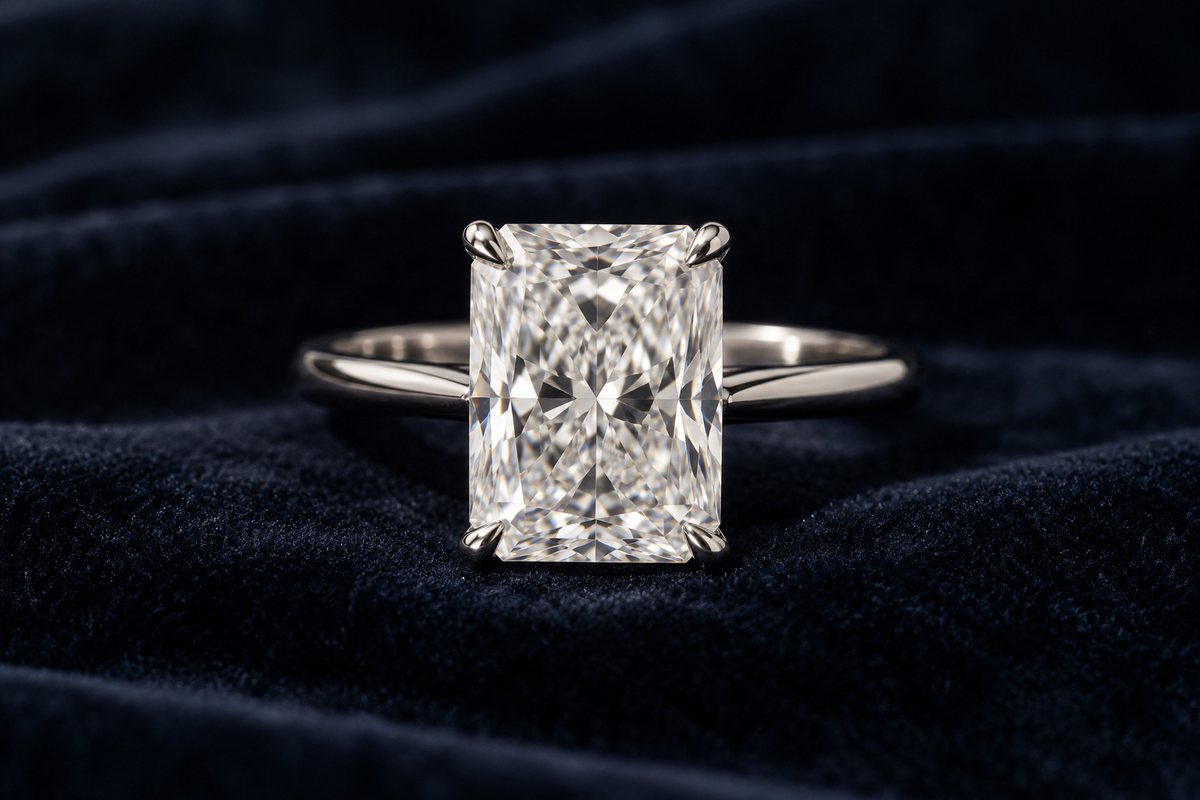
A radiant cut is a square or rectangular diamond with trimmed corners and brilliant-style faceting, so it has the clean outline of an emerald cut with sparkle closer to a round. For radiant cut engagement rings, that combination means plenty of fire, better tolerance of inclusions than an emerald cut, and corners that are less exposed than a princess cut’s. The keys to choosing a good one are the length-to-width ratio you prefer, a balanced facet pattern, and careful attention to colour, because the cut can concentrate it.
This guide includes a few product links near the end. As an Amazon Associate, Diamond Taire earns from qualifying purchases, at no extra cost to you.
This guide explains how the radiant was developed, how its faceting works, how to pick a ratio, how it compares with emerald, princess, cushion and round, what to check when no lab gives it a cut grade, and which settings suit it.
At a glance
- What it is: a rectangular or square outline with cropped corners and roughly 70 brilliant-style facets, developed by Henry Grossbard in the late 1970s.
- Clarity: GIA notes the radiant is more forgiving of inclusions than an emerald cut, so an eye-clean stone is often possible at a lower clarity grade.
- Colour: modified brilliants like the radiant can intensify face-up colour, which is great for fancy yellows but worth watching in white diamonds.
- Ratio: roughly 1.00 to 1.05 reads as square; above that it looks rectangular, and the right choice is a matter of taste.
- No lab cut grade: GIA grades cut only on rounds, so judge radiants by eye, symmetry and measurements.
Where the radiant cut came from
The radiant is a modern design. GIA credits Henry Grossbard with patenting it in the late 1970s (GIA’s ring guide dates it to 1977). His aim was a stone with the elegant, rectangular outline of a step cut but the brilliance of a round. After the patent lapsed, other cutters adopted the style, which is one reason radiants vary so much from stone to stone.
For context on how it sits among other shapes, see Diamond Shapes Explained.
How a radiant combines two cutting styles
Most diamond shapes fall into two families. Step cuts, like the emerald and Asscher, have long parallel facets that create broad flashes of light and a calm, mirror-like look. Brilliant cuts, like the round, have triangular and kite-shaped facets that break light into lots of small sparkles and flashes of colour. The radiant takes the step cut’s trimmed rectangular outline and fills it with brilliant faceting on both the crown and pavilion.
The result is often described in the trade as a “crushed ice” look: a dense, fine, glittering pattern rather than the bold arrows of a round. Some radiants show larger, chunkier flashes instead. Neither is better; it comes down to which you prefer, which is why seeing the stone, or good video of it, matters.
Radiant vs other shapes
| Shape | Faceting | Sparkle | Hides inclusions | Shows colour | Corner exposure |
|---|---|---|---|---|---|
| Radiant | Brilliant, trimmed corners | High, often crushed-ice | Good | Can intensify colour | Lower (cropped corners) |
| Emerald | Step cut | Broad flashes, calm | Poor (open table) | Shows colour more | Moderate (cut corners) |
| Princess | Brilliant, sharp corners | High | Good | Moderate | High (pointed corners) |
| Cushion | Brilliant, rounded corners | High, chunky or crushed-ice | Good | Can show colour | Low |
| Round | Brilliant | Highest when well cut | Good | Hides colour well | None |
Radiant vs emerald cut: which suits you?
These two share an outline, so they are often compared. GIA describes the radiant as combining the emerald cut’s outline with the brilliant’s sparkle, and as more forgiving of inclusions, because the emerald cut’s large open table puts everything on show. If you love the quiet, “hall of mirrors” look and are happy to pay for high clarity, an emerald may suit you; the site’s guide to emerald cut engagement rings covers it in depth. If you want more sparkle and more flexibility on clarity, a radiant usually makes more sense.
Choosing a length-to-width ratio
Ratio is the stone’s length divided by its width, and it changes the whole character of the ring. Trade guidance commonly treats 1.00 to 1.05 as square; above that, the stone reads as rectangular.
| Ratio | Looks | Who it often suits |
|---|---|---|
| 1.00 to 1.05 | Square radiant | People who like a compact, modern look; often paired with straight-edged side stones |
| 1.10 to 1.20 | Softly rectangular | A balanced shape that can look almost square from a distance |
| 1.20 to 1.40 | Classic rectangle | A classic rectangle that lengthens the finger without looking narrow |
| 1.40 and above | Long and slim | Those who want maximum finger-lengthening; can look narrow in smaller sizes |
GIA notes that elongated stones can make fingers look slimmer, while shorter ones can flatter petite hands, and recommends trying different proportions before deciding. Taste counts more than any chart here. If you like elongated shapes in general, the guide to an elongated cushion cut is a useful comparison.
Colour and clarity: where the radiant helps and where it does not
Clarity
The busy brilliant faceting breaks up the view into the stone, which helps disguise small inclusions. GIA suggests diamonds with less-than-exceptional clarity can be good candidates for the radiant. Many buyers find eye-clean stones in the VS2 to SI1 range, but check each stone, because a large dark inclusion under the table will still show. The clarity guide explains what each grade usually looks like.
Colour
Here the radiant works against you slightly. GIA notes that modified brilliant cuts can make face-up colour appear lighter or darker, and cutters sometimes recut coloured diamonds into radiants to strengthen their face-up colour. GIA gives the example of a large round graded in the W to X range that was recut into a radiant and then graded Fancy yellow. That is excellent news if you want a yellow or other coloured diamond, but in a white diamond it means slight warmth may show more than in a round of the same grade, especially in deeper or longer stones. Viewing the stone in daylight is the best test. For more on the scale itself, see the diamond colour guide.
What to check when there is no cut grade
GIA gives an overall cut grade only to round brilliants. For a radiant, the report shows polish and symmetry, and the rest is up to you. GIA’s own buying tips are a good checklist: a well-centred culet, parallel sides, and corners cropped evenly so no corner looks too wide or too narrow. Beyond that:
- Watch for dark areas. Some radiants show a dark band across the middle, similar to the bow-tie in ovals, or a dark centre.
- Look at depth. A very deep stone hides weight underneath and faces up small for its carat weight. Compare millimetre measurements.
- Check the girdle at the corners. GIA lists radiants among shapes whose corners need adequate girdle thickness to resist chipping.
- Be cautious of “ideal” labels. On fancy shapes these are usually a seller’s description rather than a lab grade.
The principles in the guide to diamond cut quality apply here too.
Settings that suit radiant cut engagement rings
The cropped corners make a radiant more practical than a princess for everyday wear, but they still benefit from protection.
- Four-prong solitaire: the classic option. GIA notes a radiant works well as a solitaire without extra embellishment. Prongs should sit on the cropped corners.
- Halo: a halo can make the centre look larger and echoes the stone’s outline.
- Three stone: GIA notes trilliants, baguettes and trapezoids are common side stones because their straight edges complement the radiant’s silhouette.
- Bezel: the most protective choice for hands-on lifestyles.
- East-west: GIA reports growing interest in setting elongated radiants sideways for a modern look.
For a full comparison of styles, see how to choose the right ring setting.
Value: radiant vs round, natural vs lab-grown
Fancy shapes, radiants included, generally cost less per carat than round brilliants of similar colour and clarity, largely because rounds carry the strongest demand. The gap varies by size, grade and market. At the time of writing (October 2026), lab-grown radiants cost a fraction of comparable natural stones; prices change, so compare current listings. If long-term value matters to you, read Lab-Grown or Natural Diamond? before deciding.
Who a radiant cut suits, and who it may not
- Suits: people who like a rectangular or square outline but want more sparkle than an emerald cut; buyers who would rather spend on size than on top clarity; anyone who wants a fancy yellow or other coloured diamond to look its richest; active wearers who prefer cropped corners to sharp points.
- May not suit: lovers of the calm, glassy look of step cuts; buyers who want the most colour-forgiving shape in a white diamond (a round is better at hiding tint); people who dislike a busy, crushed-ice sparkle pattern.
Radiant cut buying checklist
- Decide on square or rectangular, and try a few ratios on your hand.
- Get the grading report and confirm the shape, measurements and girdle description.
- Check symmetry: centred culet, parallel sides, evenly cropped corners.
- Look for dark centres or bands in the face-up view, in more than one kind of light.
- Compare millimetre size against carat weight to spot overly deep stones.
- Check colour in daylight, particularly in white gold or platinum settings.
- Confirm the stone is eye-clean from normal viewing distance.
- Choose prongs that cover the corners, or a bezel for active hands.
- Insure the ring and schedule periodic prong checks.
Common mistakes
- Buying on paper alone. Two radiants with the same grades can look very different.
- Underestimating colour. A grade that looks white in a round may show warmth in a radiant.
- Ignoring depth. Deep radiants can look a size smaller than their weight suggests.
- Over-paying for clarity. The radiant’s faceting means top clarity grades are rarely needed to look clean.
- Uneven corners. Lopsided cropping makes the outline look off once set.
- Thin girdles at the corners. They raise the risk of chipping.
Sources this guide draws on: GIA 4Cs guidance on selecting a radiant cut diamond; GIA radiant cut engagement ring guide; GIA research notes on protecting diamonds from chipping; trade references on radiant cut history, facet count and length-to-width ratios.
Useful tools for this guide
Practical picks for choosing, checking and caring for jewellery. As an Amazon Associate, Diamond Taire earns from qualifying purchases, at no extra cost to you. Prices and availability are set by Amazon and may vary by country.
- Gemstones of the World by Walter Schumann (5th edition)
A classic illustrated reference to more than 1,900 gemstones.
View on Amazon - Foldable 30x Jeweller’s Loupe
Pocket magnifier for checking stones, settings and hallmarks up close.
View on Amazon - KElofoN Travel Jewellery Case
Compact case with ring rolls and earring slots so pieces do not scratch each other.
View on Amazon
Frequently asked questions
Are radiant cut diamonds more sparkly than round?
A well-cut round brilliant is usually the most brilliant shape. A good radiant comes close, with a dense, glittering pattern many people find just as appealing. It sparkles far more than step cuts like the emerald.
Is a radiant cut cheaper than a round diamond?
Generally yes, per carat at similar grades, though the difference varies with size and market. Its ability to hide inclusions can also let you choose a lower clarity grade.
What is the best ratio for a radiant cut?
There is no single best ratio. Around 1.00 to 1.05 looks square; above that it becomes rectangular, and the right length is a matter of taste. Try a few on your hand.
Do radiant cut diamonds chip easily?
They are less exposed than princess cuts because the corners are cropped. GIA still lists radiants among shapes whose corners need an adequate girdle, so choose prongs that cover the corners or a bezel.
Does a radiant cut look bigger than other shapes?
Rectangular radiants can look a little larger than squares of the same weight because of their length. Deep radiants, though, can face up small, so compare measurements.
What colour should I choose for a radiant cut?
Because radiants can intensify colour, many buyers choose a slightly higher colour grade than they would for a round, particularly in white metal. Warmer metals are more forgiving. View the stone in daylight before deciding.
A radiant gives you the poise of a rectangular outline with real sparkle and some welcome flexibility on clarity. Choose your ratio, check symmetry and colour with your own eyes, and protect the corners, and it will make a beautiful, practical engagement ring.